
Billionaire Bernard Arnault Just Lost $77 Billion — And It's The Wake-Up Call Every Founder Needs Right Now

Billionaire Bernard Arnault Just Lost $77 Billion — And It's The Wake-Up Call Every Founder Needs Right Now
Breaking News | October 9, 2026 | By Jason Lim
The man who was once the richest person on earth just lost $77 billion in a single year. Not from fraud. Not from a market crash. Not from a bad bet. From something far more dangerous — and far more relevant to every founder reading this right now.
The press is calling it a China slowdown. A luxury hangover. A post-pandemic correction. Every headline is pointing at the macro.
They are all wrong about what actually happened. And if you build your company on the same blind spot, you won't lose $77 billion — but you will lose your buyers. Quietly. One by one. Before you ever see it coming.
This Is Not A Billionaire Problem. This Is YOUR Problem.
Think about your best customers right now. The ones who said yes fastest. The ones who referred others. The ones you built your whole pitch around.
Now ask yourself: Who are they trying to become? Not who they are today. Who they are striving to be. Because that is what they are actually buying when they buy from you. They are buying an identity. A version of themselves they want to step into.
What happens when that aspiration shifts? When the identity they were chasing is no longer the identity they want? When owning your product, wearing your brand, or using your service no longer signals the right thing about who they are?
They leave. Not dramatically. Not with a complaint. They just quietly stop buying. They stop referring. They stop responding to your follow-ups. And you spend 18 months wondering what changed — while the answer was staring you in the face the whole time.
That is exactly what happened to the most powerful luxury empire ever built. And LVMH's Q3 revenue report drops in three days — October 12, 2026. The numbers are expected to confirm what the market already knows. The question is whether you are going to learn the real lesson before it costs you.
What Actually Happened
Here are the facts, all verified and cited.
Bernard Arnault's fortune has fallen by approximately $77 billion in 2026 — the steepest year-to-date decline of any individual on the Bloomberg Billionaires Index (Benzinga, October 4, 2026). His net worth now sits at roughly $131 billion, placing him 13th globally. At his peak he was worth more than $250 billion and held the title of the world's richest person. He has now dropped out of the Bloomberg top 10 for the first time since 2012.
LVMH's market capitalisation has contracted by approximately $167 billion in 2026 (IBTimes UK, October 6, 2026), with the Fashion & Leather Goods segment — the crown jewel that houses Louis Vuitton — recording a 5% revenue decline in the first half of the year. Analyst estimates from JL Warren Capital suggest Louis Vuitton's China sales have fallen close to 30% year-over-year. Chinese consumers, once LVMH's fastest-growing and highest-spending cohort, have been retreating from Western luxury brands at a rate that has shaken the entire sector.
Wall Street initially blamed post-pandemic normalisation. Then the macro environment. Then China's economic slowdown. Analysts have layered on every external explanation available.
But here is what every external narrative misses: the Chinese luxury buyer did not stop spending. They shifted. Domestic luxury — local high-end brands, cultural heritage goods, quieter status signals — is surging. The aspiration changed. The buyer's identity journey changed. And Billionaire Bernard Arnault's empire, built to deliver one specific identity signal, could not pivot fast enough to follow it. Arnault's move is one Jason has seen across 1,000+ founders. Here's what most miss.
The Lesson Most Founders Will Never Extract From This Story
Most founders think the problem is a crowded market, a price-sensitive buyer, or a competitor with better features.
The real problem is they have no system for tracking who their buyer is trying to become — and they lose them the moment that aspiration shifts.
Every buyer has two identities: who they are today, and who they are trying to become. They do not buy products. They buy the gap between those two identities. When your offer closes that gap — when owning it, using it, or being associated with it makes them feel closer to who they want to be — they buy. Enthusiastically. Repeatedly. And they refer others who share the same aspiration.
The catastrophic mistake — the one that cost LVMH $167 billion in market value — is assuming that aspiration is static. That what your buyer wanted to become last year is what they want to become this year.
For a decade, owning a Louis Vuitton bag in China signalled: I am internationally successful, cosmopolitan, aspirationally Western. That was the identity gap the brand closed. But something changed inside Chinese consumer culture. The aspiration shifted toward: I am proud of where I come from. I support what is ours. I signal sophistication through cultural knowledge, not Western logos.
Louis Vuitton couldn't close that new gap. And no amount of marketing spend, price adjustment, or new collection changed that. Because the problem was never the product. The problem was that the brand had become the wrong identity vehicle.
“You don’t lose customers to competitors. You lose them when your brand stops being the person your buyer is trying to become.”
— Jason Lim | DreaMaker.club
Founder Story Card
Leon — $2M Partnership Closed After a Positioning Shift
Leon was selling a B2B SaaS platform to mid-market finance teams. His product had not changed. His price had not changed. But his close rate had collapsed over 12 months. Deals were slowing down, budgets were tightening, and buyers who once moved fast were now stalling indefinitely.
When Jason worked with him through the Future of Selling System, they mapped the buyer's identity journey. The discovery: his ICP's aspiration had shifted. They no longer wanted to be seen as cost cutters — they wanted to be seen as innovation leaders within their firms. Leon's pitch was still built around efficiency savings. The aspiration had moved. The pitch hadn't.
Leon repositioned his entire opening conversation to speak to the new aspiration. Within one quarter, he closed a $2M partnership with a firm that had previously ghosted him for 9 months.
The Hidden Opportunity Most Founders Will Miss
LVMH's pain is a signal — not just about luxury, but about every market where buyer aspiration is quietly shifting right now.
The hidden opportunity is this: the founders who learn to sell to buyer identity — not buyer demographics — will clean up in the next 12 to 18 months.
Post-2026, your ICP is going through a values reconfiguration. The global business buyer who once aspired to be the fastest scaler is now increasingly aspiring to be the most resilient operator. The founder who once sold on speed-to-market is now closing deals by selling on certainty and durability. The aspiration has shifted from hypergrowth to intelligent growth.
The founders who are inside the right conversation — the ones who have already mapped where their buyer's identity is heading — will be positioned to capture deals their competitors can't even get in the door for. This window is real, and it is open right now. LVMH's Q3 report drops October 12. The press will call it a macro story. You'll know it is a buyer identity story. The question is: which side of this insight are you on?
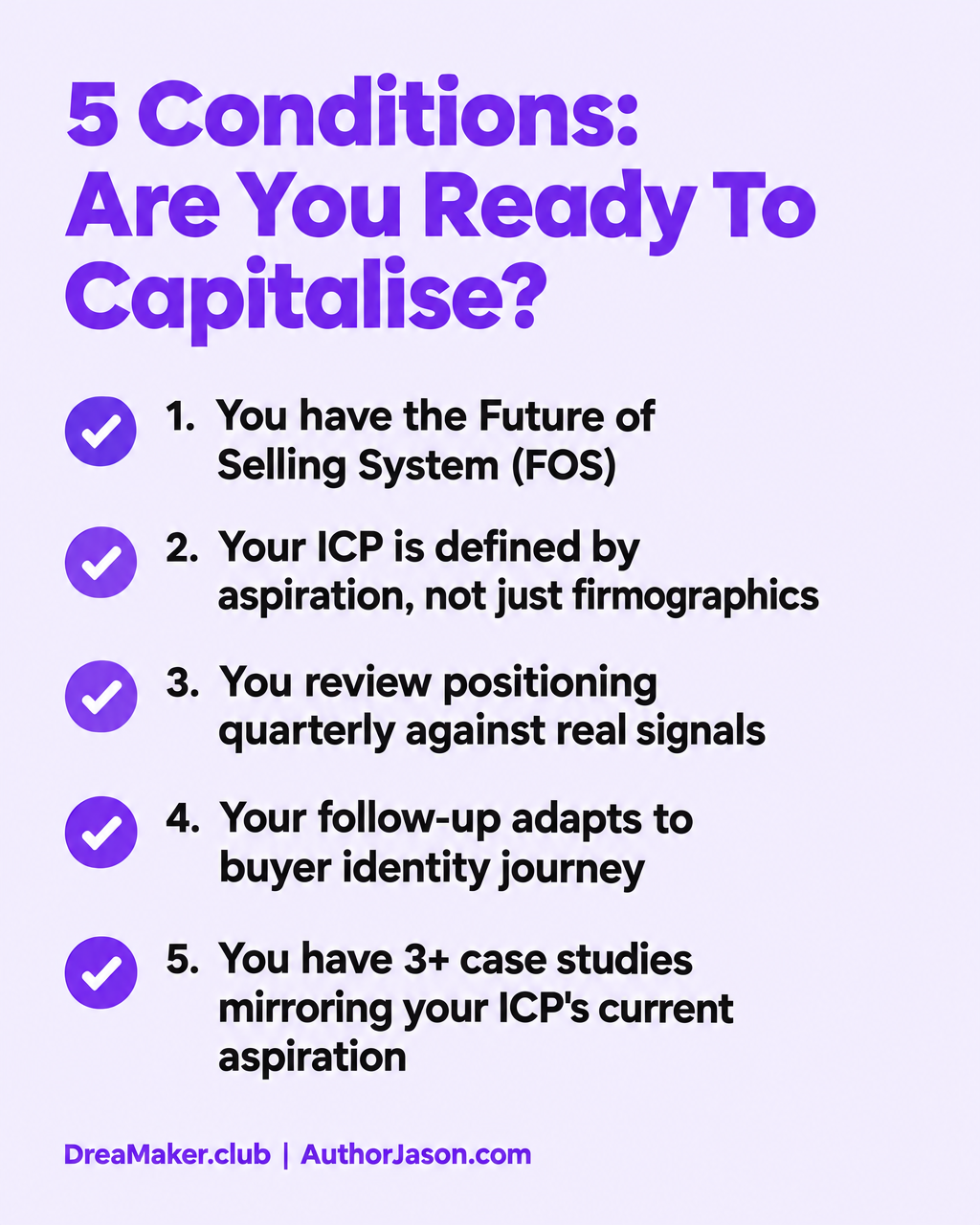
5 Conditions: Are You Ready To Capitalise?
✅ Condition 1: You have the Future of Selling System (FOS)
Without a structured system for selling to buyer identity — not just buyer firmographics — you will keep pitching to who your buyer was, not who they are becoming. FOS gives you the framework to read the shift and reposition in real time.
✅ Condition 2: Your ICP is defined by aspiration, not just firmographics
Industry, headcount, and revenue range describe who your buyer is. Aspiration describes what they are trying to become. Your ICP profile needs both layers to stay relevant as identity shifts.
✅ Condition 3: You review your positioning quarterly against real buyer signals
Not against your own assumptions. Against what buyers are actually saying in discovery calls, objections, and the questions they ask most frequently. Those signals tell you when the aspiration is moving before your close rate does.
✅ Condition 4: Your follow-up adapts to buyer identity journey stages
A buyer early in their identity shift needs different language than one who has already committed to the new aspiration. If every follow-up sounds the same, you are broadcasting to demographics — not speaking to identity.
✅ Condition 5: You have 3+ case studies that mirror your ICP's current aspiration
Case studies sell identity. Your buyer reads a case study and thinks: Is that the kind of person I want to be? If your case studies reflect an older version of what your ICP aspired to, they will feel dated — even if the result is impressive.
NEW! | October 2026
Dear Founders — Are You Still Pitching to Who Your Buyer Was?
If your close rate has been quietly softening and you can't explain why — you might not have a pipeline problem. You might have a buyer identity mismatch. You are speaking to an aspiration that has already moved on. And no amount of hustle fixes a positioning that is aimed at the wrong version of your buyer.
I know how it feels. When deals slow down, most founders look at their product, their price, or their team. The last place they look is the buyer's identity journey. I felt the same way in the early years — until I saw founder after founder fix their close rate not by changing their offer, but by changing what their offer meant to the buyer.
That's what the Future of Selling System (FOS) is built for. And here is what we have found: Salesforce's State of Sales research confirms that 76% of buyers now expect sellers to understand their business needs before first contact — meaning identity alignment is no longer a nice-to-have, it is the entry ticket.
FOS has been tested across 1,000+ founders since 2015, generating $22M+ in combined sales by graduates. Including:
- Jeffrey Teo — 63 customers in 100 days
- Stanley Tan — 45 buyers in 3 hours
- Leon — $2M partnership closed after a positioning shift
Not ready for $19? Start free.
The Objection Playbook: 25 Word-for-Word Scripts to Close More Sales
The exact words Jason's founders use when a buyer says "too expensive", "send me info" or "I need to think about it". Free PDF, sent to your inbox.
Send Me the 25 ScriptsBernard Arnault already moved — and lost $77 billion finding out his buyers had moved first. The only question is whether you will learn this lesson from his story, or whether someone will one day write about yours.


