
How Billionaire Bill Gates Wrote Proposals That IBM Couldn’t Say No To
Sales, Consulting Proposals, Startup Founders
How Billionaire Bill Gates Wrote Proposals IBM Couldn’t Refuse — A Founder’s Guide to Writing Consulting Proposals that Win
Bill Gates wrote a proposal that helped build an empire. Jason turns that lesson into a simple system so startup founders can write consulting proposals that actually win deals — without 20 pages or a sales degree.

Meta description: Bill Gates wrote the proposal that built the Microsoft empire. Here’s how startup founders can write consulting proposals that actually win the deal. $0.63/day.
Why Most Consulting Proposals Lose the Deal Before the Client Reads Page Two
If you’re leading sales for a small team, you already know this pain. You stay up late polishing a detailed proposal. You add timelines, diagrams, and every feature you can think of. You hit send. Then you wait.
Days pass. Your inbox stays quiet. No clear no. No clear yes. Just silence that slowly turns into a feeling of rejection. Not because your startup is weak. But because the proposal never landed in the right place to begin with.
Jason has seen this pattern with more than 1,000 founders since 2015. Smart teams. Great products. Strong conversations. Then a proposal that turns all that momentum into confusion and delay instead of a clear decision. The founder feels tired, not broken. Frustrated, not failed. And still, it hurts every time a warm opportunity quietly drifts away.
The harsh truth is simple and kind at the same time. Most proposals lose the deal before page two because they answer the wrong question. They try to prove how hard you’ll work. While the client is actually asking a softer, more human question: can I trust you to solve this problem without making my life harder?
As Jason teaches at AuthorJason.com, a proposal only works when it behaves like a sales document that reduces risk and clarifies decisions — not like a bloated scope-of-work document that drowns the buyer in details and leaves them unsure what they’re actually agreeing to.
How Bill Gates Wrote the Proposal that Built the Microsoft Empire
In 1980, Bill Gates wrote one of the most consequential proposals in business history. IBM needed an operating system for its new personal computer. Gates didn’t yet have the OS ready. But he understood IBM’s real need better than IBM had written it down on paper.
His proposal wasn’t a wall of technical specifications. It was a clear answer to the only question that mattered: can you solve this problem in a way that fits IBM’s business? Gates framed the engagement as a partnership. Microsoft would provide the operating system. IBM would ship it. And Microsoft would retain the right to license it to other manufacturers.
The pivotal move came when Gates and his small team acquired QDOS (which later became MS‑DOS) from Seattle Computer Products, then presented it to IBM as a ready, adaptable solution. Instead of promising to invent something from scratch, he proposed to deliver certainty quickly — exactly what a risk‑averse giant needed while the personal computer race was heating up.
According to several accounts of the deal, IBM initially assumed it would own any software shipped on its machines. Gates flipped that assumption in the proposal discussions, keeping licensing rights so Microsoft could sell the system to other hardware makers like Compaq. IBM got its launch; Microsoft quietly kept the upside of an entire industry.
That single clause turned a small software company into a near‑monopoly. It sat there, quietly, inside a proposal. One line. One condition. One decision. The power of that proposal wasn’t in its length. It was in its clarity. Gates showed IBM that he understood their world. Then he had the confidence to propose terms that served the engagement, not just the default terms IBM expected to see on paper.
As Jason teaches at AuthorJason.com, a winning consulting proposal does what Gates did with IBM: it anchors on the buyer’s strategic risks, then uses one or two carefully chosen clauses to align incentives for both sides instead of merely listing features and hours.
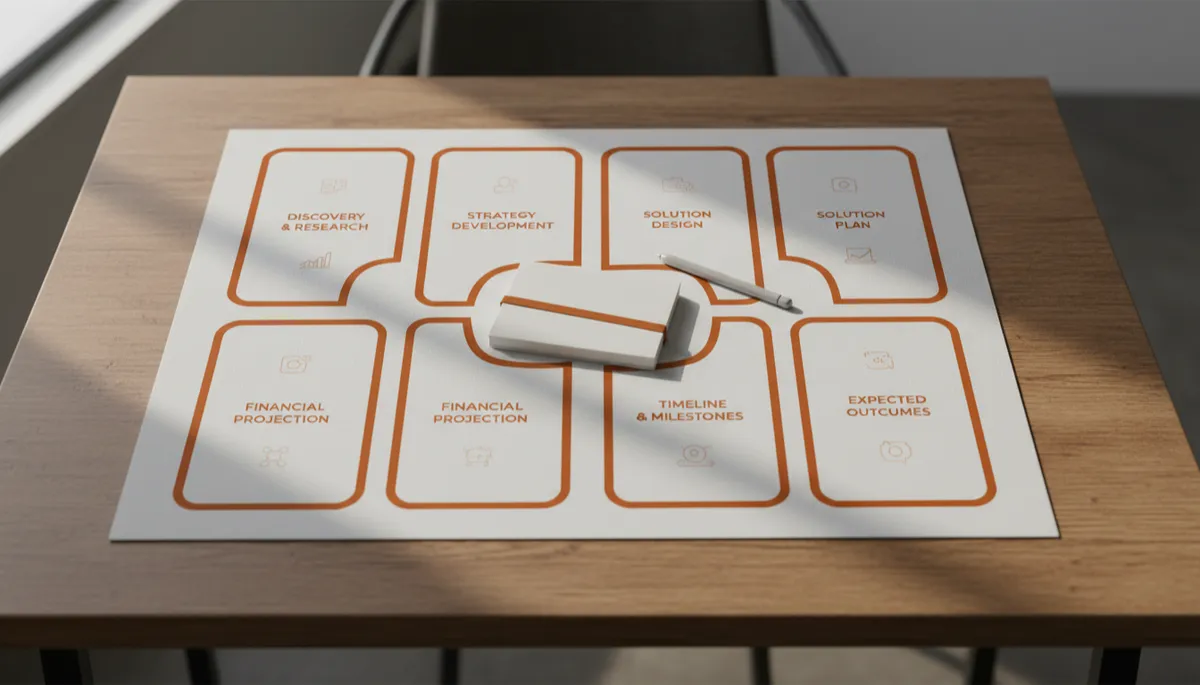
Gates didn’t write the IBM proposal as a technical document. He wrote it as a clear answer to the question IBM was really asking: can you solve this?
The Eight‑Section Winning Proposal Jason Teaches Every Startup Founder
Jason teaches founders to stop chasing 20‑page documents. The best consulting proposals win in two to three pages. Clients don’t buy deliverables. They buy certainty and outcomes. That’s why every winning proposal carries the same eight core elements, arranged in a simple sequence that reads like a calm conversation on paper.
- Executive summary — hooks the reader and reframes the outcome in a single short screen.
- Problem statement — shows that you understand their world, in their own words, better than they wrote it in the brief.
- Proposed solution — paints a picture of the win. Not features, but the future state they actually care about.
- Methodology — proves competence without drowning them in process charts.
- Timeline — builds trust with simple, concrete milestones instead of vague ranges.
- Investment — anchors value before price, and presents the fee as a business decision, not a cost line item.
- Social proof — de‑risks the decision with short testimonials and relevant results. Zendesk research shows that 97% of B2B buyers see testimonials as the most trusted content in a proposal ( Zendesk).
- Next steps — ends the proposal by telling them exactly what to do if they want to move forward this week.
As Jason teaches at AuthorJason.com, the eight sections aren’t bureaucracy — they’re a written sales conversation so the winning consulting proposal feels like a natural continuation of the call, not a legal surprise that confuses the buyer.
What Sections Should Every Winning Consulting Proposal Include?
Every winning consulting proposal includes eight sections: executive summary, problem statement, proposed solution, methodology, timeline, investment, social proof, and clear next steps for the client.
What’s the Length of a Consulting Proposal — and Does Length Affect Win Rate?
Jason sees the best win rates with focused, two‑ to three‑page proposals. Longer documents rarely win more work. They usually create confusion and delay instead of clarity and confident decisions.
Why Do Most Consulting Proposals Fail to Win the Client?
Most proposals fail because they focus on deliverables and effort, not outcomes and clarity. They don’t show a deep understanding of the client’s real problem, so the decision‑maker feels more risk than relief while reading them.

Cuban’s rule: every vague term creates doubt. Every specific creates trust. A proposal is a commitment — not a conversation.
How Cuban and Bezos Write Proposals Defined by Specificity and Clarity
Mark Cuban treats a proposal as a contract the moment he writes it. In interviews and on Shark Tank, he repeats the same pattern. A proposal is not a maybe. It’s a commitment. A specific amount. Specific terms. A specific timeline. Specific expectations on both sides. No “roughly.” No “we can discuss this later.”
Every ambiguity creates doubt. Every specific creates trust. When your client reads your proposal after a long day, they’re tired. Their brain loves concrete details because it can rest. It hates vagueness because it has to keep working to figure out what you actually mean and what might happen if they say yes.
Jeff Bezos built Amazon on disciplined writing. No PowerPoint decks. Six‑page narrative memos. His belief was simple: clear writing is the by‑product of clear thinking. If you can’t write a proposal clearly, you haven’t yet thought clearly about the engagement. Harvard Business Review has echoed this link between clarity of writing and decision quality in leadership teams ( HBR).
One famous example is Bezos’s insistence on “narrative memos” for new initiatives. Teams proposing a major project must write a tight document that starts with the customer problem, then walks through the proposed solution, risks, and success metrics. Meetings begin with silent reading — proof that the proposal itself has to stand on its own.
Cuban has shown a similar bias toward specificity on Shark Tank. When founders offer fuzzy projections, he pushes for precise customer counts, concrete profit margins, and a clear use of funds. The deals that survive this scrutiny do so because the founders can state, in simple language, what happens, when, and for whom as soon as the money moves.
As Jason teaches at AuthorJason.com, the winning consulting proposal borrows this discipline: it reads like a short Bezos‑style memo with Cuban‑level specificity in the terms, so the buyer can say yes without guessing what they just committed to.
Should You Send a Proposal Before Getting Verbal Agreement from the Client?
Jason teaches founders to get verbal agreement first. When you confirm scope, outcomes, and budget directly, the proposal becomes a written confirmation, not a surprise. Sending proposals too early usually lowers win rates and increases ghosting.
What’s the Most Important Section in a Consulting Proposal?
The problem statement is often the most important. When the client feels deeply understood in that section, they relax. They read the rest of the proposal looking for reasons to say yes instead of reasons to protect themselves by saying no.
As Jason teaches at AuthorJason.com, your proposal becomes a sales document the moment the problem statement mirrors the buyer’s own language — that’s when the winning consulting proposal starts working before they even reach the price.
3 Proposal Mistakes that Kill the Deal — and the Bonus Mistake that Hurts Most
Mistake 1 (Aria, founder of a strategy consulting firm): she sent a 22‑page proposal. The buyer’s reply: “Impressive — we’ll review it with the team.” That was the last message. The proposal created a committee instead of a decision. The right move: one page or three pages — never 22. If the solution needs 22 pages to explain, the buyer isn’t ready to buy it yet.
Mistake 2 (Aria): she opened with credentials. Page 1 was her bio. Page 2 was her methodology. The buyer’s problem showed up on page 5. By then the buyer felt like they were reading about Aria, not about themselves. The right move: the buyer’s problem is the first paragraph. Their stated outcome is the second. Your approach is the third. Your credentials are the last section.
Mistake 3 (Aria): she presented price without context. The number appeared without any explanation of what it represented or why it was the right investment compared to the cost of the problem. The buyer called the price high. The price was fair. But the frame was missing. The right move: before the price, state the cost of the problem. After the price, state the outcome. The price sits between two numbers that make it feel logical.
The bonus (Jason, in the third person): he found that the most common proposal mistake is writing it too early — before the buyer has fully confirmed they own the problem. The proposal was technically excellent but answered questions the buyer hadn’t asked yet. The buyer didn’t feel seen in it. They felt like they’d received a template. Jason introduced a pre‑proposal conversation: one 15‑minute call with three specific questions before any writing. Proposals written after that call closed at a much higher rate. The proposal didn’t change. The sequence did. The right move: don’t write the proposal before you ask, “What would the right solution need to include to make you say yes?” Write the answer in the first paragraph of the proposal.
As Jason teaches at AuthorJason.com, the winning consulting proposal is usually the one written last in the process — after the buyer has already helped you shape the problem, outcome, and constraints with you in a short, focused conversation.
The Proposal that Closes — The Founder’s Full Script
Jason teaches founders to present the proposal on a call instead of sending a PDF into the void. The structure is simple and conversational. First, you start with the buyer’s problem in their own words: “Here’s how I summarized what you told me last week about the missing revenue and dropped handoffs.” You pause and ask, “Did I get that right?” and wait until they agree.
Second, you move to the approach and logic: “Based on that, here’s the path I recommend and why it fits your constraints.” You briefly walk through the major milestones, not every task. You keep tying each piece back to the outcome they said they wanted, so the proposal feels like a map of their future, not an internal process document about you.
Third, you present the price with a clear frame: “Before I share the investment, let’s connect it to the cost of leaving this unsolved and the upside of solving it.” Only then do you share the number and ask for one specific next step: “If this feels like a fit, would you be comfortable confirming the decision today so we can start on Monday?” This script turns the static document into a live decision moment.
As Jason teaches at AuthorJason.com, it’s better to treat the winning consulting proposal as a shared page and a short script — not as an attachment you hope someone reads between back‑to‑back meetings.
What Jason’s Founders Experience After Their First Winning Proposal
Jason sees a quiet shift the first time a founder sends a proposal that really wins. The founder walks into the follow‑up call calmer. They know what they sent was clear, kind, and specific. They’re no longer hoping the client “got it.” They’re ready to talk about next steps or honest objections, not defend a messy PDF.

Over 1,000 founders. More than $22M in combined sales. The winning proposal is never the longest — it’s the one that makes the client feel most understood.
Jason worked with one founder, Maya, who ran a seven‑person product studio. Her team did excellent work but lived in feast‑and‑famine cycles. She wrote long, meticulous proposals that tried to cover every possible scenario. Clients often went silent after praising the document. It felt confusing and unfair, like doing all the homework and still failing the test with no notes.
With the Future of Selling System, Maya rebuilt her proposal around the eight sections. She cut it down to three pages. She used language her clients actually used on calls. She added one clear guarantee, inspired by research showing that eight out of ten B2B decision‑makers look for guarantees before choosing a provider ( Monday.com). Her next enterprise client signed within a week. The win wasn’t just in revenue. It was in feeling like her proposal finally matched the quality of her work.
As Jason teaches at AuthorJason.com, the first winning consulting proposal is usually the one that convinces the founder, not just the buyer — it proves to them that a clear, simple structure can achieve what frantic effort never did.
How the P.I.T.C.H. Model Feeds the Winning Proposal
Inside the Future of Selling System, Jason teaches a simple P.I.T.C.H. model that shapes every sales conversation before any proposal is written. The model keeps founders focused on outcomes, not feature lists. It turns messy discovery calls into organized notes that almost naturally flow into the eight proposal sections. You can explore the P.I.T.C.H. model in more detail here: P.I.T.C.H. formula.
Practically, the Future of Selling System has founders use the educate and close stages of the P.I.T.C.H. model to rehearse the proposal before it ever hits the page. “Educate” means slowing down enough to restate the buyer’s situation in their words and check for understanding. “Close” means asking, directly, what a successful project would need to look like for them to feel comfortable committing.
Those two moves build a bridge. When the founder later writes the document, each section of the proposal matches something the buyer has already heard and agreed to. The problem statement reflects the educate step. The investment and next steps reflect the close step. Instead of feeling like a new pitch, the proposal reads like a written confirmation of a conversation the buyer remembers having.
That’s why Jason insists founders treat the P.I.T.C.H. model as the prep work for every winning consulting proposal. When the educate and close stages are done well, the document stops being a risky sales step and becomes a quiet artifact of a shared decision. You can always return to the core explanation here: P.I.T.C.H. formula.
Self‑check
- Does your proposal start with the buyer’s stated problem — or with your methodology and credentials?
- Is your pricing presented with clear logic — or dropped in without context and left for the buyer to justify?
- Does your proposal end with a defined decision point — or with “please let me know your thoughts”?
As Jason teaches at AuthorJason.com, the winning consulting proposal is simply the written reflection of a conversation shaped by the P.I.T.C.H. model — not a separate document bolted onto the end of the sales process.
Frequently Asked Questions About Writing a Consulting Proposal
How Do You Handle Price Objections that Show Up After the Client Receives Your Proposal?
Jason encourages founders to treat price objections as signals, not attacks. When a client objects, it usually means one of three things isn’t clear: the outcome, the risk, or the payment structure. Jason teaches founders to revisit the problem statement and proposed solution directly, ask calm questions, then adjust scope or terms instead of reflexively discounting. The proposal stays intact. The shape of the project changes.
Handled this way, objections turn into collaboration. Many founders Jason supports report feeling more confident after these conversations, even when the answer is no. They know the proposal did its job: creating clarity for both sides instead of silent confusion.
Should a Startup Founder Charge a Fee for Proposals?
Founders rarely charge a fee for a standard, winning consulting proposal. Charging can work when the “proposal” is really a paid diagnosis or workshop that delivers stand‑alone value, but early‑stage buyers typically expect proposals to be part of your sales process.
What’s the Ideal Length for a Consulting Proposal?
Jason targets two to three pages. Long enough to show you understand the problem, outcome, and path — short enough that a tired executive can read it in one sitting and make a decision without needing a committee.
Why Do Most Consulting Proposals Fail to Close the Deal?
Most fail because they’re written as internal project plans, not sales documents. They bury the buyer’s problem, skip over clear outcomes, and drop the price without context — so the safest option for the buyer is to delay or decline.
When Should You Follow Up After Sending a Consulting Proposal?
Jason prefers scheduling the follow‑up while you’re booking the proposal review: “Can we book 20 minutes on Thursday to walk through it together?” If that isn’t possible, he suggests a calm follow‑up within 48–72 hours, framed around clarity, not pressure.
How Many Options Should a Consulting Proposal Include?
One to three at most. Often, a single, well‑argued option is best. If you add tiers, Jason recommends a clearly “recommended” option so the winning consulting proposal doesn’t turn into a menu that overwhelms the buyer.
Should Your Consulting Proposal Include Detailed Legal Terms?
High‑friction legal language can slow deals. Jason suggests keeping proposals commercially clear and attaching standard terms or a simple service agreement separately. The proposal’s job is to win the decision; the contract’s job is to formalize it.
How Specific Should Your Outcomes Be in the Proposal?
Outcomes should be as specific as you can reasonably commit to: “Reduce lead response time from 48 hours to under 4” is better than “improve response.” Specific outcomes make the winning consulting proposal feel like a concrete bet, not a wish.
How Do You Keep Proposals from Going to a Large Internal Committee?
Jason recommends identifying the real decision‑maker early and writing for them. Keep the document short, start with their problem, and include a one‑page executive summary so the winning consulting proposal can circulate without losing the story.
Tier‑One Founders’ Wins Using the Future of Selling System
Over the years, Jason has watched founders turn clearer proposals into real, measurable gains. Tan generated $29,693 in 16 days by narrowing his offer and sending focused, two‑page proposals instead of sprawling documents. Teo brought in 63 new clients in 100 days after shifting from “here’s everything we can do” to “here’s the specific outcome we’ll own with you.” Leon grew from $2.5K to more than $2M in revenue by pairing a stronger sales cadence with proposals that felt like partnership agreements, not vendor quotes.
These stories aren’t about magic words. They’re about founders who were already capable, leading teams, and doing good work. The Future of Selling System simply gave them a way to capture that strength on paper so buyers could see it and say yes with confidence.
In Tan’s case, the breakthrough offer came to a mid‑market SaaS company that had been stalled for months. Instead of a feature tour, he opened with a one‑paragraph problem statement using the VP’s own language about churn and slow onboarding. Then he presented one specific engagement with one timeline, one price, and one start date. The deal was approved on the first review call.
Teo closed a key regional client after rewriting his usual slide‑based proposal into a three‑page narrative. Page one: the client’s stated growth goal. Page two: the specific campaigns Teo’s team would run to hit it. Page three: the investment and a clear “yes/no by Friday” decision point. The buyer signed within 48 hours, telling him, “This is the first proposal that actually feels like a plan for us.”
Leon’s breakthrough came with a global account that had previously treated his company as a vendor. He framed his new proposal as a jointly owned initiative with shared milestones, shared governance, and transparent reporting. The tone shifted from “we’ll deliver” to “we’ll achieve this with you.” That winning consulting proposal opened a multi‑year relationship and became the template for every enterprise deal he chased afterward.
Gates wrote a single licensing clause that built the Microsoft empire. Cuban makes every term specific so doubt can’t find a gap. Bezos built a company on the belief that clear writing is proof of clear thinking. For Jason’s founders, the winning proposal isn’t the document you send after the meeting. It’s the proof that you understood the meeting completely.


