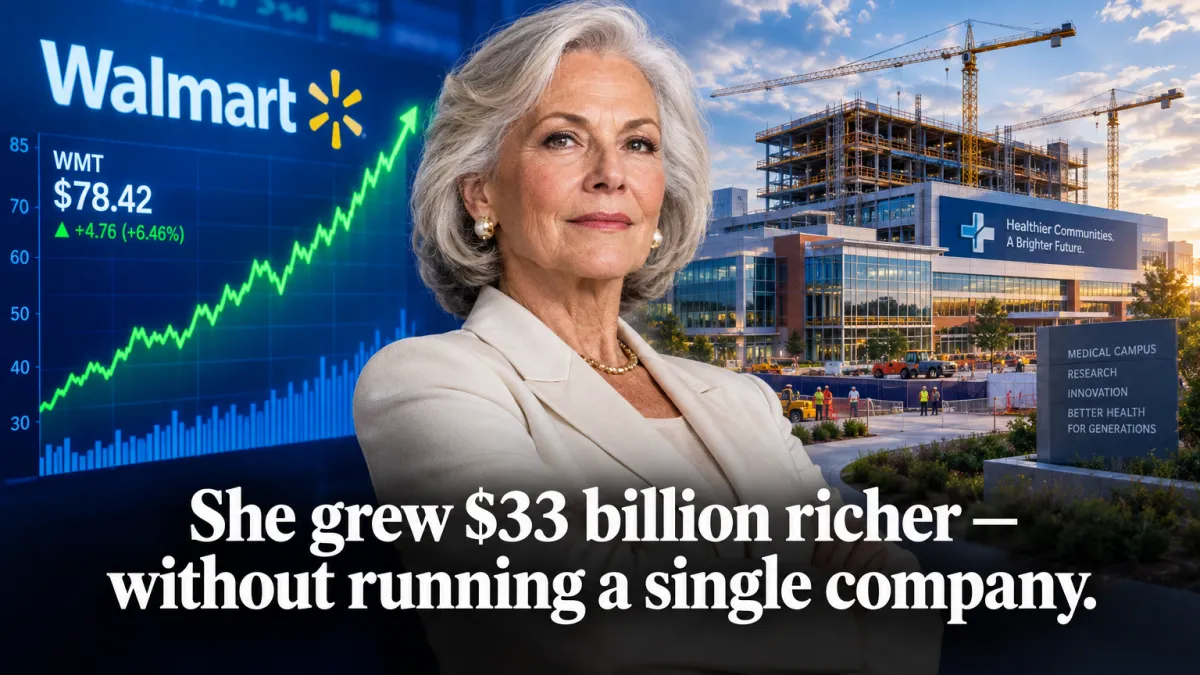
Billionaire Alice Walton Just Got $33 Billion Richer Without Running a Company — And It Changes Everything For Startup Founders
Published September 25, 2026 | Source: Fortune | Author: Jason Lim
Part 1 — Hook
Alice Walton just grew $33 billion richer in a single year — without running a single company.
Most people will read that headline as a story about inheritance. The lucky daughter of a retail giant, watching her net worth climb while the world works. They'll scroll past it. They'll feel vaguely envious or vaguely impressed and move on.
Startup founders shouldn't scroll past it. Because buried inside this story is the clearest possible demonstration of the one thing every founder claims to want — and almost no founder actually builds: a system that generates value whether you show up or not.
Part 2 — Press
Here's what hits close to home if you're building a business right now.
You are probably the engine of your own revenue. You pitch. You close. You deliver. You follow up. You are the product, the sales team, and the operations department rolled into one. When you stop moving, the income stops moving. That is not a startup. That is a job with extra steps and more risk.
Meanwhile, a 76-year-old woman grew her fortune by $33 billion in twelve months — by not running a company. She doesn't sit on Walmart's board. She doesn't manage its supply chain. She doesn't give earnings calls. She doesn't chase clients. She built — or in her case, inherited — a structure. And that structure did the work.
The uncomfortable question isn't why she got richer. The uncomfortable question is: what structure are you building so your business grows when you step away from it?
Part 3 — Play
The numbers deserve a moment.
According to Fortune, between March 2025 and March 2026, Alice Walton's net worth grew by $33 billion, per Forbes data. Today she is worth nearly $120 billion. She did this, as Fortune reported on September 25, 2026, without running Walmart or sitting on its board — unlike her brothers, who also hold significant Walmart shares but maintain more active roles.
Her wealth is structural. Walmart's 2026 proxy statement, cited by Fortune, shows Walton Enterprises holds approximately 3 billion shares directly and votes another 513 million held by the Walton Family Holdings Trust. As Fortune noted, since her fortune stems almost entirely from her inherited stake in Walmart, when the stock climbs, so does her net worth.
What is she doing with the leverage that structure creates? On September 17, 2026, her Alice L. Walton Foundation broke ground on a Bentonville health campus built in partnership with the Mercy health system and Cleveland Clinic, according to Fortune. The foundation is committing $350 million toward a 250-bed hospital and cancer center. This follows the 2021 founding of the Alice L. Walton School of Medicine — a tuition-free medical school in Bentonville, Arkansas, which welcomed its inaugural class of 48 students in July 2025. Tuition is waived for the first five cohorts, confirmed by the school's official site and Axios in October 2024. The average American medical graduate carries over $200,000 in student debt, per reporting from multiple outlets — which makes this not just a gift but a structural intervention in who can become a doctor.
Billionaire Alice Walton's move is one Jason has seen across 1,000+ founders. Here's what most miss.
Part 4 — Lesson + Root Cause Reframe
The Root Cause Reframe
Most founders think the problem is that they need more hustle. But the real problem is that they have never built a system that sells, delivers, or compounds without them in the room.
Alice Walton did not make $33 billion last year because she worked harder than you. She made it because decades ago — or more accurately, because her father decades ago — a structure was put in place that does not require daily input to produce daily output. The Walmart share position grows when the business grows. She does not need to be the one growing it.
That is the lesson most founders miss when they see this story. They look at the inheritance and call it luck. They miss the architecture. The architecture is the lesson.
The Quotable Lesson
"The system you build while you sleep is worth more than the hustle you run while you're awake."
Notice what Walton does with the leverage her structure gives her. She does not hoard it. She redeploys it toward the thing she cares most about: health care access. She founded a medical school. She is building a hospital. She is targeting underserved communities in rural Arkansas. According to Time magazine, her vision is for the educational model to spread to other regions with limited health resources.
This is what founders with real systems eventually discover: once the revenue structure works without you, you stop selling for survival and start deploying for impact. The mission becomes visible because the noise of constant selling goes quiet.
But here's where most founders stop short. They build a great product or service. They close deals through sheer personal effort and charm. They grow. And then they hit a wall — because the business is still entirely dependent on them showing up. They haven't built a system. They've built a very demanding job.
Founder Story Card
The visible problem: Revenue stalls whenever the founder steps back. Deals only close when the founder is personally in the room.
The real root cause: The founder never built a sales system that works independently of their presence. They are the system — and that is the ceiling.
The founder lesson: A business that cannot operate without you is not a business. It is a high-risk freelance arrangement. Walton's wealth compounds because the structure compounds. Your revenue should too.
The move to make now: Identify the one part of your sales and conversion process that currently requires you personally. Build the system, the message, or the asset that replaces your presence with something that works at scale.
Part 5 — Opportunity + Conditions
The Hidden Opportunity
Here is what Alice Walton's story reveals that most business commentary completely ignores.
The moment a founder builds a system that generates revenue without requiring their constant presence, an entirely new category of opportunity opens. You stop reacting and start deciding. You stop pitching to survive and start choosing who to serve. You stop measuring success in hours worked and start measuring it in value created.
And crucially — just like Walton redirecting her structural wealth into healthcare and education — you can now point your business at a mission that is worth pursuing. Not because you can afford to be altruistic, but because the system gives you the leverage to act on what you actually believe matters.
The opportunity in front of every startup founder right now is not to work harder. It is to build the structure that works while they sleep, so they can eventually show up only for the work that genuinely requires them.
But this only works when four conditions are in place.
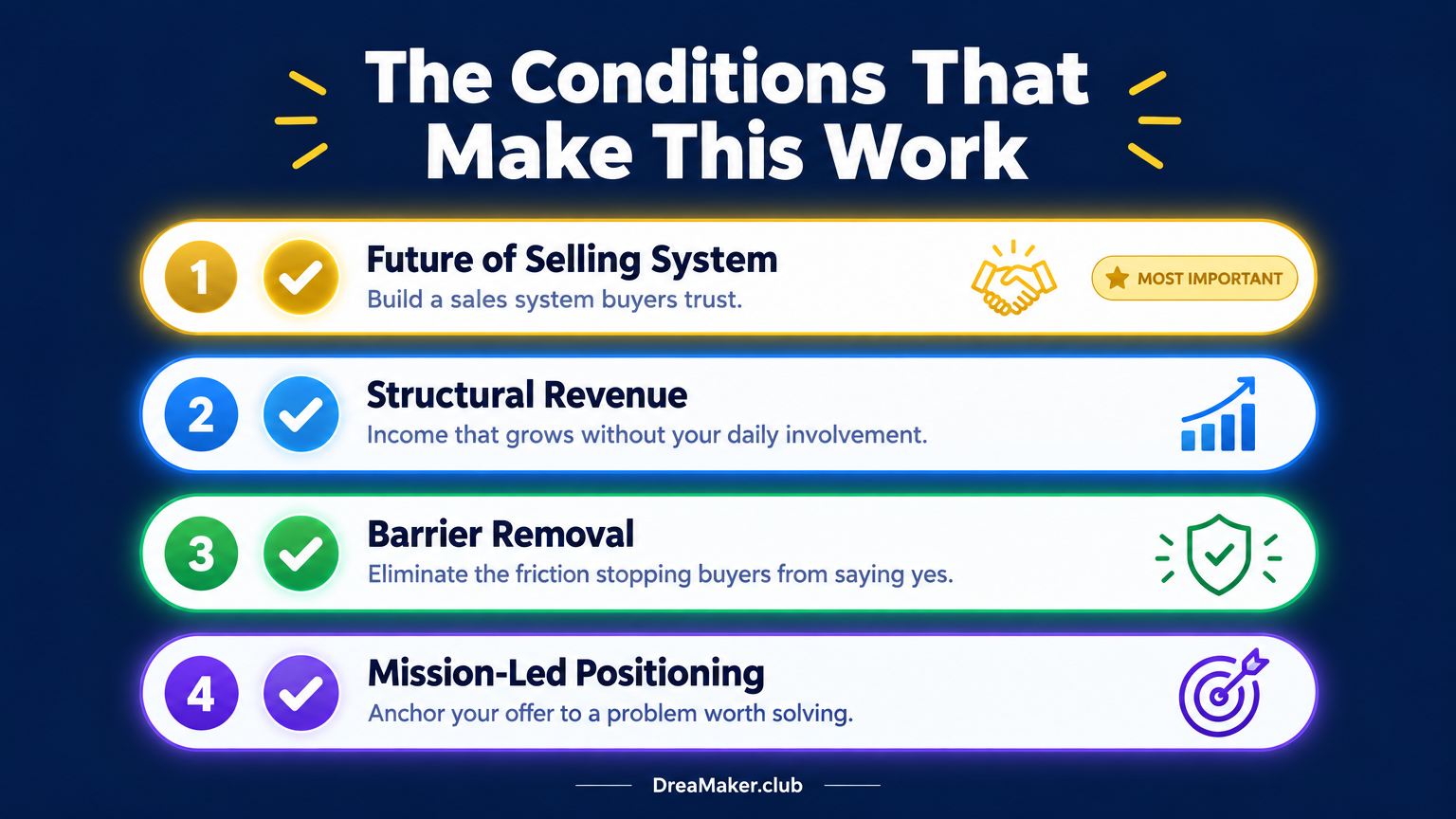
The Conditions That Make This Work
- Future of Selling System: Before anything else works, you need a sales system that buyers can understand, believe in, and act on — without you holding their hand through every step. The Future of Selling System gives founders the framework to convert expertise and trust into a reliable, scalable sales process. Without this condition, every other move you make is built on sand.
- Structural Revenue: Build at least one income stream that does not require you to personally close each deal. Productised services, licensing, recurring revenue models, or equity positions — the form matters less than the principle: your financial output should compound, not flatline when you sleep.
- Barrier Removal: Walton's tuition-free model eliminates the biggest barrier between talented people and medicine — debt. In your business, identify what is stopping your best-fit buyers from saying yes. Then systematically remove it. Price architecture, trust signals, risk reversal, and clear messaging are all barrier-removal tools. Deploy them.
- Mission-Led Positioning: When you know what your business is actually for — not just what it sells — your positioning sharpens, your messaging becomes magnetic, and the buyers you want self-select in. Walton's medical school isn't positioned as a school. It is positioned as a fix for a broken system. Position your business the same way.
Part 6 — Native Ad
Part 7 — Sting
Alice Walton already moved. The only question is whether you will — or whether you'll read about someone else who did.


