Barry Diller just walked away from an $18 billion deal. Here's why that's the most important sales lesson of 2026.
On Wednesday, September 23, 2026, Diller's company People Inc. — formerly IAC — withdrew its proposal to take MGM Resorts International fully private, just months after making the offer publicly. The move sent MGM shares down 8% after hours and left boardrooms stunned. But the real story isn't about a deal collapsing. It's about what every founder gets wrong before they ever make an offer.
Let that number sit for a moment: eighteen billion dollars.
Diller didn't walk away because the asset was bad. He said himself he still holds 66.8 million MGM shares and has "total confidence in both the management and the Company's prospects." He's not fleeing a bad investment. He walked away because the conditions weren't right — and he was disciplined enough to say so publicly and move on clean.
Most founders can't do that. They pitch before they've built the conditions. They make an offer before trust is established. They push for the close when the timing is wrong and the buyer isn't ready. And then they wonder why a "great deal" keeps dying at the final stage.
If Diller — one of the most experienced dealmakers in American business history — can walk away from an $18 billion offer because the mix wasn't coming together, what does that tell you about how seriously you should take conditions before your next sales conversation?
What Actually Happened
Here are the verified facts. On June 1, 2026, People Inc. formally proposed to buy all outstanding MGM Resorts shares it did not already own, at $48.30 per share in cash, according to a letter filed with the SEC. At the time, People already held approximately 27% of MGM — 66.8 million shares — built up since 2020 when pandemic lockdowns had depressed share prices. The total transaction would have valued MGM at more than $18 billion, according to reporting by Skift and the Nevada Independent.
MGM's board formed a special committee of independent directors to evaluate the proposal and held negotiations with People over several months. On September 23, Diller announced the withdrawal. In his own words: "There are lots of ingredients that go into a proposal of this kind on its way to completion. We didn't feel the mix was coming together in the way we had hoped and have decided not to pursue taking the company private at this time. What is undimmed is our belief in the future of MGM Resorts." (Deadline, September 23, 2026)
The timing was notable. Just one day earlier, Caesars Entertainment shareholders had approved Tilman Fertitta's competing $17.6 billion acquisition, which would take Caesars private, according to the Las Vegas Review-Journal. Meanwhile, Las Vegas demand had softened — Strip-wide occupancy was flat in Q2 2026 and average daily rates fell 4%, according to Skift. MGM itself had posted a net loss of $285.3 million in Q3 2025 before recovering to net income of $292.4 million in Q2 2026, per SEC filings as reported by Financial News.
Billionaire Barry Diller's move is one Jason has seen across 1,000+ founders. Here's what most miss.
The Real Reason Offers Fail
Most founders think their offer failed because of price. The real problem is conditions — the buyer wasn't ready, the trust wasn't built, and the timing was wrong.
Diller didn't say the asset was overpriced. He didn't say he was outbid. He said the mix wasn't coming together. That's a conditions problem, not a valuation problem.
This is the lesson most founders completely miss:
"The market doesn't reward who was right. It rewards who built the conditions before they made the ask."
Diller spent six years quietly accumulating 27% of MGM before making his formal bid. He sat on the board. He understood the asset from the inside. When he finally made the move in June 2026, it wasn't a cold pitch — it was a structured approach built on deep contextual knowledge. And even then, when external conditions (softening Las Vegas demand, competitor consolidation, board dynamics) didn't align, he withdrew cleanly and preserved the relationship for a future attempt.
Founders pitch too early, too cold, and too urgently. They make offers before positioning is clear, before buyer trust is established, and before the market window is open. Then when the deal collapses, they assume the problem was the price or the product. It was never the product. It was the conditions.
Founder Story Card
The visible problem: "My offer keeps getting rejected or ignored even though I know my product is genuinely good."
The real root cause: The founder is pitching before conditions are built. The buyer hasn't been given enough trust, timing, or context to say yes — so silence or rejection is the only rational response available to them.
The founder lesson: An offer is not the beginning of a sale. It's the last step. Everything before the offer — positioning, trust-building, timing, and condition-setting — determines the outcome before you ever open your mouth.
The move to make now: Map out every condition your buyer needs in place before they can say yes. Fix those conditions first. Make the offer last.
The Hidden Opportunity In Diller's Walk Away
Here's what most people watching this story will miss: Diller's withdrawal is not a failure. It is a masterclass in strategic patience and condition management.
He still holds 27% of MGM. He's still on the board. He publicly stated People Inc. remains "open to and interested in the possibility of a strategic transaction with MGM Resorts." He didn't burn the relationship, lose the asset, or damage his reputation. He walked away clean — because he had built the conditions to do so gracefully before he ever made the first offer.
The opportunity for startup founders right now is enormous — because your competitors are still doing the opposite. They are pitching cold, rushing the close, and burning buyer relationships when deals fall through. Every one of those burned relationships is a buyer who is now looking for someone else who understands how deals actually get done.
You can be that someone. But only if you understand how to build conditions before you make the ask. These are the conditions that make it work:
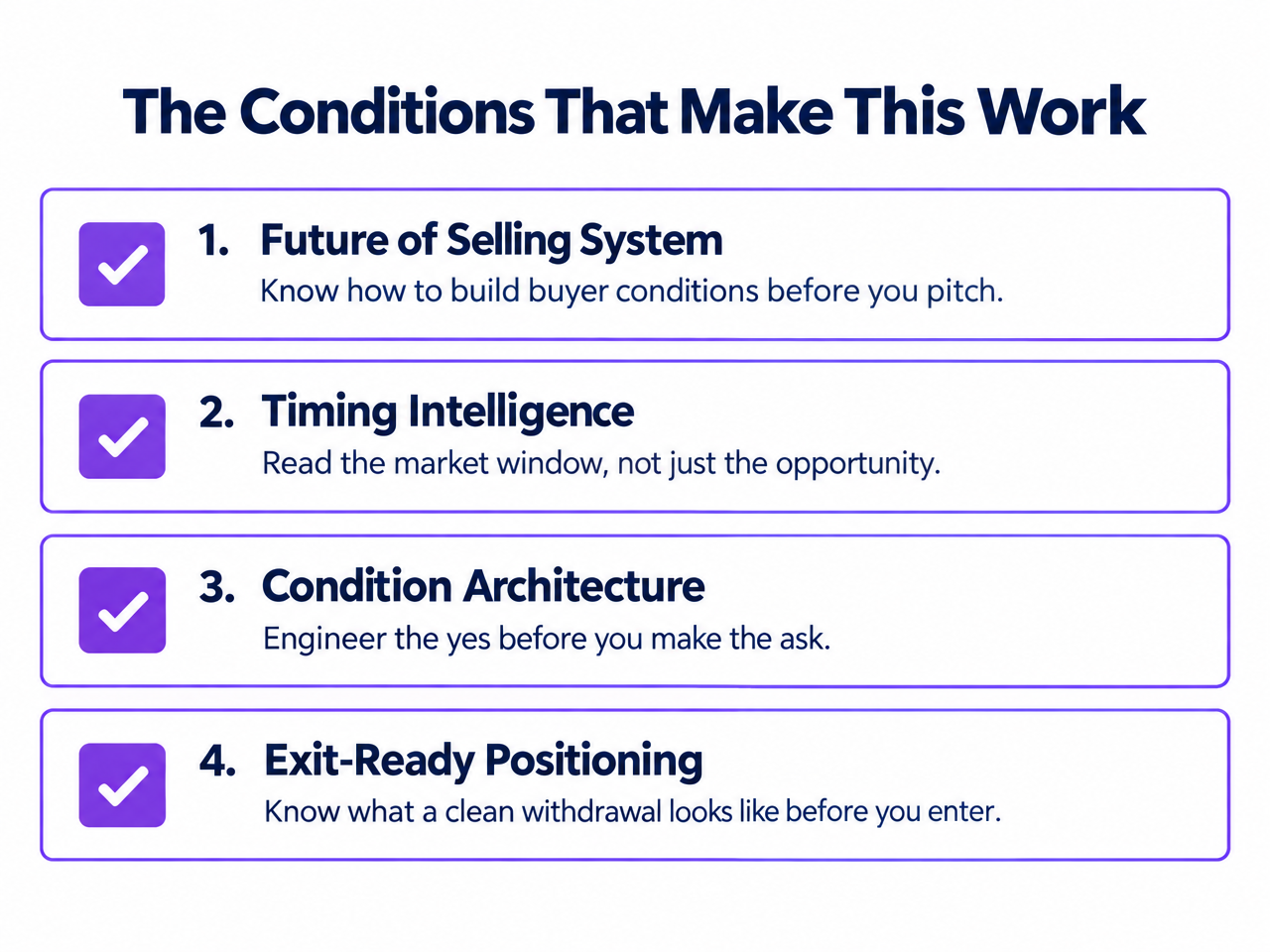
The Conditions That Make This Work
- Future of Selling System: Before you can build buyer conditions, you need a system that teaches you how trust, timing, and positioning translate into revenue. FOS is that system — it shows founders how to engineer the yes before they ever make the ask. Without this foundation, you're guessing.
- Timing Intelligence: Diller read the market and pulled when demand softened and competitor consolidation shifted the landscape. Founders who understand market timing make their move when the buyer is ready — not just when the founder is ready.
- Condition Architecture: Map every psychological and situational condition your buyer needs before they can say yes. Build those conditions into your positioning, content, and conversations — long before you pitch.
- Exit-Ready Positioning: Know what a clean withdrawal looks like before you enter any deal. Founders who can walk away gracefully — like Diller did — preserve relationships and create future opportunities. Founders who can't walk away destroy them.
Diller already moved. The only question is whether you will — or whether you'll read about someone else who did.


