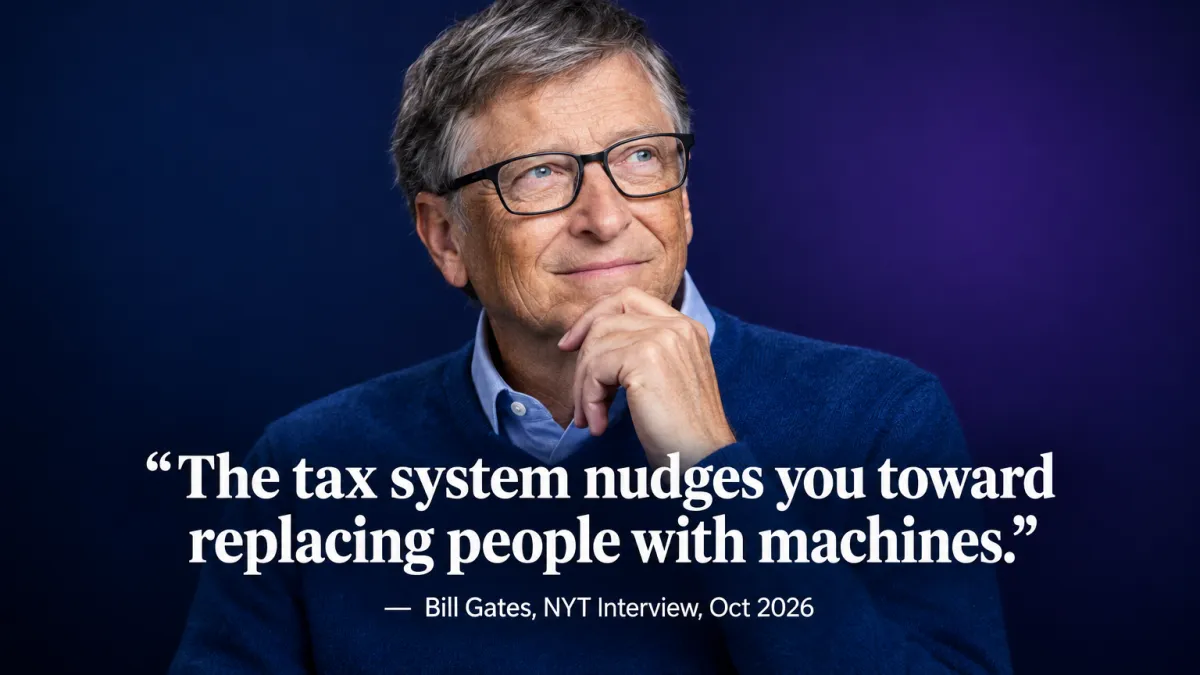
Billionaire Bill Gates Just Called for a Robot Tax — And It Changes Everything For Founders Who Are Still Pitching AI as a Headcount Play
Part 1 — The Hook
Bill Gates just proposed taxing every robot that takes a human's job. Your buyer read it this morning. Now ask yourself: does your pitch still sound like a headcount-reduction play?
On October 1, 2026, in a widely circulated interview on The Ezra Klein Show (New York Times), Bill Gates made the case for a robot tax — a levy on companies that use automation to replace human workers. He also floated the idea of government-designated "Human Reserved" job categories, roles that should remain protected from machine displacement regardless of technological capability.
Journalists called it a policy story. The Bloomberg and Business Insider headlines buried what actually matters. Because if you sell anything AI-related — automation, workflow tools, efficiency software, productivity platforms — your buyer just got handed a political reason to slow-walk every deal you have in pipeline.
Part 2 — The Stakes Are Personal
Put yourself in your buyer's chair right now. She is a COO at a 200-person manufacturing firm. She was already nervous about how her AI vendor purchase would look to her team. Now the richest tech mind of the last century — a man who built the software era — is on the New York Times telling the world that replacing workers with machines should come with a penalty.
What does she do with your pitch deck that leads with "reduce labour costs by 40%"? She puts it in the drawer. Not because she doesn't want to buy. Because buying now feels politically risky. The board might ask questions. The union rep is already forwarding her the article.
This is not a hypothetical. This is the room your next call is walking into. And if you walk in with the same pitch you used eighteen months ago, you are not being ignored because your product is bad. You are being ignored because your pitch is out of sync with the emotional reality of October 2026.
The founders who see this shift and move first will clear their pipeline. The ones who miss it will spend Q4 wondering why deals are stalling with no clear objection to point at.
Part 3 — What Actually Happened
On October 1, 2026, Bill Gates sat down with journalist Ezra Klein for a long-form interview published by the New York Times. The conversation covered AI, inequality, and the future of work — topics Gates has been sharpening his public position on throughout 2026.
Gates argued that the current tax system structurally incentivises replacing humans with machines. As he has noted publicly on this topic: "Right now, the human worker who does, say, $50,000 worth of work in a factory, that income is taxed and you get income tax, social security tax, all those things. If a robot comes in to do the same thing, you'd think that we'd tax the robot at a similar level" [Bill Gates, Quartz interview, 2017 — a position he has consistently reaffirmed and amplified through 2026].
The October 2026 interview pushed further: Gates proposed the concept of "Human Reserved" categories — jobs where human presence should be a legal or policy requirement, regardless of whether automation is technically capable. This is a significant escalation of his prior position and one that immediately generated coverage in Business Insider, Bloomberg, and KuCoin News on the day of publication.
Gates is not a fringe voice. He is a $130+ billion net worth co-founder of Microsoft — a company that now earns billions from its own AI products via the Azure OpenAI partnership. When he argues for taxing automation, buyers pay attention in a way they simply do not when a politician says the same thing.
Billionaire Bill Gates' move is one Jason has seen across 1,000+ founders. Here's what most miss.
Part 4 — The Lesson & Root Cause Reframe
Most founders think the problem is proving AI ROI. The real problem is that your buyer's fear of regulatory optics now outweighs their FOMO — and if your pitch still sounds like a headcount-reduction play, you're triggering that fear before you've said hello.
Here is what is actually happening in the room. Your buyer wants to buy. Automation genuinely helps them. But the political climate in October 2026 means that buying an AI tool that replaces staff now carries reputational risk — with their own team, with their board, potentially with regulators if Gates' proposals get traction. The objection you will hear is not "we don't have budget" or "we're happy with our current solution." The objection you will hear is silence. Slow-walking. "Let me loop in our People team." That's not a budget problem. That's a framing problem.
The lesson Gates just taught every founder without meaning to:
When the market shifts, your pitch must shift first — or the deal dies before you open your mouth.
The founders who will win Q4 are not the ones with better AI products. They are the ones who repositioned their pitch from "we eliminate labour costs" to "we help your team do more of what only humans can do" — before their competitors figured out the shift was necessary.
Founder Story
Leon closed a $2M partnership — after repositioning one sentence.
Leon came to Jason mid-pitch cycle. His deck led with cost savings and efficiency metrics. His buyers kept stalling. Jason helped him reframe the opening from a cost play to a growth play — the same product, one repositioned value statement. The $2M partnership closed within six weeks. The market did not change. The pitch did.
Gates' interview is not a warning for AI companies. It is a market intelligence signal for every founder whose product touches how work gets done. When the world's most credible tech billionaire publicly shifts the moral frame around automation, your buyer's internal calculus shifts with it — whether they consciously register it or not. Your job as a founder-seller is to sense that shift, reframe your pitch accordingly, and walk into the room with language that makes your buyer feel safe buying — not politically exposed for doing so.
Part 5 — The Hidden Opportunity & Conditions
The hidden opportunity: While most AI-adjacent founders are in panic mode, there is a narrow repositioning window opening right now. Buyers who were cautious about AI tools are actively looking for vendors who can make the purchase feel responsible — human-amplifying rather than human-replacing. The founders who reframe fastest capture the deals that the tone-deaf vendors leave on the table. This window will close as the market standardises its language. The founders who move in October 2026 will define the category frame. The ones who wait until Q1 will be imitating the ones who moved now.
Are you ready to sell in the AI-anxiety era? Check all four conditions:
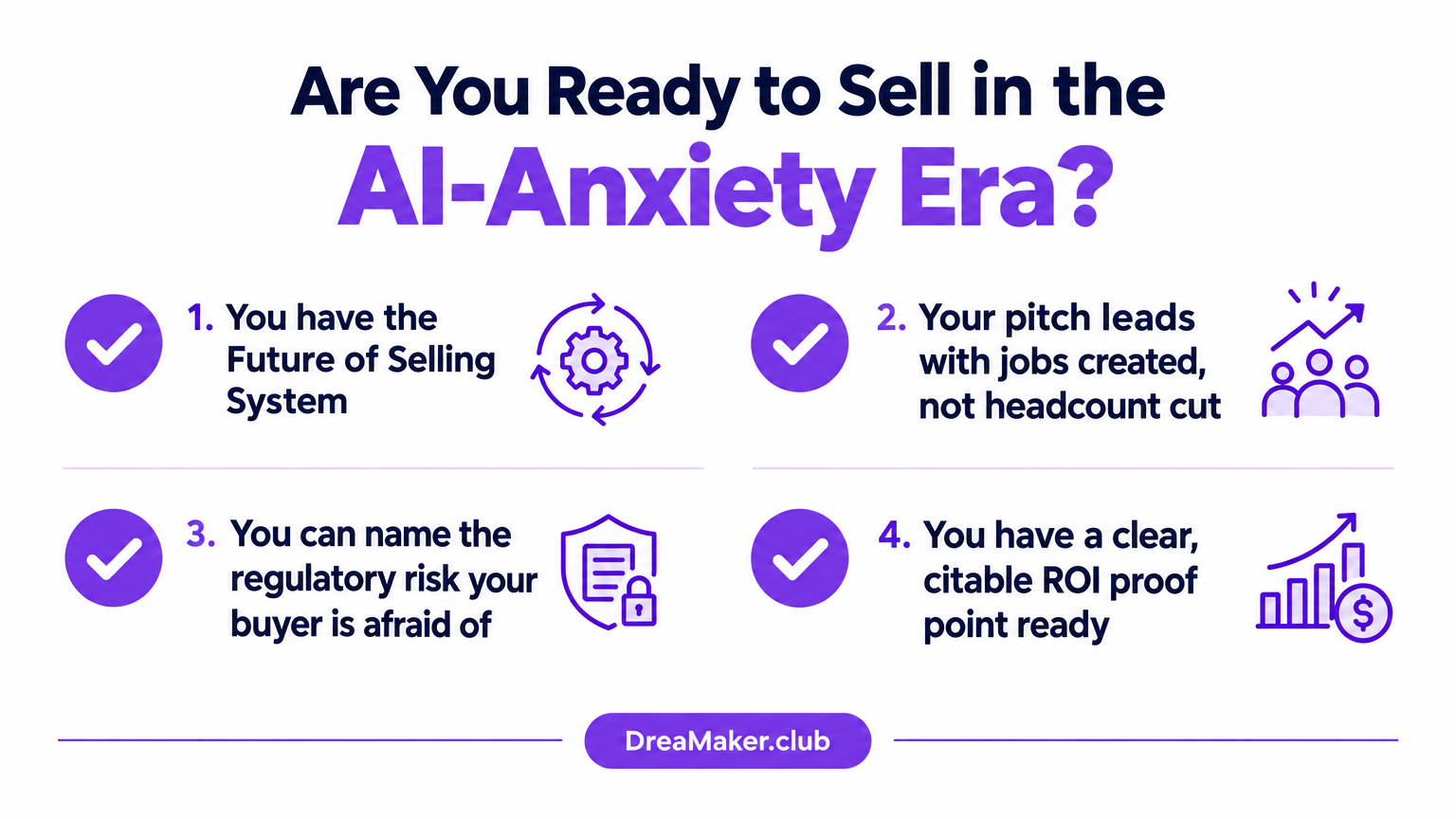
Condition 1 — You have the Future of Selling System. Repositioning a pitch under market pressure is not an instinct skill — it is a structured skill. Without a repeatable framework for reading buyer psychology and adjusting your opening, you will reframe once, get it wrong, and revert to the old pitch. FOS gives you the exact sequence to diagnose what your buyer is afraid of and lead with the language that dissolves that fear before you make a single claim about your product.
Condition 2 — Your pitch leads with jobs created, not headcount cut. Audit every slide, every opening line, every email sequence in your current go-to-market. If the word "efficiency" means "fewer people needed," rewrite it today. Lead with what your product enables humans to do that they could not do before — not with what it eliminates.
Condition 3 — You can name the regulatory risk your buyer is afraid of. When you walk into a room, can you say with confidence exactly what political or regulatory concern is sitting at the back of your buyer's mind? If you cannot name it before they can, you cannot defuse it. Know the Bill Gates story. Know the EU AI Act headlines. Know what your buyer's board is reading.
Condition 4 — You have a clear, citable ROI proof point that is not about headcount. Revenue generated. Deals closed faster. Customer retention improved. New markets entered. Any metric that proves your product creates value without the political baggage of "we cut 12 staff" is now a first-line credential. Lead with it.
NEW!
October 2026
Dear Founders,
If your pitch still sounds like a headcount play, you are handing deals to founders who repositioned six months ago — and you will not even know it, because the buyer will never tell you that is why they went quiet.
I know what it feels like to walk into a room with a pitch that used to work and suddenly feel the buyer pulling away with no clear reason. I've felt it. I've helped 1,000+ founders through it since 2015. And what I found — every time — is that the pitch was out of sync with what the buyer was afraid of, not out of sync with what the product could do.
According to Salesforce State of Sales, 76% of buyers expect sellers to understand their business needs and expectations before a sales conversation begins [Salesforce, State of Sales, 2024]. That number is higher in a politically charged market. Your buyer expects you to walk in already knowing what she is nervous about — and already having language that defuses it.
Jason's graduates have closed $22M+ in combined sales since 2015 — including Jeffrey Teo (63 customers in 100 days), Stanley Tan (45 buyers in 3 hours), and Leon ($2M partnership) — using the same repositioning disciplines inside the Future of Selling System.
Not ready for $19? Start free.
The Objection Playbook: 25 Word-for-Word Scripts to Close More Sales
The exact words Jason's founders use when a buyer says "too expensive", "send me info" or "I need to think about it". Free PDF, sent to your inbox.
Send Me the 25 ScriptsBillionaire Bill Gates already moved. The only question is whether you will — or whether you'll read about someone else who did.


