Billionaire Dario Amodei Just Said Slow Down — And It Changes Everything For AI Startup Founders
Billionaire Dario Amodei Just Said Slow Down — And It Changes Everything For AI Startup Founders
The Move That Stopped the AI World
Dario Amodei just told the AI industry to hit the brakes — and the smartest founders are taking notes.
In a move that drew immediate industry attention, Anthropic's CEO outlined a formal plan he calls "pacing the frontier" — a framework for deliberately slowing the deployment of AI capabilities until independent safety evaluators and coordinated governance between democratic-nation labs can catch up. The proposal has already attracted both significant industry support and pointed public pushback from Nvidia's Jensen Huang, according to TechCrunch. When the CEO of one of the world's most valuable AI companies publicly argues for moving slower, it is not a retreat. It is a strategic repositioning — and most founders are completely misreading it.
Why This Is Your Problem Too
Here is what founders get wrong every single time a billionaire makes this kind of move: they think it is only about big tech and government regulation. It is not.
The real pressure inside this story is trust. Amodei's entire thesis — pace the frontier, build in coordination with safety evaluators, earn the right to go fast — is built on one foundational insight that applies to every founder at every stage: your ability to move fast is governed entirely by how much trust you have already built.
Most founders are racing to ship faster, close faster, pitch faster, and scale faster. But speed without a trust foundation does not compound. It collapses. Buyers delay. Partners stall. Investors pause. The market steps back. And founders who built their business on speed instead of trust are left with a pipeline full of interest and almost no conversion. You may not be building the most powerful AI model on the planet. But you are operating in the same trust economy. If Amodei — running a company valued at $180 billion according to Forbes, with enterprise customers and government backing — believes he needs to earn the right to move fast, what does that say about where your trust level actually is right now?
What Actually Happened — And What It Really Means
The timeline matters. A week before Amodei's announcement, an Anthropic researcher published what TechCrunch described as a "doomsday warning" that rattled the AI world. The industry was already on edge. Sam Altman had publicly stated in September 2026 that safety standards were "not at a place" to push AI capabilities much further, according to Fortune. Into that environment, Amodei stepped forward not with defensiveness but with a structured plan: independent safety evaluation, democratic-nation lab coordination, and a deliberate pace to frontier deployment.
The response was immediate. According to TechCrunch, the proposal picked up significant industry support alongside pushback from Nvidia's Jensen Huang — the man whose chips power most of the AI world's ambitions. That Huang pushed back tells you exactly how much economic pressure there is to move faster. That Amodei held his position anyway tells you something about what kind of leader earns long-term trust in a market flooded with noise.
Anthropic was founded in 2021 when seven OpenAI employees walked away, convinced their previous employer was building AI too fast without regard for safety or trust, according to the Forbes 400 (September 2026). Today, four of those seven cofounders rank among the ten youngest members of the Forbes 400. Their collective estimated fortune stands at $15.5 billion. The company they built on a trust-first thesis is now valued at $180 billion.
Billionaire Dario Amodei's move is one Jason has seen across 1,000+ founders. Here's what most miss.
The Lesson Most Founders Miss
Most founders think the problem is speed. But the real problem is sequence.
Founders who struggle to close assume the answer is more outreach, faster follow-up, a better pitch deck, or a shorter sales cycle. They are solving for speed when the actual bottleneck is trust sequence. They are trying to get to "yes" before the buyer has any reason to believe the "yes" will deliver what was promised.
Amodei's move makes this visible at a scale most founders never get to see. He is not slowing down because Anthropic cannot move fast. He is slowing down because he understands that speed without trust sequence destroys the entire market — including his own. He is protecting his right to move fast later by proving he deserves to move at all.
The quotable line every founder needs to tattoo somewhere visible:
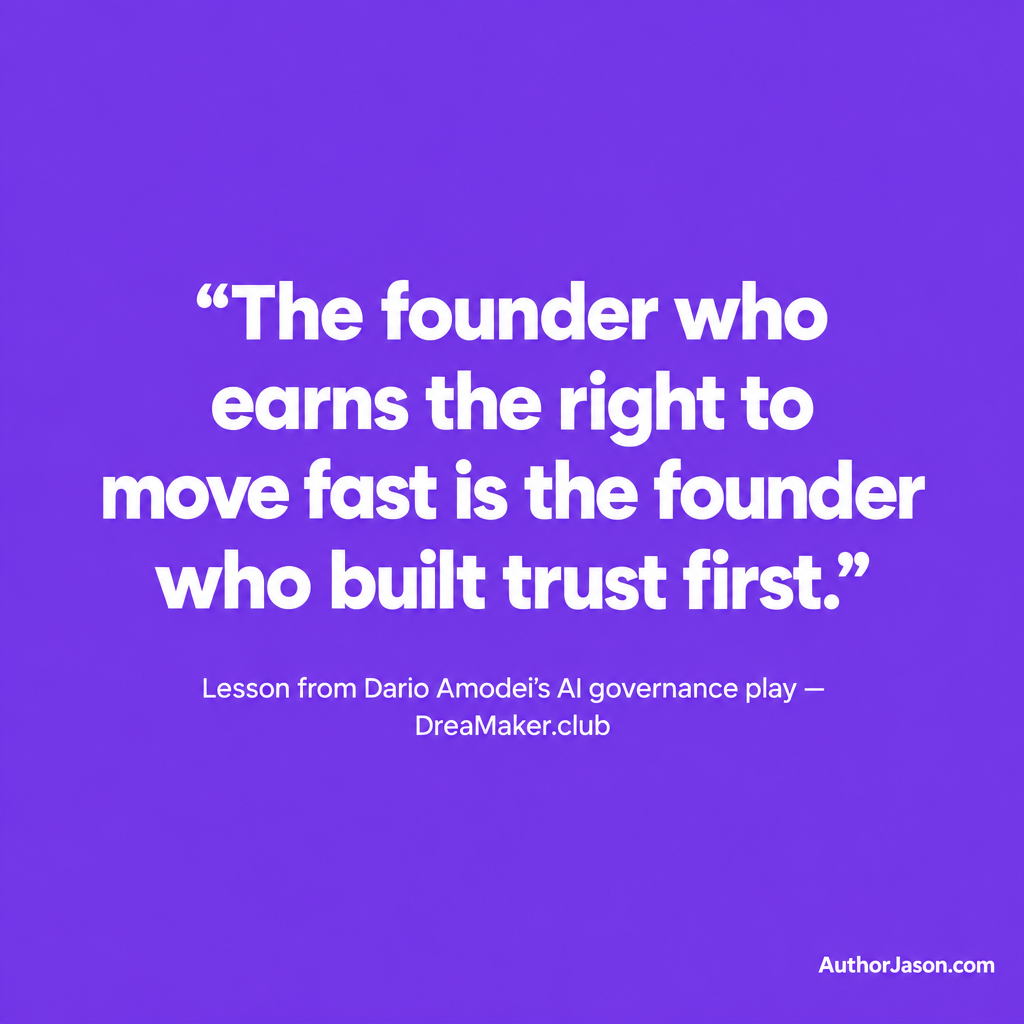
"The founder who earns the right to move fast is the founder who built trust first."
This is not soft advice. It is a commercial strategy. Trust is not a nice-to-have pre-sales activity. It is the asset that converts interest into action. It is what turns a demo into a contract, a proposal into a signed deal, and a pilot into an enterprise renewal. Without it, every fast move founders make is adding more velocity to a car with no brakes.
The founders who will win the next 24 months are not the fastest movers. They are the founders who built trust assets — in their positioning, their communication, their proof points, and their buyer psychology — and then used those assets to accelerate close rates when the market was finally ready to move.
Founder Story Card
The visible problem: A B2B SaaS founder is running hard on outreach — demos up, conversations up — but pipeline conversion is flat. Every deal is "still evaluating."
The real root cause: Buyers are interested but not yet trusting. The founder is showing capability (speed, features, demos) without first establishing credibility, proof, and safety (the buyer's version of a safety evaluator).
The founder lesson: Moving fast without trust sequence creates interest with no conversion. Buyers need to believe the outcome before they can buy the product.
The move to make now: Audit every stage of your sales process for where trust is assumed instead of earned. Add one trust-building step before each ask for commitment. Watch pipeline velocity change.
The Hidden Opportunity Right Now
Here is what almost no founder is seeing: while most of the market is racing for speed, the window to differentiate on trust is wide open. Amodei just used trust positioning to separate Anthropic from every other AI lab on the planet — in a single public announcement, at zero additional cost. The trust gap is a positioning gap, and right now that gap is enormous.
Buyers in 2026 are overwhelmed with options, pitches, and vendor promises. They have been burned by vendors who overpromised and underdelivered. They are not waiting for a better demo. They are waiting for a reason to believe. The founder who shows up with that reason — structured proof, credible positioning, a clear and honest account of what they can and cannot do — is not just winning deals. They are eliminating competition entirely. You cannot be compared to someone who has not earned the right to be compared to you.
The opportunity is to build your trust infrastructure now, while your competitors are still arguing about features and pricing. That infrastructure — your positioning, your proof system, your buyer communication framework, your conversion process — is what Amodei built at Anthropic over five years. You do not need five years. You need a system.
The Conditions That Make This Work
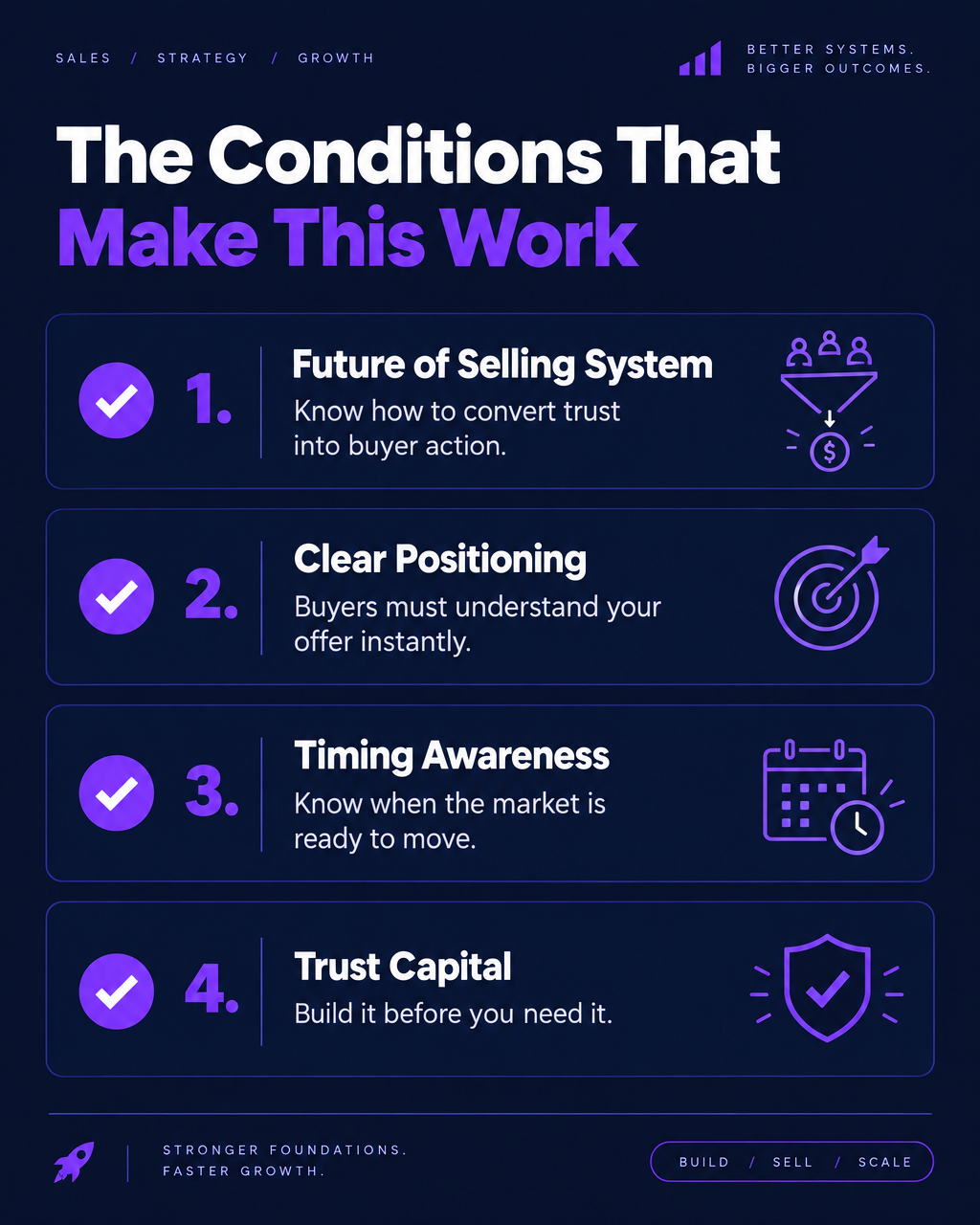
- Future of Selling System: You need a structured system that converts trust into buyer action — not just tactics, not just scripts, but a repeatable framework that sequences credibility, proof, and commitment in the right order. Without this, the trust you build sits idle.
- Clear Positioning: Buyers must understand exactly what you do, who it is for, and why it works — before they ever see a demo or receive a proposal. Positioning is the first trust signal every buyer reads.
- Timing Awareness: Amodei did not make this move randomly. He read the market, waited for the right moment (his researcher's warning created the opening), and then acted. Founders who understand their buyer's decision timing close faster with less friction.
- Trust Capital: This is the compound asset. Every proof point, every case study, every honest conversation, every kept promise is a deposit. When the buyer is ready to move, the founder with the largest trust balance wins — regardless of price.
Amodei already moved. The only question is whether you will — or whether you'll read about someone else who did.


