Billionaire David Ellison Just Settled Hollywood's Biggest-Ever Merger — And The Move That Closed It Is The One Every Founder Needs
Billionaire David Ellison Just Settled Hollywood's Biggest-Ever Merger — And The Move That Closed It Is The One Every Founder Needs
David Ellison just settled Hollywood's biggest-ever deal — and the move that closed it wasn't generosity.
On September 21, 2026, Paramount Skydance reached a settlement with 12 state attorneys general who had sued to block its $111 billion acquisition of Warner Bros. Discovery, according to CNBC and Deadline. The antitrust lawsuit — months in the making — collapsed in a single negotiating sprint. Not because Ellison gave his opponents everything they asked for. Because he made walking away cost more than saying yes.
This Is Not a Hollywood Story. It's a Mirror.
Every founder reading this has been in a version of that room. You've made a strong offer. You've built a compelling case. You've done everything right — and the other side still says no, stalls, or walks.
Most founders respond by going softer. Lower the price. Add more value. Extend the timeline. Apologise for taking up their time. They believe the problem is the offer. They make it more generous. The deal still doesn't close.
What Ellison did on September 21 was the opposite. He didn't beg. He didn't soften. He built a situation in which the cost of blocking the deal became more painful than the cost of approving it — and then he waited while that pressure did its work. The same mechanic that closed a $111 billion Hollywood megadeal is the mechanic most startup founders have never been taught to use.
What Actually Happened — And Why It Matters
Paramount Skydance — the company Ellison created through the $8 billion merger of Skydance Media and Paramount Global in August 2025 — had been pursuing an acquisition of Warner Bros. Discovery since February 2026, when it won a bidding war over Netflix, according to Wikipedia. The $110–111 billion deal was the largest proposed all-cash transaction in corporate history, per Hollywood Reporter.
12 state attorneys general, led by California's Rob Bonta, sued to block it on antitrust grounds. A federal judge had already delayed the merger and set a trial date for March 2027 — leaving the deal in legal limbo for up to a year. Then two pressure points converged simultaneously: a $7 million-per-day "ticking fee" was set to begin October 1 if the deal remained unfinished, according to Hollywood Reporter and the Daily Caller — and Ellison had made public threats to relocate out of California, with Texas and Tennessee both actively courting the company.
The settlement announced Monday requires Paramount to release a minimum of 30 films per year in theatres and spend an additional $1.5 billion on US film production over five years, per the Daily Caller. A five-member editorial independence board will oversee CBS News and CNN. Ellison confirmed via Deadline on September 21: "Having now addressed the State AGs' and WGA's concerns, we have complete clearance for this merger." The deal is expected to close by early October 2026, per CNN and Variety.
Billionaire David Ellison's move is one Jason has seen across 1,000+ founders. Here's what most miss.
The Lesson: You Don't Win By Making the Best Offer. You Win By Making the Cost of No Too High.

Root Cause Reframe
Most founders think the problem is their offer isn't good enough. But the real problem is they have no leverage — and they haven't built any.
Ellison didn't improve his offer in the final days. He didn't give Bonta structural divestitures. He didn't sell CNN or CBS. The one thing that changed was the cost structure on the other side. A $7 million-per-day fee climbing after October 1. A credible threat to leave California — with receipts: two competing states were openly recruiting. A Trump-aligned DOJ filing a statement of interest in Paramount's favour. The cost of blocking the deal kept rising while the benefit of blocking it stayed the same. At some point, the math forced the settlement.
This is the negotiation mechanic most founders never install. They build a great product. They make a clear pitch. They wait. And then they soften when the buyer hesitates. They pull the price down. They offer more time. Every concession signals the same thing: we need this more than you do. And once a buyer believes that, the deal is dead or permanently discounted.
The quotable lesson here is this: "You don't win by making the best offer. You win by making the cost of saying no too high to ignore."
Ellison had a credible alternative (moving to Texas or Tennessee). He had a hard deadline creating time pressure on the other side (October 1 ticking fee). He had institutional backing (DOJ, 70 jurisdictions worldwide already approved). He didn't need to beg. He needed to wait. And he could only afford to wait because the cost of walking away from him kept compounding.
For startup founders, this lesson translates directly. When a prospect stalls, the question is not "What more can I offer?" The question is: "What is the cost of not buying from me, and does the buyer feel it clearly?" If the cost of inaction is invisible, the deal will stall indefinitely. If you can make the cost of inaction vivid, specific, and time-sensitive — without fabricating urgency — you change the decision frame entirely.
Founder Story Card
The visible problem: A SaaS founder had a 90-day enterprise prospect who kept requesting "more information" before deciding. The founder kept sending decks, case studies, and custom proposals.
The real root cause: The prospect had no cost to delaying. Every new document reset the timeline. The founder had trained them to wait.
The founder lesson: Generosity without leverage is not a strategy. It's a slow close toward a polite no.
The move to make now: Audit every open deal. Ask: What is the real cost to this buyer of not deciding this month? If you cannot name a specific, credible cost — a competitor moving, a price increase, a capacity constraint, a market window closing — you have no leverage. And without leverage, you are hoping, not selling.
The Hidden Opportunity — And The Conditions That Make This Work
The hidden opportunity in Ellison's settlement is not about Hollywood. It is about what happens when you negotiate from strength in any market — including the market for your own startup's products and services.
When Ellison threatened to leave California, it wasn't a bluff. Texas and Tennessee were actively courting Paramount. That credibility changed everything. Most founders make "take it or leave it" statements they cannot back up — and buyers sense it immediately. The moment your walk-away position is not credible, you are negotiating from fear. And fear-based negotiations almost always end in discounting, delay, or loss.
The opportunity right now, as the largest media consolidation in history closes within weeks, is to study the exact sequence Ellison ran: establish a credible alternative, identify the other side's hard deadline, apply consistent pressure without desperation, and wait. That same sequence works in a $15,000 consulting engagement or a $150,000 enterprise contract.
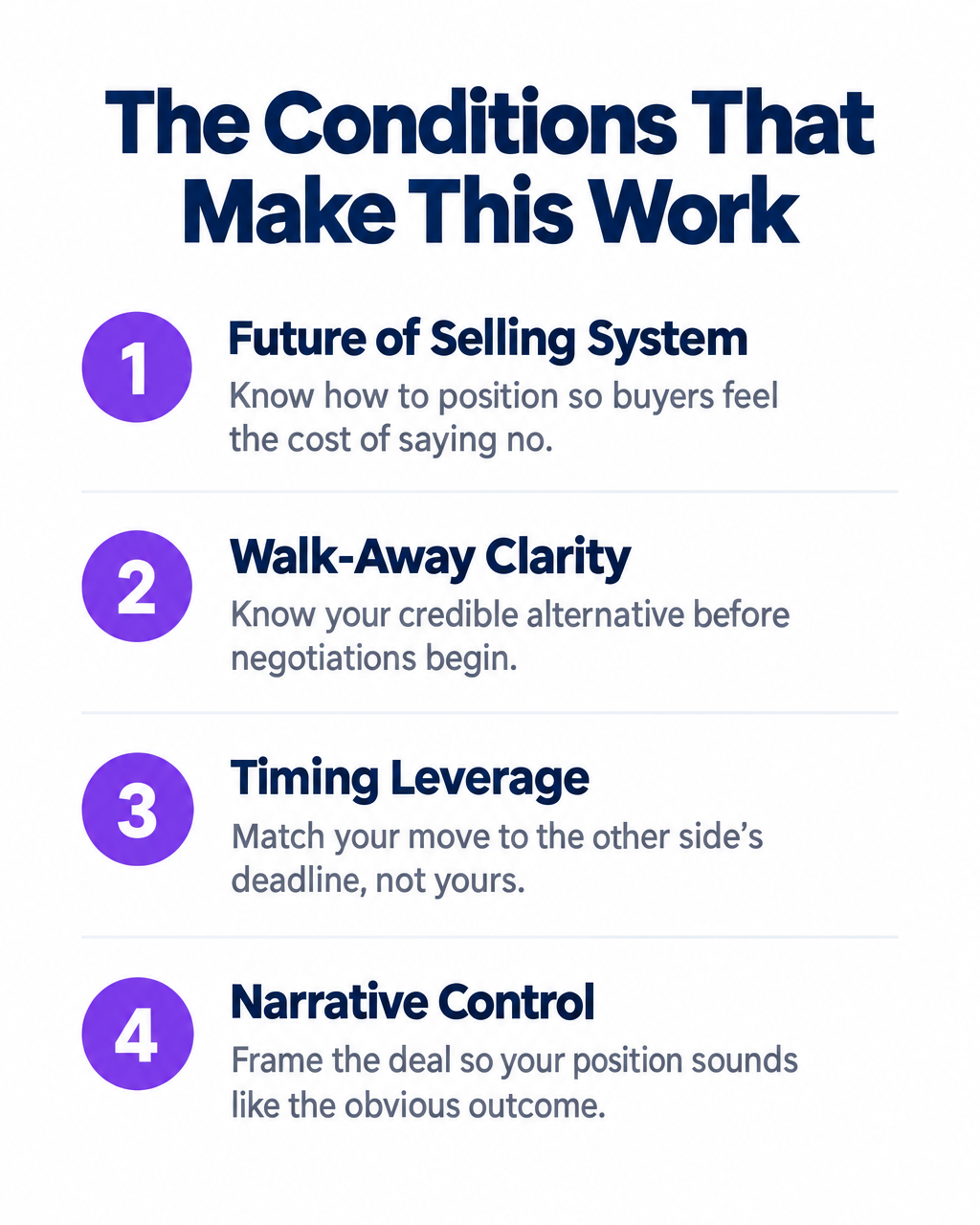
The Conditions That Make This Work
- Future of Selling System: You must know how to position your offer so buyers clearly feel the cost of saying no — not just the benefit of saying yes. FOS teaches you to construct that cost frame with precision and without manipulation.
- Walk-Away Clarity: You need a credible alternative before any negotiation begins. Ellison had Texas and Tennessee. What is your Texas? Define it before you enter the conversation — or you have no leverage to protect.
- Timing Leverage: Identify the buyer's real deadline, not yours. Ellison knew Bonta faced more political exposure than he did past October 1. Match your urgency trigger to the other side's calendar, not your revenue forecast.
- Narrative Control: Frame the deal so your position sounds like the only reasonable outcome. Ellison cited 70 international jurisdictions that had already approved — making resistance look like the outlier, not the default. Founders who control narrative control the outcome.
Ellison already moved. The only question is whether you will — or whether you'll read about someone else who did.


