

David Ellison just declared “complete clearance” on a $111 billion merger deal everyone said was dead.
Twelve state attorneys general had sued to kill it. A federal judge had paused it. A $7 million-per-day ticking fee was set to begin on September 30. Netflix had already walked away from its own competing bid. And the California AG stood at a press conference and said the settlement was “not a vote of support for this merger.”
None of it mattered. The deal closed anyway — on Ellison’s terms, on Ellison’s timeline. And the way he did it is the most important sales and deal-closing lesson any founder will read this year.
Here is the part that should make you uncomfortable.
Most founders believe that when someone says no — especially loudly, publicly, and legally — that means the deal is over. You apologise, you pivot, you chase easier prospects. You tell yourself the timing wasn’t right.
Ellison didn’t do that. When a coalition of 12 attorneys general filed an antitrust lawsuit and a federal judge granted a restraining order, he didn’t retreat. He offered concessions, set a relocation deadline, activated political allies, and made the cost of continued opposition more expensive than the cost of settlement.
This is not a story about Hollywood. It is a mirror. Every founder who has ever lost a deal “they should have won” is watching someone show them exactly how it’s done — and most will miss the lesson entirely because they’re too distracted by the headlines about studios and streaming rights.
Here are the verified facts, in sequence.
In February 2026, Paramount entered into an agreement to acquire Warner Bros. Discovery for $111 billion — after Netflix abandoned its competing bid (CNBC, June 12, 2026). The deal had already won approval from the U.S. Department of Justice and from regulators in nearly 70 jurisdictions worldwide, including the EU, China, Canada, Brazil, and the U.K. (Variety, September 21, 2026).
In July 2026, California and 11 other states filed an antitrust lawsuit in federal court in Oakland, arguing the deal would harm competition in cable, theatrical, and blockbuster film markets (Variety). A judge granted a temporary restraining order, pausing the deal for 28 days (Variety). The trial was scheduled for March 2027 — far later than Ellison’s team had hoped.
Rather than wait, Ellison applied multi-front pressure: he offered concessions including a commitment to produce 30 or more films annually (Deadline, September 21, 2026), threatened to relocate Paramount’s headquarters out of California if no deal was reached by October 1 (Variety), and — according to Deadline — California Governor Gavin Newsom played an active behind-the-scenes role in brokering the final breakthrough.
On September 21, 2026, a settlement was reached. Both studios will remain in California. The deal is expected to close within approximately two weeks, forming a combined company carrying up to $87 billion in debt (NPR, September 21, 2026) but controlling two of the world’s largest film studios, CNN, HBO Max, CBS, and TBS.
Billionaire David Ellison’s move is one Jason has seen across 1,000+ founders. Here’s what most miss.
The Lesson: You Don’t Close Deals by Asking Harder. You Close Them by Engineering Inevitability.
Beat 1 — Root Cause Reframe
Most founders think the problem is that the other side said no. But the real problem is that the other side doesn’t yet feel the pain of not saying yes.
Watch what Ellison actually did. He did not argue harder. He did not send more pitch decks. He did not lower the price. He changed the stakes. He made the cost of the deal dying — a March trial, a relocation, jobs lost, political embarrassment — more expensive than the cost of settling on his terms. He manufactured a deadline ($7 million per day starting September 30, reported by Variety). He activated allies (Governor Newsom). He reframed the narrative from “merger that kills competition” to “deal that builds a stronger Hollywood.”
By the time the California AG stood at that press conference — saying the settlement was “not a vote of support for this merger” but still signing the agreement — the deal was already done. That’s not persuasion. That’s condition engineering.
Beat 2 — The Engineered Lesson
“The deal doesn’t close because you asked. It closes because you made saying no more expensive than saying yes.”
This is where 90% of founders fail. They build a great product. They get a meeting. They give a pitch. They follow up three times. And when the prospect goes quiet, they assume the product wasn’t good enough — or the price was too high — or the timing wasn’t right.
But here’s the truth: Ellison’s opposition had every argument in the world to keep fighting. They had a federal judge. They had a trial date. They had a legitimate legal case. What they didn’t have was a reason to absorb the cost of winning — while Ellison made sure every day of delay had a visible, measurable price tag attached to it.
Your deals work the same way. The prospect who “needs to think about it” hasn’t calculated the cost of staying where they are. Your job is not to follow up. Your job is to engineer that calculation for them — clearly, honestly, and specifically.
Founder Story Card
The visible problem: A coalition of 12 states files an antitrust lawsuit, a federal judge issues a restraining order, and a March 2027 trial is scheduled. The deal appears dead.
The real root cause: The opposition hasn’t yet felt the cost of winning. They hold legal leverage but face no financial pain — yet.
The founder lesson: Closing is not about persistence. It’s about making the conditions around the deal shift so that the cost of not closing becomes higher than the cost of closing.
The move to make now: In your next stuck deal, stop following up with “just checking in.” Instead, articulate — clearly and specifically — what the prospect loses for every week they delay. Make inaction visible. Make it expensive. Then let the math do the closing.
The Hidden Opportunity: The Window Before Your Competitors Learn This Move
Beat 1 — Hidden Opportunity
Every founder reading this has at least one deal sitting in their pipeline right now that they’ve mentally filed under “probably not going to happen.” They’ve sent follow-ups. They’ve lowered the price. They’ve waited.
What Ellison’s playbook reveals is that those deals aren’t dead. They’re just unengineer. The opposition to a deal — whether it’s a procurement team, a board sign-off, a budget freeze, or a silent competitor already in the room — doesn’t need to be argued out of position. It needs to feel the cost of maintaining that position.
The founders who learn this first will close deals their competitors can’t even get to the table. The window is now — because most of the market is still operating on the old model of “present, follow up, hope.”
Beat 2 — Conditions Checklist
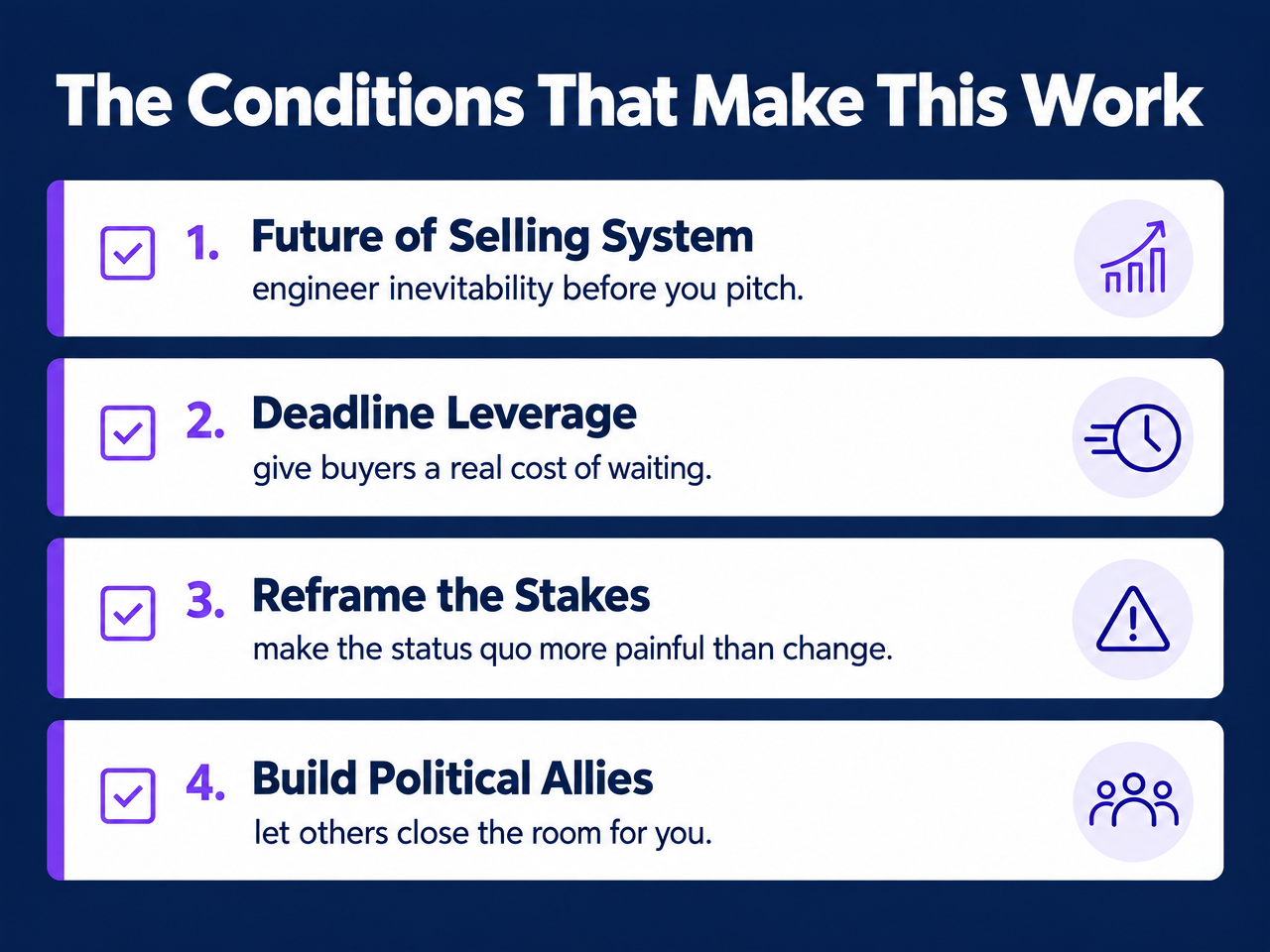
The Conditions That Make This Work
- Future of Selling System: Before you can engineer inevitability, you need a framework for understanding buyer psychology, deal structure, and the real cost of inaction. FOS gives you that — so every move you make in a deal is intentional, not reactive. Without it, you are improvising. With it, you are engineering.
- Deadline Leverage: Your deal must have a real, specific, financially visible deadline — not a manufactured one. For Ellison it was the September 30 ticking fee and the October 1 relocation trigger. For your deal it might be a pricing structure, a capacity constraint, or a market window. Build it in early. State it clearly.
- Reframe the Stakes: Ellison didn’t win by arguing his deal was good. He won by making the narrative shift from “antitrust risk” to “stronger Hollywood, more jobs, more films.” In your deals, the prospect’s objection is rarely the real objection — it is a surface expression of an underlying fear. Reframe the stakes and you dissolve the objection.
- Build Political Allies: Ellison activated Governor Newsom behind the scenes. In your deals, who is the internal champion — the person inside the buyer’s organisation who wants the deal to happen as much as you do? Find them. Equip them. Let them close the room for you.
Ellison already moved. The only question is whether you will — or whether you’ll read about someone else who did.


