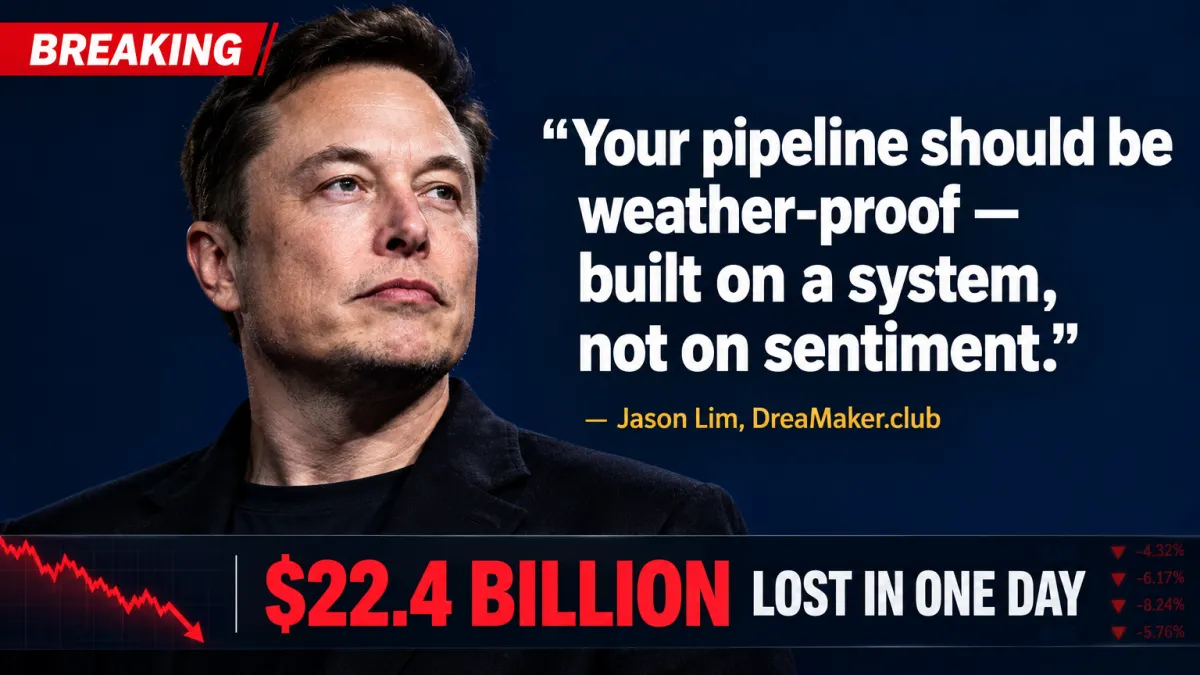
Billionaire Elon Musk Just Lost $22.4 Billion in One Day — And It Changes Everything For Founders Who Think the Market Controls Their Revenue
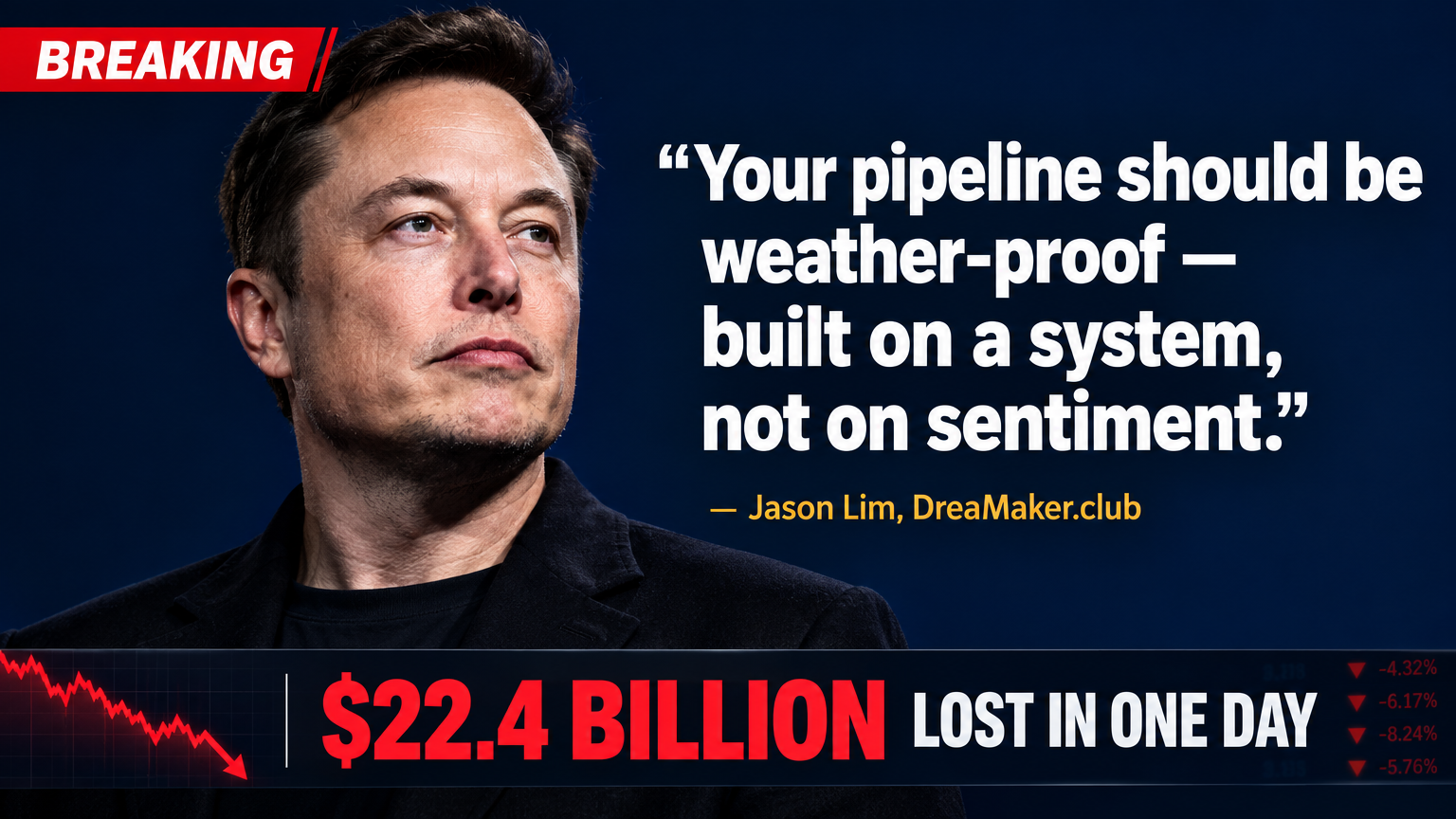
Billionaire Elon Musk Just Lost $22.4 Billion in One Day — And It Changes Everything For Founders Who Think the Market Controls Their Revenue
Elon Musk just lost $22.4 billion in a single trading session. Not over a quarter. Not over a year. One day.
According to the Bloomberg Billionaires Index (September 28, 2026), Musk's net worth dropped by $22.4 billion in one session — making it one of the largest single-day wealth losses ever recorded for any individual on the index. The trigger? A geopolitical shock wave: markets sold off sharply after news broke that the Trump administration had rejected a proposed Iran peace framework, spiking Treasury yields and hammering equity markets across the board. Forbes confirmed that 1,824 billionaires ended the day less wealthy.
Most founders read that headline and think it is a story about markets. It is not. It is a story about systems — and whether yours can survive the news cycle.
This Should Make You Uncomfortable
Here is what actually happened on September 28. The yield on the 10-year Treasury spiked. Growth stocks — including Tesla, which represents a significant portion of Musk's net worth — sold off hard. And $22.4 billion was gone before most founders had finished their morning coffee.
Now ask yourself this honestly: if the market moved against you today — if a macro event killed your three biggest inbound leads, spooked your pipeline, or triggered a budget freeze at your two hottest accounts — what would you have left?
Most founders answer that question with silence. Because most founders do not have a system. They have momentum. They have relationships. They have months where the phone rings. But when the phone stops ringing — when the market shifts, when the economy hiccups, when a war breaks out over the weekend — they discover that what they had was not a pipeline. It was luck with a good run rate.
Elon Musk lost $22.4 billion in one day. He will be fine. He has a system. The question is: do you?
What Actually Happened — And Why It Matters
Let us look at the facts. The Bloomberg Billionaires Index (September 28, 2026) tracked Musk's real-time net worth drop at $22.4 billion in a single session. The sell-off was not caused by anything Musk did or did not do. His companies reported no bad news. No product failure. No executive scandal. No lawsuit. The wealth evaporated entirely because of an exogenous geopolitical event — a policy decision made in Washington that moved bond markets, which moved equity markets, which moved Tesla's stock price.
Tesla's market capitalisation alone has swung by hundreds of billions of dollars in single sessions before. Musk's personal net worth — heavily concentrated in Tesla and the privately held SpaceX — moves in lockstep with macro sentiment. He does not control the yield curve. He does not control geopolitics. He cannot stop a sell-off. What he controls is his operating system: the businesses he built, the teams that run them, the revenue engines that fire regardless of what the Nasdaq does on any given Monday.
Billionaire Elon Musk's move is one Jason has seen across 1,000+ founders. Here's what most miss.
The Lesson Most Founders Miss
Most founders think the problem is market conditions. The real problem is that they have no system to sell through them.
When a founder loses a deal to a macro event — a customer delays because "the economy is uncertain," a CFO freezes a budget, an investor pauses commitments — most founders accept it as an act of God. They go quiet. They wait. They hope the market turns.
That waiting is not patience. It is the absence of a system.
Here is what the Bloomberg story is really telling founders: even the world's wealthiest man cannot control what the market does to his numbers in a single session. But what Musk has that most founders do not is an operating layer — a set of revenue-generating machines (Tesla deliveries, SpaceX contracts, Starlink subscriptions) that keep running regardless of what the headline says. The wealth number fluctuates. The operating system does not stop.
For a startup founder leading their own sales, the equivalent is this: your pipeline should be weather-proof. Built on a system. Not on sentiment.
Founder Story
Stanley Tan — 45 Buyers in 3 Hours
Stanley did not wait for the market to feel right. He ran a structured offer using the Future of Selling System — and closed 45 buyers in a single 3-hour session. No ads. No referrals. No market tailwind. Just a system running as designed. The economy did not cooperate. His pipeline did not care.
The root cause is not the market. The root cause is that most founders built their revenue on conditions — good vibes, warm intros, bull-market confidence, a referral that happened to land. When conditions change, the revenue stops. And they have nothing left to run.
The Hidden Opportunity in a Market Sell-Off
Here is what nobody is saying about the Musk $22.4 billion day: it is the best recruiting tool for a disciplined pipeline system you will ever see.
When markets drop, buyers get nervous. Budget approvals slow. CFOs push back. And every founder who built their sales on vibes and momentum suddenly goes quiet. That silence is your competitive window. Because the founder who has a selling system — who knows exactly what to say when a buyer stalls, who has a follow-up cadence that runs on autopilot, who can reframe a delay into a decision — that founder closes deals while everyone else waits for the market to recover.
Volatile markets do not kill deals. They reveal which founders have a system and which founders have been coasting on conditions.
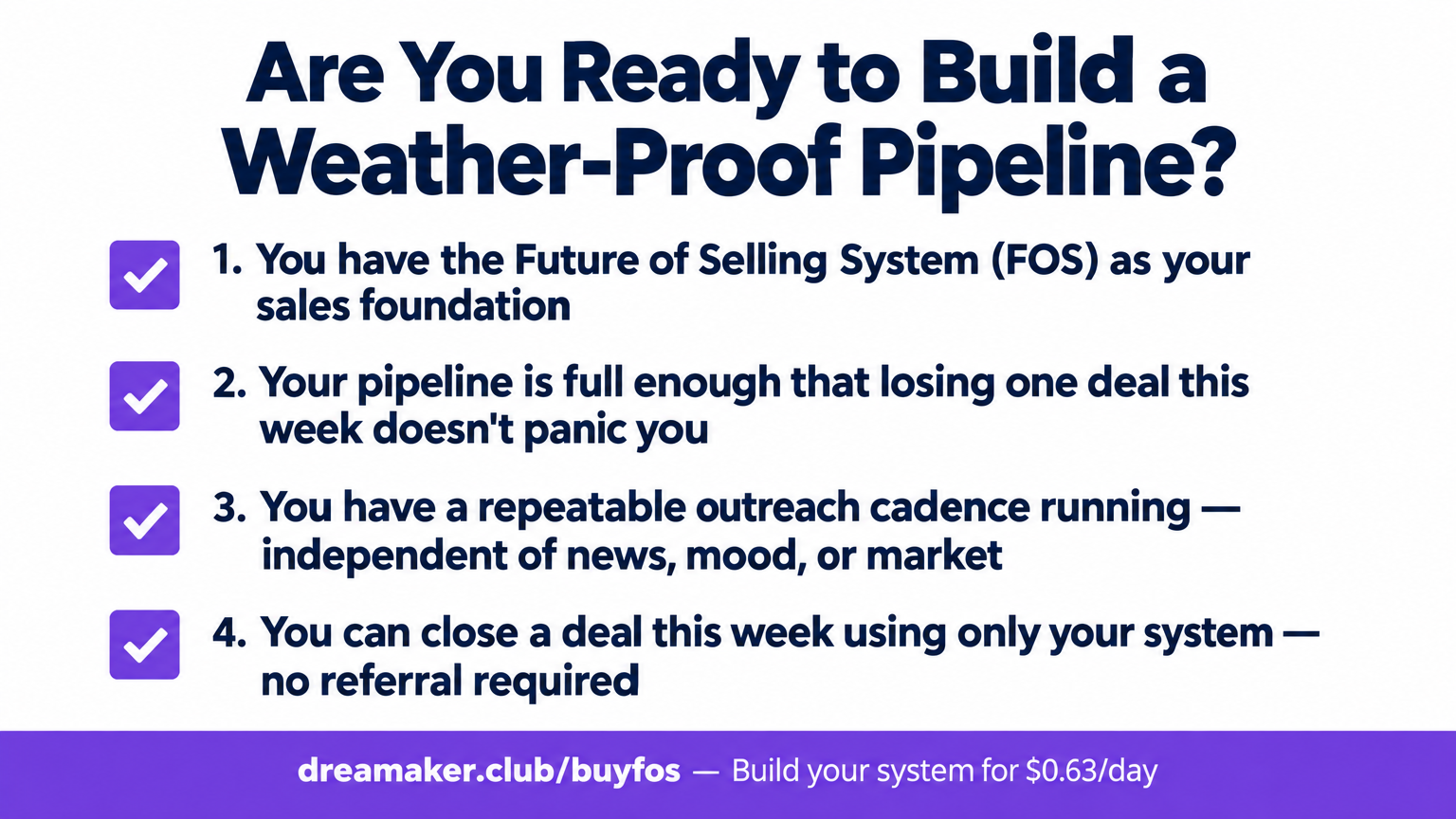
Are You Ready to Close Through the Noise?
4 Conditions That Separate System Sellers from Sentiment Sellers
Condition 1 — You have the Future of Selling System (FOS) as your sales foundation. Not gut instinct. Not referrals. Not vibes. A structured, repeatable system that runs the same way in a bull market and a sell-off. Start at $0.63/day →
Condition 2 — Your pipeline is full enough that losing one deal this week does not panic you. If one lost deal can derail your month, your pipeline is not a pipeline — it is a prayer.
Condition 3 — You have a repeatable outreach cadence running — independent of news, mood, or market. Your selling system does not pause when yields spike. It runs on Tuesday the same way it runs on a quiet Friday.
Condition 4 — You can close a deal this week using only your system — no referral, no warm intro, no lucky timing required. If you cannot, you do not have a selling system. You have a dependency.
NEW! — September 2026
Dear Founders — If your revenue rises and falls with market sentiment, you don't have a sales system. You have a weather forecast.
That is the line that separates the founders closing deals today from the ones watching the Nasdaq and waiting. And it is exactly the problem the Future of Selling System was built to solve.
I know what it feels like to have a great product and a dead pipeline. I have worked with 1,000+ startup founders since 2015 — and the ones who struggle are almost never struggling because of the market. They are struggling because they have no system to sell through it.
I felt the same way before I built the framework that has now generated $22M+ in combined sales across my graduates. What I found is that a structured selling system does not just survive bad markets — it thrives in them, because everyone else goes quiet.
Salesforce's State of Sales report found that 76% of sales reps say their biggest challenge is unpredictable pipeline — not price, not competition, not the economy. Unpredictable pipeline. That is a system problem. And system problems have system solutions.
What FOS graduates have done:
- Jeffrey Teo — 63 customers in 100 days
- Stanley Tan — 45 buyers in a single 3-hour session
- Leon — $2M partnership closed using the FOS framework
They did not wait for the market. They ran the system.
Not ready for $19? Start free.
The Objection Playbook: 25 Word-for-Word Scripts to Close More Sales
The exact words Jason's founders use when a buyer says "too expensive", "send me info" or "I need to think about it". Free PDF, sent to your inbox.
Send Me the 25 ScriptsElon Musk already moved — he built systems that kept operating while $22.4 billion evaporated. The only question is whether you will — or whether you'll read about someone else who did.


