Billionaire Elon Musk Lost $750 Billion — And Is Almost Back To $1 Trillion — And It Changes Everything For Founders Who Think One Bad Quarter Ends the Game
Billionaire Elon Musk Lost $750 Billion — And Is Almost Back To $1 Trillion — And It Changes Everything For Founders Who Think One Bad Quarter Ends the Game
Part 1 — The Hook
Elon Musk lost $750 billion in six weeks. He called himself a "former trillionaire." And now he is almost back to $1 trillion without changing his playbook once.
On June 12, 2026, SpaceX went public at $135 per share — the largest IPO in history — making Musk the world's first-ever trillionaire, per Forbes. By late July, a SpaceX stock correction had erased $750 billion of that fortune — the largest net worth loss ever recorded, according to Wikipedia. By October 2, 2026, Forbes had him back at $979.7 billion and climbing, driven by SpaceX shares up over 7% and Tesla posting 486,532 third-quarter deliveries that beat analyst expectations, per Yahoo Finance.
That is $750 billion lost. And almost entirely recovered. In less than three months. Without Musk launching a single new company, hiring a new sales team, or changing his pitch. The question every founder should be asking is not how did he bounce back? The question is: what was running while he was down?
Part 2 — The Stakes
Think about what $750 billion lost actually feels like. That is not a bad quarter. That is not a missed target. That is the single largest personal wealth destruction in the history of money — in six weeks — while the entire world watched and counted him out.
Now imagine you lost a big client. A deal fell through. Your best salesperson quit. Your pipeline dried up for a month. How long does your revenue keep running?
For most founders leading their own sales, the answer is: it doesn't. Revenue stops the moment momentum stops. Every new dollar requires a new push. Every week starts at zero.
That is not a resilience problem. It is a systems problem. And the difference between Musk at $684 billion (Bloomberg's August 1 trough, per companieshistory.com) and Musk at nearly $1 trillion today is not hustle. It is what kept compounding underneath the crisis.
Part 3 — The Facts
Here is what was running while the world wrote the obituary:
- Starlink had 10.3 million active customers across 160 countries as of March 2026, per bleap.finance — paying monthly, automatically, without Musk on a single call.
- Tesla delivered 486,532 vehicles in Q3 2026, beating analyst expectations — per Yahoo Finance, October 2, 2026.
- SpaceX completed several successful launches within 24 hours on October 2 alone, pushing shares up over 7% that day — per Yahoo Finance.
- xAI (now embedded inside SpaceX after a February 2026 acquisition valued at $250 billion, per bleap.finance) continued generating AI revenue across the combined company.
- X (formerly Twitter) hit $1 billion in annualised subscription revenue by February 2026, per bleap.finance — compounding inside the SpaceX entity.
Musk did not hustle his way from $684 billion back to the cusp of $1 trillion. Seven companies — each with its own revenue system, customer base, and compounding mechanism — kept moving the number while his name was trending for all the wrong reasons.
Billionaire Elon Musk's recovery is one Jason has studied across 1,000+ founders. Here is what most miss.
Part 4 — The Lesson & Root Cause Reframe
Beat 1 — Root Cause Reframe
Most founders think the problem is that they are not resilient enough. They see Musk bounce back from $750 billion in losses and think: I need to be tougher, grind harder, stay positive.
But the real problem is not resilience. The real problem is that your revenue is entirely dependent on your personal energy in any given week. When you are up, deals close. When you are down — when a pitch bombs, a deal falls apart, a key client churns — the pipeline freezes because you are the pipeline.
Musk could lose $750 billion and not change his sales behaviour because he does not have a sales behaviour. He has a sales system. Starlink bills 10.3 million customers monthly without a single sales call. Tesla has a delivery machine that outputs 486,000 units a quarter without Musk on the showroom floor. SpaceX launches without him reciting a pitch deck.
The founders who recover fast are not the toughest. They are the ones whose selling system kept running while they were down.
Beat 2 — The Lesson
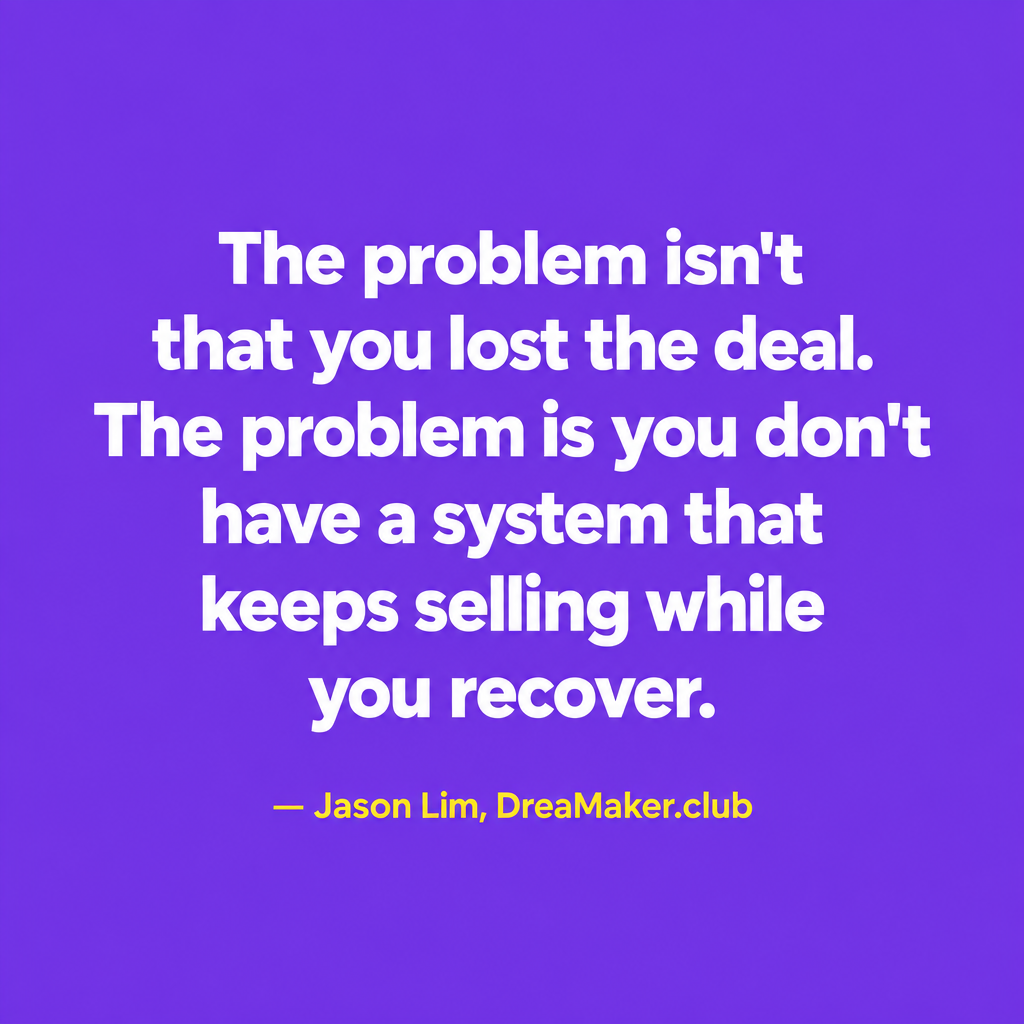
The quotable truth: "The problem isn't that you lost the deal. The problem is you don't have a system that keeps selling while you recover."
Founder Story Card
Stanley Tan — 45 Buyers in 3 Hours
Stanley Tan was doing everything manually — chasing leads one by one, following up by gut feel, starting every week from scratch. When he installed the Future of Selling System, he stopped selling and started running a system. The result? 45 buyers committed in a single 3-hour window. Not because he got tougher. Because his system kept compounding while he focused on delivery.
The gap between the founder who recovers in 90 days and the one who never recovers is not mindset. It is infrastructure. One has a selling system that compounded during the bad weeks. The other has a sales habit that only works when they feel good.
Part 5 — The Hidden Opportunity
Beat 1 — The Opportunity Most Founders Miss
Every founder watching Musk's comeback is looking at the wrong number. They are watching $750 billion lost and $1 trillion incoming. What they should be watching is the 3-month gap between those two numbers — and what kept moving inside it.
The hidden opportunity right now, in Q4 2026, is not that the economy is recovering or that buyers have loosened their budgets. The opportunity is this: most of your competitors are founder-dependent. Their pipeline stalls when their founder is distracted, discouraged, or overwhelmed. If your selling system keeps running through the hard weeks, you do not just survive the dip — you gain ground while they freeze.
Q4 is when founders who have a system pull away from founders who are still winging it. The window is right now.
Beat 2 — Are You Ready to Build Back?
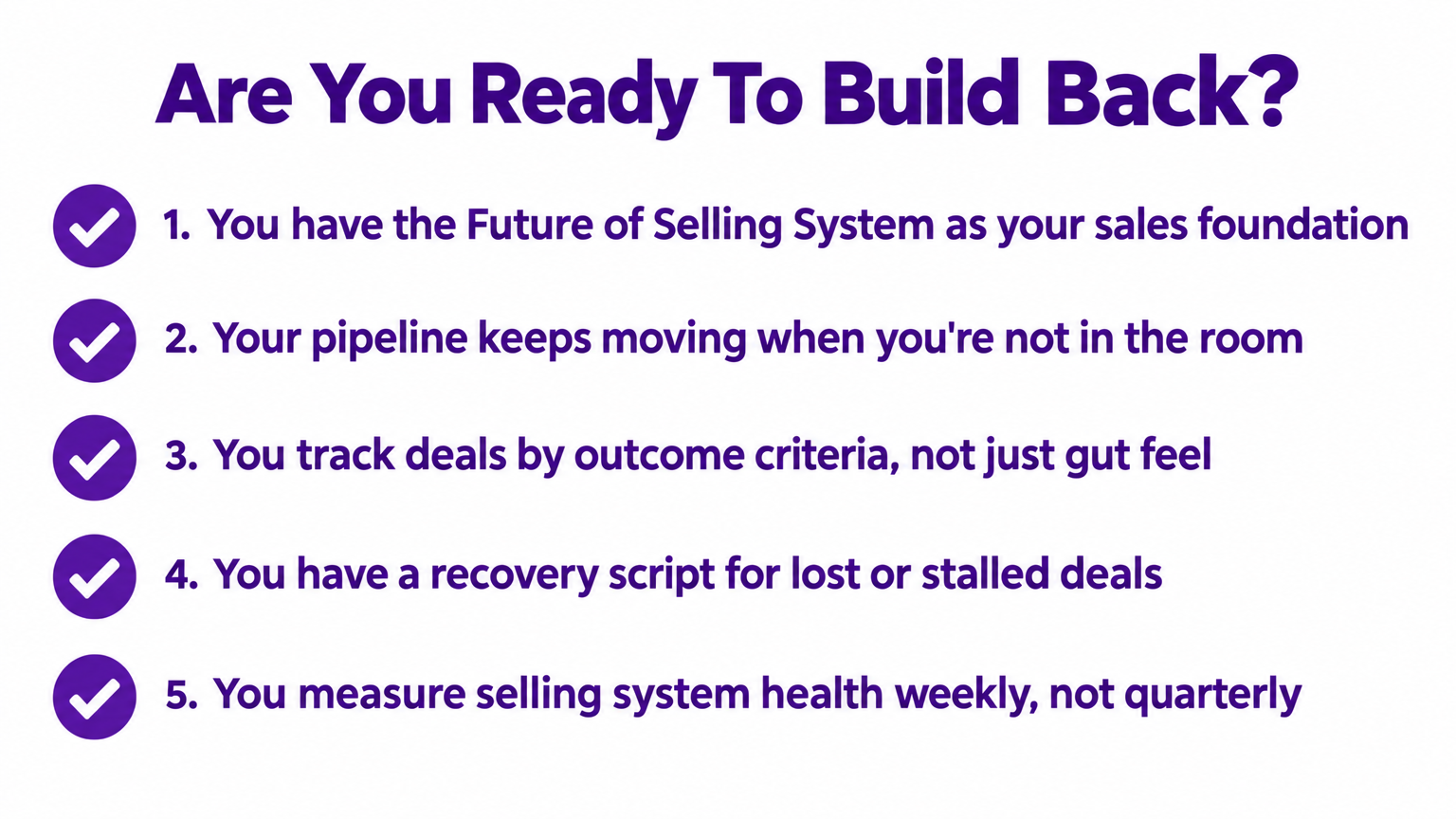
Are You Ready To Build Back? Check These Conditions First.
- Condition 1: You have the Future of Selling System as your sales foundation — so your pipeline keeps moving whether you are at your best or not.
- Condition 2: Your pipeline keeps moving when you are not in the room — deals progress, follow-ups fire, and buyers stay warm without daily manual effort from you.
- Condition 3: You track deals by outcome criteria, not just gut feel — you know exactly what condition a deal must meet before you advance, hold, or cut it.
- Condition 4: You have a recovery script for lost or stalled deals — a repeatable sequence you run every time momentum drops, not a new improvised approach each time.
- Condition 5: You measure selling system health weekly, not quarterly — you catch pipeline decay in days, not months.
If you can check all five, your Q4 compounds. If you cannot, your Q4 is another sprint that resets to zero on January 1.
NEW! | October 2026
Dear Founders — Your Revenue Shouldn't Stop Every Time You Do
If your revenue stops the moment you hit a rough patch, you don't have a business — you have a job with extra stress. Musk just proved the point at $750 billion scale. The founders in Jason's community who build back the fastest aren't tougher — they have a system that keeps selling while they recover.
Get The Future of Selling System — $19/month ($0.63/day) →I know how you feel. You've been told to push harder, follow up more, and grind through it. Every founder Jason has coached felt exactly that — burned out by a sales approach that only works when they're at 100%.
What they found — across 1,000+ founders since 2015 — is that the fix isn't more effort. It's a system. Jeffrey Teo got 63 customers in 100 days. Leon closed a $2M partnership. Stanley Tan committed 45 buyers in 3 hours. None of them got tougher. They got a system.
Salesforce's State of Sales report confirms that 76% of sales reps say their biggest challenge is engaging prospects with relevant insights at the right time — which is exactly what a selling system solves automatically.
The Future of Selling System (FOS) is built specifically for startup founders leading teams of 5+, selling in the US market. $22M+ in combined sales by graduates. Results in 90 days or less.
Start Building Your System Today →Not ready for $19? Start free.
The Objection Playbook: 25 Word-for-Word Scripts to Close More Sales
The exact words Jason's founders use when a buyer says "too expensive", "send me info" or "I need to think about it". Free PDF, sent to your inbox.
Send Me the 25 ScriptsElon Musk already moved. The only question is whether you will — or whether you'll read about someone else who did.


