
Billionaire Elon Musk Just Lost $32 Billion in a Single Day — And It Changes Everything For Startup Founders
Billionaire Elon Musk Just Lost $32 Billion in a Single Day — And It Changes Everything For Startup Founders

Part 1 — Hook
Elon Musk just shed $32.1 billion in a single trading session — and walked away still the richest person on earth. On September 23, 2026, global markets sold off sharply on oil price surges and renewed inflation fears, carving more than thirty-two billion dollars from his net worth in hours. Most founders saw a headline about a billionaire having a bad day. The founders who pay attention saw something far more important: a live masterclass in what happens when your financial floor is built on a system, not on sentiment.
Part 2 — Press
Here is what should actually unsettle you about this story — and it has nothing to do with Musk.
Think about the last time your pipeline dried up for a week. Or the last time a deal fell through and you felt the ground shift beneath you. Or the last time a macro event — a rate move, a competitor's announcement, a bad news cycle — froze your buyers in place and your revenue along with them.
Now imagine losing thirty-two billion dollars in one session and still being able to operate, invest, build, and lead without missing a beat. That is not luck. That is not net worth. That is the result of a system so deeply embedded that no single event — no matter how large — can break the underlying structure.
Most founders do not have that. They have a sales process that works when everything is working. The moment conditions shift, the pipeline stops, the confidence cracks, and the business stalls. This story is a mirror. And the reflection is uncomfortable.
Part 3 — Play
On September 23, 2026, the Bloomberg Billionaires Index recorded a single-day loss of $32.1 billion for Musk — one of the largest single-session wealth declines in the index's history, according to Bloomberg's real-time reporting published at 11:02 PM UTC that evening. The selloff was driven by a broad market retreat as oil prices spiked and inflation data reignited fears of prolonged high interest rates.
Despite the loss, Musk's net worth stood at approximately $927 billion at market close, per Bloomberg's Billionaires Index. Year-to-date, he remains up more than $307 billion in 2026. He held his position as the world's wealthiest individual — a rank he has held without interruption throughout the turbulence.
The businesses generating his wealth — spanning electric vehicles, private space exploration, artificial intelligence, and social infrastructure — continued operating without visible disruption. No emergency statements. No pivots. No visible panic. A $32 billion single-day loss produced the same observable output as any other Wednesday.
Billionaire Elon Musk's move is one Jason has seen across 1,000+ founders. Here's what most miss.
Part 4 — Lesson + Root Cause Reframe
Root Cause Reframe
Most founders think the problem is volatility. But the real problem is that their revenue depends on conditions staying calm.
When conditions are calm, deals close. When conditions shift — when buyers get cautious, when markets move, when competitors make noise, when a macro event eats a news cycle — founders without a system watch their pipeline seize up. They mistake the external event for the cause. The real cause is structural: they built a sales process for fair weather, not for the full range of conditions business actually operates in.
Musk did not become immune to market forces. He became immune to needing the market to be cooperative in order to keep building. That is the distinction most founders miss entirely.
The Lesson
"The market punishes your net worth. It cannot touch your next move."
The quote above is not about wealth. It is about architecture. Musk's ability to absorb a $32 billion loss without behavioural disruption is a product of the same discipline that every founder at scale has learned, usually the hard way: the system has to work regardless of conditions, or it does not really work at all.
This applies directly to startup sales. If your pipeline only fills when you are confident, only converts when buyers are relaxed, and only closes when timing is perfect — you do not have a sales system. You have a good-weather routine. The moment conditions change, it stops. And in business, conditions always change.
The founders who survive volatility are not the ones with the best product. They are the ones who built a process so well-calibrated that a bad week, a lost deal, or a market shock does not change what they do next. Their next move is already determined by the system, not by their emotional state in the moment.
Founder Story Card
The visible problem: A founder's revenue flatlines every time there's a macro shock, a competitor move, or a slow buyer market. They assume the problem is timing.
The real root cause: Their sales process was built around ideal conditions — warm leads, receptive buyers, calm markets. It has no mechanism for maintaining output when conditions shift.
The founder lesson: Resilience in business is not an attitude. It is a system. If your next move requires conditions to cooperate, you are one bad week away from stalling.
The move to make now: Audit your sales process for weather-dependency. Identify the steps that only work when buyers are already warm and conditions are already calm — then rebuild those steps so they work regardless.
Part 5 — Opportunity + Conditions
The Hidden Opportunity
Here is what most founders will do with this story: nothing. They will read the headline, feel a momentary mix of awe and irrelevance, and move on. That is the opportunity — for you.
Every time a macro event shakes the market, buyers get cautious. Cautious buyers do not stop buying. They stop buying from founders they are not certain about. They consolidate spend toward the people and companies they already trust. The founders with a system for building that trust quickly — consistently, regardless of market noise — are the ones who close during the quarters when everyone else is waiting for conditions to improve.
A $32 billion single-day loss did not stop Musk's organisations from running. A nervous buyer market does not have to stop your pipeline — if your sales system was built to operate in exactly those conditions. This is not the moment to wait. It is the moment to build the structure that keeps you moving when everyone around you has frozen.
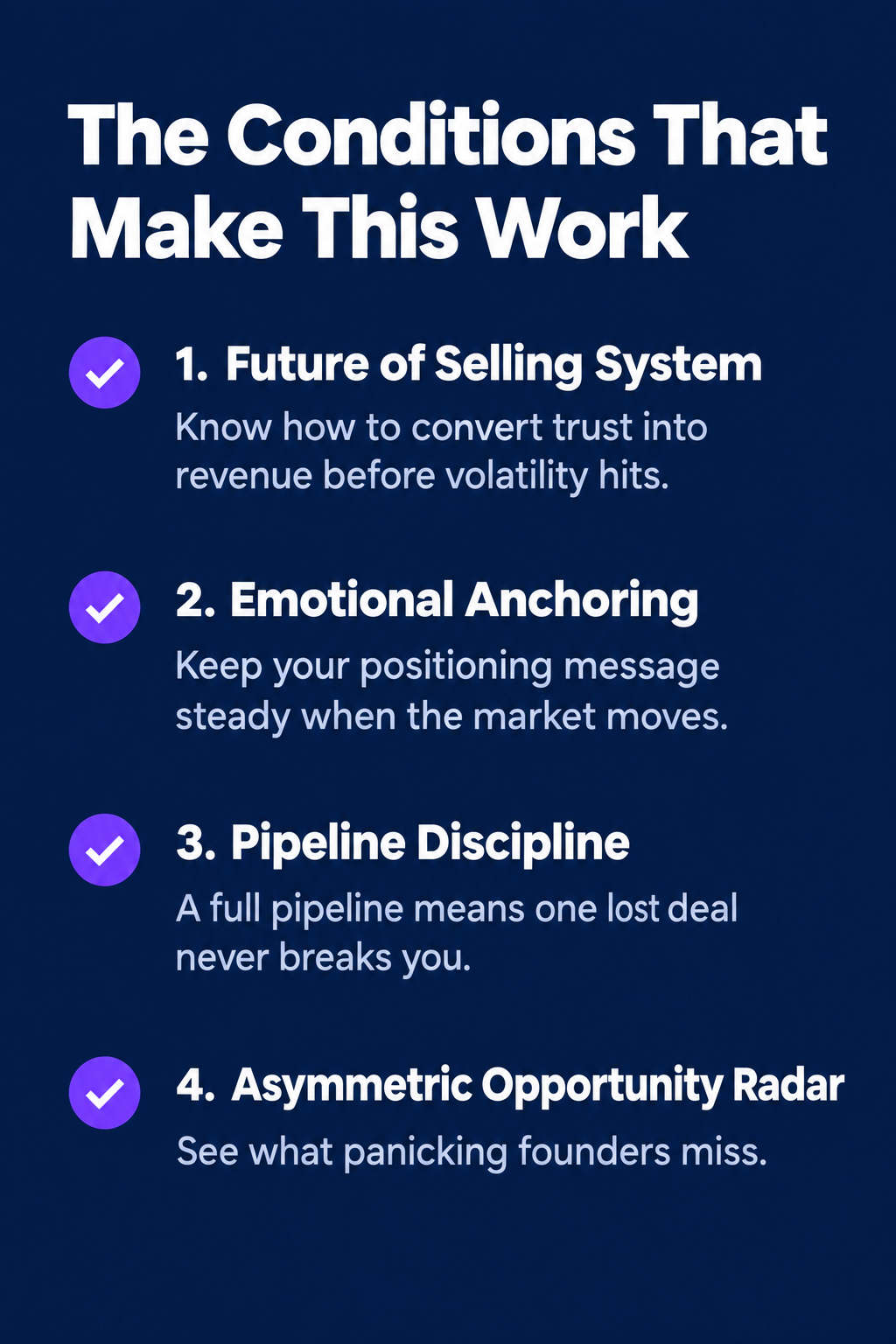
The Conditions That Make This Work
- Future of Selling System: You need a sales framework built to generate trust, clarity, and conversion regardless of market conditions — not one that relies on buyers already being warm and ready. FOS gives founders exactly that operating layer.
- Emotional Anchoring: Your positioning message has to stay steady when the market moves. Founders who change their pitch every time buyers get cautious signal uncertainty — and uncertain founders lose to certain ones every time.
- Pipeline Discipline: A consistently full pipeline means no single lost deal can break your momentum. Build the pipeline before you need it, not after the quarter turns bad.
- Asymmetric Opportunity Radar: Train yourself to spot what cautious markets create — buyers consolidating, competitors going quiet, niches opening. The founders who move during the freeze are the ones who come out the other side with market share.
Part 6 — Native Ad
Part 7 — Sting
Musk already moved. The only question is whether you will — or whether you'll read about someone else who did.


