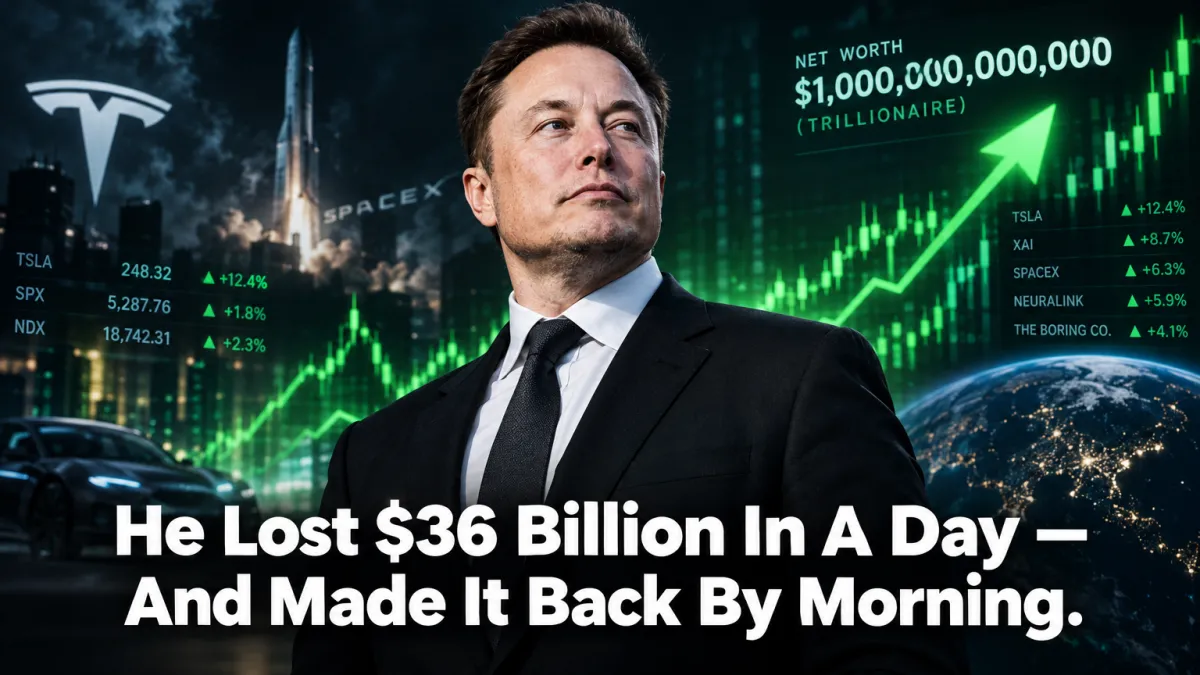
Billionaire Elon Musk Lost $36 Billion In A Day — And Made It Back By Morning. Here's What Startup Founders Are Missing
Billionaire Elon Musk Lost $36 Billion In A Day — And Made It Back By Morning. Here's What Startup Founders Are Missing
By Jason Lim | DreaMaker.club | October 12, 2026
Part 1 — Hook
Elon Musk lost $36 billion in a single day this week — then made it back the next morning.
He did it five times in five days. On October 5, Forbes confirmed he crossed $1 trillion again. By October 9, he had shed $36 billion as SpaceX and Tesla shares fell. By Friday morning he had recovered $22 billion before lunch and was back above $1 trillion (Forbes, October 9, 2026).
Every headline called it volatility. Every anchor called it risk. Every founder reading it thought: that must be terrifying.
It was not. And the reason why is the single most important lesson in sales and business you will read this month.
Part 2 — Press
Think about the last time you lost a deal.
Not a $36 billion deal. Just a deal. The one you spent three weeks on. The one you thought was ready to close. The buyer ghosted, or said we are pausing, or picked someone cheaper.
How did it feel? Did the whole month collapse? Did your team slow down? Did you start wondering if your pricing was wrong, your pitch was broken, your market was soft?
Now compare that to a man who lost $36 billion before dinner — and woke up the next day to get it back.
The difference is not personality. It is not resilience. It is not that Elon Musk does not care. It is something structural. Something most founders are not building — and will not build until a losing streak forces them to.
One lost deal should not be able to destroy your month. If it can, that is the real problem.
Part 3 — Play
Here is what actually happened, as reported by Forbes (October 5 and October 9, 2026), Bloomberg Billionaires Index (October 10, 2026), and Wikipedia (updated October 11, 2026):
- June 12, 2026: SpaceX completed the largest IPO in history at $135 per share, reaching a valuation near $1.77 trillion (Bloomberg, June 2026). Musk's approximately 38% stake made him the world's first trillionaire.
- Late July 2026: A SpaceX stock correction reduced his net worth by $750 billion — the largest single net worth decline in recorded history (Wikipedia, updated October 11, 2026).
- October 5, 2026: Musk crossed $1 trillion again as SpaceX and Tesla rallied. Forbes reported his net worth up $30.6 billion in a single day.
- October 9, 2026: He lost $36 billion and dropped below $1 trillion as SpaceX and Tesla shares fell. By Friday morning he had recovered $22 billion and crossed back above $1 trillion (Forbes, October 9, 2026).
- As of October 9, 2026: Net worth approximately $1.11 trillion — nearly three times richer than Jeff Bezos at $378.2 billion (Forbes, October 9, 2026).
As Forbes noted, daily stock movement can cause Musk to lose or gain tens of billions in a single session. The market moved. He did not blink — because no single move can destroy a system that large.
Billionaire Elon Musk's five-day trillion-dollar yo-yo is one of the clearest demonstrations Jason has seen across 1,000+ founders of what happens when you build at scale — versus when you are still hunting one buyer at a time. Here is what most miss.
Part 4 — Lesson + Root Cause Reframe
Beat 1: Root Cause Reframe
Most founders think the problem is that the market is unpredictable. Bad timing. Uncertain economy. Buyers who take forever to decide. Competitors who undercut on price.
But the real problem is that they have no pipeline underneath.
Musk lost $36 billion and made it back — not because he has nerves of steel, but because he has fifty active conversations happening simultaneously at scale. SpaceX has government contracts. Starlink has subscriptions. Tesla has quarterly deliveries. xAI has enterprise licences. When one asset swings down, others are still running. The system is never dependent on any one outcome.
Now look at most founders with teams of five to twenty people. They have one or two active proposals. They are talking to three buyers. When one goes cold, the whole pipeline freezes. They call it a slow month. Jason calls it a structural failure — one baked in long before the deal fell apart.
Beat 2: The Lesson
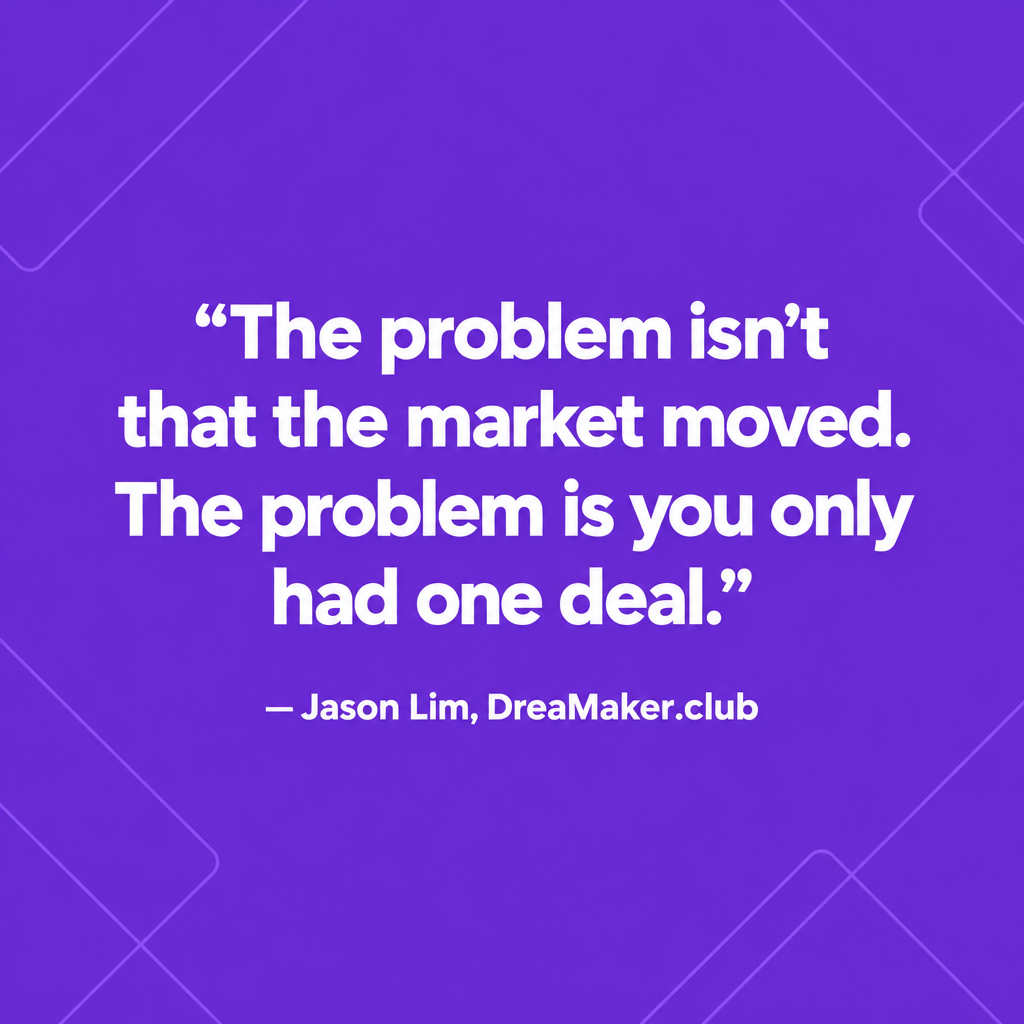
The problem is not that the market moved. The problem is you only had one deal.
The trillion-dollar lesson from Musk this week is not about SpaceX or stock markets. It is about the foundational principle of every durable revenue system: no single outcome should have the power to determine your month.
Founder Story Card
The founder who stopped holding his breath on every deal
Stanley Tan was selling high-value training contracts. Every proposal felt like life or death — one yes meant a great month, one no meant a terrible one. After going through the Future of Selling System, he stopped chasing individual deals and started building a repeatable pipeline process. Within 90 days he had 45 buyers commit at a single session. Not because he became a better talker. Because he finally had a system running underneath him.
Part 5 — Opportunity + Conditions
Beat 1: The Hidden Opportunity
Here is what almost nobody is extracting from Musk's trillion-dollar yo-yo: the real moat is not his wealth. It is his repeatability.
Most founders watch the number go up and think they need more money. The actual opportunity is to study the structure — how does he keep recovering? Because every time the market corrects, a different part of his portfolio is already moving in the opposite direction. That is not luck. That is architecture.
For a startup founder with a team of five to thirty people, the equivalent is a pipeline with ten or more active, qualified conversations at any given time — running through a system, not through your memory and manual follow-ups. When one buyer goes cold, nine others are still warm. When one deal slips a quarter, three others are moving to close. You stop reacting. You start operating.
The window between hunting and having a system is exactly where founders are most at risk right now. Q4 2026 pipeline decisions made this week will determine January 2027 revenue. This is the moment.
Beat 2: Conditions Checklist
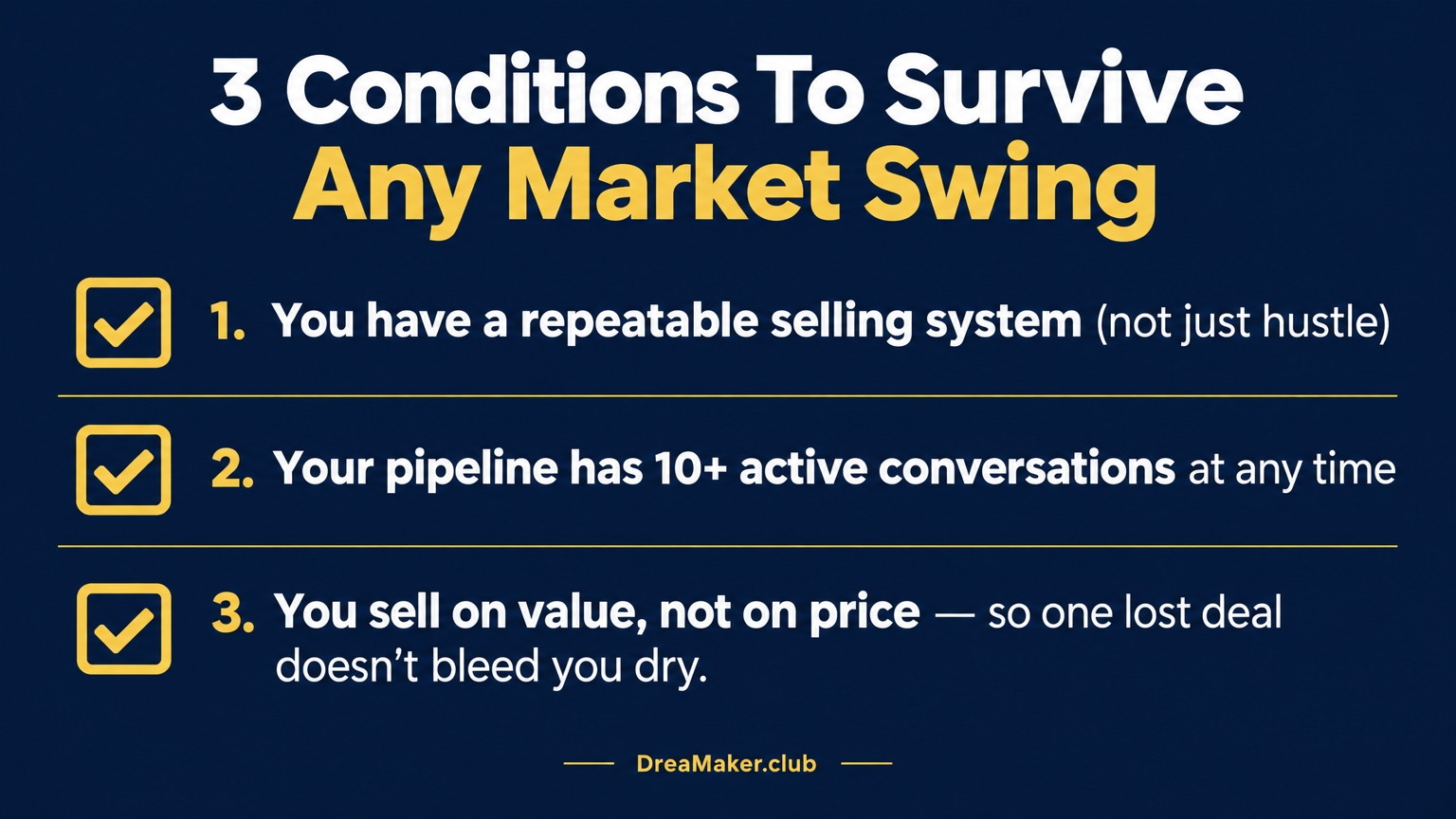
3 Conditions To Stop Bleeding When A Deal Falls Through
Condition 1: You are running the Future of Selling System
FOS is the repeatable sales framework that gives your team a consistent process for generating, qualifying, and closing pipeline — so no single deal outcome can decide your month. Without it, everything else on this list is just theory.
Condition 2: You have 10+ active conversations in your pipeline at all times
Not leads. Not email subscribers. Active conversations with qualified buyers who have a real problem your product solves and the authority to say yes. Ten conversations means one cold deal barely moves the needle.
Condition 3: You sell on specific value, not on price or product features
When a buyer says too expensive or we will think about it, they are telling you they do not yet see the value clearly enough to justify the investment. Founders who sell on outcomes close at higher rates and lose fewer deals to inertia.
Part 6 — From the Desk of Jason Lim
NEW!
October 2026
Dear Founders,
Your deal just fell through. And you do not have another one ready.
That single sentence describes 80% of the founder conversations I have in Q4 every year. A hot deal that went cold. A proposal that stalled. A buyer who disappeared. And behind it: silence. No pipeline. No system. Just the memory of the last conversation and the hope that another one will come along.
I know how that feels. I have seen it 1,000 times — and lived a version of it myself before I built the system.
I felt like I was the only one who could not get the pipeline right. What I found — and what every graduate of the Future of Selling System finds — is that it is just a process. A specific, teachable, repeatable process that removes the guesswork and replaces it with a system that runs whether you are having a great week or a terrible one.
According to Salesforce State of Sales, 76% of sales reps say that selling is harder than it was five years ago. The founders who beat that statistic are not more talented. They are more systematic.
Since 2015, the Future of Selling System has helped 1,000+ founders build repeatable pipeline that survives a bad week, a lost deal, and a down market. Combined, FOS graduates have closed $22M+ in new sales. Jeffrey Teo landed 63 customers in 100 days. Stanley Tan brought 45 buyers to close in a single session. Leon secured a $2M partnership.
For $19/month — $0.63/day — you get the entire system. Every framework. Every script. Every session. No more hoping the next deal comes through. No more losing a month every time a buyer ghosts.
Get the Future of Selling System — $19/monthCancel anytime. No contracts. Start today.
Not ready for $19? Start free.
The Objection Playbook: 25 Word-for-Word Scripts to Close More Sales
The exact words Jason's founders use when a buyer says too expensive, send me info or I need to think about it. Free PDF, sent to your inbox.
Send Me the 25 ScriptsElon Musk already moved. The only question is whether you will — or whether you will read about someone else who did.


