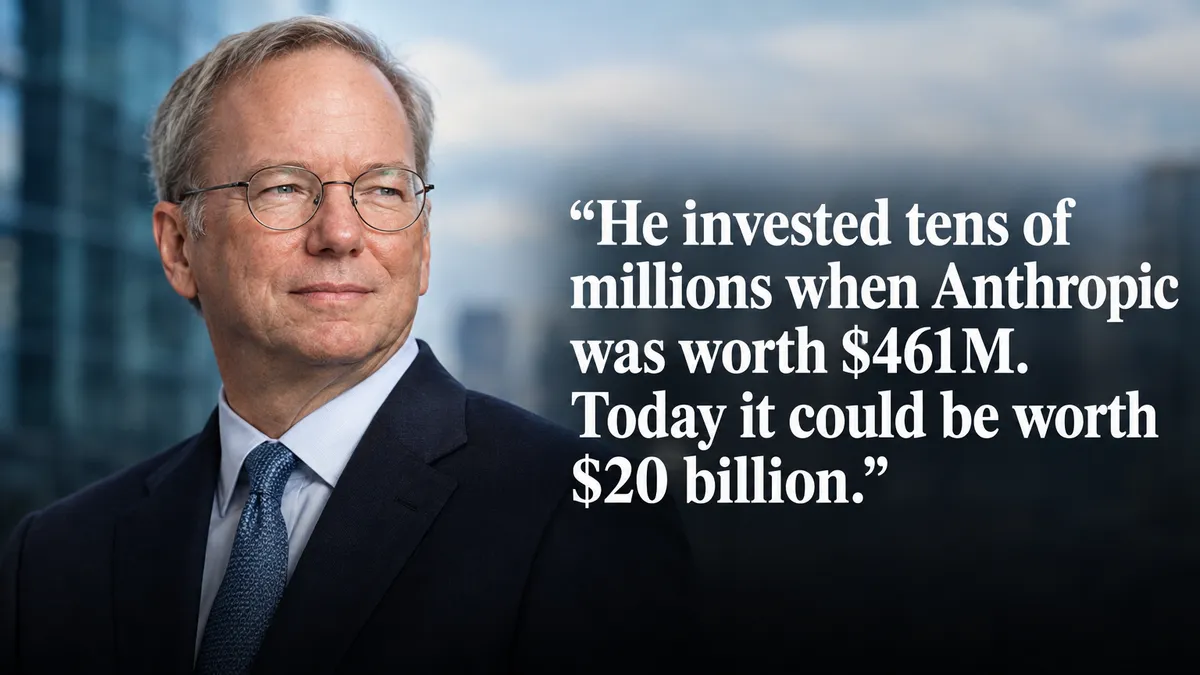
Billionaire Eric Schmidt Just Turned A Quiet 2021 Bet Into $20 Billion — And It Changes Everything For Founders Still Waiting Until They're Ready
Part 1 — The Move Everyone Missed
Eric Schmidt bet tens of millions on a $461M AI startup in 2021 — and barely anyone noticed. Now that startup, Anthropic, is heading into an IPO at a valuation between $1.8 trillion and $2 trillion, and Schmidt's quiet 1% stake could be worth up to $20 billion. That's not luck. That's conviction at the moment everyone else was still asking questions. And most founders — the ones reading this right now — are making the exact same mistake Schmidt avoided.
Part 2 — Why This Hits Different
Think about where you were in 2021. ChatGPT didn't exist yet. Most people hadn't heard of large language models. The AI wave that would reshape every industry was still invisible to almost everyone. And that's exactly when Schmidt moved — not when it was obvious, not when it was safe, not after the press covered it.
Now ask yourself: How many times in the last two years have you waited for the right moment to build your sales system? To hire the right person? To commit to a process before you knew it would definitely work? If you're honest, the answer is: too many times. And the window — just like Anthropic's Series A window — doesn't come back.
The founders who will dominate the next three years are not the ones who move when it's proven. They're the ones who move before it is. Right now. When it still feels early.
Part 3 — What Actually Happened
On October 19, 2026, Bloomberg reported that former Google CEO Eric Schmidt owns approximately 1% of Anthropic PBC, the AI company behind the Claude models. According to Bloomberg, Schmidt invested tens of millions of dollars in Anthropic's Series A fundraising round. PitchBook data cited by Bloomberg indicates Anthropic was valued at just $461 million at that time — in 2021.
Fast forward to October 2026: prospective investors now suggest a public valuation of between $1.8 trillion and $2 trillion, Bloomberg reports. By straightforward arithmetic, 1% of $2 trillion is $20 billion. Even at Anthropic's most recent private valuation of $965 billion, the stake adds nearly $10 billion to Schmidt's existing $57.5 billion fortune. Bloomberg notes the position would expand his net worth by approximately one-third, to nearly $80 billion, at the upper end of the range.
The IPO timeline is concrete: Anthropic plans to formally begin marketing its public offering as early as the week of November 9, 2026, with trading expected before year-end, Bloomberg reported. Anthropic's Q3 2026 revenue hit $16.8 billion — up 45% quarter-over-quarter — and the company was profitable on an adjusted basis (Crypto Briefing, October 2026).
Schmidt has since expanded his AI bets. Bloomberg notes his investment vehicles have backed Mistral AI, Reflection AI, and World Labs alongside Anthropic — a portfolio built on a pattern, not a one-off gamble.
Billionaire Eric Schmidt's move is one Jason has seen at his events, which since 2016 have reached 100,000+ founders across Asia. Here's what most miss.
Part 4 — The Lesson Most Founders Will Never Extract
Beat 1 — Root Cause Reframe
Most founders think the problem is that they need more certainty before they commit. They're waiting for the market to prove itself, for the pipeline to be stronger, for the team to be bigger, for the product to be perfect before they invest in a real selling system.
But the real problem is that the window doesn't announce itself. Schmidt didn't invest in Anthropic because the timing was obvious. He invested because he had a framework for reading conviction-worthy signals before the crowd did — and he had the infrastructure to act on that conviction immediately. He didn't need the market to validate him first. He moved, and the market followed.
Founders who are still manually closing every deal, still winging every follow-up, still depending on their own charisma and memory to keep a pipeline alive — they are structurally incapable of moving fast when the window opens. Because before you can capitalize on a window, you need a system running behind you. Schmidt had one. Do you?
Beat 2 — The Lesson
The window to get ahead is always open before everyone else sees it — and always closed by the time they do.
Here's what most founders miss about the Schmidt story: this wasn't a lucky bet. Schmidt had built a pattern-recognition engine from decades of operating inside the biggest technology transitions in history. He led Google through the search advertising revolution. He watched the mobile revolution reshape entire industries. By 2021, when Dario Amodei and crew spun out of OpenAI to found Anthropic, Schmidt had seen enough pivotal moments to know — this was one of them.
And he didn't deliberate for months. He committed tens of millions — fast.
The lesson for founders is not "invest in AI." The lesson is that conviction without a system to execute on it is just a dream. Schmidt's framework — his ability to spot the window — was built over decades of being inside major transitions and making structured bets. Your selling framework is exactly the same. You need to build it before the moment arrives, not scramble to assemble it when the deal is already in the room.
Founder Story Card
"Jeffrey Teo came to Jason with a pipeline problem. He wasn't waiting for certainty — he was waiting for a system. Once he had one, he signed 63 customers in 100 days."
That's not charisma. That's what a selling framework looks like when it's actually running. Jeffrey didn't get lucky. He got structured.
Part 5 — The Hidden Opportunity (And Whether You're In Position To Take It)
Beat 1 — The Hidden Opportunity
The Anthropic IPO isn't just a capital markets event. It's the signal that the AI era is now public, permanent, and priced in — which means every B2B buyer who has been cautiously observing AI is now being forced to decide. Your prospects who have been saying "we're still evaluating" are about to feel the heat of the market making that decision for them.
That creates a 60–90 day window — right now, through Q1 2027 — where founders with a clear, repeatable sales motion can run ahead of the noise. The buyers will be in motion. They'll be spending. The only question is whether your name comes up when they do — or your competitor's does.
Schmidt moved at the moment most people were still asking questions. The founders who move in the next 60–90 days will look just as prescient in three years.
Beat 2 — Are You In Position?
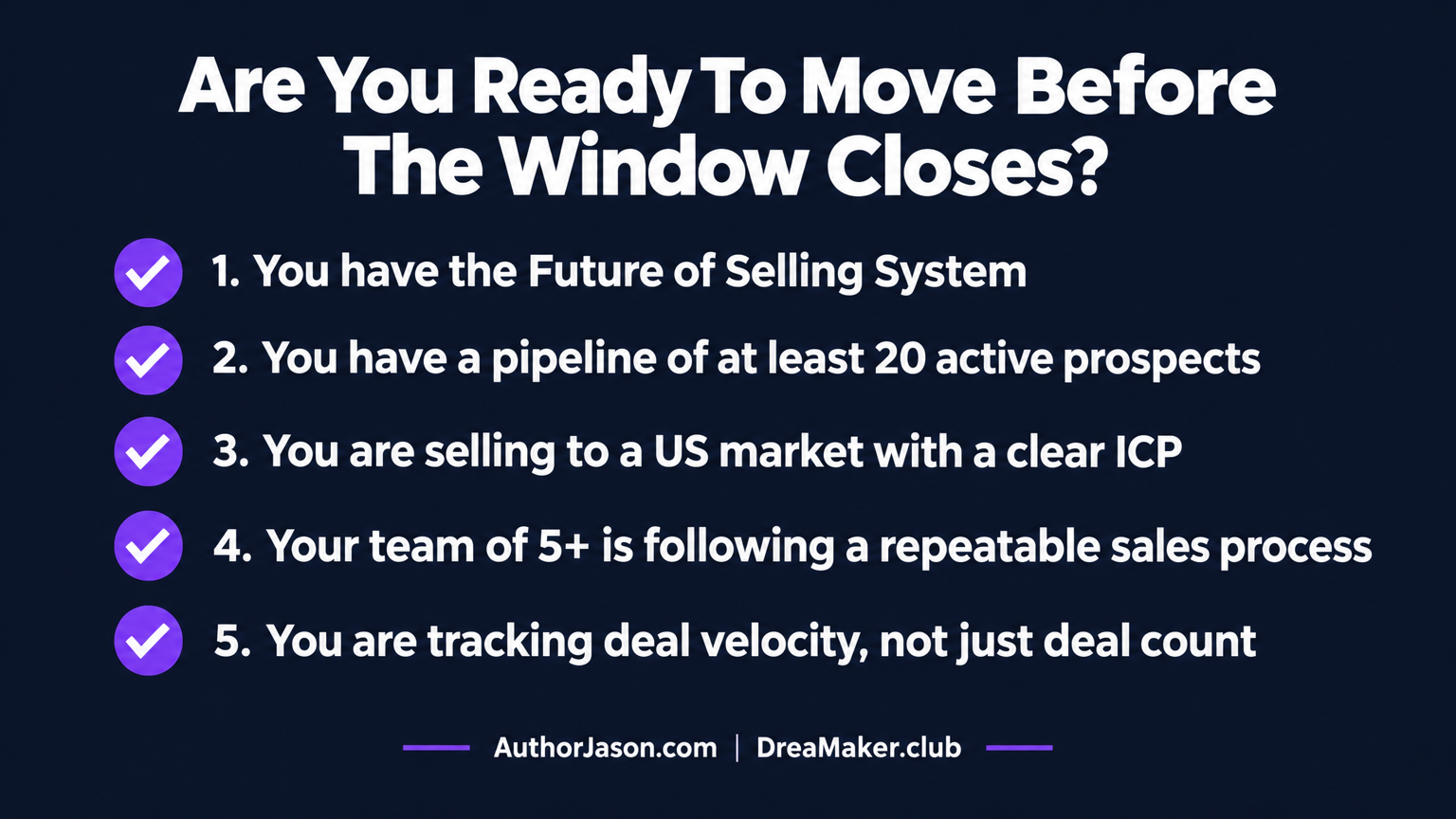
Are You Ready To Move Before The Window Closes?
If you checked fewer than 3 of those, the window Schmidt exploited in 2021 is exactly the kind of window you are not positioned to take — even if you can see it opening right in front of you.
NEW! ▶ October 2026
Dear Founders,
If your sales pipeline depends entirely on you showing up every day — you're one bad quarter away from zero. And the window won't wait.
I know how that feels. I've talked to thousands of founders across Asia who had great products, real buyers — and no system to convert them consistently. They felt like they were always one breakthrough away. The problem wasn't effort. It was architecture.
What I found — and what changed everything for the founders in my programmes — is the Future of Selling System (FOS). It's the same framework that helped Jeffrey Teo sign 63 customers in 100 days, helped Leon close a $2M partnership, and helped Stanley Tan pitch to 203 people with 90 showing up live.
According to Salesforce's State of Sales report, 76% of sales reps say they spend too little time actually selling — because they have no system. FOS fixes that. For startup founders leading their own sales, with a team of 5+, targeting the US market — this is the infrastructure you need before the next window opens.
Jason's events have reached 100,000+ founders across Asia since 2016. His graduates have collectively generated $22M+ in combined sales. And FOS is how they did it.
(Salesforce, State of Sales, 2025 — 76% of sales reps report insufficient time selling due to lack of process.)
Not ready for $19? Start free.
The Objection Playbook: 25 Word-for-Word Scripts to Close More Sales
The exact words Jason's founders use when a buyer says "too expensive", "send me info" or "I need to think about it". Free PDF, sent to your inbox.
Eric Schmidt already moved. The only question is whether you will — or whether you'll read about someone else who did.


