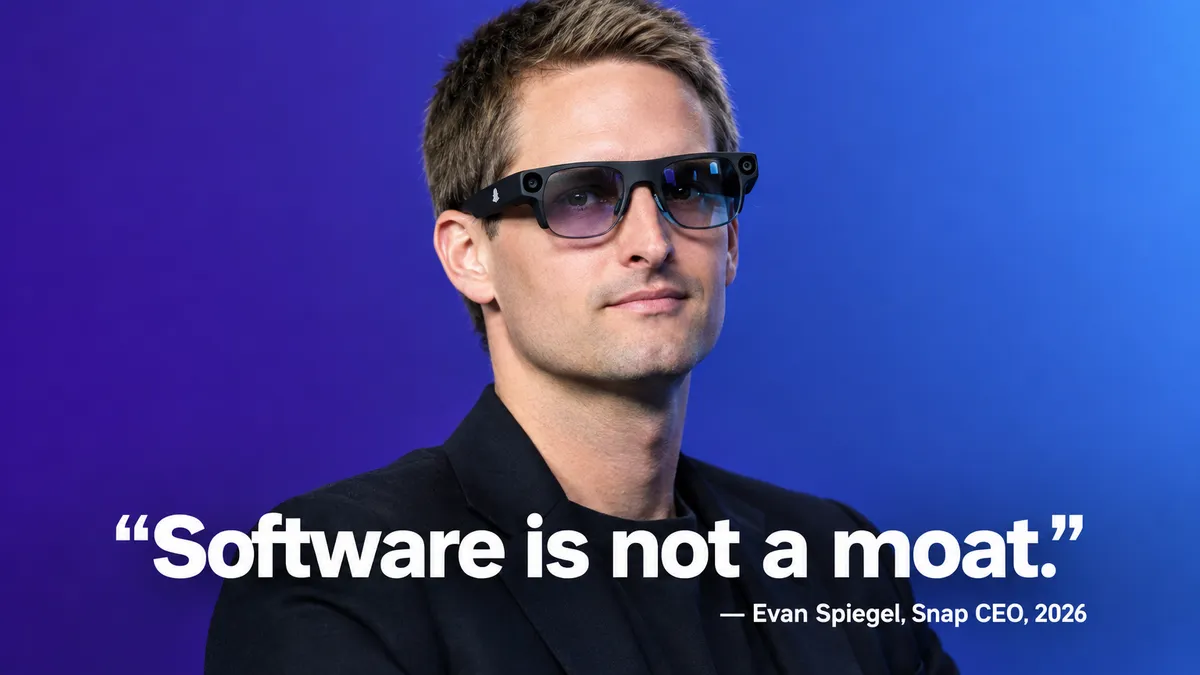
Billionaire Evan Spiegel Spent $3 Billion Building The Best AR Glasses On Earth — And Lost 69% Of The Market To A $500 Pair Of Ray-Bans
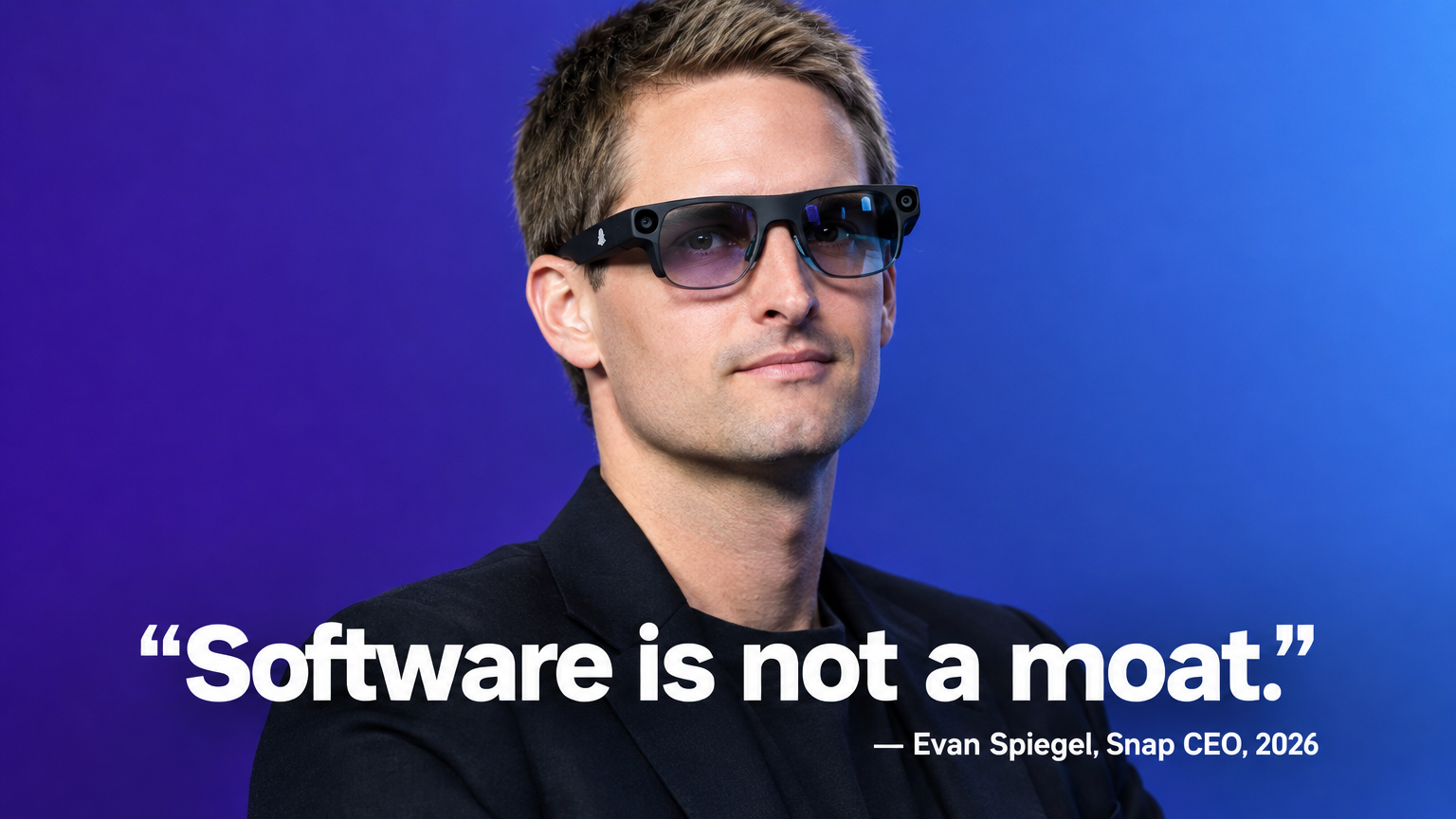
Evan Spiegel just launched the most advanced AR glasses ever sold to consumers — and he's already losing badly. Snap's new Specs hit shelves on September 16, 2026 at $2,195. Reviewers called them technically brilliant. And yet Meta's $500 Ray-Bans, widely regarded as the inferior product, hold 69.2% of the entire smart glasses market. Spiegel didn't hide from this. He said it himself in a podcast that almost nobody clipped: "Software is not a moat." He was right. And if you're a startup founder who keeps losing deals to a competitor you know is worse than you — this story is yours.
Here is what stings. You've built something genuinely better. Your product works. Your results are real. You can prove it on a whiteboard, in a demo, in a side-by-side comparison. And still — your pipeline is thin, your close rate is soft, and buyers who openly admitted yours was the better solution somehow ended up signing with someone else.
You've probably told yourself it's pricing. Or the economy. Or that the buyer just didn't "get it." Evan Spiegel told himself the same thing for eleven years and $3 billion. He was wrong then. And if you're still believing the product will eventually do the selling for you — you're wrong now too. The gap between the best product and the most sales has never been wider. And it has a name.
Snap launched its first generation of Spectacles in 2016. Since then, according to technology.org (January 2026), the company has spent approximately $3 billion over 11 years developing AR wearable technology. The September 2026 Specs are the result: true waveguide AR displays, real-time object recognition, live translation, and hands-free AI interaction — all packed into a glasses form factor. CNBC and Engadget reviewers called them "a genuine leap" over any consumer AR product currently on the market.
Meanwhile, Meta's Ray-Ban smart glasses — no AR display, no waveguide, no object recognition — sold over 7 million units. Sales tripled in 2025 alone (TechXplore, 2025). IDC's Q1 2026 data puts Meta at 69.2% of the global smart glasses market. The reason is not technology. It is EssilorLuxottica: the world's largest eyewear retail network, which manufactures and distributes Ray-Ban through tens of thousands of opticians, retailers, and department stores globally. Meta didn't win on product. Meta won on pipeline.
Spiegel acknowledged this directly. In a May 2026 interview on Lenny's Podcast (cited by Benzinga), he said: "Software is not a moat" — and added that distribution has become the defining competitive variable in hardware. Billionaire Evan Spiegel's move is one Jason has seen across 1,000+ founders. Here's what most miss.
The Lesson Most Founders Refuse To Hear
Most founders think the problem is the product. If it just worked a little better. If the demo was a little sharper. If the case study was a little more compelling. They keep investing in what they build, because building is what they know.
But the real problem is the selling system. Or rather — the absence of one. Spiegel didn't lose 69% of his market because Meta built a better product. He lost because Meta built a better pipeline. Specifically: a structured distribution partnership that put their product in front of buyers repeatedly, in trusted environments, with a consistent message, at scale. That is not a marketing strategy. That is a selling system.
Here is the quotable truth that most founders need tattooed on their wall:
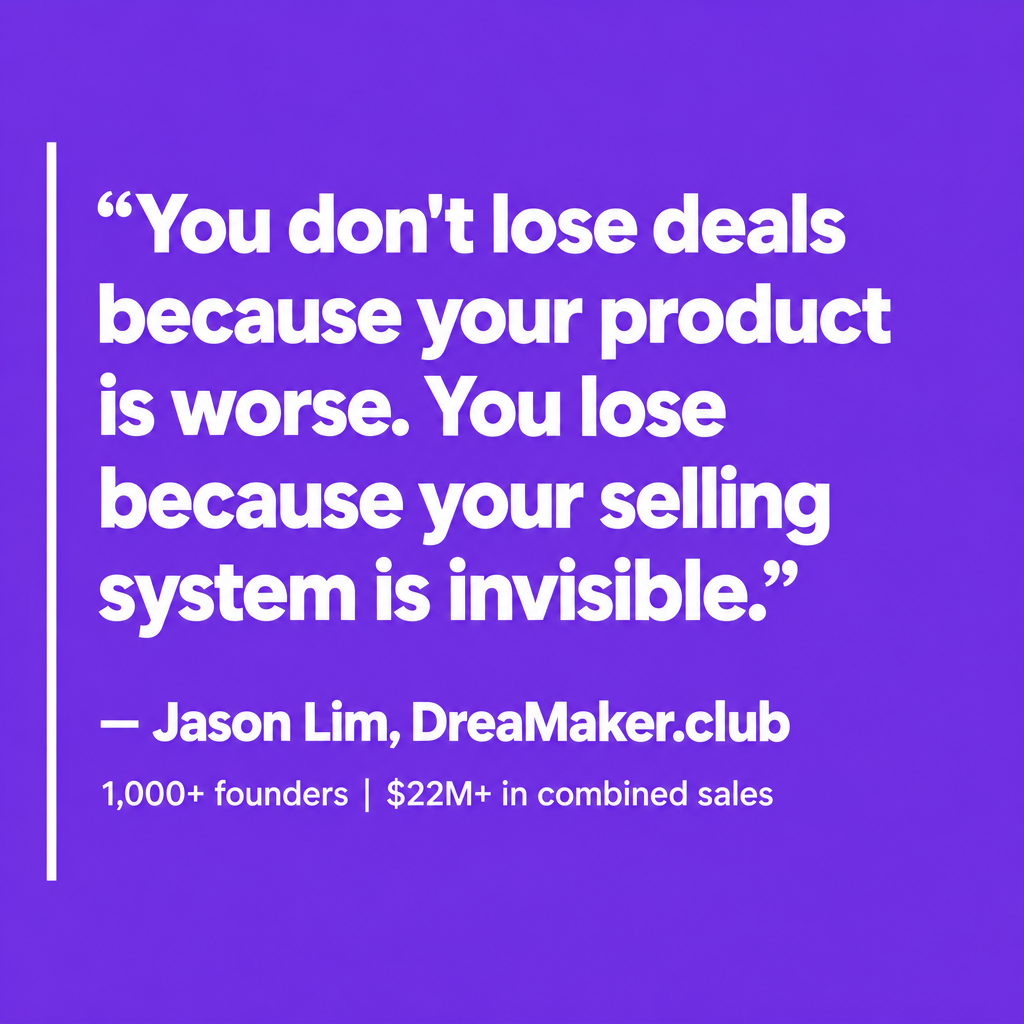
Think about what this means in practice. Your buyer's attention is finite. They are being reached — repeatedly, consistently, through trusted channels — by competitors who may not be as good as you. You are waiting for your product to create its own gravity. It will not. Products do not sell themselves. Systems do.
Snap is not a startup with five employees hoping word-of-mouth carries the load. It is a publicly traded company with a $2 billion-a-year engineering budget. And even at that scale, Spiegel admits the product is not enough. If a $3 billion R&D investment cannot substitute for distribution — what makes you think your next feature will?
Founder Story
Stanley Tan: 45 Buyers in 3 Hours
Stanley didn't have a better product than his competitors. He had a better system. Using the Future of Selling System, he structured a single event that produced 45 qualified buyers in under 3 hours. His competitors had bigger budgets and bigger teams. Stanley had a repeatable process. The system won — not the product.
Spiegel's confession — "Software is not a moat" — is not a tech industry observation. It is a sales truth. The moat is the process by which buyers find you, trust you, and choose you — repeatedly, predictably, at scale. Without that, even a $3 billion product floats in a vacuum.
The Hidden Opportunity — And Whether It's Yours
Here is what almost every analyst missed: Snap's loss is not a hardware story. It is a window — open right now — for any startup founder competing in a category where the market leader is winning on distribution, not product quality.
Buyers in feature-rich, high-consideration categories — SaaS, professional services, B2B hardware, consulting — are not automatically choosing the best product. They are choosing the product that reached them most consistently, through the most credible channels, with the clearest message. If your selling system is absent or inconsistent, your superior product is invisible. And invisible products do not close.
The opportunity is this: your competitor has a distribution advantage that has nothing to do with being better than you. The moment you install a structured selling system — one that reaches buyers repeatedly, builds trust systematically, and creates urgency without pressure — you do not just compete. You flip the dynamic. You become the one buyers find first, trust most, and choose by default.
But this window only stays open if you move before the market normalises. Snap had eleven years. They waited. Meta moved. Check these conditions before the same thing happens to your category.
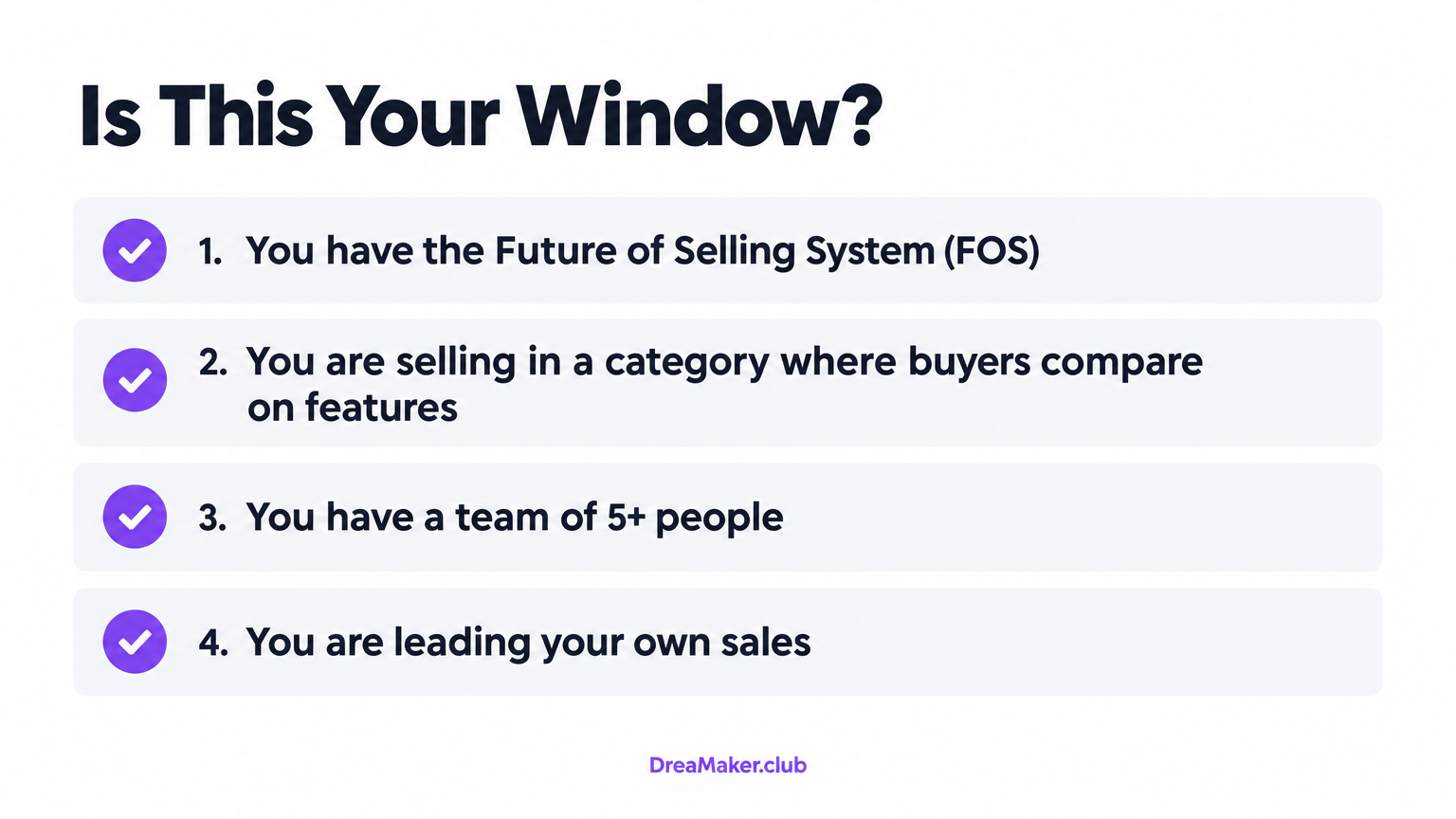
Is This Your Window? — 4 Conditions
- ✓ Condition 1: You have the Future of Selling System (FOS). A structured, repeatable system for finding, trusting, and closing buyers — without relying on product superiority alone. This is the non-negotiable foundation. Without it, the other three conditions don't matter. Get FOS at dreamaker.club/buyfos →
- ✓ Condition 2: You are selling in a category where buyers compare on features. If your buyers are evaluating solutions side-by-side and still choosing your competitor — the differentiator is not the product. It is the selling process. This is your largest open leverage point.
- ✓ Condition 3: You have a team of 5 or more people. A selling system only multiplies when there are people to run it. If you are still the sole closer in your company, this is the single highest-leverage hire and system investment you can make right now.
- ✓ Condition 4: You are leading your own sales. If you are the founder who is still in the room — or still should be — you are the one who needs this system most. Not your salesperson. Not your marketing team. You. Because the system starts with the person the buyer most wants to hear from.
NEW! → October 2026
Dear Founders — Your product is not the problem. Your selling system is.
You're losing deals to a competitor you know is inferior — not because they're better, but because they have a system you don't. That is fixable. Right now. For $0.63 a day.
I know how you feel. You've felt that gut punch of watching a worse competitor win deals that were supposed to be yours. What Jason's 1,000+ founders have found is this: the product was never the issue. The system was missing.
According to the Salesforce State of Sales report, 76% of sales professionals say buyers expect a personalised, systematic engagement — yet most founders have no repeatable process at all. That gap is where deals die. The Future of Selling System (FOS) closes that gap.
FOS results from Jason's founders:
- $22M+ in combined sales by graduates since 2015
- Jeffrey Teo: 63 customers in 100 days
- Stanley Tan: 45 buyers in 3 hours
- Leon: $2M partnership closed
Not ready for $19? Start free.
The Objection Playbook: 25 Word-for-Word Scripts to Close More Sales
The exact words Jason's founders use when a buyer says "too expensive", "send me info" or "I need to think about it". Free PDF, sent to your inbox.
Send Me the 25 ScriptsBillionaire Evan Spiegel already moved — he admitted the product wasn't enough. The only question is whether you will, or whether you'll read about someone else who did.


