
Billionaire Gautam Adani Just Bet $100 Billion On The Layer Every Startup Founder Ignores — And It Changes Everything For Founders Who Are Still Selling Products Instead of Infrastructure

Breaking News · October 15, 2026
Billionaire Gautam Adani Just Bet $100 Billion On The Layer Every Startup Founder Ignores — And It Changes Everything For Founders Who Are Still Selling Products Instead of Infrastructure
Adani just signed a 50:50 AI hardware JV with Jabil. Now every founder needs to ask: are you selling a product, or owning a layer?
On October 14, 2026, Gautam Adani's conglomerate signed a landmark 50:50 joint venture with Jabil — one of the world's largest electronics manufacturing companies — to produce AI servers, racks, and data center hardware inside India. The next day, speaking at the Bloomberg New Economy Forum, Adani doubled down: the $100 billion AI infrastructure commitment is not a press release. It is a position.
Most founders read this as a geopolitics story. They are missing the most expensive lesson in business strategy.
Why This Hits Different For Founders
Think about your last three sales calls. You probably talked about features. Maybe ROI. Maybe a case study. You were selling a product.
Adani is not selling products. He is building the layer that every AI-driven business in India — and beyond — cannot function without. When your buyer needs your infrastructure to run their operation, you do not negotiate price. You set terms.
The painful truth: most startup founders are fighting for market share at the product layer — the most competitive, most commoditised, most margin-compressed layer in every industry. Meanwhile, the billionaires are quietly buying the floor beneath it. And when a founder finally realises the difference, they have usually already built the wrong thing for five years.
The Facts
What Actually Happened — And Why The Numbers Matter
On October 14, 2026, Adani Group and Jabil announced a 50:50 joint venture to manufacture AI servers, GPU racks, and data center infrastructure hardware inside India. The JV is designed to serve domestic demand — India's AI compute market is projected to grow explosively over the next decade — and positions Adani as the foundational hardware layer for any enterprise, government, or hyperscaler building AI capacity in the region (Bloomberg, October 14, 2026).
The JV is part of a broader $100 billion AI infrastructure commitment spanning data centers, renewable energy supply (critical for powering compute at scale), and manufacturing. Speaking at the Bloomberg New Economy Forum on October 15, 2026, Adani emphasised affordable, reliable energy as the non-negotiable precondition for AI at scale — a position that reveals a second-order infrastructure play most commentators missed entirely.
As of October 15, 2026, Adani's net worth sits at approximately $112.7 billion (Bloomberg Billionaires Index), making him India's richest person. His group spans ports, airports, energy, logistics, media, and now AI hardware — each a foundational layer in a different industry vertical.
Adani's move is one Jason has seen across 1,000+ founders. Here's what most miss.
The Lesson
Most Founders Think The Problem Is Their Product. The Real Problem Is Their Layer.
Root Cause Reframe: Most founders think the problem is that their product isn't good enough, their pitch isn't sharp enough, or their pricing isn't right. So they iterate the product, refine the deck, and discount the deal.
But the real problem is that they are selling at the wrong layer.
Products exist at a layer where comparison is easy, switching is cheap, and buyers have leverage. Infrastructure exists at a layer where comparison is hard, switching is expensive, and the seller has leverage. Adani does not compete on features. He owns the floor.
Every startup has a version of this choice. It is not about becoming a conglomerate. It is about repositioning what you sell — from a feature set that buyers can compare, to an operating condition that buyers cannot remove.
Founder Story Card
Leon: From $0 to a $2M Partnership — By Repositioning From Product to Infrastructure
Leon came into Jason's Future of Selling System selling a SaaS tool at the product layer. Every call was a negotiation. Every deal took 90 days. Buyers were comparing him to three other vendors every time.
Jason helped him reframe. Not the product — the position. Leon stopped selling the tool and started selling the operating infrastructure his buyers needed to run their teams. Same technology. Different layer. Different conversation.
The result: a $2M partnership — not a software subscription. Because when you own the layer, you do not quote a price. You propose a partnership.
The Opportunity
The Hidden Opportunity: Every Startup Already Has An Infrastructure Layer — Most Just Can't See It
Adani's $100 billion play looks like a billionaire's move. It is not. It is a positioning move — and it is available to every founder at every revenue stage.
Every product you sell sits on top of a buyer problem that is bigger than the product. The CRM tool sits on top of a revenue operations problem. The HR platform sits on top of a talent retention problem. The logistics software sits on top of a supply chain fragility problem. The question is not what your product does. The question is: what would your buyer's operation look like without you — and can you make that cost of removal feel catastrophic to them?
That is the infrastructure layer. And the window to claim it in your market is open right now — because most of your competitors are still fighting at the product layer.
5 Conditions To Own The Infrastructure Layer In Your Market
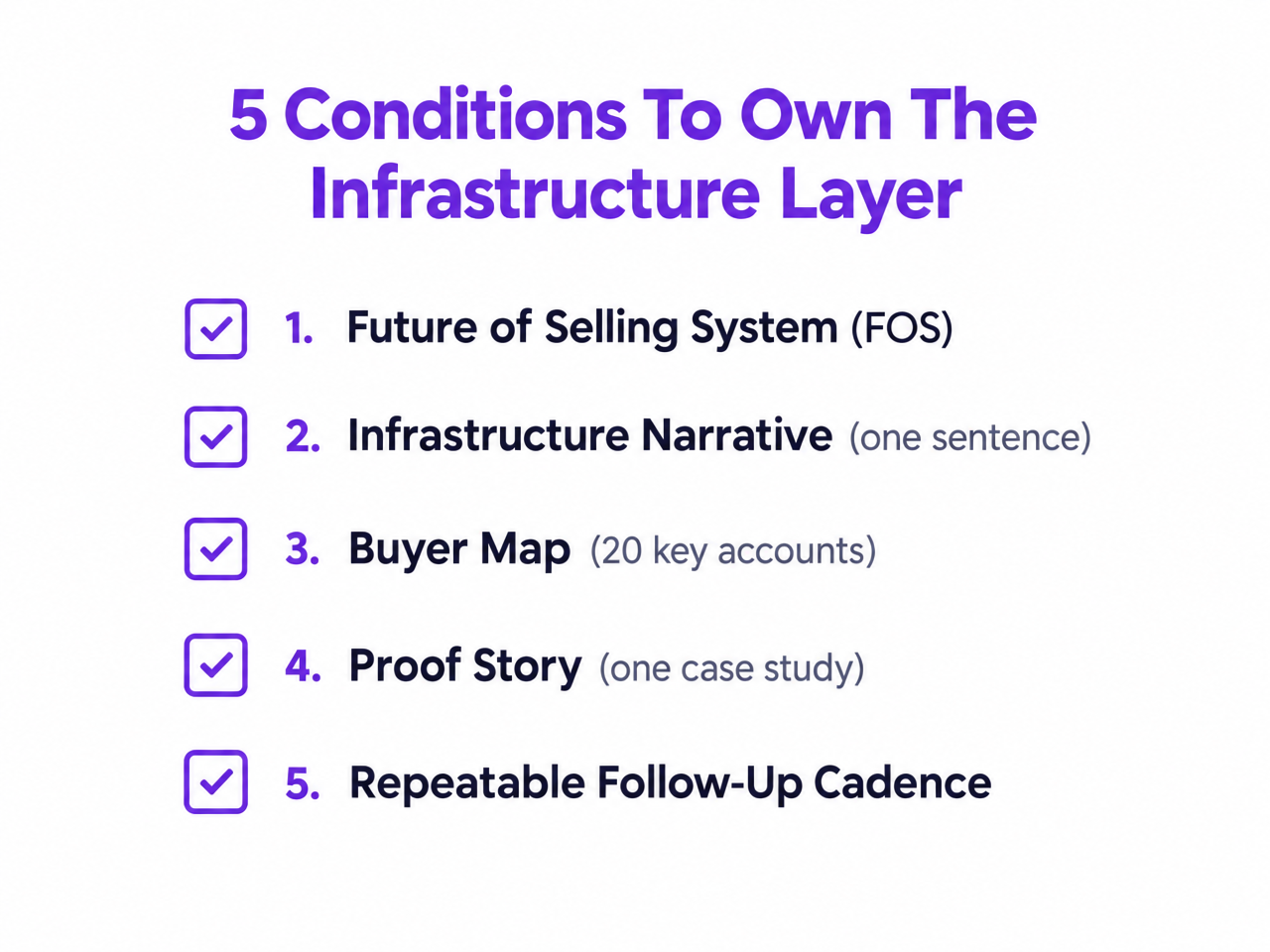
Future of Selling System (FOS)
You need a structured selling system before you can claim any layer. Without FOS, you are not owning infrastructure — you are improvising around it. This is the non-negotiable starting point.
Infrastructure Narrative (One Sentence)
You need a single, clear sentence that repositions what you sell from a product to a condition: "Without [your solution], [buyer's team/operation] cannot [critical outcome]." If you cannot write that sentence, you are still at the product layer.
Buyer Map (20 Key Accounts)
Infrastructure is not sold to everyone — it is deployed into the accounts where removal would be catastrophic. Map your 20 highest-leverage buyer accounts and sell depth, not breadth.
Proof Story (One Case Study)
You need one documented story of a buyer whose operation improved measurably after embedding your solution. Not a testimonial. A before/after operational narrative. This is the proof that converts infrastructure positioning from a claim into a fact.
Repeatable Follow-Up Cadence
Infrastructure deals take longer to close because the stakes are higher. You need a follow-up system that keeps you present without feeling pushy — one that builds trust across a longer buying cycle without requiring you to be personally available 24/7.
NEW!
October 2026
Dear Founders...
If you have been sitting at the product layer — competing on features, losing deals to cheaper alternatives, and watching your margins shrink — the problem is not your product. The problem is your layer. And until you have a selling system that repositions you from vendor to infrastructure, every sales call is a negotiation you are losing before it starts.
I know how it feels to have a great product and still lose deals you should win. I've felt it. Most of the 1,000+ founders I have worked with since 2015 felt it too. What we found is that the moment you move from selling what your product does to selling what your buyer cannot operate without — everything changes. Deals close faster. Margins hold. Buyers come back.
According to the Salesforce State of Sales report, 76% of sales professionals say that selling has fundamentally changed — and the top performers are those with a structured system, not more hustle. Buyers are more informed, more cautious, and faster to compare. The only way to break out of comparison mode is to claim the layer beneath the comparison.
The Future of Selling System (FOS) is built for startup founders with a team of 5+ who are leading their own sales in the US market. It has produced:
- $22M+ in combined sales across FOS graduates
- Jeffrey Teo: 63 customers in 100 days
- Stanley Tan: 45 buyers closed in 3 hours
- Leon: $2M partnership from a repositioned infrastructure narrative
Not ready for $19? Start free.
The Objection Playbook: 25 Word-for-Word Scripts to Close More Sales
The exact words Jason's founders use when a buyer says "too expensive", "send me info" or "I need to think about it". Free PDF, sent to your inbox.
Send Me the 25 ScriptsBillionaire Gautam Adani already moved. The only question is whether you will — or whether you'll read about someone else who did.


