Billionaire Gautam Adani Just Reclaimed India's #1 Spot After Losing $150 Billion — And It Changes Everything For Startup Founders
Billionaire Gautam Adani Just Reclaimed India's #1 Spot After Losing $150 Billion — And It Changes Everything For Startup Founders
Part 1 — Hook
Adani just reclaimed India's #1 richest spot — three years after losing $150 billion in a single week.
This is the story that most people will read as a billionaire comeback. Most people will be wrong. What Adani just proved has nothing to do with wealth rankings and everything to do with what happens to a business when the market turns against you — and how you position yourself to still be standing when it turns back. If you are a startup founder and you think this story is not about you, keep reading. It is entirely about you.
Part 2 — Press
Here is what most founders do when the pressure hits: they go quiet. They soften their offer. They start discounting. They start apologising for their price. They start explaining themselves to people who never asked. And slowly, while trying to survive the dip, they destroy the very positioning that would have carried them through it.
Adani did none of that.
When Hindenburg Research published its explosive short-seller report in January 2023 — accusing the Adani Group of stock manipulation and financial fraud — the group's market value lost more than $150 billion in days, according to Bloomberg. His personal fortune fell by as much as 60%. When the US Department of Justice indicted him in November 2024 on bribery charges, his net worth dropped another $12 billion in a single day, according to Wikipedia.
And yet here you are, reading about the day he came back to #1.
The question every founder should be sitting with right now is not how he survived. The question is what he refused to do while surviving.
Part 3 — Play
On September 23, 2026, the M3M Hurun India Rich List 2026 was released — and it put Adani back at the top. His family's wealth stood at ₹9.23 lakh crore (approximately $96 billion), a 13% increase from the previous year, according to Business Standard. Mukesh Ambani, who had held the #1 position, saw his wealth decline 10% to ₹8.63 lakh crore ($90 billion), placing him second. The gap between India's two wealthiest families now stands at approximately ₹59,400 crore, according to Inkl's coverage of the Hurun list.
This comeback happened against a backdrop of significant headwinds. The Adani Group denied all wrongdoing related to the Hindenburg report. India's Supreme Court later ruled in the group's favour. The US DOJ, under the second Trump administration, was reported to be in the process of dropping the charges as of May 2026, according to the New York Times via Wikipedia. The shares, which had collapsed, recovered substantially, according to Forbes.
Meanwhile, the group continued expanding — ports, airports, green energy, data centres — never pausing the infrastructure of growth even during the storm.
Billionaire Gautam Adani's move is one Jason has seen across 1,000+ founders. Here's what most miss.
Part 4 — Lesson + Root Cause Reframe
Most founders think the problem is external attack. But the real problem is what they do to themselves in response to it.
When a short-seller report, a bad review, a lost client, or a hostile competitor hits a founder's business, the surface problem looks like reputation damage. But the actual root cause of failure — in these moments — is almost never the attack itself. It is the founder's internal collapse of positioning. They start believing the attacker's narrative. They start defending instead of building. They stop showing up with conviction. And buyers, sensing the shift, disappear.
Adani did not defend himself to the market. He defended himself in the courts — and kept building to the market.
The engineered lesson here is this:
"The comeback is not luck. It is the compounding of conviction while everyone else retreats."
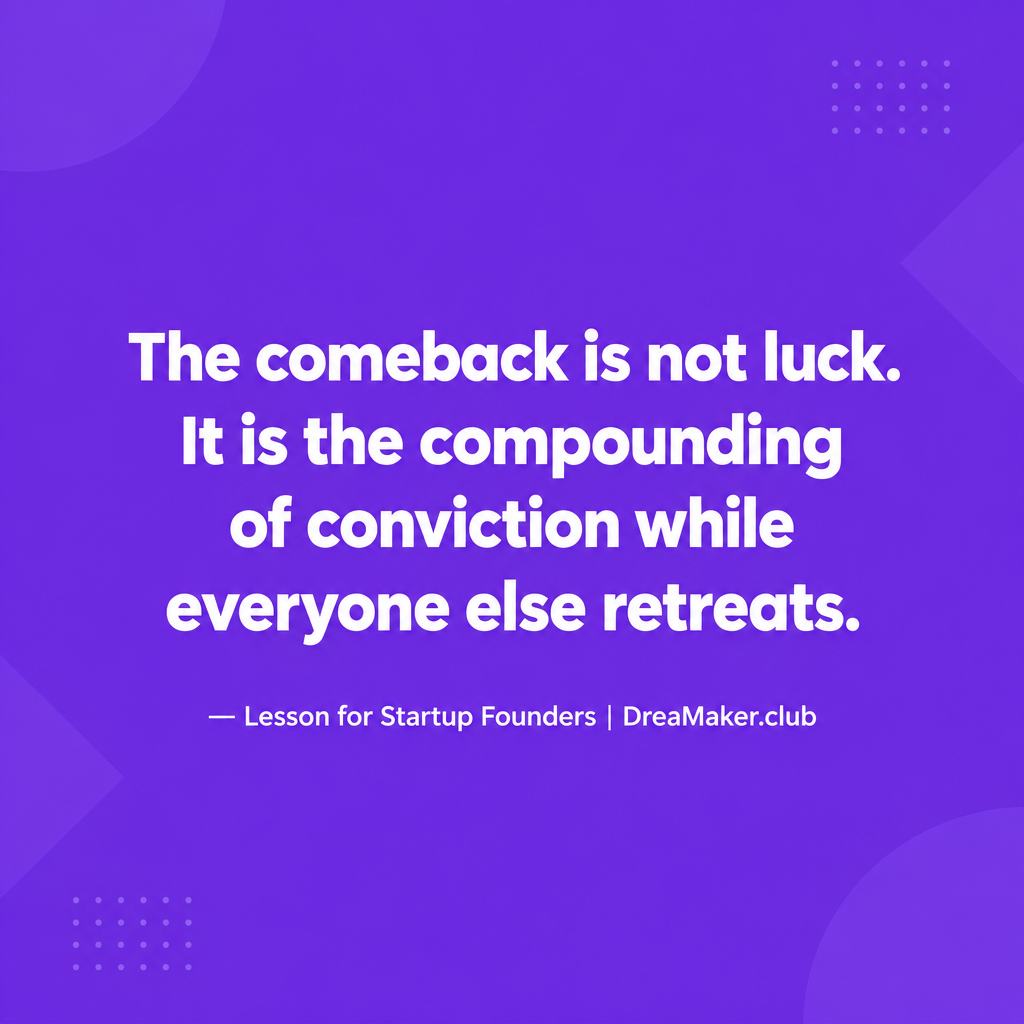
Conviction is not stubbornness. It is the sustained clarity of your positioning even when the market is loudest against you. It is staying on message when you want to go quiet. It is continuing to invest in your infrastructure — your offer, your trust system, your sales pipeline — when every instinct says to freeze.
The Adani Group did not pause its green energy buildout because of Hindenburg. It did not stop its airport expansion because of the US indictment. It kept compounding. And when the market turned — as markets always eventually do — there was something there to recover to.
Most founders have nothing to recover to because they dismantled their positioning during the dip.
Founder Story Card
The visible problem: A competitor publishes a damaging claim about your business. Leads go cold. Revenue slows. Your confidence fractures.
The real root cause: You respond by softening your positioning — lowering your price, over-explaining your offer, disappearing from the market — and inadvertently confirm the attacker's narrative to every buyer watching.
The founder lesson: The attack is not your crisis. Your response to the attack is your crisis. Buyers do not abandon credible founders under pressure. They watch to see if you believe in yourself. If you do not, they will not.
The move to make now: Identify where your positioning is conditional on external approval. Build the sales and trust infrastructure that keeps generating buyer confidence independently — regardless of what the market says about you this week.
Part 5 — Opportunity + Conditions
The hidden opportunity in the Adani story is not the comeback itself. The opportunity is the gap his competitors failed to close while he was down. Because while the market was loudest about Adani's troubles, the actual infrastructure of the Adani Group — the ports, the renewable energy contracts, the airport operations, the data centre expansion — kept compounding quietly.
For startup founders, the equivalent gap opens every time a credible competitor in your market goes quiet. That is the moment buyers are available. That is when your positioning — if it is robust and trust-first — can capture ground that would never be available in calmer conditions.
But you can only capture that ground if you built the right conditions before the storm. And you can only hold it if those conditions are still in place when the dust settles.
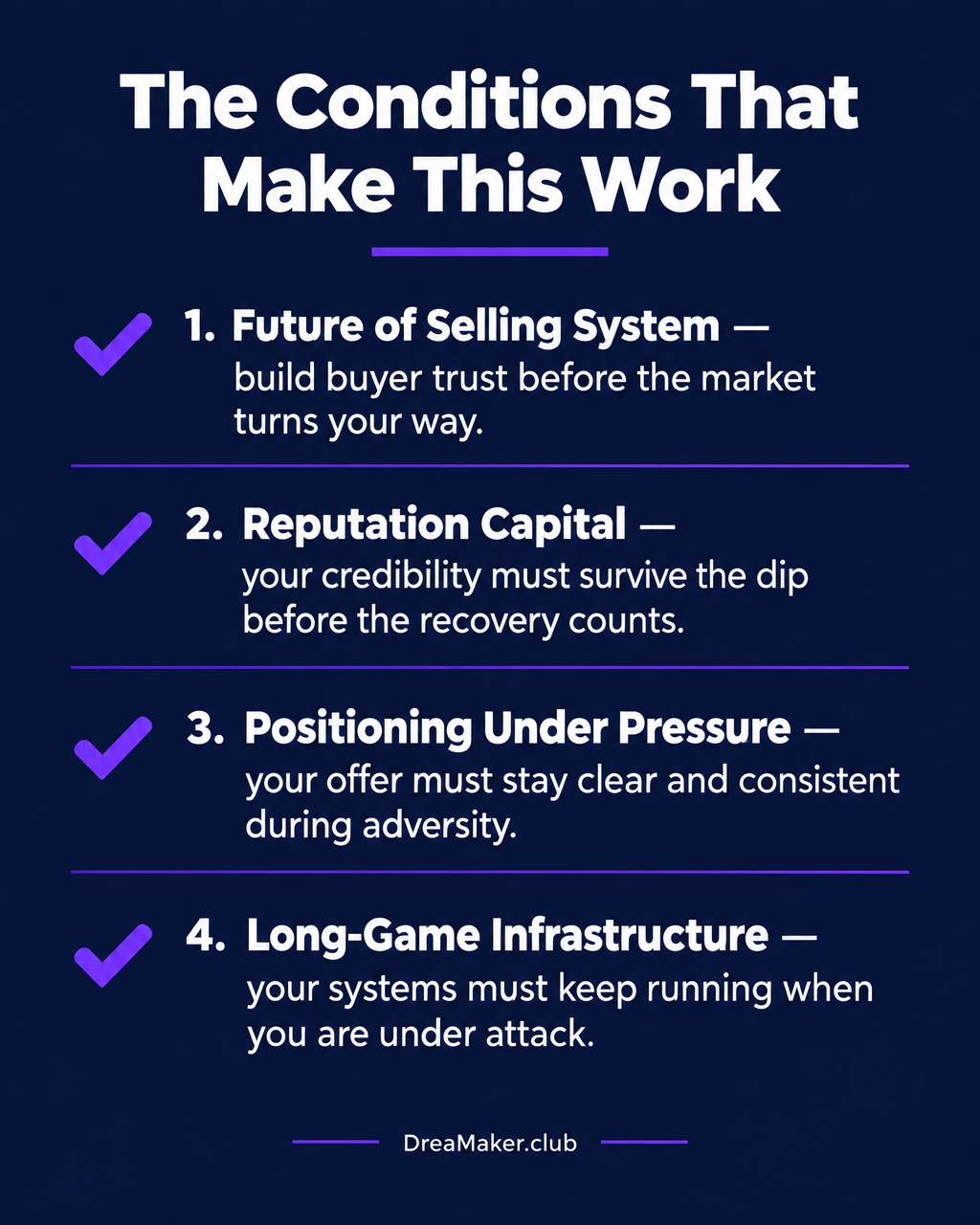
The Conditions That Make This Work
- Future of Selling System: Your sales and trust infrastructure must be built and running before adversity hits — not assembled in response to it. A system that generates buyer confidence independently of external noise is what separates founders who recover from those who don't.
- Reputation Capital: You cannot borrow trust in a crisis. The credibility that carries you through a dip is the credibility you built before it. Invest in your reputation architecture during the good periods — it pays compound interest when the pressure comes.
- Positioning Under Pressure: Your offer must be defined clearly enough that it does not require you to defend it personally every time the market is hostile. Vague positioning collapses under scrutiny. Precise positioning holds.
- Long-Game Infrastructure: Adani never stopped building. Your systems — pipeline, content, sales process, follow-up, client delivery — must keep running during the storm. Founders who freeze their infrastructure during adversity have nothing to recover to when conditions improve.
Part 6 — Native Ad
Part 7 — Sting
Adani already moved. The only question is whether you will — or whether you'll read about someone else who did.


