
Billionaire Israel Englander Just Asked For $20 Billion — And Got $30 Billion Back — And It Changes Everything For Startup Founders
Billionaire Israel Englander Just Asked For $20 Billion — And Got $30 Billion Back — And It Changes Everything For Startup Founders

Part 1 — The Hook
Israel Englander asked for $20 billion. The market sent back $30 billion. That gap is the most important sales lesson of 2026.
Millennium Management, the $97 billion hedge fund Englander built from a $35 million starting stake in 1989, went to market with a target. Institutional investors — pensions, endowments, sovereign wealth funds — didn't just meet that target. They buried it by 50 percent. The raise was oversubscribed before it closed. That doesn't happen by accident. It happens by design. And the design is the lesson most founders will completely miss.
Part 2 — Press
Here is the question you should be asking yourself right now:
When was the last time a buyer came back to you with more than you asked for?
Most founders spend their entire year chasing. Chasing leads. Chasing responses. Chasing the decision-maker's calendar. Chasing a yes that keeps slipping to next quarter. And because they are always chasing, they are always behind. They are always negotiating from need. They are always the one who wants the deal more than the buyer does.
What happened at Millennium this week is the mirror image of that. Englander didn't chase. He created conditions so compelling that $30 billion showed up trying to get in — for a fund that was only targeting $20 billion. That is not fundraising. That is demand gravity. And you can engineer it. Most founders just don't know how — because no one has shown them what it actually looks like inside a winning sales system.
Part 3 — Play
Millennium Management, founded in 1989 by Israel Englander with $35 million, now manages $97 billion in assets under management, according to Caproasia on September 26, 2026. In July 2026, reports emerged that the firm was in talks to raise $20 billion in fresh capital. By September 26, 2026, those talks had resolved with a result that floored the industry: demand exceeded $30 billion — a 50 percent oversubscription on a nine-figure target.
The firm runs a platform model — over 340 semi-autonomous investment teams, each operating their own book under strict, centrally enforced risk controls. When Bobby Jain, Millennium's former co-CIO, left to launch his own $6 billion fund in 2023, many assumed the departure would weaken the machine. Instead, in April 2026, Jain closed Jain Global to outside investors and returned exclusively to manage capital for Millennium. The ecosystem didn't fracture. It contracted inward — and grew stronger. The $30 billion demand figure confirmed it. Bloomberg had reported in June 2026 that Englander's firm was targeting at least $10 billion; the final figure doubled that and then oversubscribed by half again.
Billionaire Israel Englander's move is one Jason has seen across 1,000+ founders. Here's what most miss.
Part 4 — The Lesson and Root Cause Reframe
Most founders think the problem is that they are not reaching enough buyers. But the real problem is that they are chasing buyers instead of creating conditions that make buyers afraid to miss out.
Englander didn't send a pitch deck to 10,000 institutions. He built 37 years of proof. He built a system — the pod model — that functions and compounds regardless of any individual's departure. He built a track record so verifiable that the due diligence writes itself. By the time Millennium went to market in 2026, it wasn't selling access to a fund. It was offering limited access to something buyers already knew they needed and couldn't easily replicate elsewhere.
That is the lesson:
"The founder who chases buyers will always lose to the one who creates conditions that make buyers afraid to miss out."

Chasing creates resistance. The harder you chase, the more a buyer doubts your value — because if your offer were truly compelling, you wouldn't need to push. Demand gravity is the opposite. It is what happens when your positioning, proof, and process are so clearly aligned to what the buyer already wants that they self-select toward you — and they self-select urgently, because they can see other serious buyers circling.
The Millennium story exposes a second truth: systems outlast individuals. When Jain left, the pod model kept compounding. The firm didn't depend on any one person's genius. It ran on architecture. Most founder-led businesses are the inverse — the founder IS the product, the pitcher, the closer, the delivery mechanism, and the renewal conversation. Remove the founder and the revenue disappears. That is not a business. That is a job. And a job cannot be oversubscribed.
Founder Story Card
The visible problem: A B2B SaaS founder is struggling to fill her sales pipeline. She is posting on LinkedIn, running cold outreach campaigns, and attending two networking events per week — and still losing 70 percent of her conversations at the first follow-up.
The real root cause: She is chasing buyers one by one with no demand gravity. Each conversation starts from zero. There is no proof architecture, no visible social consensus, no system that tells the next buyer that serious people are already in. She is the bottleneck in her own sales process.
The founder lesson: Demand gravity is not about being louder. It is about being positioned so that your proof, your platform, and your people make the next buyer feel they are the last one to the party — not the first.
The move to make now: Stop designing your pitch for one buyer. Start designing your positioning for 30 billion dollars worth of demand. Stack proof publicly. Make your system visible. Let the evidence do the chasing.
Part 5 — The Opportunity and Conditions
Here is the opportunity most founders are sleeping on right now.
The current market is flooded with undifferentiated offers. AI tools have made it cheaper than ever to generate noise — cold emails, social content, lead magnets. The result is that buyers are drowning in pitches and starving for proof. In that environment, the founder who has built genuine demand gravity — verifiable results, a systematic delivery model, visible social proof from credible sources — does not compete on price. They do not negotiate on timing. They set terms. The same way Millennium set a $20 billion target and watched the market send back 50 percent more.
The window for founders to build this positioning advantage is open right now. It will not stay open. As AI-generated noise intensifies through 2027, buyers will retreat toward trust signals they can verify. Founders who have built those signals will win. Founders who are still chasing will find the chase gets harder every quarter.
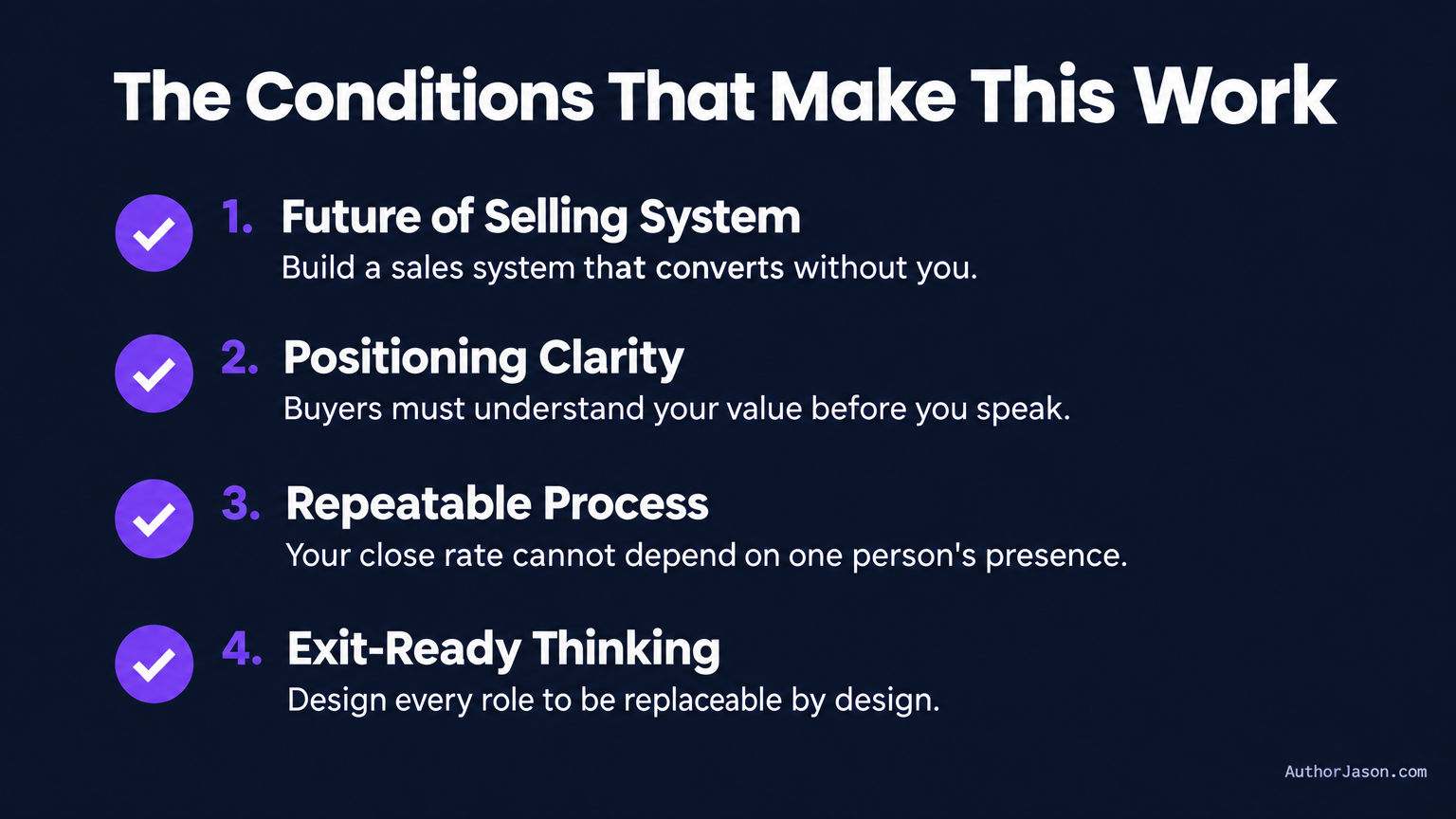
The Conditions That Make This Work
- Future of Selling System: You need a structured, repeatable sales process that converts without being founder-dependent — one that stacks proof, builds buyer trust in advance, and creates the conditions for demand gravity before a single conversation begins.
- Demand-First Positioning: Your offer must be framed in terms of what serious buyers are already pursuing — not what you are trying to sell. Position yourself as the destination, not the vendor.
- Verifiable Proof Architecture: Case studies, outcomes data, and third-party validation must be visible before the buyer ever reaches out. If your proof only appears inside the sales conversation, it arrives too late.
- System Over Founder: The moment your business can only close because you are personally in the room, you have a ceiling. Demand gravity requires that your model is visible and credible enough to run independently of your personal presence in every deal.
Part 6 — A Word From Jason
Part 7 — The Sting
Israel Englander already moved. The only question is whether you will — or whether you'll read about someone else who did.


