Billionaire Jaime Gilinski Signed a Contract at Dawn — And Turned It Into $514 Million Worth of Control by Nightfall
He Didn't Write a Cheque. He Signed a Contract.
Jaime Gilinski signed a Venezuelan oil contract — then immediately used it as currency to buy $514 million in equity. He didn't pay cash. He paid with sequencing. Most founders read this story and miss the whole thing. They see oil. They see Venezuela. They see a billionaire doing billionaire things. What they don't see is the 7-month sales architecture that made the move possible — and the exact same architecture that separates founders who close big deals from the ones who keep chasing them.
Let That Land for a Second
You have been told that big deals require big capital. That you need to have the money before you can make the move. That investors, boards, and partners need to see cash on the table before they will take you seriously.
Gilinski just proved that is not how it works at the top.
He used a rights contract — a freshly-signed 25-year oil agreement with Venezuela's state oil company PDVSA — as the literal currency to acquire majority control of a NYSE-listed company worth over half a billion dollars. He didn't need cash. He needed position. And position is something he built methodically, quietly, and deliberately over seven months before he ever made the closing move.
If you are a startup founder leading your own sales and you do not have a sequenced pipeline architecture underneath every deal you are chasing right now — this story is for you.
What Actually Happened — And What Most People Missed
Here is the full sequence, as reported by Forbes (October 9, 2026) and Bloomberg (September 3, 2026):
- March 2026: Gilinski invests $107 million via his affiliate Colden Investments into GeoPark (NYSE: GPRK) at $8.31 per share, acquiring approximately 20% of the company and becoming its largest shareholder. [GeoPark press release, March 5, 2026]
- March–April 2026: He makes additional open-market purchases, increasing his stake to approximately 28%. [SEC Schedule 13D Amendment No. 3, April 2026]
- September 2, 2026: Gilinski secures a 25-year Production Participation Contract with PDVSA Petróleo for the Bare oil block in Venezuela's Orinoco Oil Belt — a field with an estimated 15.7 billion barrels of original oil in place and current production of approximately 11,000 barrels per day. [GeoPark announcement, September 2, 2026]
- Immediately after signing: He exchanges his 95% interest in the Bare contract holder to GeoPark in return for 42.1 million newly issued GeoPark shares at $12.22 each — a 26% premium to the 30-day average price — totalling approximately $514 million. [Forbes, October 9, 2026; Bloomberg, October 9, 2026]
- Result: Grupo Gilinski will hold approximately 56.3% of GeoPark, giving him majority control of the company. GeoPark plans to scale Bare production from 11,000 barrels per day to 95,000. [Forbes, October 9, 2026]
Billionaire Jaime Gilinski is worth $40.3 billion according to the Bloomberg Billionaires Index — and his move is one Jason has seen across 1,000+ founders. Here's what most miss.
The Lesson: The Deal You See Is Not the Real Deal
Beat 1 — Root Cause Reframe
Most founders think the problem is they don't have enough capital to close big deals. But the real problem is they don't have enough position inside their buyer's world — and they try to close before they've built it.
Gilinski didn't walk into a boardroom in September 2026 and make a $514 million move cold. He spent seven months becoming GeoPark's largest shareholder, earning board-adjacent influence, learning the company's exact strategic gaps — and then, when he held a uniquely valuable asset in his hands, he already had the relationship infrastructure to make a single phone call that closed the deal.
That is not deal luck. That is deal architecture.
Beat 2 — The Lesson
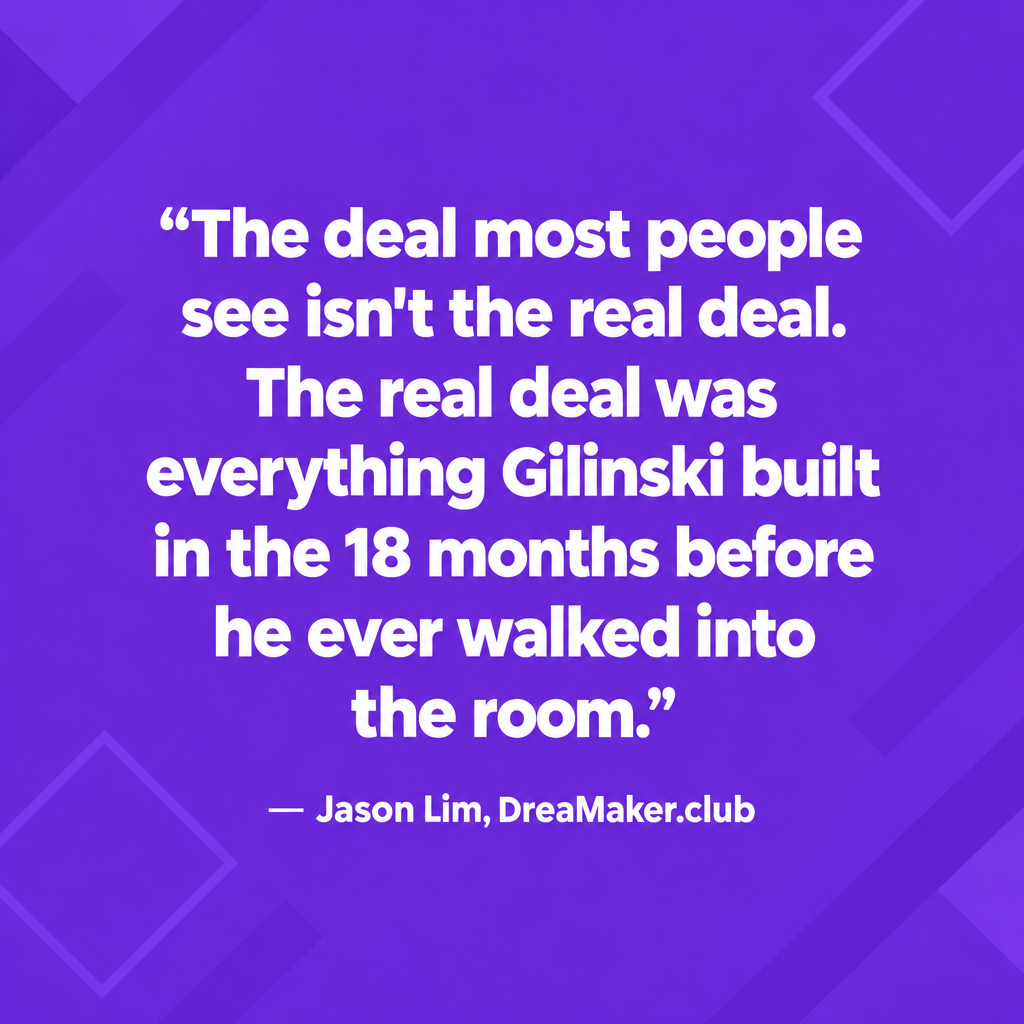
The deal most people see is not the real deal. The real deal was everything Gilinski built in the months before he ever made the ask.
Founder Story Card
The Founder Without Position
One of Jason's founders — a 12-person B2B team in professional services — had been chasing a single whale account for six months. Every meeting went well. Every follow-up was professional. Every proposal was detailed. And every decision kept getting delayed. When Jason reviewed the situation, the diagnosis was immediate: the founder had been pitching without ever building position. There was no existing relationship inside the account. No early beachhead. No sequenced trust-building. He was trying to close a $500,000 deal with a stranger. The moment he shifted — getting a foot in the door with a small advisory engagement, delivering visible results, and building relationships with three stakeholders before going back to the main close — the deal happened in 11 days. He had not changed his offer. He had changed his position.
Here is the counter-intuitive truth that founders miss: the close is not where the deal is won. The close is where the deal is confirmed. The deal is won in the 90 days of structured relationship activity that happens before the close. Gilinski entered GeoPark as a shareholder. He built inside-the-tent trust. He learned the exact strategic gap — Venezuela. And when he was positioned to fill that gap, the deal was already closed in all but paperwork.
Most founders do the opposite. They generate a lead, schedule one meeting, pitch, send a proposal, follow up twice, and when the deal stalls they blame the buyer. The real issue is they tried to close without position. They asked before they had earned the right to ask.
The Hidden Opportunity: Deal Currency Is Not Always Cash
Gilinski's move reveals something that most startup founders will not see until it is pointed out: in high-value deals, the actual currency being exchanged is rarely just money. It is access, positioning, strategic assets, and trust — packaged in a way that the other side needs more than they need a bank transfer.
For founders, this means: if you have positioned yourself correctly inside your buyer's world — as a strategic partner, a trusted advisor, a proven performer — you have deal currency that your cash-less competitors do not have. The opportunity right now is to audit your pipeline and ask a hard question: in which of your active deals have you actually built enough position to use something other than price as your closing lever?
If the answer is "none," you are still operating as a stranger trying to close deals. Gilinski's playbook says: become an insider first, then make the move.
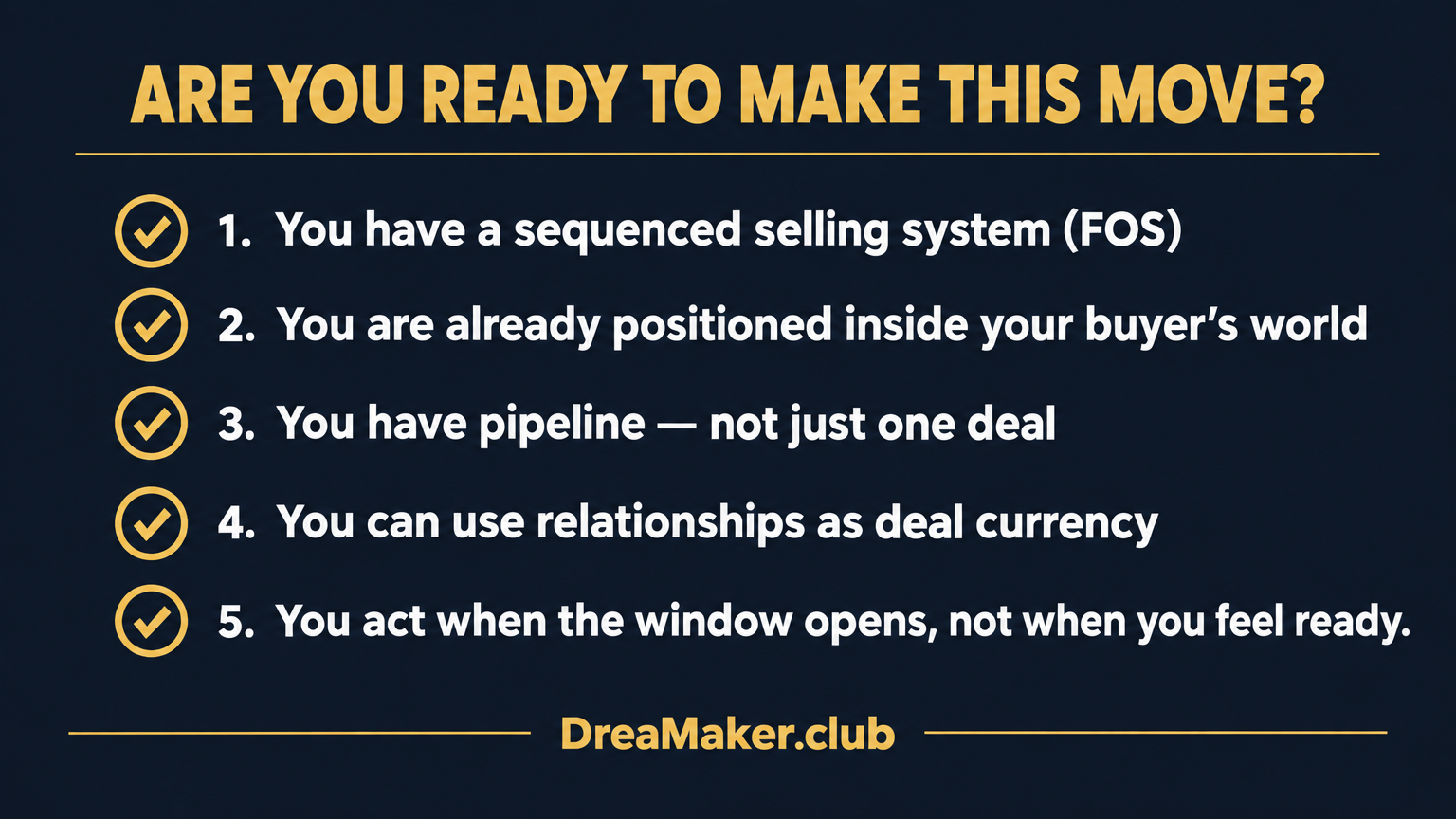
Are You Ready to Make This Move? Check These Conditions First.
✅ Condition 1 — You have a sequenced selling system (Future of Selling System).
You cannot execute Gilinski-level deal architecture without a system that manages every touchpoint, every relationship stage, and every follow-up sequence. One-deal-at-a-time hunting does not produce the kind of positioned pipeline that makes $514M moves possible. This is the non-negotiable foundation. → Get the Future of Selling System
✅ Condition 2 — You are already inside your target buyer's world before you pitch.
Not as a vendor who sends emails. As a value-contributor who is seen, known, and trusted. If your first touchpoint with a buyer is a pitch deck, you have already lost the architecture advantage.
✅ Condition 3 — You have active pipeline — not just one deal.
Gilinski's move was possible because he had been building multiple strategic positions simultaneously. If you only have one deal in play, every conversation feels existential and you negotiate from desperation, not strength. Build multiple pipeline stages and your positioning power multiplies.
✅ Condition 4 — You understand what your buyer values more than your price.
GeoPark didn't value Gilinski's cash. They valued his Venezuelan access. What does your buyer value more than your price? Strategic introductions? Market positioning? Early results they can show internally? Find that — and lead with it.
✅ Condition 5 — You are prepared to act when the window opens, not when you feel ready.
Gilinski signed the PDVSA contract and immediately used it. He did not wait for a better moment. He had a sequenced system, a positioned relationship, and a clear view of the window — and he moved. Founders who hesitate at the threshold of a deal they built rarely get a second shot at the same window.
NEW! — October 2026
Dear Founders — If You Are Still Closing Deals Without Position, You Are Losing Deals You Should Be Winning.
Get the Future of Selling System — $19/month ($0.63/day) →The pain: You are doing everything right — good product, professional follow-ups, strong proposals — and deals are still stalling. You know the relationship is warm but the close keeps slipping. The real problem is not your pitch. It is that you are showing up as a vendor, not as a positioned insider. And positioned insiders win deals that vendors never even get invited to.
I felt the same way. When I started coaching founders in 2015, I saw the same pattern across hundreds of teams: great founders, great products, losing to competitors with worse offerings — simply because the competitor had built better position. I felt that frustration too. I found that the answer was never more pitching. It was a system — a sequenced architecture that builds position before you ever ask for the close.
According to Salesforce's State of Sales report, 76% of buyers prefer to work with vendors recommended by someone they trust — meaning unpositioned outreach is losing before it starts. The Future of Selling System teaches founders exactly how to become the insider, not the vendor.
Since 2015, Jason has worked with 1,000+ startup founders, generating $22M+ in combined sales by graduates. Founders like Jeffrey Teo (63 customers in 100 days), Stanley Tan (45 buyers in 3 hours), and Leon (a $2M partnership close) all used this system — not to pitch harder, but to position smarter.
Start the Future of Selling System Today →Not ready for $19? Start free.
The Objection Playbook: 25 Word-for-Word Scripts to Close More Sales
The exact words Jason's founders use when a buyer says "too expensive", "send me info" or "I need to think about it". Free PDF, sent to your inbox.
Send Me the 25 ScriptsBillionaire Jaime Gilinski already moved — seven months of quiet positioning and one perfectly-timed close. The only question is whether you will build the same architecture now, or whether you will read about someone else who did.


