
Billionaire Jamie Dimon Just Called Your Pitch Sloppy — And It Changes Everything For Founders Who Can't Close
Billionaire Jamie Dimon Just Called Your Pitch Sloppy — And It Changes Everything For Founders Who Can't Close

The Word Every Founder Needs to Hear Right Now
Jamie Dimon just told the world your pitch is sloppy — and the data says he is right.
The CEO of the largest bank in America went on The Master Investor Podcast with Wilfred Frost and called out something most founders would never say out loud about themselves: too many leaders are, in his exact words, "sloppy as hell" with how they communicate. He wasn't talking about presentation polish. He was talking about the thinking underneath it. And if you've ever walked out of a sales conversation wondering why the buyer didn't get it — this is the story you need to read before your next pitch.
Why This Hits Different for Founders
Here's what stings about Dimon's observation: it doesn't apply to bad founders. It applies to smart ones.
The founders who lose deals aren't the ones without a product. They're the ones with a product that buyers can't decode quickly enough to say yes. They know their solution inside out. They can explain every feature, every integration, every use case. And that's precisely the problem. When you know too much, your communication collapses under the weight of it. The pitch becomes a download. The buyer gets lost. And the deal dies not because the product wasn't right — but because the thinking behind the message was never organised before it left your mouth.
Dimon is describing the number one reason founders lose deals in the middle of conversations they should be winning. The problem isn't confidence. It isn't product-market fit. It isn't pricing. It's that they are communicating before they have finished thinking.
What Dimon Actually Said — and Why It Matters
Jamie Dimon made these remarks in the context of giving advice to ambitious professionals, as reported by Forbes on September 25, 2026. His core argument, as covered by Forbes contributor Sho Dewan, was direct: "sloppy communication reflects sloppy thinking." He described sloppy communicators as people who "pontificate" — rambling without destination, leaving the listener confused about what the actual goal is.
His prescription was equally direct. He cited Jeff Bezos's practice at Amazon, where senior executives were required to replace PowerPoint slide decks with carefully crafted six-page narrative memos before major discussions. As reported by Forbes in July 2026, Dimon pointed to this as an example of how disciplined communication forces leaders to sharpen their arguments before expressing them — leading to better decisions, faster. He also advocates what he calls the "rule of three": structuring any high-stakes communication around three clear options with a recommended path, giving the listener both clarity and a decision to make.
According to Forbes (2026 Billionaires List), Dimon's net worth is approximately $3.0 billion. He has led JPMorgan Chase — America's largest bank by assets, with more than 300,000 employees worldwide — as CEO since 2006. His 2025 compensation package was $43 million, a 10.3% increase on the prior year, as reported in regulatory filings covered by Reuters and Bloomberg. Billionaire Jamie Dimon's observation is one Jason has seen play out across 1,000+ founders. Here's what most miss.
The Root Cause Most Founders Never Find
Most founders think the problem is that buyers don't understand the product. But the real problem is that the founder hasn't finished thinking before they start talking.
This distinction matters enormously. When you believe the buyer doesn't understand you, you fix the wrong thing. You add more slides. You build a longer demo. You find new analogies. You hire a copywriter. And none of it works — because the clarity problem was never in the output. It was in the input. The thinking was incomplete before the communication began.
Here's the quotable truth: An unclear pitch is not a sales problem. It is a thinking problem in disguise.

The reason Dimon's "rule of three" works so powerfully in leadership is the same reason it would work in a sales conversation. When you present three options with a clear recommendation — "We have three approaches. Here's how I weigh each one. Here's why I'd choose this path for you" — you are doing the cognitive work the buyer was hoping someone would do for them. You remove confusion. You signal expertise. You accelerate trust. And trust is the only thing that converts.
The founders who close consistently are not the ones with the most features. They are the ones whose thinking is so organised that the buyer feels safe making a decision.
Founder Story Card
The visible problem: The founder keeps losing deals to "let me think about it" — and assumes the buyer just needs more time.
The real root cause: The pitch is structured around how the founder thinks about the product, not how the buyer makes a decision. The message never arrives with enough clarity for a yes.
The founder lesson: Disciplined communication is disciplined thinking made visible. If your buyer leaves confused, you left confused — you just didn't know it yet.
The move to make now: Before your next sales conversation, write down three things: the problem you solve, the one option you recommend, and the single reason why this is right for them today. Speak from that structure — nothing else.
The Hidden Opportunity Inside Dimon's Warning
Most founders will read Dimon's comment as career advice for employees. That's the miss. This is a market advantage hiding in plain sight.
If the majority of leaders — including senior executives at some of the largest organisations on earth — communicate sloppily, then the founder who shows up with organised, structured, buyer-centred thinking will stand out immediately. Not because of the product. Not because of the price. Because the buyer will feel something rare: they will feel understood. And the moment a buyer feels understood, resistance drops, trust rises, and the conversation shifts from evaluation to commitment.
In a world where AI is doing more and more of the background research, shortlisting, and comparison shopping before a buyer ever speaks to a founder, the conversation itself has become the product. The question is no longer "can you explain what you do?" — the buyer already knows. The question is now: "can you think clearly enough in front of me that I trust you to solve this problem?"
The window to build that advantage is right now — before every other founder catches up.
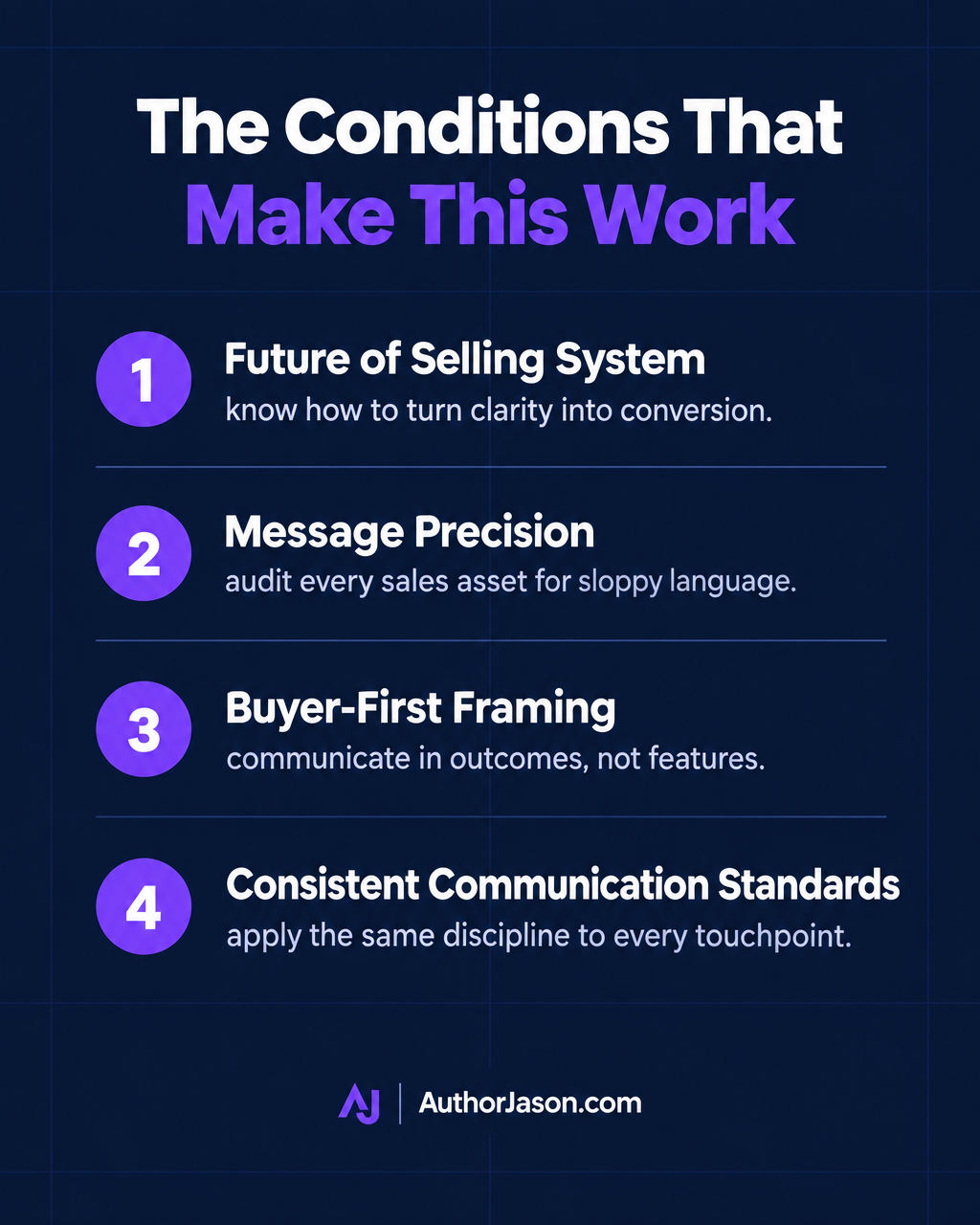
The Conditions That Make This Work
- Future of Selling System: You need a proven framework that trains you to communicate your offer in the way buyers actually make decisions — not the way founders naturally explain products. Without this, disciplined thinking alone still won't convert.
- Message Precision: Audit every sales touchpoint — your emails, your opener, your first two sentences in a conversation — and strip anything that adds explanation without adding clarity. If it doesn't help the buyer decide, cut it.
- Buyer-First Framing: Restructure every pitch around three elements: the buyer's specific problem, your recommended path, and the one reason this is right for them now. Stop presenting. Start recommending.
- Consistent Communication Standards: Apply the same discipline to follow-up emails, proposals, and referral conversations that you apply to your main pitch. Sloppy communication at any touchpoint resets trust — regardless of how good the meeting was.
Dimon already moved. The only question is whether you will — or whether you'll read about someone else who did.


