Billionaire Jeff Bezos Just Added $102 Billion In One Month Without Touching Amazon — And It Changes Everything For Founders Who Think Buyers Need To Believe Before You Do
He Just Made $102 Billion Without Selling A Share.
Jeff Bezos added $102 billion to his net worth in September 2026 — and not one dollar came from Amazon stock. It came from two private bets: Blue Origin, valued at $140 billion after its first-ever outside funding round, and Prometheus AI, a co-founded industrial intelligence startup valued at $41 billion. The market didn't discover Bezos. Bezos revealed himself — after he had already committed $30 billion of his own money first. That sequence is not accidental. It is the most important sales and positioning lesson of this decade, and almost every startup founder has it completely backwards.
Why This Should Make You Uncomfortable
Think about the last time you walked into a sales conversation. What was the internal question running on repeat? Probably something like: "Will they believe in this? Do they see the value? Are they ready to buy?"
Here's what Bezos never asked. He never needed outside validation to move forward. He poured $30 billion of his own capital into Blue Origin across 26 years — funding rockets, lunar landers, orbital systems, and NASA contracts — before a single external investor was ever offered a seat at the table. He built Prometheus AI with $5.6 billion in Series A funding and $2 billion more at Series B — most of it his own money — before the company had a widely known product or public profile.
Most founders are doing the exact opposite. They approach buyers from a place of hoping to be believed. They present decks, quote ROI numbers, and wait for the room to lean forward. And when it doesn't — when buyers say "let me think about it" or "send me more information" — founders assume the problem is the product, the price, or the pitch. It is not. The problem is what the buyer reads in the room before you even open your mouth.
When conviction is absent from the seller, doubt is the only thing the buyer feels.
What Actually Happened — The Facts
According to Forbes and the Bloomberg Billionaires Index, Jeff Bezos's fortune surged by an estimated $102 billion in September 2026, pushing his net worth to approximately $370 billion as of early October 2026 — making him the world's second-richest person, passing Alphabet co-founder Larry Page (Forbes, October 2026; TheStreet, October 9, 2026; Bloomberg, October 8, 2026).
The entire gain came from two private holdings — not Amazon shares, not public-market movements:
- Blue Origin raised outside capital at a $140 billion post-money valuation — its first-ever external funding round, led by Coatue Management with approximately $4 billion. Bezos owns 93% of Blue Origin. Before this round, he had personally put roughly $30 billion of his own money into the company across 26 years (Wall Street Journal, September 2026; Bloomberg Billionaires Index, October 2026; Benzinga, October 2026).
- Prometheus AI — an industrial AI startup Bezos co-founded with Vik Bajaj, former Chief Scientific Officer of Verily — closed a $12 billion Series B at a $41 billion valuation in June 2026. Bezos contributed the majority of the Series A ($5.6 billion) and $2 billion into the Series B. Forbes estimates he holds approximately a 35% stake (Bloomberg Billionaires Index, October 2026; Axios, June 2026).
Blue Origin also secured a $700 million NASA contract to build its next telecommunications orbiter and a separate $468 million NASA contract for an uncrewed lunar mission — part of NASA's $20 billion moon base program (Benzinga, October 2026).
Billionaire Jeff Bezos's move is one Jason has seen across 1,000+ founders. Here's what most miss.
The Lesson Most Founders Will Never Extract From This Story
Beat 1 — Root Cause Reframe
Most founders think the problem is that buyers don't believe in the product yet. But the real problem is that the founder doesn't believe in it enough to act like it's already true — and buyers can feel that gap from across the table in under 90 seconds.
Bezos didn't pitch Blue Origin to investors for 26 years waiting for someone to validate the concept. He funded it, built it, launched it, failed publicly with it, and kept going — entirely on his own conviction. When outside investors finally arrived, the signal wasn't "please believe in this." The signal was: "You're late. And there's still room."
That is an entirely different energy from what most founders bring to a sales call. Most founders bring hope. Bezos brought proof of conviction — the most powerful closing signal in the world.
Beat 2 — The Lesson
Your conviction is the product before the product is the product. If you can't get there yourself, your buyer will never get there either.
This isn't abstract motivation. It shows up in specific, observable behaviors during a sales conversation:
- A founder who is unsure of their price will offer a discount before the buyer asks.
- A founder who needs the deal to survive this quarter will call five times in three days — and the buyer will feel the desperation.
- A founder who doesn't genuinely believe their offer changes lives will understate it — they'll "just" the whole pitch to death: "It's just a small thing we put together..."
None of these are pitch problems. They are belief problems. And no amount of slide redesign, pricing strategy, or script tweaking fixes them.
Bezos's pattern — across Amazon, Blue Origin, and now Prometheus — is always the same: maximum personal commitment first, then the world follows. He doesn't ask the world to believe before he does. He believes so completely, and so publicly (with capital, time, and reputation on the line), that the world has no logical choice but to follow.
Jason has seen this pattern repeat across more than 1,000 founders since 2015. The ones who close big — who get Jeffrey Teo's 63 customers in 100 days, or Stanley Tan's 45 buyers in 3 hours, or Leon's $2M partnership — are not the ones with the best product. They are the ones who sell from a place of certainty so total that the buyer's risk calculation collapses.
Founder Story
Stanley Tan — 45 Buyers In 3 Hours
Stanley was running a group event. He had a room of 60 people and needed to close. Before he got on stage, Jason asked him one question: "Do you personally believe this is the best decision they can make today?" Stanley paused. Then he said yes — not to Jason, but to himself. That afternoon, 45 of 60 said yes. When a founder's belief is total, the buyer's resistance dissolves. The product hadn't changed. The pitch hadn't changed. The founder's internal state had.
The Hidden Opportunity — And The Conditions To Capture It
Beat 1 — The Hidden Opportunity
Most founders are chasing better tactics when the actual opportunity is internal: the moment you sell from full conviction — not from fear, not from hope, not from desperation — your close rate jumps before you change a single word of your pitch. This is not motivational theory. According to Salesforce's State of Sales report, 76% of buyers say the single most important factor in their decision is whether they trust the salesperson — not the product, not the price, not the company. The salesperson.
And trust is not manufactured by a clever script. It is transmitted when the founder is operating from complete internal alignment — when what they say, what they believe, and what they've personally committed to are all the same thing.
The opportunity right now: your competitors are still using fear as their fuel. They're discounting. They're apologising for their price. They're writing "just checking in" emails three days after a pitch. The moment you stop doing those things — the moment you operate from the conviction Bezos operates from — you have an unfair advantage that no competitor can copy by watching your deck.
Beat 2 — The Conditions
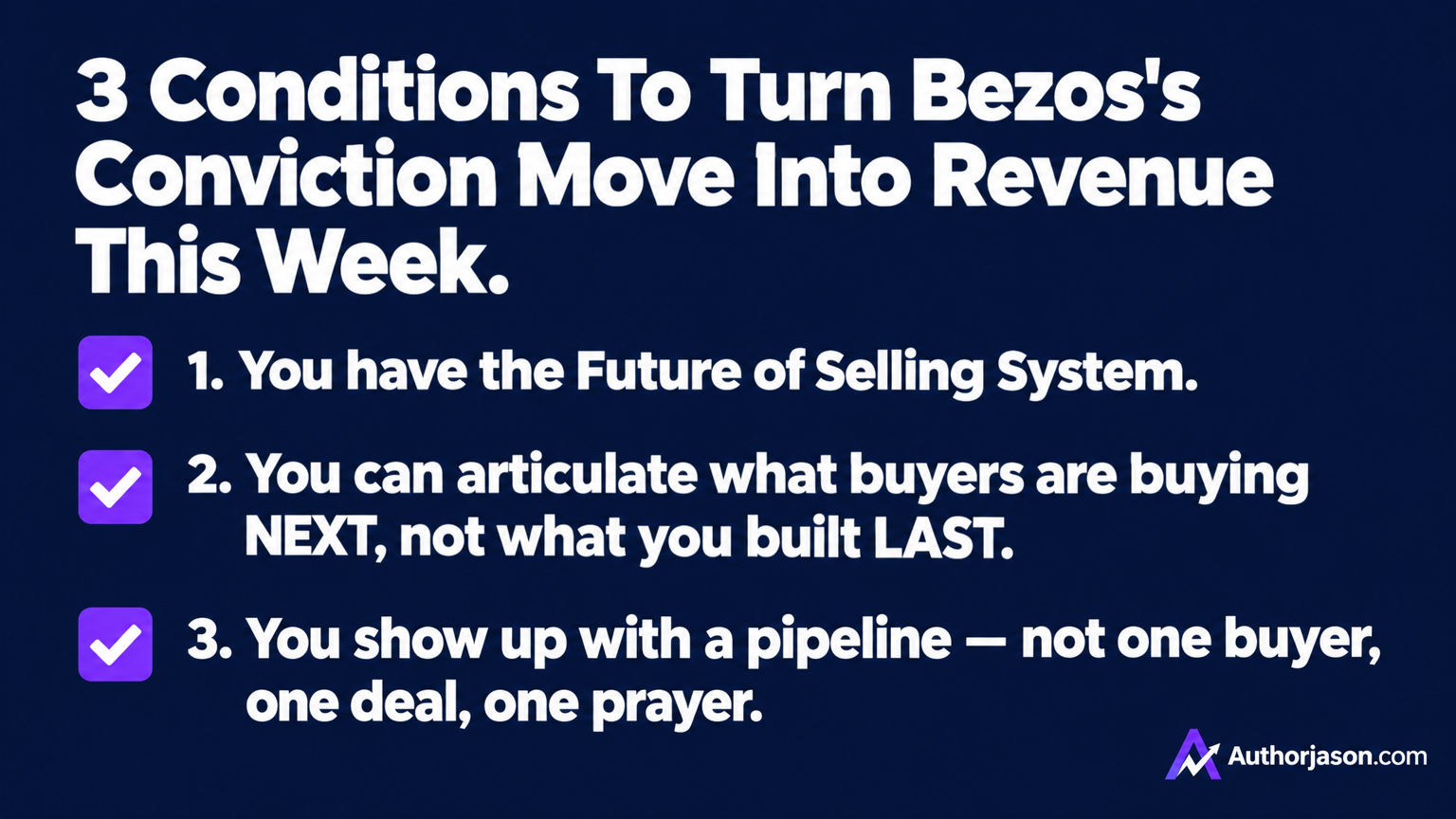
Are You In Position To Move On This?
✅ Condition 1 — You Have The Future of Selling System
Conviction without a system is just enthusiasm. The Future of Selling System gives you the structured process — from positioning to pipeline to close — that makes conviction executable. Without it, high belief turns into high-energy randomness. With it, every interaction has a direction, a sequence, and a close built in. This is the non-negotiable foundation.
✅ Condition 2 — You Can Articulate What Buyers Are Buying Next, Not What You Built Last
Bezos doesn't sell Blue Origin on what it has already done. He sells on what it will make possible — colonies on the moon, orbital infrastructure, a multi-planetary civilization. Buyers don't pay for your past. They pay for their future. If your pitch is still product-backward — features, delivery timelines, what's included — you are selling the wrong direction. Flip it. Sell the world they enter the moment they say yes.
✅ Condition 3 — You Have A Pipeline, Not A Prayer
Bezos didn't fund Blue Origin with one NASA contract in mind. He built an entire ecosystem of multiple missions, multiple clients, multiple contracts. When you are chasing one deal, one buyer, one quarterly hope — your conviction collapses because your survival depends on the outcome. Founders with a real pipeline sell differently because they aren't desperate. Build more conversations than you need, so you can close with freedom instead of fear.
NEW! — October 2026
Dear Founders — The Reason Your Close Rate Is Low Has Nothing To Do With Your Product.
You've read this far because some part of you knows it's true: you walk into sales conversations hoping the buyer believes before you fully do. You polish your deck. You sharpen your offer. And still, too many deals die in the "I'll think about it" graveyard.
Pain Anchor: The real problem isn't your pitch — it's that you don't have a system that makes conviction executable, consistent, and repeatable regardless of the day, the deal size, or the buyer in the room.
I know how you feel. I've worked with 1,000+ startup founders since 2015 who felt the exact same way — smart founders with great products who kept losing deals they should have won. What they found was that the Future of Selling System (FOS) didn't just teach them what to say. It rewired how they showed up. They felt different. Their buyers felt it too.
According to Salesforce's State of Sales report, 76% of buyers say trusting the salesperson is the single most important factor in their decision — not the product, not the price. The FOS is built around that statistic. It gives you the system Bezos instinctively runs: total commitment first, structured process always, and a pipeline deep enough that you never need any single deal to survive.
$22M+ in combined sales by graduates. Jeffrey Teo: 63 customers in 100 days. Stanley Tan: 45 buyers in 3 hours. Leon: $2M partnership. Not because they got lucky — because they had a system.
Not ready for $19? Start free.
The Objection Playbook: 25 Word-for-Word Scripts to Close More Sales
The exact words Jason's founders use when a buyer says "too expensive", "send me info" or "I need to think about it". Free PDF, sent to your inbox.
Send Me the 25 ScriptsBillionaire Jeff Bezos already moved — $30 billion of his own money, 26 years of his own conviction, before a single outside investor was offered a seat. The only question is whether you will move on yours — or whether you'll read about someone else who did.


