Billionaire Jeff Bezos Just Landed the Most Powerful Seat in AI — And He Never Built an AI
Billionaire Jeff Bezos Just Landed the Most Powerful Seat in AI — And He Never Built an AI
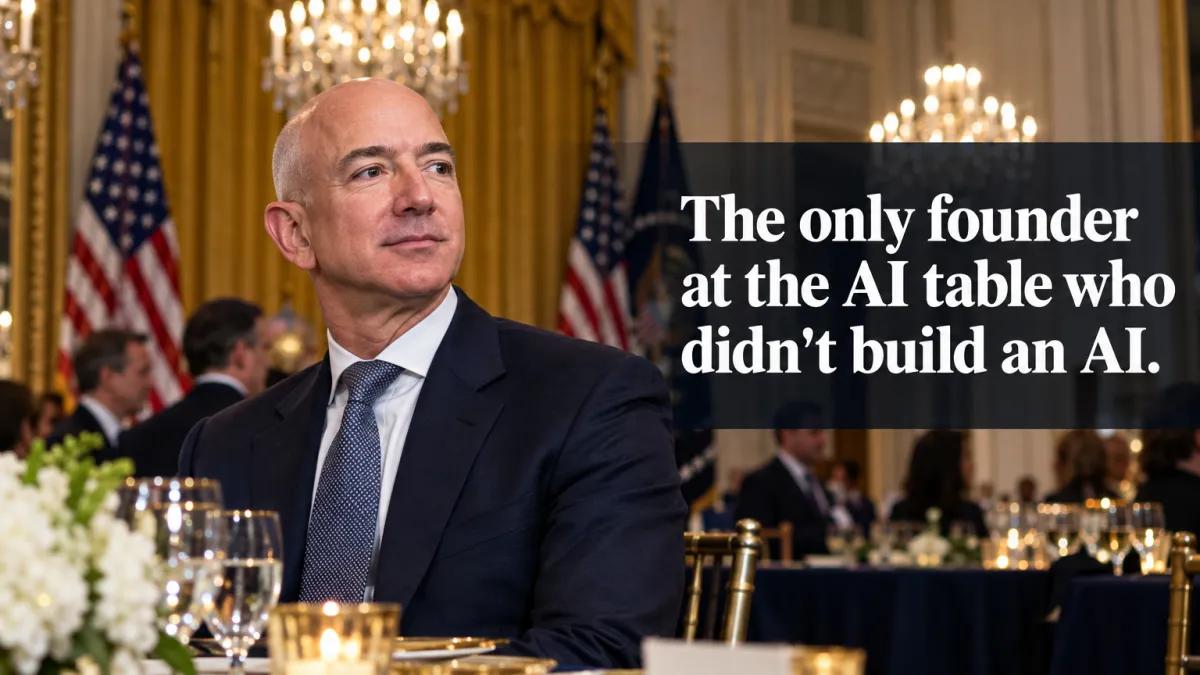
Jeff Bezos just secured a seat at the most important AI dinner on earth. He is the only man in the room who never built an AI — and that is the entire lesson for every founder selling anything right now.
On September 24, the White House East Room becomes the single most consequential business table of 2026. Sam Altman is there. Jensen Huang is there. Sundar Pichai, Elon Musk, Tim Cook — all confirmed. Every one of them can point to a product that makes headlines because it is AI.
Bezos cannot. And he is still at the table.
Why This Should Unsettle You
If you are a founder right now, you are almost certainly racing to add something. A feature. A capability. A proof point. An AI wrapper. Something that makes your offer look bigger, more current, more impressive when the buyer finally looks your way.
That instinct — build more to earn your seat — is the exact instinct that keeps most founders out of the room entirely.
The question the Trump-Xi guest list forces onto the table is one most founders refuse to ask: What do I need to be so that the people who do the exciting things cannot function without me?
Altman's OpenAI runs on Amazon Web Services. So does a significant portion of global AI infrastructure. Bezos did not build ChatGPT. He built the pipes that ChatGPT cannot survive without. And now he sits beside the people who built ChatGPT — at the most powerful AI negotiating table in history — because infrastructure beats innovation in the room where deals get made.
If that does not make you reconsider how you are positioning your offer, read it again.
What Actually Happened — And Why It Matters Now
On September 24, 2026, President Donald Trump will host Chinese President Xi Jinping for a state dinner at the White House, marking Xi's first White House visit in a decade, according to The National (September 21, 2026). The dinner will be held in the East Room, with AI safety and the US-China trade truce — the Busan Truce, set to expire November 10 — confirmed as the central agenda items, per The Washington Times (September 19, 2026).
The White House confirmed the guest list to press via principal deputy press secretary Anna Kelly, according to The Washington Times: SpaceX's Elon Musk, Amazon's Jeff Bezos, Nvidia's Jensen Huang, OpenAI's Sam Altman, Google's Sundar Pichai, Dell Technologies' Michael Dell, Citigroup's Jane Fraser, and Apple Executive Chairman Tim Cook are all confirmed to attend.
Among those at the table, Bezos holds the title of Executive Chairman of Amazon — not CEO, not founder of an AI lab, not the builder of an AI model. Amazon Web Services is the world's largest cloud infrastructure provider and the backbone on which a significant portion of the global AI economy runs. That is why he is in the room. Not because he pitched his way in. Because the room cannot function without what he built.
The dinner is in 48 hours. The window for founders to absorb this lesson before their next pitch is now. Billionaire Jeff Bezos's move is one Jason has seen across 1,000+ founders. Here's what most miss.
The Root Cause — And the Lesson Most Founders Completely Miss
Most founders think the problem is that they are not impressive enough. But the real problem is that they are not indispensable enough.
There is a difference between being impressive and being indispensable. Impressive gets you a meeting. Indispensable gets you the kind of seat where two world leaders are at the table and the most powerful technology executives on earth are flanking them — because walking away from you is not an option anyone wants to explore.
Bezos did not earn his seat by out-pitching Sam Altman or out-innovating Jensen Huang. He earned it by building the layer that all of them sit on top of. AWS is not AI. AWS is what AI needs. And in every serious room where money, policy, and power converge, the person who controls the essential layer controls the conversation — even when they are not the one talking.
Here is the quotable lesson every founder needs tattooed somewhere visible before their next sales call:
"The buyer doesn't pay for what you built. They pay for what they can't afford to lose."
— Jason Lim | AuthorJason.com
Most founders pitch their product. They talk about features, capabilities, timelines, and price. They build decks that explain what they made. And buyers nod politely and say they will think about it — because impressive things are everywhere, and thinking about them costs nothing.
The founders who close at the highest levels — and who get called into rooms they did not even know existed — pitch something different. They pitch the cost of their absence. They make the buyer feel, in visceral terms, what the gap looks like if this conversation ends without a deal. That is not a sales tactic. It is a positioning architecture. And it is built long before any sales call happens.
Bezos built that architecture over decades. AWS was not pitched as an exciting cloud product. It was built as the thing businesses would eventually be unable to live without. By the time AI became the defining technology of the decade, Amazon's infrastructure was already the non-negotiable foundation. Bezos did not need to pitch indispensability. He had already engineered it.
Founder Story Card
The visible problem: A B2B SaaS founder has a genuinely strong product but keeps losing deals to competitors with bigger brand names, longer track records, or lower prices. Every pitch ends with "we'll be in touch."
The real root cause: The founder is pitching features and ROI — impressive things — instead of positioning the offer as the essential layer that makes the buyer's other systems, teams, and goals work. The buyer cannot feel the cost of saying no.
The founder lesson: Indispensability is not built in the pitch. It is built in the positioning before the pitch. When you can show a buyer that your absence creates a specific, painful, expensive gap — not just that your presence creates benefit — the conversation changes entirely.
The move to make now: Before your next sales call, write one sentence that completes this prompt: "If we don't work together, the specific thing my buyer will lose is _____." If you cannot complete that sentence with precision and specificity, your positioning is not ready. The pitch is not your problem. Go back one step.
The Hidden Opportunity — And the Conditions That Make It Real
Here is what the Bezos story reveals that almost no coverage of the Trump-Xi dinner will bother to say: the biggest opportunity in any market shift is never the new, shiny thing at the center. It is the infrastructure that makes the new, shiny thing possible.
When AI became the defining technology of the decade, every investor, buyer, and policymaker wanted a piece of it. The founders who won were not always the ones who built the most impressive AI. Many of them were the ones who owned the layer that AI could not function without — the data pipes, the compute infrastructure, the trust layer, the compliance engine, the distribution channel.
Right now, as two world leaders sit down to negotiate AI's future with the most powerful technology executives in history flanking them, there is a window for founders who understand this principle. The question is not how do I build an AI company? The question is what does every AI company need that they currently cannot source reliably, cheaply, or at scale?
That question — asked seriously, pursued relentlessly — is how a founder earns a seat at a table they were not explicitly invited to. But it only works when the conditions are right.
The Conditions That Make This Work
- Future of Selling System: You need to know how to position your value as an essential layer — not a nice-to-have — before you walk into any high-stakes conversation. FOS gives founders the architecture to communicate indispensability at every stage of the sales process, from first contact to close. Without this, even a genuinely indispensable offer gets pitched like a feature and priced like a commodity.
- Infrastructure-First Offer Design: Your offer must solve a problem that sits underneath what your buyer is already trying to build. Not better than the competition. Underneath the competition. Essential, not superior.
- Trust-Based Access: The room Bezos walked into was not earned on September 24. It was earned across years of relationships, reliability, and results at the institutional level. Founders who build trust-based access to decision-makers — not just warm leads — are the ones who get called before the bid goes out.
- Timing Intelligence: The Busan Truce expires November 10. AI safety negotiations are live. The window for founders who serve the AI infrastructure layer is open right now, and it is not permanently open. Knowing which rooms are worth entering — and when — is a skill, not luck.
Bezos already moved. The only question is whether you will — or whether you'll read about someone else who did.


