Billionaire Jensen Huang Just Added $190 Billion In 6 Years — And It Changes Everything For Founders Who Think Product Is The Answer
Billionaire Jensen Huang Just Added $190 Billion In 6 Years — And It Changes Everything For Founders Who Think Product Is The Answer
Part 1
Jensen Huang just added $190 billion to his net worth in six years — and it had nothing to do with a better product. Forbes now tracks his fortune at $194.9 billion as of September 26, 2026. The AI chip war is the headline. But the lesson founders keep missing is buried underneath it, and it will determine whether you build a company or just a very busy job.
Part 2
Most founders watching Huang's rise are thinking about AI chips. That is the wrong frame.
If you saw that number — $194.9 billion — your honest first reaction was probably: He got lucky. Right place, right time.
That reaction is the trap.
Every major player in the AI chip race — AMD, Intel, Google, Amazon, Microsoft — had the same access to the same opportunity. They had more capital, more engineers, more distribution networks. They did not lose because they lacked a product. They lost because Huang had spent 20 years building something none of them could easily replicate: a system that developers, researchers, and cloud providers were structurally dependent on.
If the same dynamic is playing out in your market right now — and it is — the question is not whether you have a better product. It is whether you have a system that buyers cannot route around.
Part 3
Here are the verified facts as of September 26, 2026.
Jensen Huang co-founded Nvidia in 1993, launching the company from a Denny's restaurant booth in San Jose with roughly $600 in starting capital (Wikipedia, September 2026; CNBC, November 2024). He took it public in 1999. For the first decade, Nvidia was a gaming GPU company that most of the business world ignored.
In October 2025, Nvidia became the first company in history to reach a $5 trillion market capitalisation (Investormint, May 2026). Huang owns approximately 3% to 4% of the company (Forbes, September 2026). That stake on a $5 trillion company now tracks at approximately $190 billion.
His fortune rose from $4.7 billion in 2020 to $162.5 billion — the fastest wealth accumulation of any founder tracked in the Forbes data set (worldtradescanner.com, citing Forbes 2026 data). On August 27, 2026 alone, Huang added $14.9 billion in a single trading session, following Nvidia's quarterly revenue report of $96.2 billion (Benzinga, reported via companieshistory.com, August 2026). The Forbes 400 2026, published September 15, 2026, confirmed the 400 richest Americans are now collectively worth a record $8 trillion — up from $6.6 trillion just one year earlier.
None of this happened because Nvidia made the best chip. It happened because Huang made the best system.
Billionaire Jensen Huang's move is one Jason has seen across 1,000+ founders. Here's what most miss.
Part 4 — Lesson + Root Cause Reframe
Most founders think the problem is product quality. The real problem is system dependency.
Every competitor who watched Nvidia's rise assumed the answer was a faster chip. AMD built faster chips. Google built custom TPUs. Amazon built Trainium. Intel spent billions on Gaudi accelerators. None of them fully closed the gap — not because Huang's hardware was always superior on paper, but because he had spent two decades building CUDA.
CUDA is Nvidia's parallel computing platform, launched in 2006. By the time the AI boom arrived, CUDA had approximately 4 million developers trained on it (bingx.com, July 2026). Switching away from Nvidia did not just mean buying new hardware. It meant retraining an entire global developer ecosystem. That switching cost is not a product feature. It is a system feature — and it took 20 years of patient investment to build.
Here is the quotable sentence that most founders will miss:
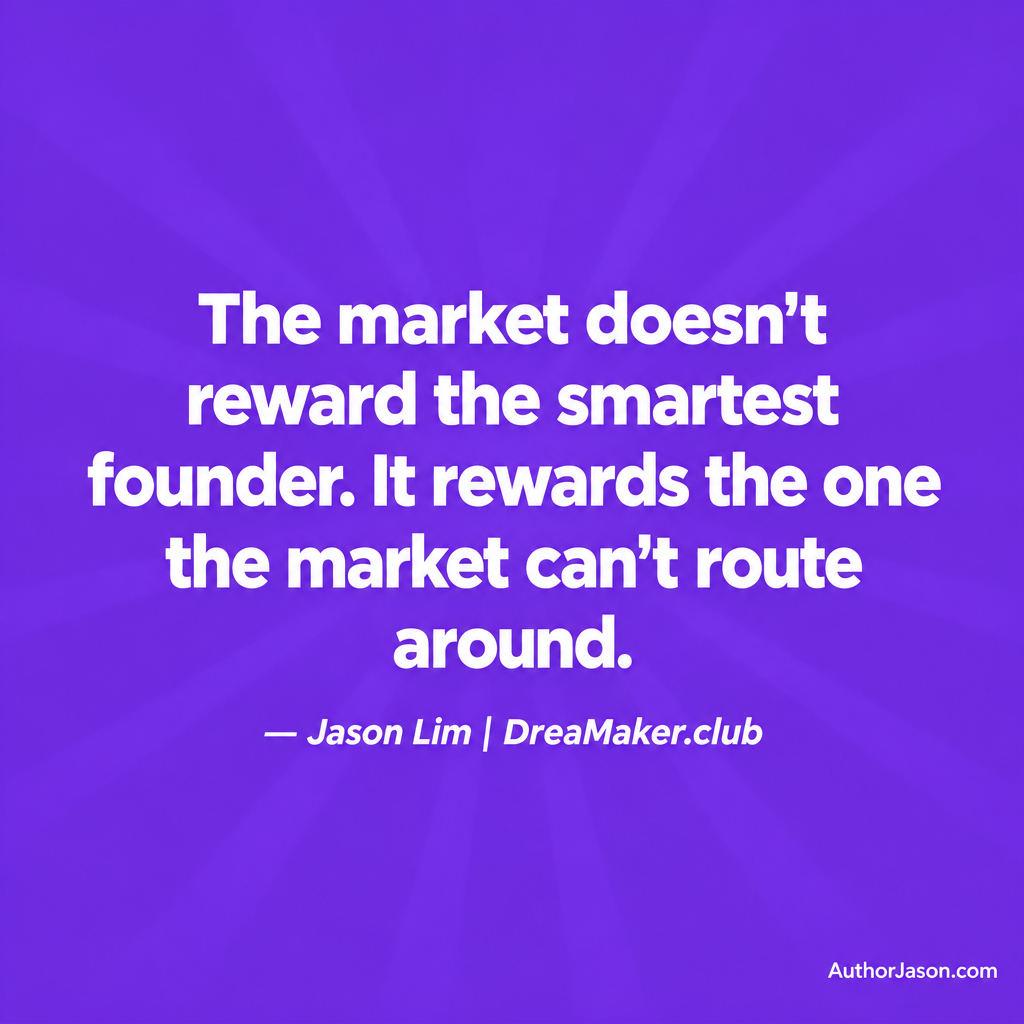
The market doesn't reward the smartest founder. It rewards the one the market can't route around.
Huang built CUDA — a system that made defecting from Nvidia economically irrational, even for competitors with more money. He did not win on specs. He won on lock-in that did not feel like lock-in, because developers genuinely loved the platform and built entire careers on top of it.
For a startup founder, this translates directly. You are not trying to build the product with the most features. You are trying to build the sales and delivery system that makes it structurally painful — or structurally irrelevant — for a buyer to consider someone else.
That system has a name in the sales context. It is called a trust architecture. It is the reason why two founders in the same market, selling nearly identical products, can produce wildly different close rates, retention numbers, and referral velocity. One is selling. The other has a system.
Founder Story Card
The visible problem: Your pipeline is full but conversion is slow. Deals stall. Buyers say "let me think about it" and disappear.
The real root cause: You are competing on product, not on system. Buyers have no structural reason to choose you over the next credible option they encounter next week.
The founder lesson: The market does not reward the smartest founder. It rewards the one the market cannot route around.
The move to make now: Stop optimising your pitch deck. Start building a sales system that creates buyer dependency — through trust, timing, and a framework that makes your competitors feel like the risky choice.
Part 5 — Opportunity + Conditions
Here is what the Forbes 400 2026 data is actually telling founders, and almost no one is saying it out loud.
The 2026 Forbes 400 combined net worth reached a record $8 trillion — up from $6.6 trillion just one year earlier (Forbes, September 15, 2026). The top 20 richest Americans got nearly $1 trillion richer in a single year (Forbes, September 2026). The minimum net worth to make the list hit a record $4.4 billion.
Every single one of the biggest gainers — Huang, Dell, Page, Brin — had one thing in common: they controlled infrastructure. Not products. Infrastructure. The thing other people had to use to participate in the market at all.
For a founder, "infrastructure" does not mean data centres. It means your sales and conversion system. The founder who makes it irrational for a buyer to go elsewhere — through trust, social proof, timing, and a clear framework — controls the infrastructure of their market.
That window is available right now, because most of your competitors are still selling. They have not built a system yet. The gap is real, and it is narrowing every month that the AI-driven buyer does their own research faster than you can catch them.
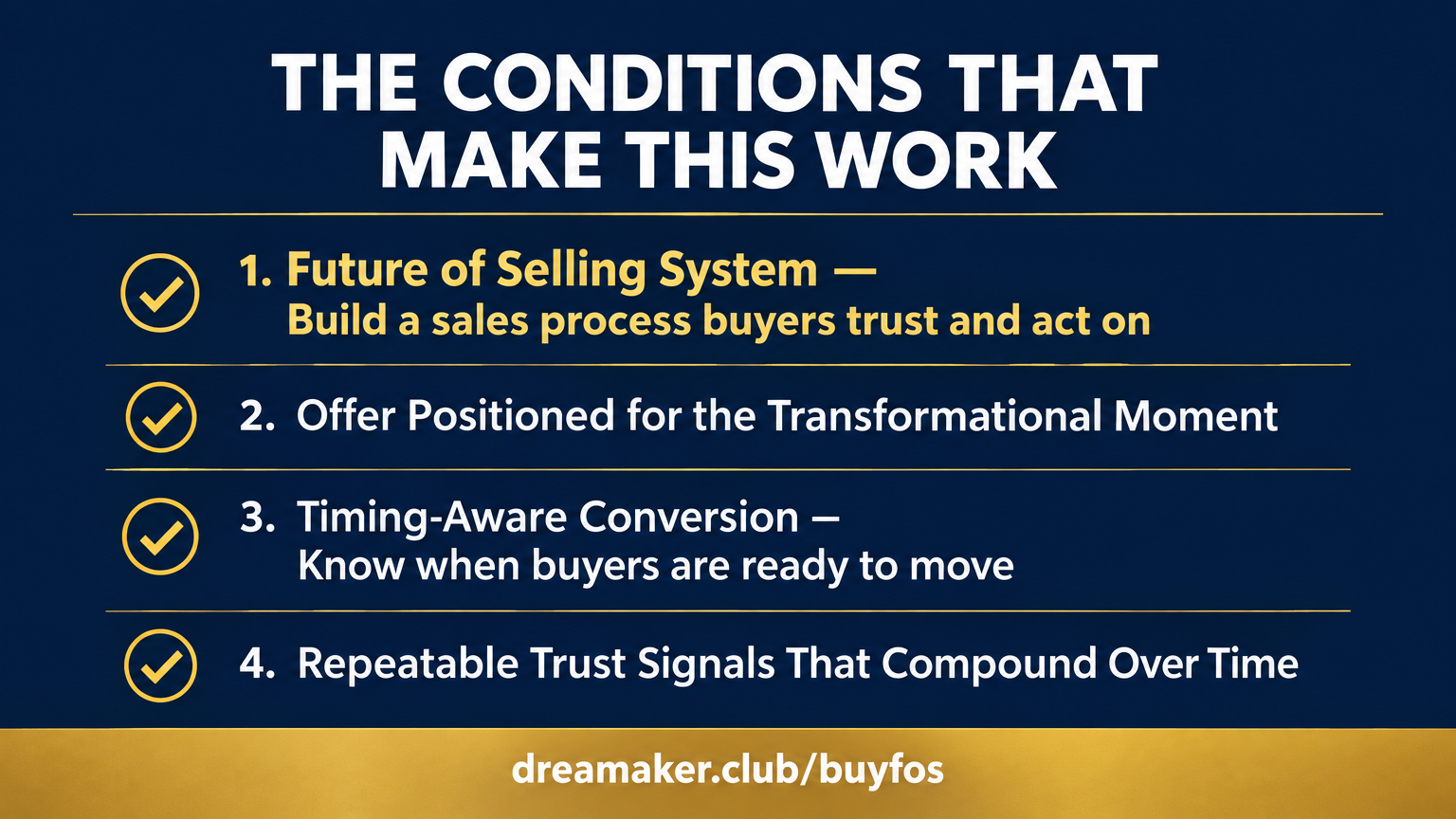
The Conditions That Make This Work
- Future of Selling System: Build a repeatable, trust-first sales process that converts buyers without pressure tactics or founder-dependent heroics — the same way CUDA created structural dependency before competitors could respond.
- Offer Positioned for the Transformational Moment: Your offer must match the biggest fear or aspiration your buyer holds right now — not what you think is valuable, but what the market is actively paying to solve.
- Timing-Aware Conversion: Know when your buyer is ready to move, not when you need them to. Huang did not push CUDA adoption — he built the ecosystem and let the AI wave do the pushing for him.
- Repeatable Trust Signals That Compound: Every touchpoint — content, referral, case study, conversation — must add to a growing trust architecture that makes you the obvious, low-risk choice without a pitch.
Part 6
Jensen Huang already moved. The only question is whether you will — or whether you'll read about someone else who did.


