Billionaire Jensen Huang Just Crossed $200 Billion By Saying What Every Other CEO Is Afraid To Say — And It Changes Everything For Founders Who Are Softening Their Pitch
Billionaire Jensen Huang Just Crossed $200 Billion By Saying What Every Other CEO Is Afraid To Say — And It Changes Everything For Founders Who Are Softening Their Pitch
Jensen Huang just said what nobody else in tech will say — and the market paid him $4.7 billion in a single day to prove it.
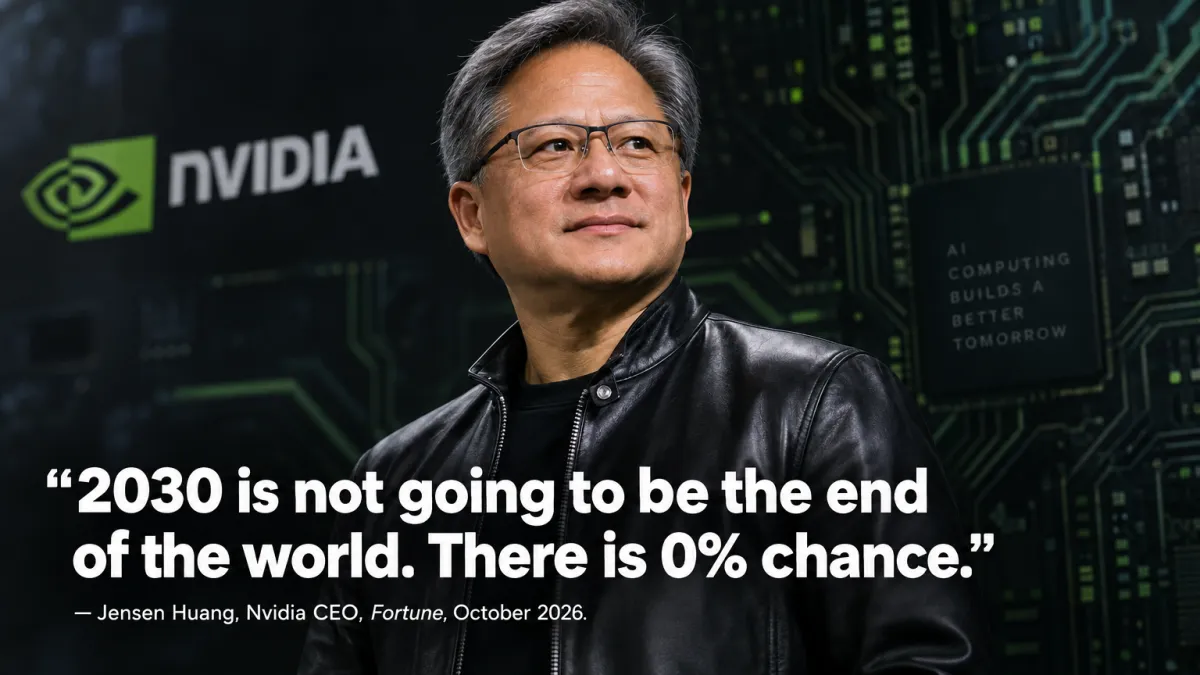
While every other AI executive hedged, qualified, and softened their language to avoid controversy, Huang stood in front of a CBS News camera and said the quiet part loud: "2030 is not going to be the end of the world." He called the AI apocalypse narrative "complete nonsense." He told policymakers to stop letting science fiction drive AI regulation. And then, as if the market needed to underline his point, Nvidia shares surged past $237 — a fresh all-time record — and Huang's net worth crossed $204.5 billion. The world's seventh-richest person didn't get there by hedging. He got there by holding a position.
Why This Should Make Every Founder Uncomfortable
Think about the last time you were on a sales call. A prospect pushed back. They said "I'm not sure AI is the right move right now" or "the market feels uncertain." What did you do?
If you softened your position — if you said "I understand your concern, there are definitely risks to consider" — you just signalled that you don't fully believe in your own solution. And if you don't believe in it, why should they?
Most founders think hedging is professional. It's not. It's fear dressed up as empathy. Jensen Huang just demonstrated, in front of the world, what happens when you hold your position — even when it's unpopular, even when your closest peers disagree, even when billions of dollars are on the line. The market rewarded him. Your buyers will reward you the same way — with trust, and with a yes.
What Actually Happened — And Why The Numbers Tell A Bigger Story
On October 2, 2026, shares of Nvidia surged to a fresh all-time high above $237 per share — up 26% since January 2026 — after Morgan Stanley reinstated the firm as a top-pick investment in the semiconductor sector, citing its broad customer base and undemanding valuation. Jensen Huang added $4.7 billion to his fortune in a single trading session, pushing his estimated net worth to $204.5 billion, according to Forbes. Nvidia's market capitalisation now stands at approximately $5.7 trillion, making it the world's most valuable company — up from $5 trillion in 2025, according to Forbes.
The stock's rise was fuelled not only by Wall Street analysis, but by a series of material events: the US government approved the sale of Nvidia's H200 chips to ten Chinese technology firms; Nvidia announced a planned acquisition of Hugging Face, the AI startup and open-source model hub; and Nvidia's Blackwell and Vera Rubin chip lines have projected sales that analysts are placing in the $1 trillion stratosphere. Nvidia is also preparing to double its CPU revenue to approximately $40 billion in the coming year. Meanwhile, Fortune reported on October 4, 2026, that Huang has repeatedly and publicly rejected AI doomerism — calling it, among other things, "complete nonsense" in a July 2026 Axios interview, while simultaneously insisting that AI safety remains "paramount" and requires "full-stack engineering."
This is not accidental. Huang has held a public, named, non-negotiable position since 1993 — when he co-founded Nvidia in a Denny's restaurant and bet everything on a chip category nobody believed in. Thirty-three years later, he is still doing exactly the same thing: making a $5.7 trillion argument with his chest out. Billionaire Jensen Huang's move is one Jason has seen across 1,000+ founders. Here's what most miss.
The Lesson — And The Root Cause Reframe Most Founders Completely Miss
Beat 1 — Root Cause Reframe
Most founders think the problem is objections. The prospect said it's too expensive. The prospect said they need to think about it. The prospect said the timing isn't right. So the founder chases better rebuttals, better scripts, better closing lines.
But the real problem is ambiguity. Buyers don't object to price. They object to uncertainty. And uncertainty is created the moment you hedge, qualify, or soften your position to avoid making someone uncomfortable. The second a founder says "of course, there are many valid approaches" or "I understand if this isn't the right fit for everyone" — they have just handed the buyer permission to say no. Not because the product isn't good. Because the founder's own posture communicated doubt.
Jensen Huang does not do this. When the AI doomerism crowd — including some of the most credentialed researchers and well-funded executives in the world — pressed their case publicly, Huang didn't hedge to avoid controversy. He named it. He said the end-of-the-world narrative was "complete nonsense" (Axios, July 2026). He told policymakers not to let science fiction drive national AI policy (Fortune, October 4, 2026). He held his position. And notice: he did not abandon safety — he called safety "paramount." He held both truths simultaneously, without softening either one. That is not recklessness. That is precision conviction.
Beat 2 — The Lesson

Conviction isn't arrogance — it's the operating system of trust. Buyers are not looking for the most agreeable founder. They are looking for the founder who knows something they don't — and who has the backbone to say it plainly. Every time you soften a position to avoid an objection, you reduce the buyer's confidence in the very solution you are asking them to bet on. Jensen Huang has spent 33 years being the most convicted person in any room he enters. It is not a personality quirk. It is a sales system.
Founder Story
Stanley Tan. 45 buyers. 3 hours.
Stanley Tan came to Jason already believing his product was good. What he didn't have was the system to make buyers believe it as fast as he did. Once he stopped hedging — once he held his position the way Huang holds his on AI — the room changed. He closed 45 buyers in a single 3-hour session. Not because the pitch got cleverer. Because the conviction became undeniable.
The Hidden Opportunity — And The Conditions You Need To Capture It
Beat 1 — Hidden Opportunity
Here is what nobody in your industry is talking about: your competitors are hedging. They are softening every claim, qualifying every result, and accommodating every objection to avoid being challenged. This means the moment you walk into a room — or onto a call — and hold a clear, named, non-negotiable position, you are not just selling differently. You are immediately distinguishable. In a market where AI, SaaS, and B2B solutions are commoditising faster than ever, conviction is not just a character trait — it is a competitive moat. The founder who holds their position earns the buyer's trust. The one who hedges earns a "let me think about it."
Jensen Huang didn't just say something polarising. He said something specific, citeable, and repeatable. That is exactly how buyers talk about solutions they trust — they repeat your words, because your words were clear enough to remember. If your buyers can't summarise your position in one sentence after a call with you, your pitch is too hedged.
Beat 2 — Conditions Checklist
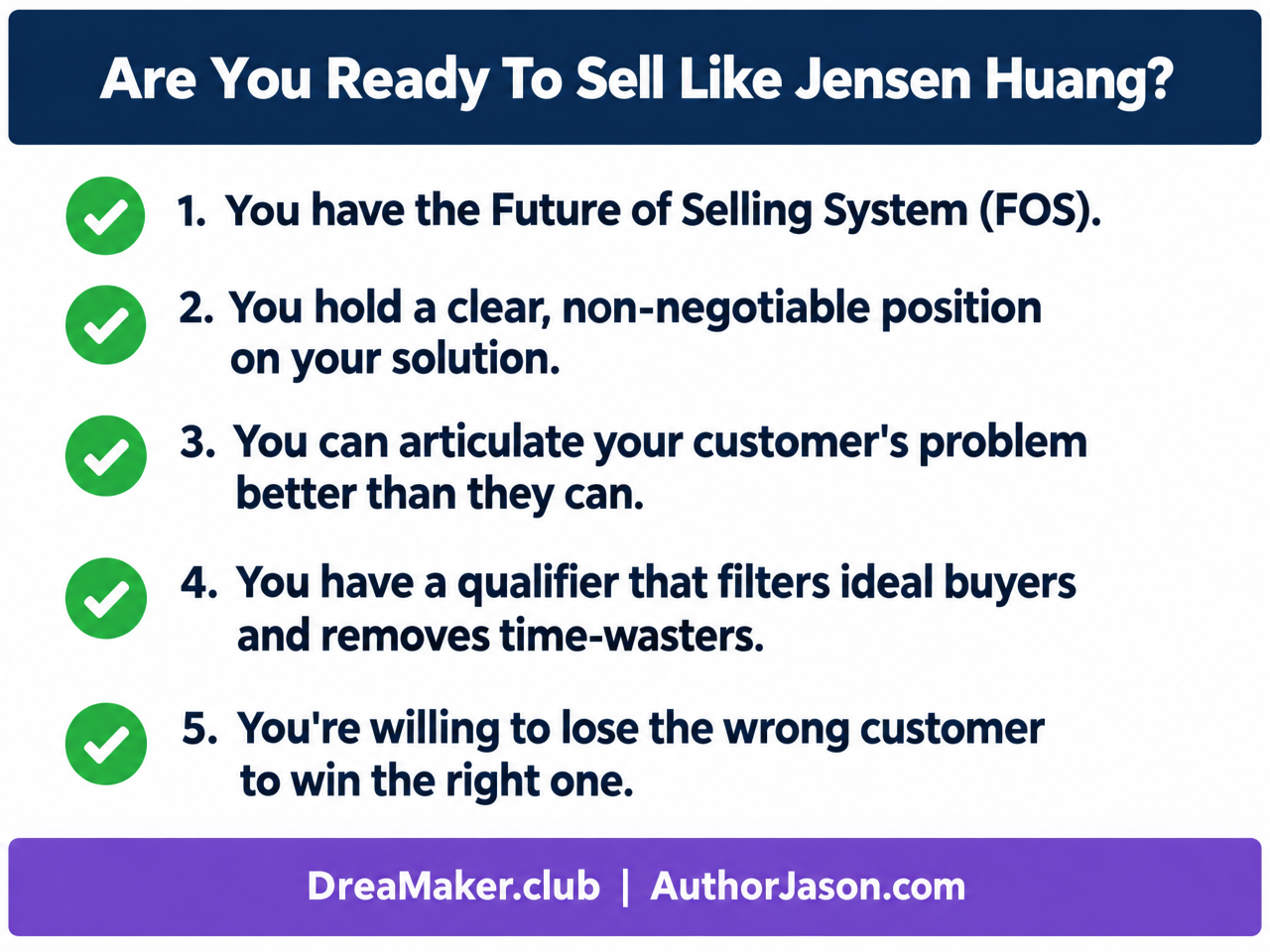
Are You Ready To Capture This Opportunity?
✅ Condition 1: You have the Future of Selling System — a repeatable selling framework that gives you the structure to hold your position under pressure, qualify the right buyers, and close without chasing.
✅ Condition 2: You hold a clear, non-negotiable position on your solution — you can say in one sentence what you believe, why you believe it, and who it is for. Not a hedge. A position.
✅ Condition 3: You can articulate your buyer's problem better than they can — before you pitch your solution, the buyer feels understood, not sold to.
✅ Condition 4: You have a qualifier that filters ideal buyers and removes time-wasters before the pitch even begins — so you are never in front of someone who was never going to buy.
✅ Condition 5: You are willing to lose the wrong customer to win the right one — because conviction, by definition, is not for everyone. And that's the point.
NEW! → October 2026
Dear Founders,
If you've been softening your pitch to avoid turning anyone off — you're already losing the deal before it starts. You can't close from a hedged position. Jensen Huang just added $4.7 billion in a day by saying exactly what he believes. You have a sales call next week. What are you going to say?
I know how you feel. I've sat in front of buyers and watched myself hedge, qualify, and soften — hoping it would make them more comfortable. It didn't. It made them less confident in me. What I found — and what 1,000+ founders since 2015 have found — is that conviction, delivered inside a structured selling system, is what moves buyers from "I'll think about it" to "let's go."
According to Salesforce's State of Sales report, 76% of buyers say they want a seller who can demonstrate clear expertise and a defined point of view — not someone who agrees with everything they say. The Future of Selling System gives you that structure: the framework to hold your position, qualify the right buyers, and close without chasing. Jeffrey Teo used it to land 63 customers in 100 days. Stanley Tan closed 45 buyers in 3 hours. Leon secured a $2M partnership. Combined, graduates of this system have generated $22M+ in sales.
Not ready for $19? Start free.
The Objection Playbook: 25 Word-for-Word Scripts to Close More Sales
The exact words Jason's founders use when a buyer says "too expensive", "send me info" or "I need to think about it". Free PDF, sent to your inbox.
Send Me the 25 ScriptsJensen Huang already moved. The only question is whether you will — or whether you'll read about someone else who did.


