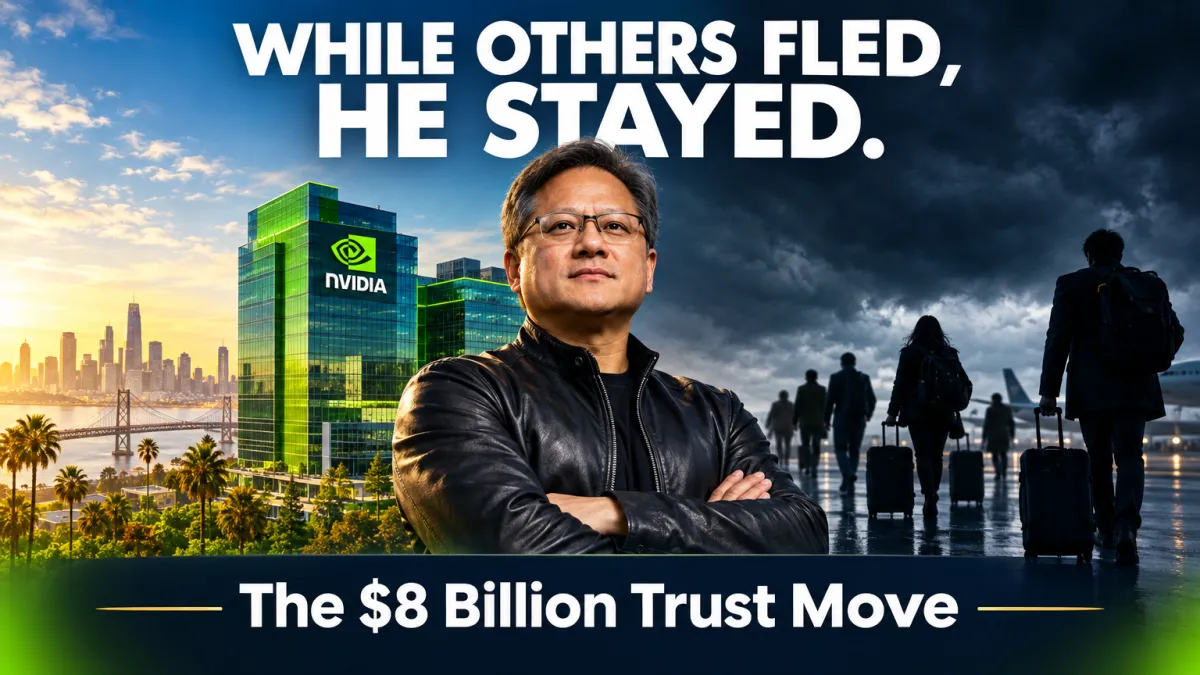
Billionaire Jensen Huang Just Accepted an $8 Billion Tax Bill — And It Changes Everything For Founders Who Want To Be Trusted
Billionaire Jensen Huang Just Accepted an $8 Billion Tax Bill — And It Changes Everything For Founders Who Want To Be Trusted
Part 1 — The Story That Changes the Way You Sell
Jensen Huang just refused to leave California — even with an $8 billion tax bill waiting for him. While peers quietly relocated to lower-tax states, he stayed put. Most founders will read this as a billionaire quirk. They will miss the only part of the story that matters to their business.
Every founder wants buyers to trust them faster. What almost no founder understands is that trust is not a feeling you create with words — it is a signal you send with cost. When leaving is cheap and staying costs $8 billion, staying becomes the most credible thing you can do. Huang just gave every founder in the world a masterclass in buyer psychology — and most will scroll past it.
Part 2 — Why This Hits Different If You Are Building Something
Here is what stings if you are a founder: you already know the lesson Huang just demonstrated publicly — and you are still not doing it.
Every day, you look for ways to reduce friction, lower the cost of closing, and make your offer feel safer to buyers. You soften your pricing. You hedge your positioning. You add so many opt-outs and guarantees that your offer starts to look like a company that does not fully believe in itself.
And then a man who could have simply moved to Texas or Florida stands firm in California with an $8 billion reason to leave — and his credibility doubles overnight.
The problem is not that you do not know that commitment builds trust. The problem is that you keep treating trust as a feeling to manage rather than a signal to send. You are trying to talk buyers into confidence. Huang just demonstrated that buyers do not need to be talked into anything. They need to see evidence that you are not going anywhere.
That evidence has to cost you something. If it costs you nothing, it signals nothing.
Part 3 — What Actually Happened
California enacted a new wealth tax in 2026 targeting ultra-high-net-worth residents, with estimates placing Jensen Huang's personal tax liability at approximately $8 billion, according to a report by 247 Wall St published September 21, 2026.
Within months of the law's introduction, Larry Page and Sergey Brin — co-founders of Google — relocated out of California, as did venture capitalist and PayPal co-founder Peter Thiel, per the same report from 247 Wall St.
Huang made no such move. As of the report's publication date of September 21, 2026, he remains based in Santa Clara, California — where NVIDIA, the AI chip company he co-founded, is headquartered.
His decision to stay is not a lifestyle preference. It is a visible, costly, public act in a market that watches every signal a leader sends. When peers exit, staying becomes differentiation. When the exit is cheap and staying costs $8 billion, staying becomes reputation.
Billionaire Jensen Huang's move is one Jason has seen across 1,000+ founders. Here's what most miss.
Part 4 — The Lesson and the Root Cause Reframe
Most founders think the problem is getting buyers to trust them faster. But the real problem is that founders keep sending signals that say I might not be here tomorrow.
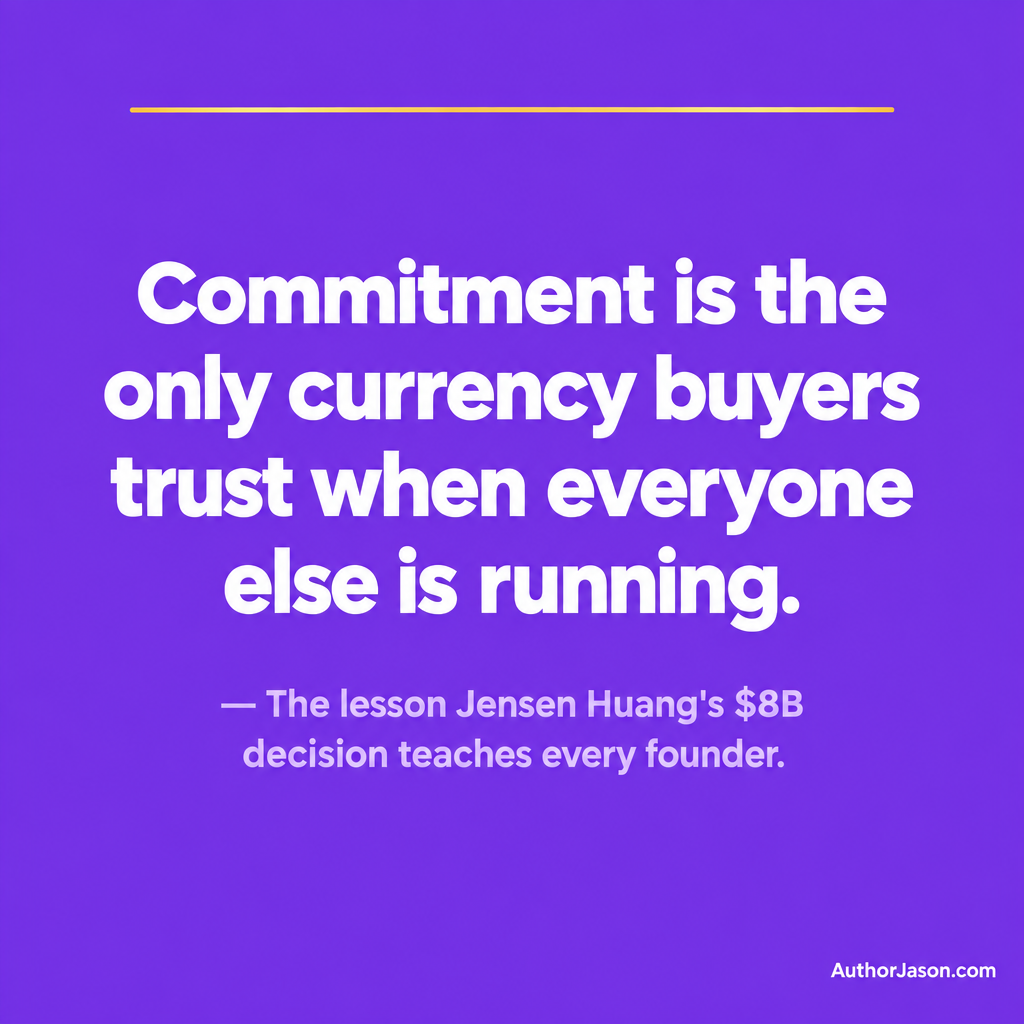
"Commitment is the only currency buyers trust when everyone else is running."
That is the lesson buried in Huang's decision. In a moment when the rational move was to leave — when the tax cost was objectively enormous, when peers had already shown the exit was available — he stayed. And in staying, he sent a signal no marketing campaign could replicate: I am not going anywhere.
Buyers — whether they are enterprise procurement teams, mid-market decision-makers, or individual consumers — are always running a background check on your commitment level. They are asking: Will this founder still be here in 12 months? Will this company honour what it promises? Is this a long game or a cash grab?
Founders try to answer those questions with words. Case studies. Testimonials. Guarantee clauses. Huang answered with $8 billion.
The reason founders struggle to close is rarely their product. It is rarely their price. It is almost always the invisible doubt buyers carry into every conversation: what if this person bails when things get hard?
You cannot talk your way out of that doubt. You can only signal your way out. And the signal has to cost you something real — a visible stake, a public position, a boundary you will not cross for a quick win. When buyers see you bearing cost to stay consistent, they stop shopping around. When they see you fold the moment staying gets expensive, they never fully commit.
Founder Story Card
The visible problem: Founders cannot get buyers to close faster or commit at higher price points.
The real root cause: Buyers do not believe the founder will still be committed in six months — because the founder keeps removing all the cost and risk from their own side of the deal, which makes the offer look fragile.
The founder lesson: Trust is not built by reducing your risk. Trust is built by visibly bearing it. The signal is the cost you are willing to pay to stay.
The move to make now: Identify one public, specific, costly commitment signal you can make this week — a guarantee you actually stand behind at your own expense, a position you hold without hedging, a boundary that shows buyers you are playing a long game and will not compromise it for a short-term close.
Part 5 — The Opportunity and the Conditions That Make It Real
Here is what almost nobody is talking about: the founders who understand this moment are about to pull far ahead of every competitor who is still competing on features and price.
When the market is volatile — when buyers are nervous, budgets are compressed, and every vendor is promising the moon — commitment signals become the rarest and most valuable asset in a sales conversation. Buyers are sorting every vendor into one of two buckets right now: vendors they trust to be here next year, and vendors they are not sure about. Most founders do not even know which bucket they are in.
The founders who win in this environment are not the ones with the best product deck. They are the ones who can say — and prove — "We are not going anywhere." The ones who have structured their offer, their positioning, and their entire sales approach around making that signal undeniable. That window is open right now, and it will not stay open once competitors catch on.
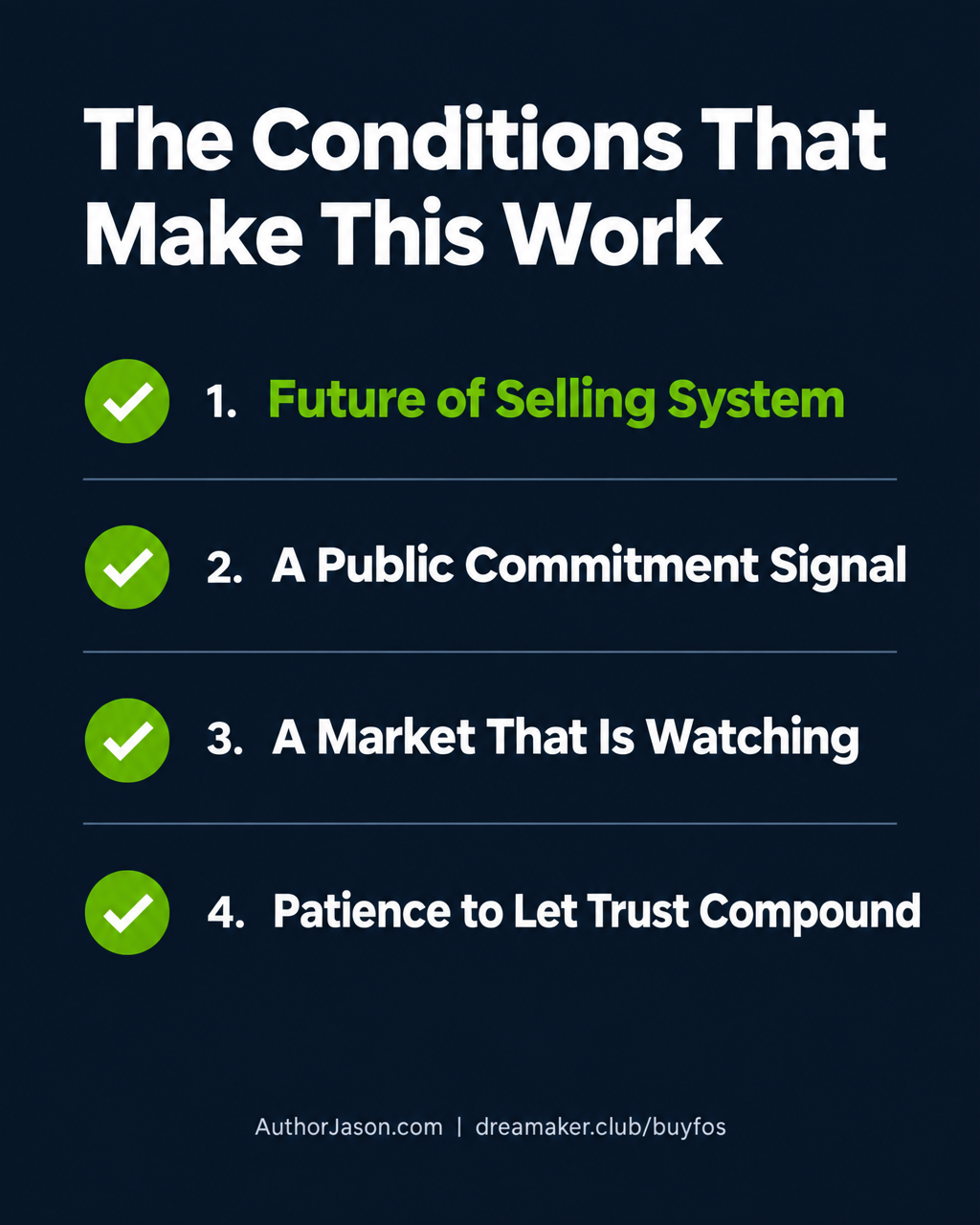
The Conditions That Make This Work
- Future of Selling System: You need a structured sales methodology that bakes your commitment signal into every touchpoint — so buyers feel it before you ever ask for the close. The Future of Selling System gives founders the framework to make trust the foundation of every conversation, not an afterthought bolted on after the pitch. Without this structure, your commitment signal is a moment. With it, your commitment signal is a system. See FOS here →
- A Public Commitment Signal: The signal must be visible, specific, and costly enough to be credible. A vague "we are in it for the long haul" is not a signal — it is a phrase. Huang's $8 billion is a signal. Identify your version: a guarantee you actually stand behind, a price you will not discount, a client you will turn away, a position you will not abandon to chase a trend.
- A Market That Is Watching: Your commitment signal only works if it reaches the people making the buying decision. Publish it. Say it. Stand by it publicly — not just in private pitch decks or one-on-one sales calls. The signal compounds when more people see it.
- Patience to Let Trust Compound: Commitment signals do not convert immediately. They build over time. The founders who win are the ones who make the signal today and let it work across 30, 60, 90 days of the buyer's decision journey — resisting the urge to compromise it the moment a short-term deal looks tempting.
Huang already moved. The only question is whether you will — or whether you'll read about someone else who did.


