Billionaire Jensen Huang Just Welcomed an $8 Billion Tax Bill — And It Changes Everything For Startup Founders
Billionaire Jensen Huang Just Welcomed an $8 Billion Tax Bill — And It Changes Everything For Startup Founders
Jensen Huang just welcomed an $8 billion tax bill that other billionaires moved states to avoid. While Larry Page, Sergey Brin, and Peter Thiel quietly relocated — buying Miami mansions, converting family offices to Delaware, listing Nevada addresses — Huang told CBS News the potential levy felt like a privilege. Not a strategy. A privilege. That single word is the most important business signal of the week, and almost no founder will hear it correctly.
Why This Hits Different If You Are Building a Business Right Now
Most founders read this story and feel one of two things: admiration that fades quickly, or a private thought that goes something like easy to say when you have $184 billion. Both reactions miss the point — and both are expensive mistakes.
The Huang story is not about taxes. It is not about California. It is not about wealth redistribution or ballot measures. It is about what happens when a founder's identity is so inseparable from their mission and their market that no external condition — not regulation, not geography, not a multibillion-dollar bill — can shake the foundation they have built.
That is the thing most founders are not building. They are building businesses that require favorable conditions. When conditions shift — a market dries up, a platform changes its algorithm, a tax code tightens — they scramble. They relocate. They restructure. They flee. And the buyers who were watching decide the business is not as solid as it looked.
Huang did not move. And every buyer, partner, and recruit who watched what happened just received a signal that Nvidia is not going anywhere. That signal is worth more than $8 billion.
What Actually Happened — The Facts Founders Need
California's Proposition 40 — formally Initiative No. 25-0024 — is a ballot measure that California voters will decide on November 3, 2026, according to 247 Wall St., published September 21, 2026. It proposes a one-time 5% excise tax on accumulated wealth above a one-billion-dollar threshold. Residency is fixed by a snapshot date of January 1, 2026. The tax would be due in 2027, payable over five years.
Roughly 200 to 250 individuals with combined net worth of approximately one trillion dollars would be affected, per 247 Wall St. For Jensen Huang — whose fortune is estimated at $184 billion, driven largely by his stake in Nvidia — the potential liability sits at approximately $8 billion over five years, as reported by Benzinga and CBS News on September 21, 2026.
Bloomberg reported that at least six billionaires publicly cut ties with California before the residency snapshot cutoff: Larry Page, Sergey Brin, Peter Thiel, Don Hankey, Travis Kalanick, and Steven Spielberg, per 247 Wall St. Page purchased two Miami waterfront mansions for a combined $173 million and converted his family office to a Delaware corporation with a Florida address. Sergey Brin acquired a $51 million Miami property and listed Nevada as his official residence. Their departures alone are projected to cost California $26.7 billion in lost one-time revenue, reducing the tax's total projected intake from $100 billion to $40 billion, according to 247 Wall St.
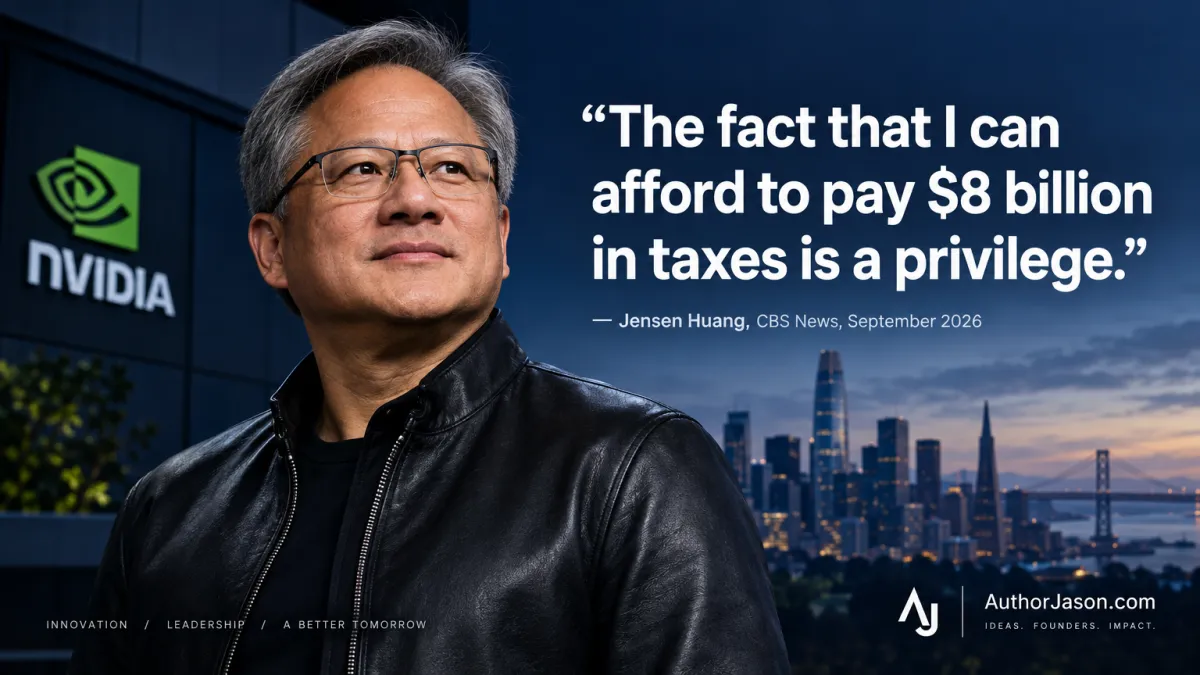
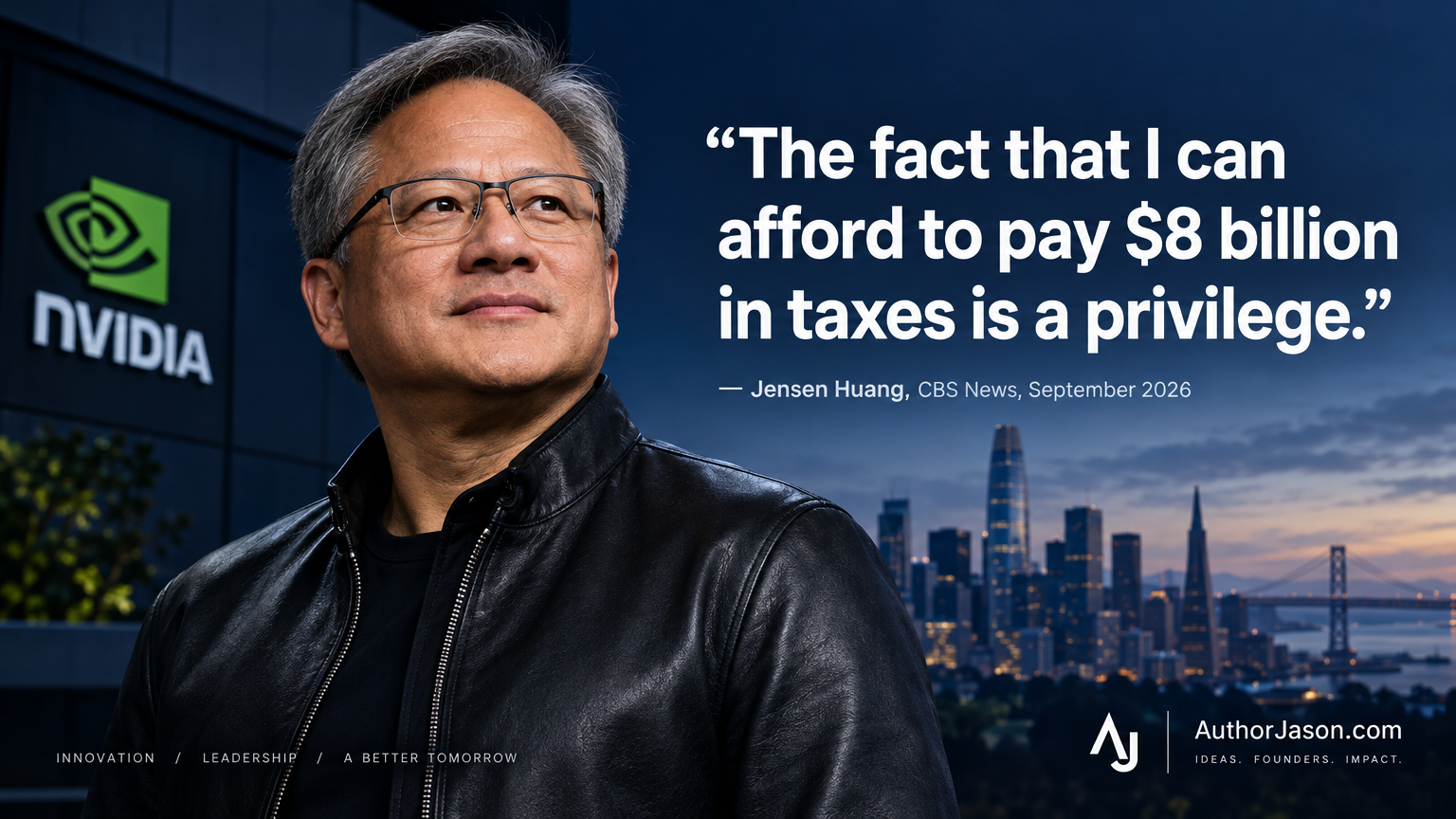
In a CBS News interview with correspondent Jo Ling Kent, published September 21, 2026, Huang said: "The fact that I can afford to pay $8 billion in taxes over five years is a privilege. I feel it's a privilege. It's a responsibility. And nothing would give me more joy than to be able to pay even more taxes." He added: "I'm not afraid of paying taxes — I'm just afraid of being poor."
Billionaire Jensen Huang's move is one Jason has seen across 1,000+ founders. Here's what most miss.
The Lesson Most Founders Will Completely Miss

Root Cause Reframe
Most founders think the problem is conditions — the tax rate, the regulatory environment, the city, the platform, the algorithm, the market cycle. But the real problem is building a business that can only survive when those conditions stay favorable.
Huang did not stay in California because the taxes are cheap. He stayed because his identity, his mission, and his market value do not require a favorable tax code to justify their existence. He built something so undeniably valuable — and so clearly rooted in a specific mission — that leaving would have cost him more in trust, signal, and market positioning than $8 billion ever could.
The Lesson
Paying the $8 billion bill is the reward — not the punishment. The real threat to your business isn't the tax man. It's never building something worth taxing.
Founders who flee difficult conditions are not making a strategic move. They are revealing that their foundation was conditional. And buyers notice. Recruits notice. Partners notice. Every time a founder restructures around avoiding pressure rather than delivering value, they send a signal that the business is built on proximity to favorable conditions — not on genuine, transferable worth.
The founders who win are the ones who are so clearly positioned, so obviously the right choice for their specific buyer, and so mission-rooted in what they do that no external pressure makes them flinch. That is not an accident. That is a sales and positioning system.
Founder Story Card
The visible problem: Founders feel squeezed by taxes, regulations, platform changes, or market shifts — and restructure, relocate, or pivot to escape the pressure.
The real root cause: They built a business that depends on external conditions staying favorable. When conditions change, the foundation reveals itself as conditional, not mission-rooted.
The founder lesson: Huang's refusal to flee is not altruism — it is the outward signal of a business so clearly positioned and so mission-driven that geography is irrelevant. His identity is his moat, not his zip code.
The move to make now: Build a sales and positioning system so clear, so trusted, and so aligned with your mission that no market condition — no tax, no algorithm change, no competitor — can shake your foundation or confuse your buyers.
The Hidden Opportunity Inside This Story
Every time a high-profile billionaire or founder publicly flees a market — California, the UK, a crumbling industry sector — they leave something behind: the trust, the visibility, and the market share that buyers now need to redirect somewhere. Page, Brin, Thiel, Kalanick. Their departures do not erase the demand in those markets. They create a vacuum.
Founders who stay rooted, clearly positioned, and mission-driven are not just surviving — they are inheriting the market that the flight-risk founders are abandoning. The California vote is November 3, 2026. The positioning window is open right now.
But capturing that window requires something most founders have not built: a sales and positioning system that makes buyers choose you on conviction, not on coincidence. The founders who will win this moment are not the ones who read this story and feel inspired. They are the ones who already have a system for converting their expertise, trust, and timing into predictable revenue — and who can activate it faster than the founders still scrambling to find stable ground.
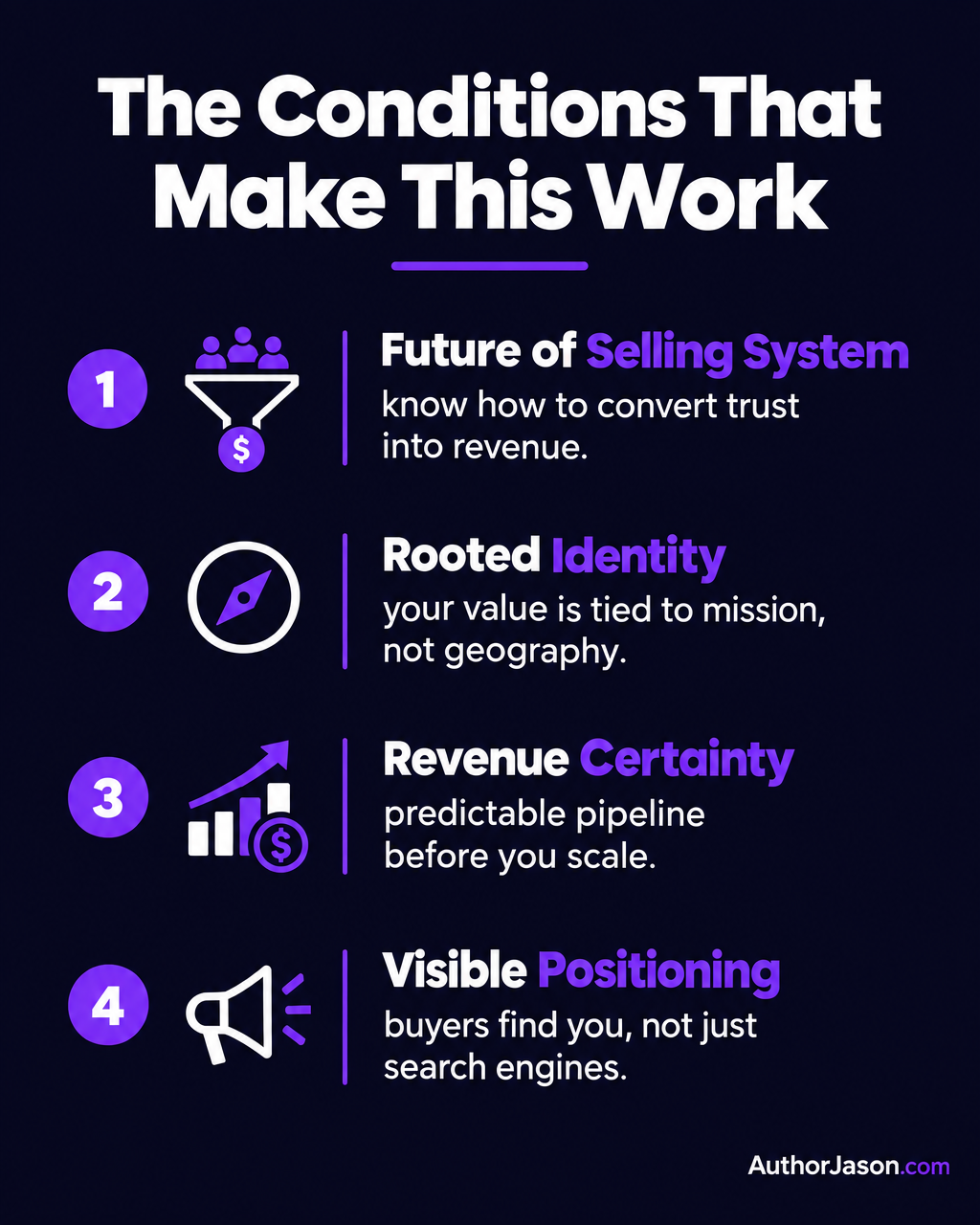
The Conditions That Make This Work
- Future of Selling System: You need a proven framework for turning your expertise, trust, and timing into consistent, predictable sales — before the market shifts again. Without it, mission alone does not convert to revenue.
- Rooted Identity: Your value must be tied to a clear mission and a specific buyer outcome — not to geography, platform, or favorable conditions. If your positioning requires favorable conditions to work, it is not positioning. It is luck.
- Revenue Certainty: A predictable pipeline that does not collapse under pressure. Huang did not fear the $8 billion bill because Nvidia's revenue engine is not conditional. Yours should not be either.
- Visible Positioning: Buyers need to be able to find you, understand your offer, and make a decision — without needing you to chase them. Clarity of positioning is what makes staying in a difficult market an advantage, not a liability.
Jensen Huang already moved. The only question is whether you will — or whether you'll read about someone else who did.


