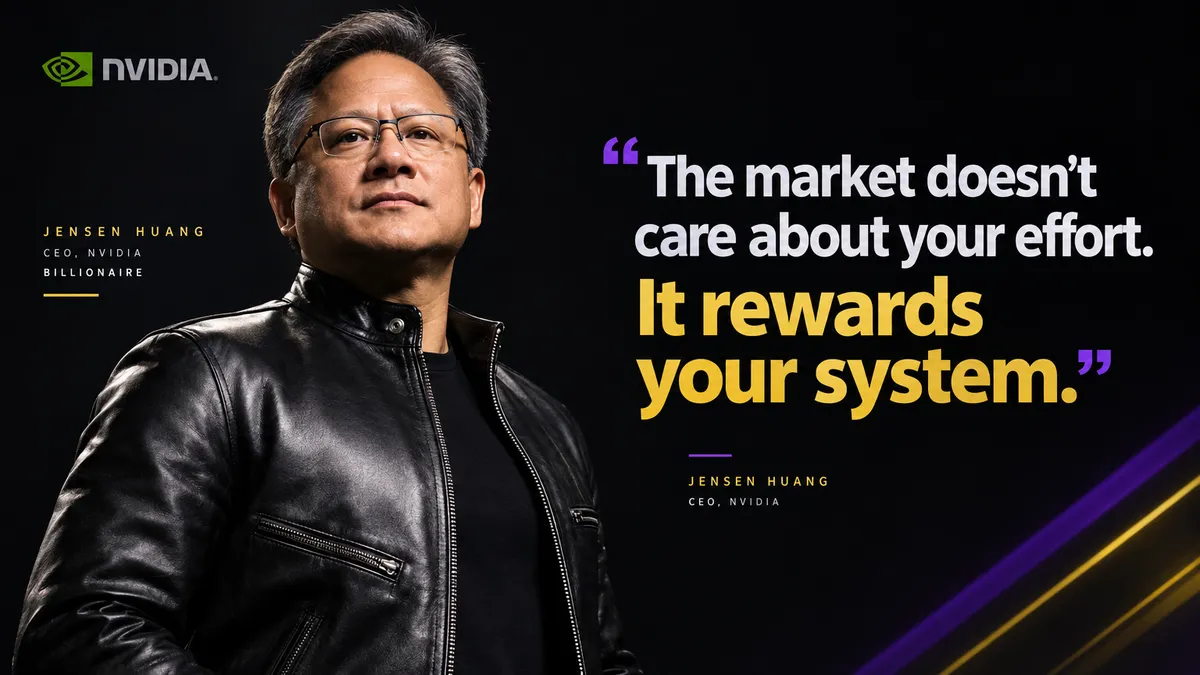
Billionaire Jensen Huang Just Lost $2.5 Billion In A Day — And It Changes Everything For Founders Who Think Market Conditions Control Their Revenue
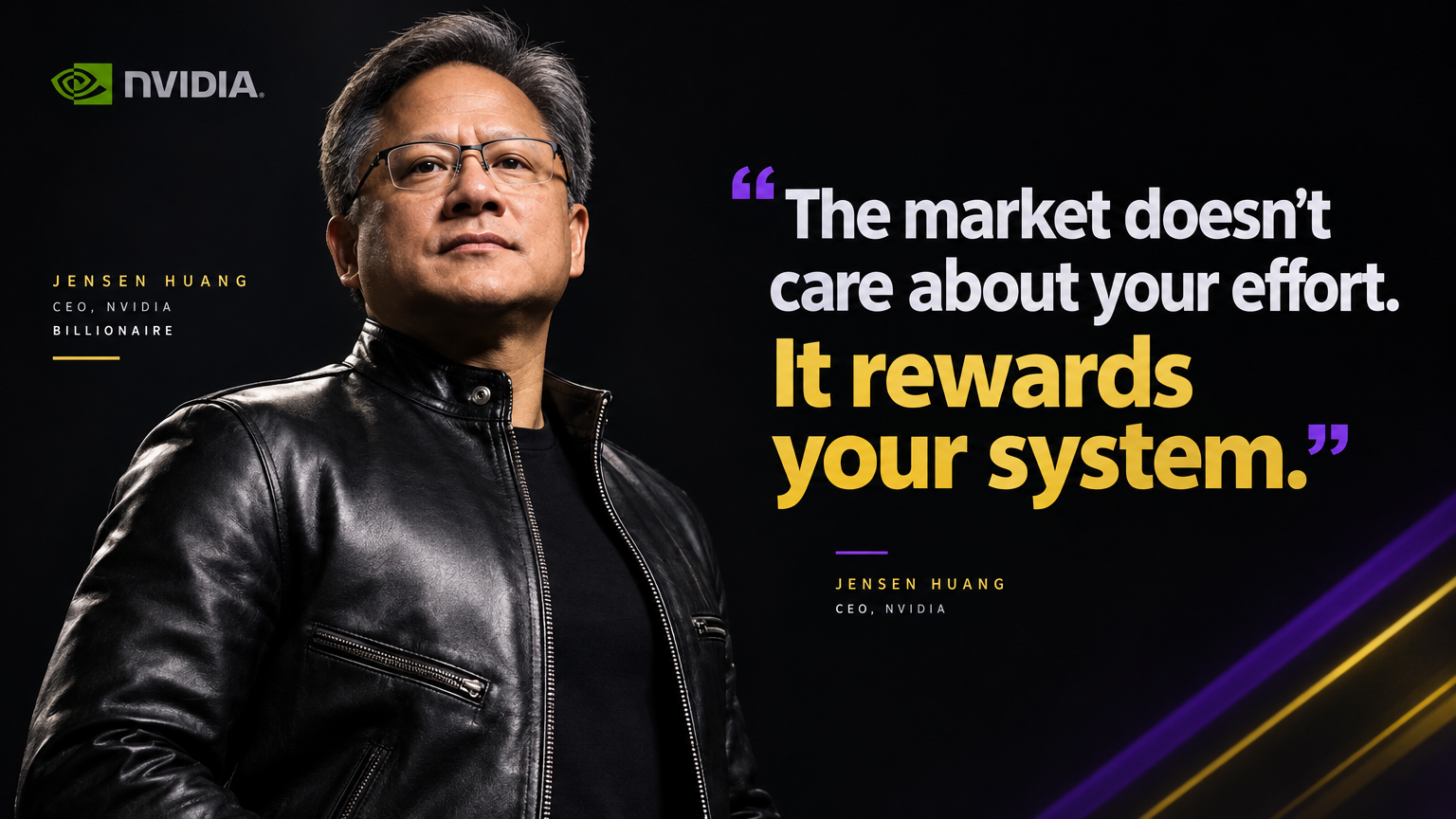
Jensen Huang, Nvidia CEO | Photo illustration: DreaMaker.club / AuthorJason.com
Billionaire Jensen Huang Just Lost $2.5 Billion In A Day — And It Changes Everything For Founders Who Think Market Conditions Control Their Revenue
Jensen Huang woke up on October 13, 2026 worth $2.5 billion less than the night before.
No product failure. No scandal. No strategy mistake. The global chipmaker selloff — triggered by a Samsung and SK Hynix rout in Seoul — swept across the Nasdaq and took Nvidia with it. Bloomberg's Billionaires Index confirmed the single-session drop. At the same moment, Meta's Mark Zuckerberg gained $8.2 billion. Same market. Same session. Opposite outcomes.
If you read this as a market story, you will miss everything that matters to your business right now.
Here is what most founders do not want to admit:
Your pipeline behaves exactly like Nvidia's stock price — except you have no market cap to cushion the fall.
When the economy tightens, deals disappear. When a key buyer stalls, revenue freezes. When a competitor cuts price, your pipeline collapses. You call this bad luck or bad timing. But Jensen Huang did not lose $2.5 billion because of bad luck. He lost it because external forces moved — forces that had nothing to do with Nvidia's fundamentals.
The question for you: when market forces move in your industry — when a competitor gets funded, when a big client pauses, when the macro gets noisy — does your pipeline hold, or does it evaporate? If you cannot answer that with certainty, you do not have a selling system. You have a mood.
What Actually Happened
On October 13, 2026, a chipmaker selloff originating in Korea's semiconductor market — led by heavy losses in Samsung and SK Hynix — rolled into the US Nasdaq session. Nvidia, despite reporting no negative operational news, was caught in the sector-wide correction. According to the Bloomberg Billionaires Index (October 13, 2026), Jensen Huang's net worth fell $2.5 billion in a single trading session, dropping his ranking on the real-time wealth tracker.
Context: Huang's net worth stands at approximately $96 billion. Nvidia's trailing twelve-month revenue is $130.5 billion (Nvidia Q4 FY2026 Earnings, February 2026). The company controls an estimated 80% of the AI training chip market (Morgan Stanley Research, September 2026). Not one of those fundamentals changed on October 13.
At the same time, Mark Zuckerberg gained $8.2 billion as Meta surged 3.33% on the same Nasdaq session — driven by strong AI advertising momentum. Same market. Same session. Two billionaires. Two opposite outcomes determined entirely by their positioning, not their work ethic that day.
Billionaire Jensen Huang's $2.5 billion single-day drop is one Jason has tracked across 1,000+ founders. Here's what most miss.
The Lesson Most Founders Miss — And the Root Cause Nobody Talks About
Most founders think the problem is market conditions. They say: "The economy is soft." "Buyers are cautious." "Our industry is down." They wait for conditions to improve before they push harder on sales.
But the real problem is not the market. The real problem is that they have no selling system — so every external shift becomes a revenue event.
Jensen Huang did not choose to lose $2.5 billion. Chipmaker sentiment moved and Nvidia's stock moved with it — because in public markets, short-term price is driven by macro forces, not daily execution. Huang knows this. He does not rebuild Nvidia's business every time the stock dips. The fundamentals — $130.5B in revenue, 80% market share in AI chips — stay intact regardless of a single session's noise.
Founders do not have that luxury yet. When macro sentiment shifts, they feel it immediately in their pipeline — because their pipeline is built on relationships, on goodwill, on a single buyer's mood. There is no system underneath to hold it.
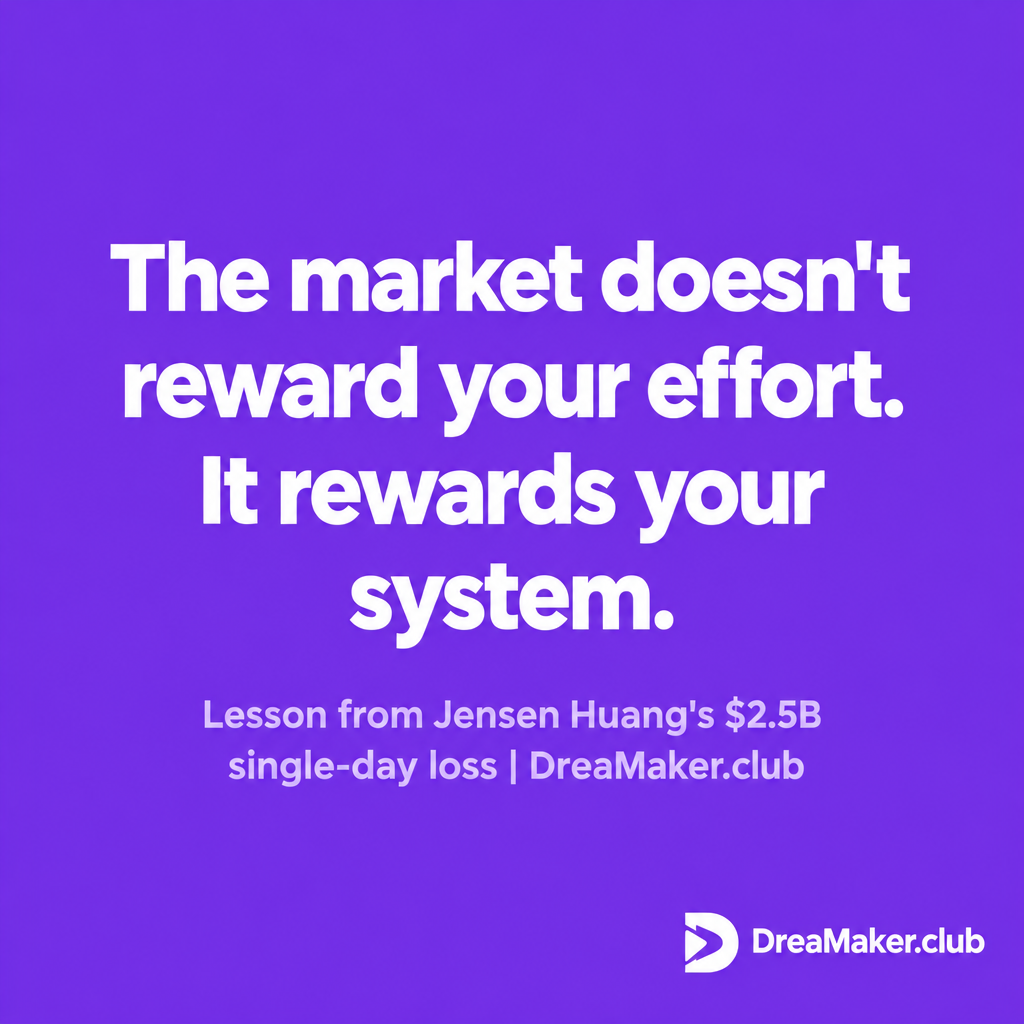
The quotable lesson: "The market does not reward your effort. It rewards your system."
Here is what that means operationally for a startup founder running a team of five or more:
- If your revenue rises when you personally hustle and falls when you pull back — you have a mood, not a system.
- If your pipeline depends on one anchor client, one vertical, or one referral source — you are one macro event away from a $2.5 billion day of your own (scaled to your ARR).
- If your team cannot close without you in the room — the system does not exist yet.
Nvidia's stock fell. Its fundamentals did not. The founders who will win in 2026 and beyond are the ones whose sales fundamentals — their repeatable process, their conversion rates, their pipeline depth — hold steady regardless of what the market does around them.
Founder Story
Stanley Tan closed 45 buyers in 3 hours.
Not 45 leads. 45 buyers. In a single session. He did not hustle harder than the day before — he ran a system for the first time. The market did not change. The process did. That is the difference between effort-dependent revenue and system-driven revenue.
The Hidden Opportunity — And The Founders Who Will Take It
Here is the opportunity most founders are completely missing right now:
When market turbulence hits — when chipmaker selloffs, rate decisions, or geopolitical shocks create fear in the buyer's market — most founders pause. They freeze. They wait for the dust to settle. Their competitors do the same.
That creates a brief window — usually 5 to 15 business days — where the founders with a repeatable selling system capture deals at lower resistance. Buyers who have been sitting on decisions suddenly feel the urgency the macro creates. They need a proven solution, not a pitch. If you have a system that demonstrates results in advance, you close in the window. If you do not, you wait it out and wonder why Q4 was soft.
October 2026 is that window. The chipmaker selloff just opened it. The question is whether you have the system to walk through it.
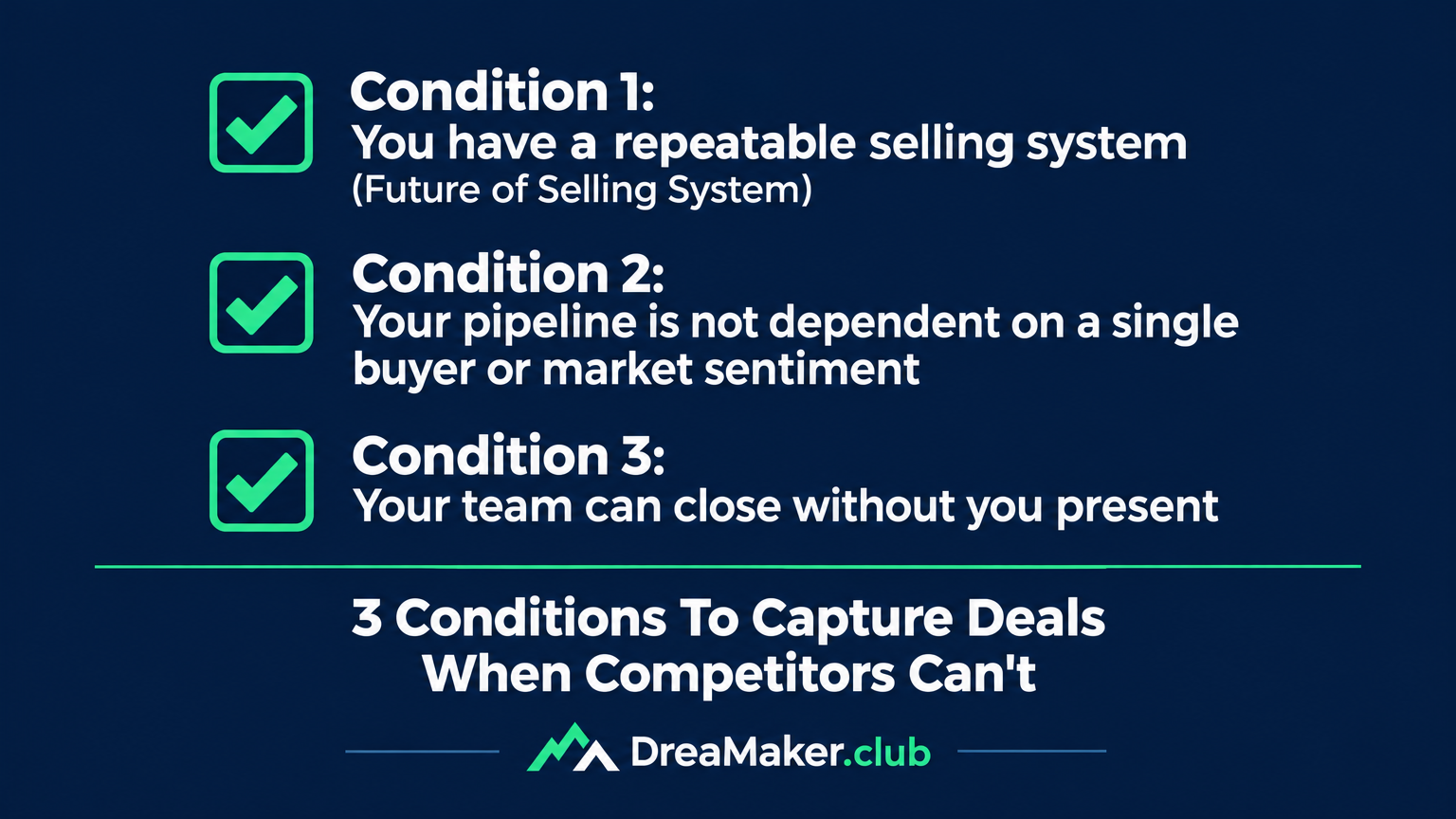
3 Conditions To Capture Deals When Competitors Can't:
✅ Condition 1 — You have the Future of Selling System (FOS).
Not a loose set of scripts. A structured, sequenced system that your team can run without you in the room. FOS is the prerequisite. Every other condition assumes it is already in place.
✅ Condition 2 — Your pipeline is not single-threaded.
You have multiple active conversations across at least three different buyer segments. When one segment freezes, the other two keep moving. Jensen Huang's business runs across data centres, gaming, automotive, and robotics. No single buyer type can collapse his revenue. Neither should yours.
✅ Condition 3 — Your team can close without you present.
Macro windows are short. If only the founder can close, the window closes before you reach half your pipeline. Your system must be teachable, runnable, and scalable across your team — not trapped in the founder's head.
NEW!
October 2026
Dear Founders,
If your pipeline dries up every time the market gets nervous, you don't have a selling system — you have a mood. And a mood will not close deals in October 2026.
I have felt this too — the quarter that collapses the moment a single anchor client pauses. I felt it when I thought having a great product was enough. I found that it is never the product. It is always the system.
Salesforce's State of Sales (2025) found that 76% of salespeople say their biggest challenge is not the product — it is a repeatable, scalable process. The process is the product.
Since 2015, Jason has trained 1,000+ founders — generating $22M+ in combined sales across graduates. Jeffrey Teo closed 63 customers in 100 days. Stanley Tan closed 45 buyers in 3 hours. Leon closed a $2M partnership. None of them got better market conditions. All of them got a system.
Not ready for $19? Start free.
The Objection Playbook: 25 Word-for-Word Scripts to Close More Sales
The exact words Jason's founders use when a buyer says "too expensive", "send me info" or "I need to think about it". Free PDF, sent to your inbox.
Send Me the 25 ScriptsBillionaire Jensen Huang already moved. The only question is whether you will — or whether you'll read about someone else who did.


