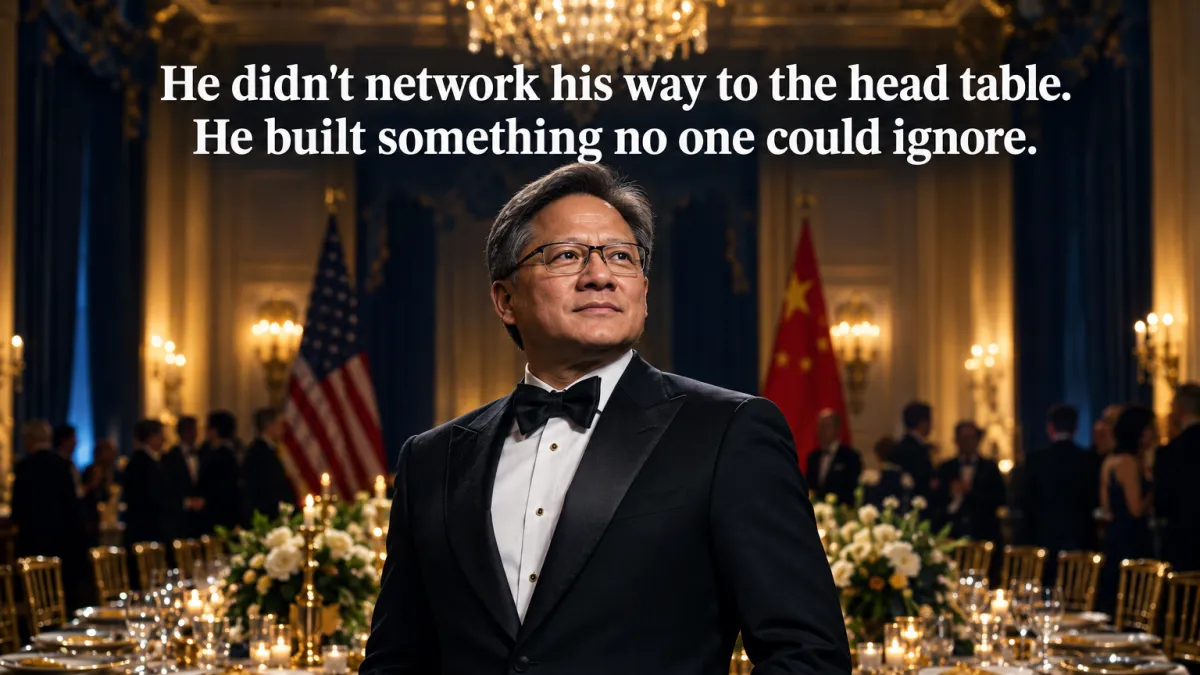
Billionaire Jensen Huang Just Sat Between Two Presidents — And It Changes Everything For Startup Founders
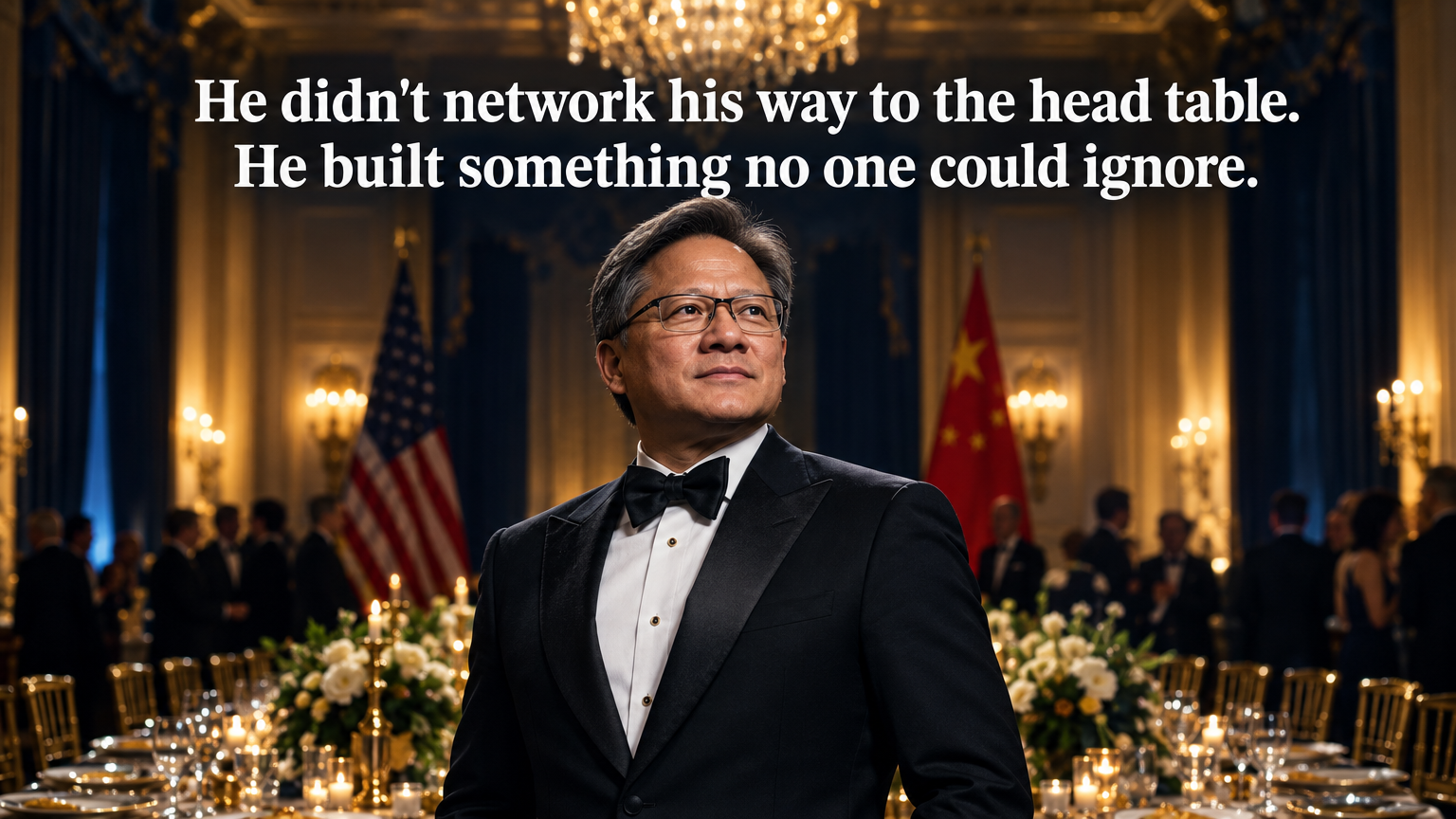
Billionaire Jensen Huang Just Sat Between Two Presidents — And It Changes Everything For Startup Founders
Jensen Huang sat between the US and Chinese presidents. His chips are banned from China. That's the point. On the night of September 24, 2026, the Nvidia CEO was photographed at the head table of the White House State Dinner for Xi Jinping — alongside Elon Musk, Lisa Su, and Tim Cook. Every other founder in your city watched from the outside. Here is why that seat was never about networking.
Here is the uncomfortable mirror most founders avoid. They spend years trying to get into rooms. They attend conferences, collect business cards, follow up obsessively, and build LinkedIn presences optimised for access. They hustle to be seen by the right people. And still — the room never opens.
Jensen Huang did not work his way up a diplomatic guest list. He did not lobby a White House aide or charm his way through a State Department contact. He built something so undeniably central to the future of the global economy that two superpowers had to place him at the table where they were negotiating the future of AI, trade, and technology geopolitics.
The question that should unsettle you is not "How do I network better?" It is: "Have I built something that a room cannot afford to ignore?" Most founders haven't. And most founders won't ask.
The facts are striking on their own. The state dinner was held on September 24, 2026, in the East Room of the White House, during Chinese President Xi Jinping's state visit to Washington — only the second state dinner of the current Trump administration, according to NewsBytesApp. The White House published a guest list of more than 100 names spanning tech executives, Cabinet officials, Supreme Court Justices, and diplomats.
Of those 100-plus attendees, only a handful were placed at the actual head table. According to Forbes (September 24, 2026), that table seated Trump, Xi, their wives Melania Trump and Peng Liyuan, Elon Musk, Apple Executive Chairman Tim Cook, AMD CEO Lisa Su — and Jensen Huang, alongside his wife Lori Huang. CNBC confirmed the seating arrangement on September 25, 2026.
The detail that reframes everything: Forbes reported on the same date that both Nvidia and AMD's most advanced AI chips are currently banned from export to China. Huang was seated at a diplomatic table negotiating geopolitics around technology his own company is legally prohibited from selling into that market. Fortune noted on September 25 that Huang swapped his trademark black leather jacket for a tuxedo to attend. The tension in that image is not incidental — it is the entire story.
Billionaire Jensen Huang's move is one Jason has seen across 1,000+ founders. Here's what most miss.
The Lesson: Access Is Not a Networking Problem. It Is a Positioning Problem.
Most founders think the problem is access. But the real problem is indispensability.
Networking is a tool. Positioning is a magnet. When you have built something that the most powerful decision-makers on earth cannot strategically ignore, you do not chase the room — the room sends an invitation. Huang did not earn his seat by being likeable, well-connected, or politically aligned. He earned it by building the company that manufactures the chips that power the AI arms race that both the US and China are staking their economic futures on. Even a government that bans your product still has to sit you at the table and negotiate your future. That is what irreplaceability looks like at its most extreme.
The quotable lesson every founder should frame and put on their wall:
"The founders who get the best rooms are not the best networkers. They are the ones who built something the room cannot afford to ignore."
For founders, this cuts deep because the instinct is almost always to chase access rather than build value. The founding logic is: if I could just get in front of the right investor / buyer / partner, everything would change. But that logic is backwards. The investor, buyer, or partner who truly needs what you have built will find a way to reach you. The ones who require you to hustle for attention are the ones for whom your offer is optional — and optional offers never command premium rooms, premium prices, or premium partnerships.
The lesson from September 24 is not that you need to build a trillion-dollar chip company. It is that every founder, at every scale, has a version of this choice: build something replaceable and spend your life chasing rooms, or build something irreplaceable and let the rooms chase you.
Founder Story Card
The visible problem: "I can't get meetings with the right buyers, investors, or partners."
The real root cause: Your offer is replaceable. There is no compelling reason for the room to seek you out — because walking away from you costs them nothing.
The founder lesson: Access follows indispensability. The moment your offer becomes genuinely irreplaceable in a specific category, the friction of access disappears. The room comes to you.
The move to make now: Audit your positioning ruthlessly. If your offer could be swapped for a competitor's with minimal friction and minimal pain, you have not yet built the thing that earns the seat. That is where to start — not with your outreach strategy.
The Hidden Opportunity Most Founders Will Walk Past
The AI era is generating category-defining moments in real time. Every major industry — healthcare, finance, logistics, education, professional services — is being restructured by AI-driven tools and systems. This restructuring is creating gaps: gaps where a new category leader can plant a flag and become the default choice before incumbents wake up.
The founders who position their offers as essential infrastructure — not just products or services — will be the ones summoned to the rooms where the real decisions are made. This is not metaphor. Access, deals, investment, media, and partnerships all flow to the founders who have made themselves genuinely irreplaceable in a specific, clearly defined category. The window to stake that claim in any given AI-adjacent market is measured in months, not years.
Jensen Huang did not accidentally become indispensable to the AI supply chain. He made a decade of positioning bets on GPUs for parallel computing long before "AI" became a boardroom word. The founders who move now — who define their category, build their proof stack, and commit to irreplaceable positioning before the market consolidates — are the ones who will be in the room when the next geopolitical dinner happens in their industry.
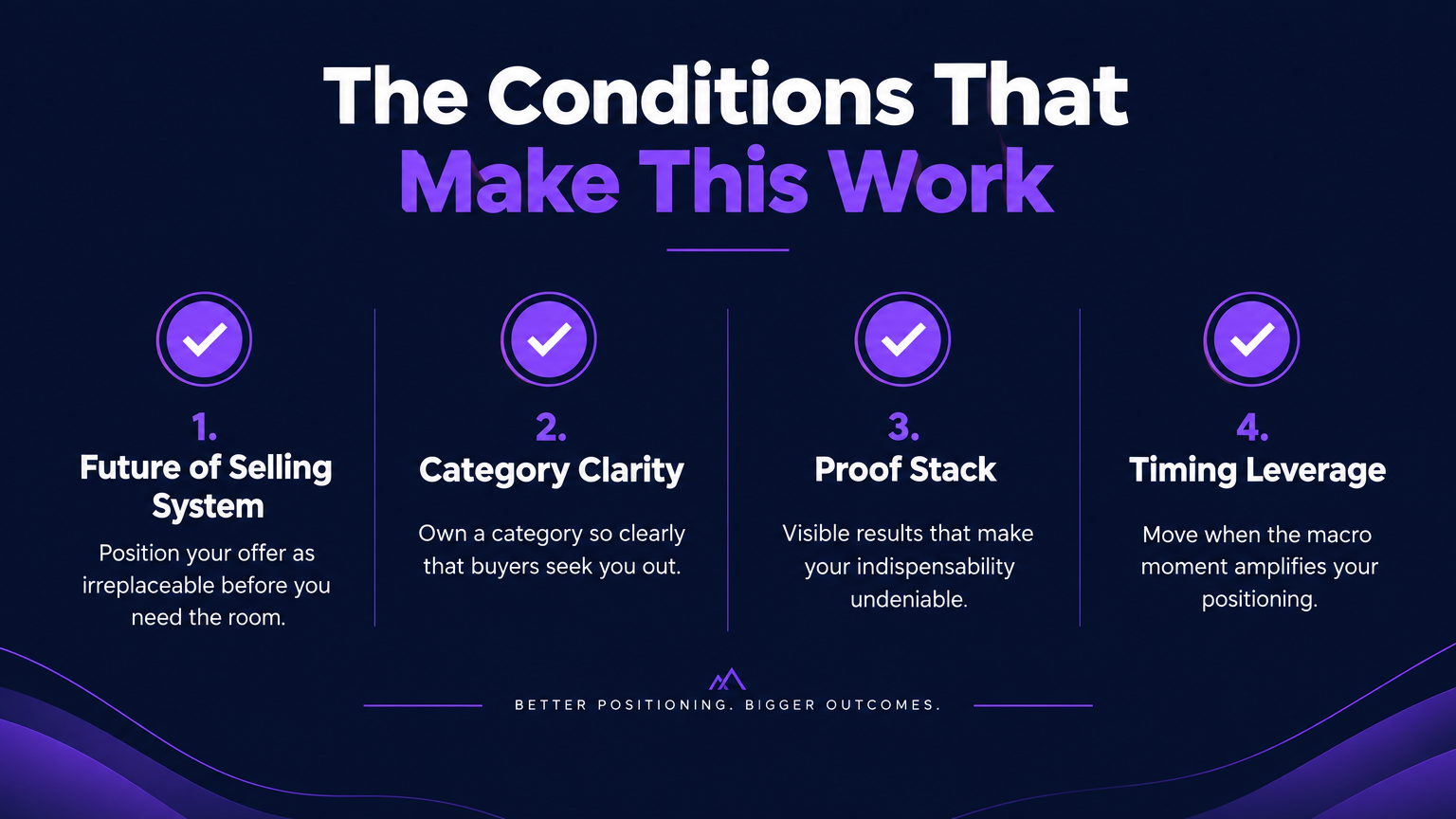
The Conditions That Make This Work
- Future of Selling System: Position your offer as irreplaceable before you need the room. FOS gives you the framework to define your category, articulate your indispensable value, and build a sales system that buyers seek out — rather than one you have to push.
- Category Clarity: Own a category so clearly and specifically that when a buyer thinks of the problem, your name is the only name that comes to mind. Vague positioning never earns a seat at the table.
- Proof Stack: Visible, public, credible results that make your indispensability undeniable to anyone who checks. Social proof, case studies, and third-party validation turn positioning claims into positioning facts.
- Timing Leverage: Move while the macro moment — the AI wave, the industry restructuring, the regulatory shift — is still amplifying your positioning. Timing does not replace indispensability, but it multiplies it for the founders who are already positioned.
Jensen Huang already moved. The only question is whether you will — or whether you'll read about someone else who did.


