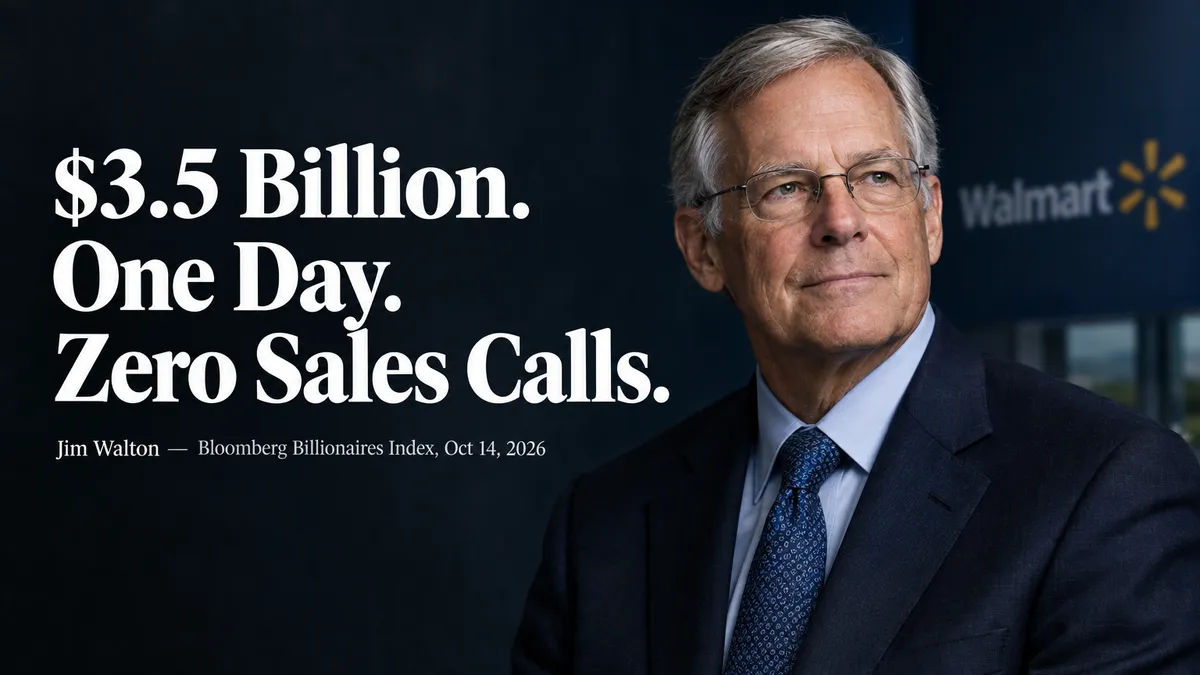
Billionaire Jim Walton Just Made $3.5 Billion In One Day Without A Single Sales Call — And It Changes Everything For Founders Who Are Still The Bottleneck
Billionaire Jim Walton Just Made $3.5 Billion In One Day Without A Single Sales Call — And It Changes Everything For Founders Who Are Still The Bottleneck
By Jason Lim | October 15, 2026 | Breaking News
Part 1 — The Hook
Jim Walton made $3.53 billion on October 14, 2026 — and he never once picked up the phone to close a deal.
While most founders were grinding through follow-up emails, chasing ghosted prospects, and wondering why Q4 pipeline feels thin — a man who hasn't sat in a sales meeting in years quietly added $3.53 billion to his net worth in a single trading day. No pitch. No cold call. No demo. Just a system that Sam Walton built 60 years ago, still running at full speed.
Part 2 — The Press
Here's the part that should bother every founder reading this.
You woke up on October 14, 2026 and hustled. You followed up. You prepared a deck. You jumped on a call and pitched your heart out — hoping to close a $10,000, $50,000, maybe a $100,000 deal.
Jim Walton also woke up that morning. He didn't pitch anyone. He didn't run a demo. He didn't post on LinkedIn. He didn't personally sell a single thing. And by end of day, Bloomberg reported his net worth had jumped by $3.53 billion — his biggest single-day gain since June 3, 2026.
His sister Alice added $3.50 billion. His brother Rob added $3.41 billion. In a single trading session, the Walton family collectively gained over $10 billion. Combined.
The difference between Jim Walton and a founder who is still the bottleneck in their own sales isn't intelligence, talent, or even capital. It's this: one of them built a system. The other is still being the system.
Part 3 — The Play
The numbers are verifiable and startling. According to the Bloomberg Billionaires Index updated October 14, 2026, Jim Walton's net worth reached $145 billion — up 2.5% in a single day. That $3.53B daily gain is his largest since June 3, 2026, and his wealth is up 10.1% year-over-year.
Jim is the youngest son of Sam Walton, who founded Walmart — a business that has grown into the world's largest retailer by revenue, reporting $713.2 billion in sales for the year to January 31, 2026 (Bloomberg, 2026). The Walton family controls approximately 44% of Walmart's stock through Walton Enterprises and the Walton Family Holdings Trust. Walmart became the first non-tech, brick-and-mortar retailer to cross a $1 trillion market cap — in February 2026 (Forbes, 2026).
Jim Walton doesn't run Walmart's sales floor. He doesn't close deals. He holds a stake in a system his father built — and that system earns while he sleeps, eats, and breathes. Billionaire Jim Walton's move is one Jason has seen across 1,000+ founders. Here's what most miss.
Part 4 — The Lesson + Root Cause Reframe
Beat 1: The Root Cause Reframe
Most founders think the problem is that they aren't closing enough deals. So they chase more leads. They refine their pitch. They read another sales book. They try a new script. They grind harder.
But the real problem is that they are personally required for revenue to happen at all. The moment they stop showing up, the pipeline empties. The moment they take a vacation, deals go cold. The moment they step away, everything stalls — because there is no system. There is only them.
Sam Walton understood something that took him decades to build and that most founders never get to: the goal is not to be a great salesperson. The goal is to build something that sells without you. Walmart's $713 billion in annual revenue doesn't happen because Sam is making calls. It happens because the system — the supply chain, the pricing model, the buying experience, the store layout, the replenishment cycle — is engineered to convert, every single day, without any individual human being essential to the process.
Jim Walton isn't rich because he works hard. He's rich because he owns equity in a system that works hard.
Beat 2: The Lesson
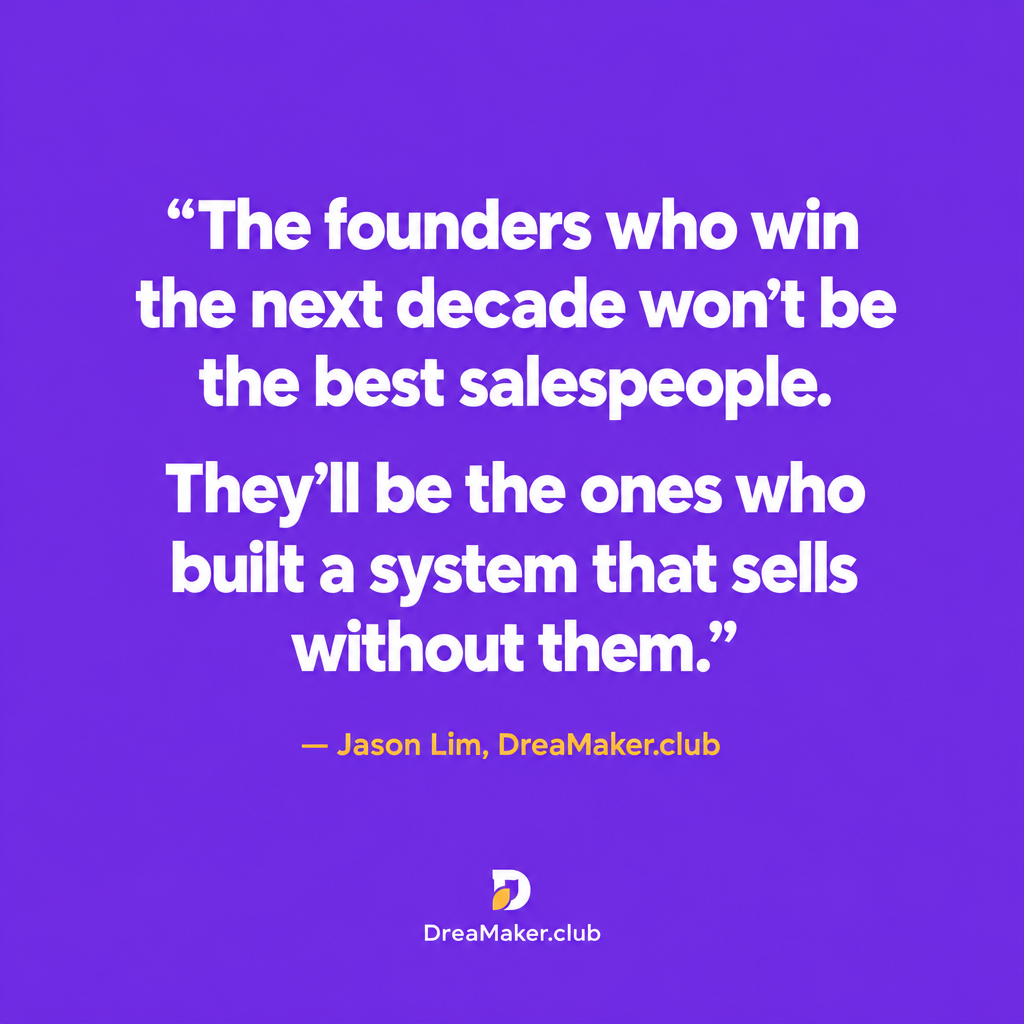
“The founders who win the next decade won’t be the best salespeople. They’ll be the ones who built a system that sells without them.”
Founder Story Card
Stanley Tan — Closed 45 Buyers in 3 Hours
Stanley didn't close 45 buyers because he pitched 45 times. He closed them because he had a system — a repeatable sequence that qualified, educated, and converted buyers before they ever sat across from him. When Jason helped him install that system, his conversion stopped being about effort and started being about structure. Three hours. Forty-five buyers. That's what a system looks like in action.
Part 5 — The Opportunity + Conditions
Beat 1: The Hidden Opportunity
The Walton story isn't about passive income. It isn't about being born into money. It's about recognising that wealth — and sustainable revenue — compounds through systems, not through hustle. Every founder reading this has the opportunity right now to make the same fundamental shift Sam Walton made: stop being the salesperson and start being the architect of the selling system.
The US market is approaching Q4 — the single highest-buying quarter of the year across B2B categories. Founders who enter Q4 with a selling system in place will capture a disproportionate share of buyer attention. Founders who enter Q4 still relying on personal hustle will hit a ceiling — because there are only so many hours in a day, and buyers have more options than ever.
The question isn't whether you should build a system. The question is whether you'll do it before Q4 closes — or whether you'll spend January explaining to your team why the pipeline is empty again.
Beat 2: Conditions — Are You Ready?
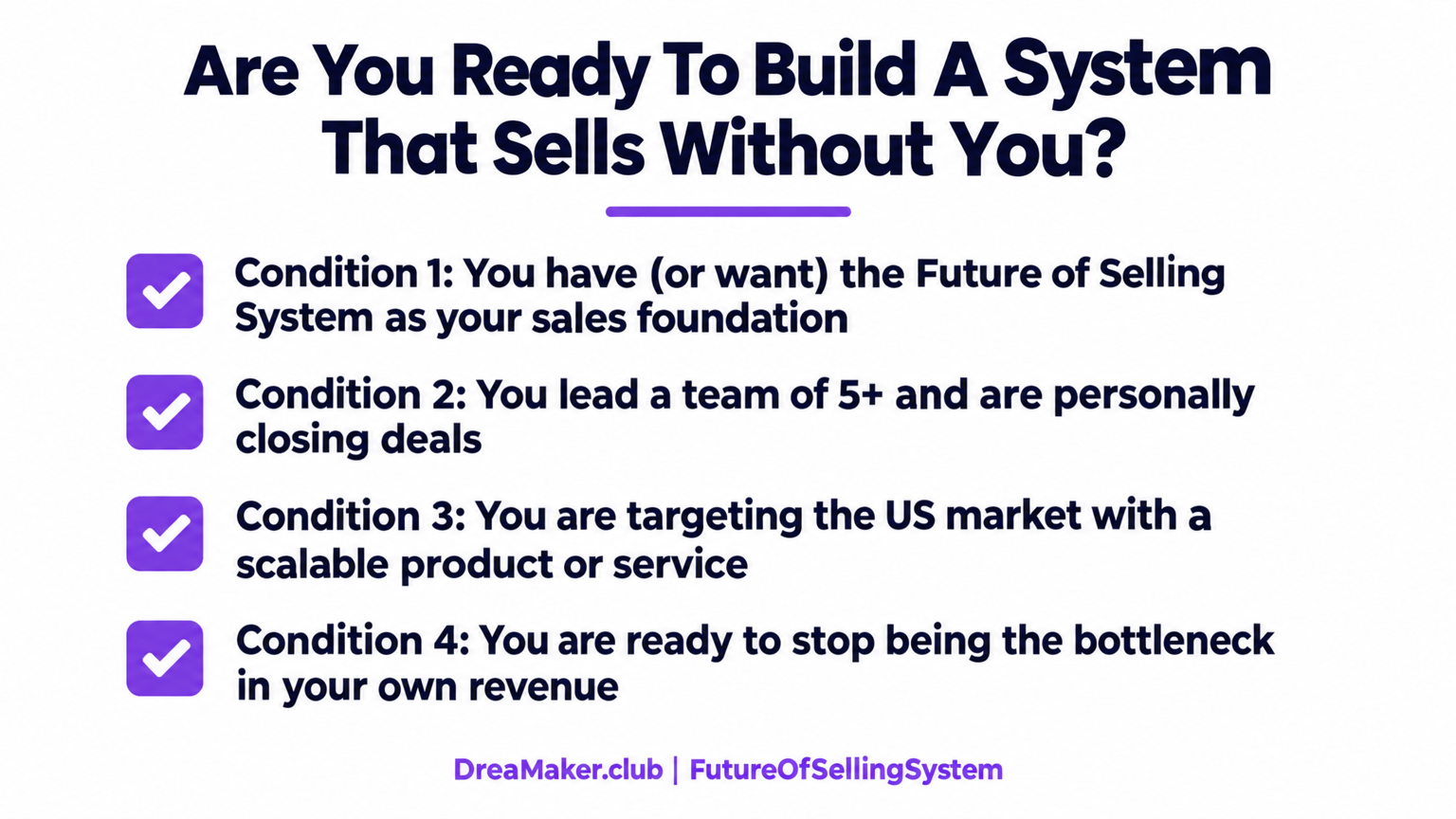
Conditions Checklist
Condition 1: You have (or are ready to install) the Future of Selling System as your sales foundation. This is non-negotiable — a system built on guesswork is not a system. FOS gives you a repeatable, teachable, scalable framework your team can run without you on every call.
Condition 2: You are leading a team of 5 or more and are still personally closing the majority of deals. If revenue stops when you stop, you are the bottleneck — and that is the signal it's time to build the system.
Condition 3: You are selling into the US market with a product or service that has scalable unit economics. The US buyer pool rewards founders with structured, professional sales processes — and punishes ad hoc pitching with long sales cycles and high churn.
Condition 4: You are entering Q4 and know this is the moment — not January. The highest-volume buying window of the year is open right now. Founders who install the system today capture Q4. Founders who plan to start in January chase Q4's exhaust fumes.
Part 6 — A Message From Jason
NEW! — October 2026
Dear Founders,
If Jim Walton's $3.53 billion day made you feel anything — even a small pang of frustration that your revenue stops the moment you stop — that feeling is data. It's telling you that you've built a job, not a system. And every day you wait to fix that, you are the ceiling on your own company's growth.
Get the Future of Selling System — $19/month ($0.63/day) →I know what it feels like to be the one person your whole pipeline depends on. I've sat across from over 1,000 founders since 2015, and the pain is always the same: "If I take my foot off the gas, everything slows down." That's not a pipeline problem. That's a system problem.
Here's what I've found: when founders install a repeatable selling system — one their team can run with or without them — revenue doesn't just maintain. It compounds. Jeffrey Teo acquired 63 customers in 100 days. Stanley Tan closed 45 buyers in 3 hours. Leon secured a $2M partnership. Not because they worked harder. Because they had a system that worked for them.
According to Salesforce's State of Sales report, 76% of sales professionals say that having a consistent, structured selling process is the #1 factor in hitting quota. Yet most startup founders are still winging it — pitching differently every call, following up inconsistently, and wondering why conversion rates don't improve.
The Future of Selling System gives you the P.I.T.C.H. Formula — a five-step framework that has generated $22M+ in combined sales across 1,000+ founders since 2015. It costs $19/month. That's $0.63 a day to stop being the bottleneck and start building what Jim Walton already has: a system that works without you.
Yes — I'm Ready To Stop Being The Bottleneck →Not ready for $19? Start free.
The Objection Playbook: 25 Word-for-Word Scripts to Close More Sales
The exact words Jason's founders use when a buyer says "too expensive", "send me info" or "I need to think about it". Free PDF, sent to your inbox.
Send Me the 25 ScriptsJim Walton already moved — decades ago, when Sam Walton chose to build a system instead of being the salesman. The only question now is whether you will make the same choice, or whether you’ll read about someone else who did.


