
Billionaire Josh Kushner Just Revealed a $17.5 Billion Empire Built by Refusing One Rule — And It Changes Everything For Founders Who Think Staying In Their Lane Is Safe

Part 1 — Hook
Josh Kushner just revealed Thrive Capital manages $17.5 billion — and he didn't do it by being the best VC.
He did it by refusing to let anyone tell him what a venture capital firm is supposed to do. He co-owns the LA Lakers. He launched Oscar, a health insurance company. He backed OpenAI at $150 million before the mass market even knew what a large language model was. And then, in a rare investor letter, he explained exactly why he built it this way — in words every founder selling in a crowded market should read twice before tomorrow morning.
Part 2 — Press
Here is the uncomfortable question this story forces every startup founder to ask themselves:
Are you losing deals because you're staying in a lane your buyers never asked you to stay in?
Most founders with a team of five or more are running a sales motion that looks like this: they identify a target market, they build a pitch for that market, and then they go after that market — and only that market — until it dries up or the competition arrives. They call this "focus." Investors call it "discipline." Jason Lim calls it what it actually is: a single point of failure dressed up as a strategy.
Kushner did not become a $17.5 billion asset manager by focusing. He became one by building a system so good at identifying and closing value that it worked in venture, in consumer healthcare, in professional sports, and in AI — simultaneously. That is not a diversification story. That is a selling system story.
And if your selling system only works in one niche, you do not have a system. You have a script for one buyer type — and you are one market shift away from starting over.
Part 3 — Play
Josh Kushner founded Thrive Capital in 2009 at age 24. For the first decade, it was a respected but mid-tier tech fund, best known for early Instagram and Spotify positions. Then the decade changed. By 2022, Thrive was the largest outside investor in OpenAI, holding a position now worth a reported $5 billion on paper. By 2023, Kushner and a Thrive-adjacent consortium won the bidding war for a 27% stake in the LA Lakers — a professional sports franchise Thrive had no "business" touching as a VC. By October 2026, a Bloomberg profile confirmed Thrive manages $17.5 billion in assets across venture, public equities, and private deals, with Oscar Health — the consumer insurance company Kushner co-founded — now processing claims for millions of Americans.
In his own investor letter, cited by Bloomberg (October 2026), Kushner wrote: "We have never believed that the traditional boundaries of our industry need to define us."
He was not talking about portfolio allocation. He was describing a conviction about how value gets built — that category lines are imposed by other people, not by market reality.
Billionaire Josh Kushner's move is one Jason has seen mirrored across 1,000+ founders. Here's what most miss.
Part 4 — Lesson + Root Cause Reframe
Beat 1 — Root Cause Reframe
Most founders think the problem is market saturation — too many competitors in the niche, not enough differentiation, price pressure driving margins down. So they go narrower: tighter ICP, tighter messaging, tighter territory. They think they are sharpening their sword. They are actually shrinking their battlefield.
But the real problem is category dependency. The founders who plateau — who build a promising six-figure pipeline and can't seem to crack eight figures — are almost always founders who have built a sales motion that only works if one specific type of buyer says yes. When that buyer pulls back, gets acquired, changes budget cycles, or simply stops growing, the whole pipeline freezes. Not because the product changed. Because the selling system was never designed to generalise.
Kushner solved this problem at the fund level before it became a crisis. He built Thrive so that its ability to identify value and close deals was not dependent on one category of asset. The venture team can spot and win an OpenAI. The same conviction and relationship framework can win a Lakers bid. The same long-view, value-sequencing philosophy built Oscar from zero to a publicly traded health insurer.
Different categories. One selling system. That is the pattern.
Beat 2 — The Lesson
"The founder who lets buyers define their category will always be at the mercy of that category's cycles. The founder with a system that works across categories owns their own revenue weather."
— Jason Lim, DreaMaker.club
Founder Story Card
Stanley Tan — 45 buyers in 3 hours
Stanley Tan runs a B2B services firm. When he joined the Future of Selling System, his sales motion only worked for one segment — manufacturing clients in Singapore. Six weeks into FOS, he ran a single structured pitch session and closed 45 buyers in under 3 hours. Not in manufacturing. Across three unrelated verticals — including one he had never pitched before. His product had not changed. His system had.
Part 5 — Opportunity + Conditions
Beat 1 — The Hidden Opportunity
Here is the opportunity most founders in the US market are sleeping on right now: the buyers who are saying no to your current pitch are not saying no to your product. They are saying no to the version of your pitch that only makes sense inside your category.
The economic environment in Q4 2026 is producing budget tightening across tech, real estate, and professional services — the three sectors most startup founders target by default. But the same founders who are watching those pipelines slow are missing the fact that adjacent verticals — healthcare operations, supply chain optimisation, franchise networks, media and content businesses — are actively buying right now. The deal is available. The system to cross the category line is what is missing.
Josh Kushner made $5 billion on OpenAI not because he understood AI better than the AI researchers. He made $5 billion because he had a conviction framework — a system for assessing value and committing early — that worked outside the boundaries of what a VC is "supposed" to bet on. Your selling system, when it is strong enough, does the same thing: it works in rooms where you have never been before.
Beat 2 — Conditions Checklist
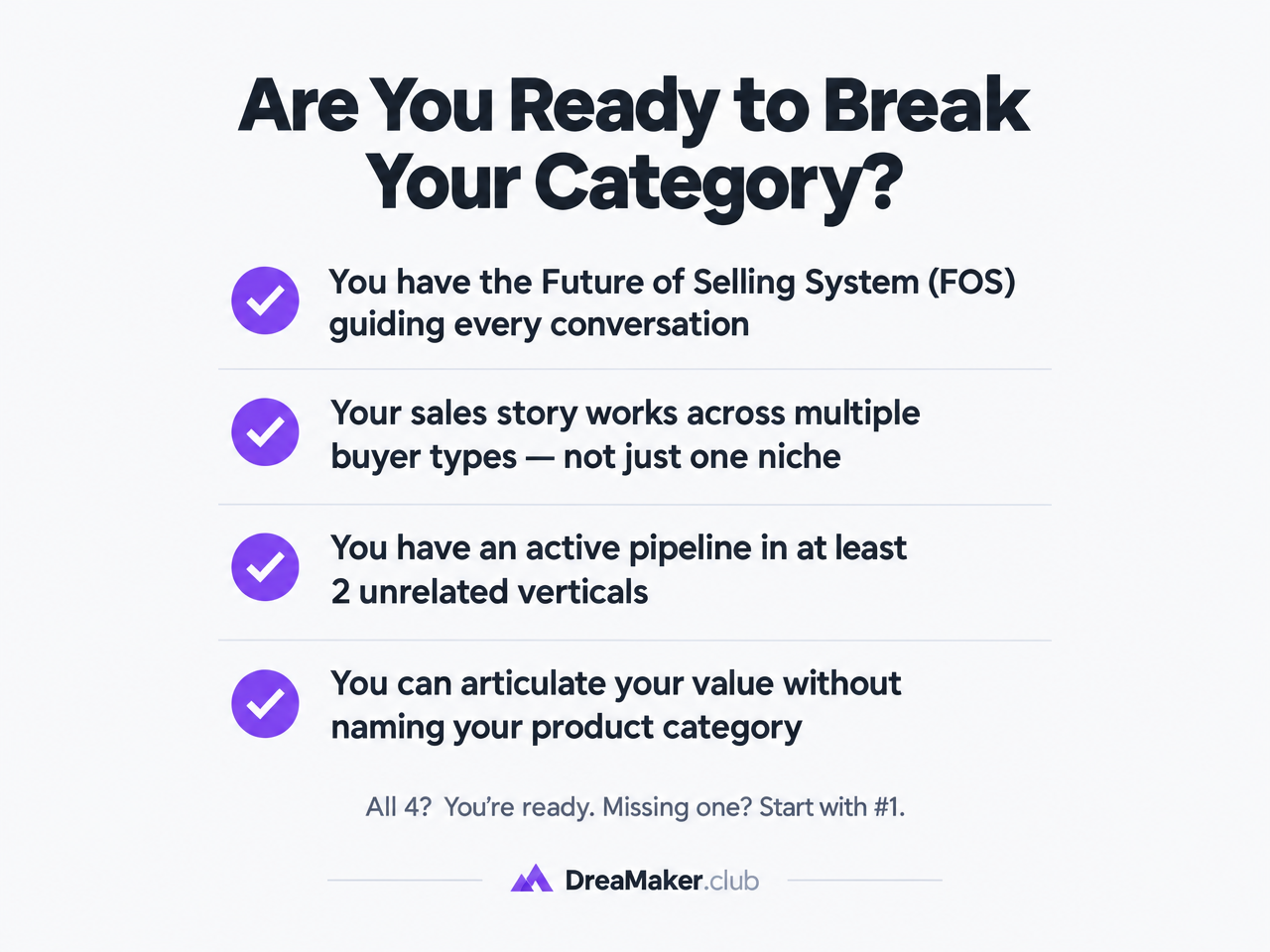
Before you try to cross a category line, check all four:
- You have the Future of Selling System (FOS) guiding every conversation. Without a repeatable system, crossing categories just means confusing new buyers instead of your old ones.
- Your core value proposition holds without your category name in it. If removing "for SaaS companies" from your pitch breaks it, you don't have a pitch — you have a niche script.
- You have an active outbound sequence running in at least one vertical you've never closed before. Kushner didn't wish his way into the Lakers bid. He had relationships already in motion.
- Your team can run discovery in a new vertical without you personally present. Kushner didn't fly to every Oscar pitch. Systems scale. Founders don't.
Part 6 — From the Desk of Jason Lim
NEW! → October 2026
Dear Founders,
If you have ever pitched a buyer outside your usual niche and felt the room go cold — not because of your price, not because of your product, but because you could not find the right words to make your value land in a new context — this is exactly what the Future of Selling System was built to fix.
Pain anchor: Most founders are stuck in one buyer type — and when that buyer type slows down, so does everything. Kushner never let one category define Thrive. You shouldn't let one buyer type define your pipeline.
I know how it feels to be locked in one lane. I felt it too, early on — until I found a system that worked regardless of who the buyer was or what industry they came from. Now I've seen it work for 1,000+ founders since 2015, generating $22M+ in combined sales across every category you can imagine.
According to Salesforce's State of Sales report, 76% of sales professionals say their sales process has changed more in the past two years than in the previous five. Buyers are smarter, more cautious, and less loyal to categories. The founders winning in that environment are the ones with a system — not a script.
FOS graduates include Jeffrey Teo (63 customers in 100 days), Stanley Tan (45 buyers in 3 hours), and Leon (a $2M partnership). No scripts memorised. No niche required. Just a system that works.
Not ready for $19? Start free.
The Objection Playbook: 25 Word-for-Word Scripts to Close More Sales
The exact words Jason's founders use when a buyer says "too expensive", "send me info" or "I need to think about it". Free PDF, sent to your inbox.
Send Me the 25 ScriptsBillionaire Josh Kushner already moved. The only question is whether you will — or whether you'll read about someone else who did.


