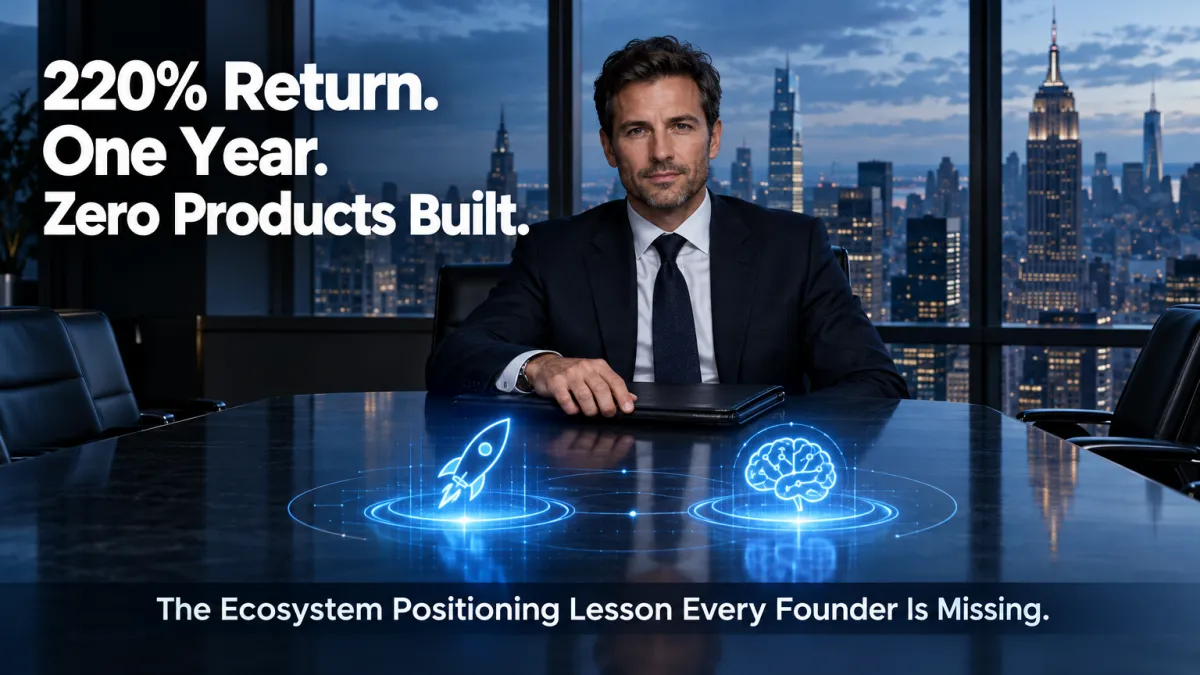
Josh Kushner just made 220% on his money in a single year — without building a product, launching a feature, or hiring a sales team.
While every founder in the room was obsessing over their tech stack, their pitch deck, and their conversion rate, Kushner did something almost no startup founder thinks to do: he positioned himself inside the ecosystems where value was already exploding. Forbes ranked him the biggest percentage gainer on the 2026 Forbes 400, with his net worth surging to approximately $16.7 billion — up from an estimated $5.2 billion just a year prior.
That is not a product story. That is a positioning story.
The Question That Should Keep You Up Tonight
Here is the question most founders will not ask themselves: if your sales are slow right now, is it because your product is bad — or because you are standing outside the room where buying decisions are already being made?
Kushner's 220% return came primarily through Thrive Capital's deep, early positions in OpenAI and SpaceX — two of the highest-velocity ecosystems in modern business history, according to Forbes reporting in September 2026. He did not invent those ecosystems. He planted himself inside them before the growth wave arrived.
Now think about your own business. Are you building in isolation, hoping buyers will find you? Or are you inside the ecosystem — the industry community, the trusted network, the visible conversation — where your buyers are already making decisions?
Most founders are working twice as hard as they need to because they are standing in the wrong room. The tragedy is that they mistake the effort for the strategy.
What Actually Happened
Josh Kushner is the founder and managing partner of Thrive Capital, a New York-based venture firm he launched in 2009 at the age of 24. For most of its early life, Thrive was known primarily as an Instagram-era investor. But Kushner made a series of concentrated, high-conviction bets on AI-era companies — most notably OpenAI and SpaceX — that transformed the fund's trajectory, according to Forbes in its September 2026 Forbes 400 report.
Forbes reported that Kushner's net worth surged approximately 220% to around $16.7 billion in the year leading up to the 2026 list, making him the single largest percentage gainer on the entire Forbes 400. Thrive Capital also closed one of the largest venture funds of 2024, raising $5 billion — a figure Bloomberg reported in October 2024 — signalling that institutional capital had followed his conviction long before the mainstream caught up.
He did not build OpenAI. He did not found SpaceX. He positioned himself inside both ecosystems early enough that the growth pulled him rather than the other way around. Billionaire Josh Kushner's move is one Jason has seen across 1,000+ founders. Here's what most miss.
The Lesson Most Founders Will Completely Miss
Most founders think the problem is that they need a better product. But the real problem is that they are standing in the wrong ecosystem.
Kushner's 220% return is not a story about due diligence or even about picking winners. It is a story about deliberate ecosystem positioning — the decision to plant yourself inside a high-velocity network before the velocity becomes obvious to everyone else.
The quotable lesson from this story:
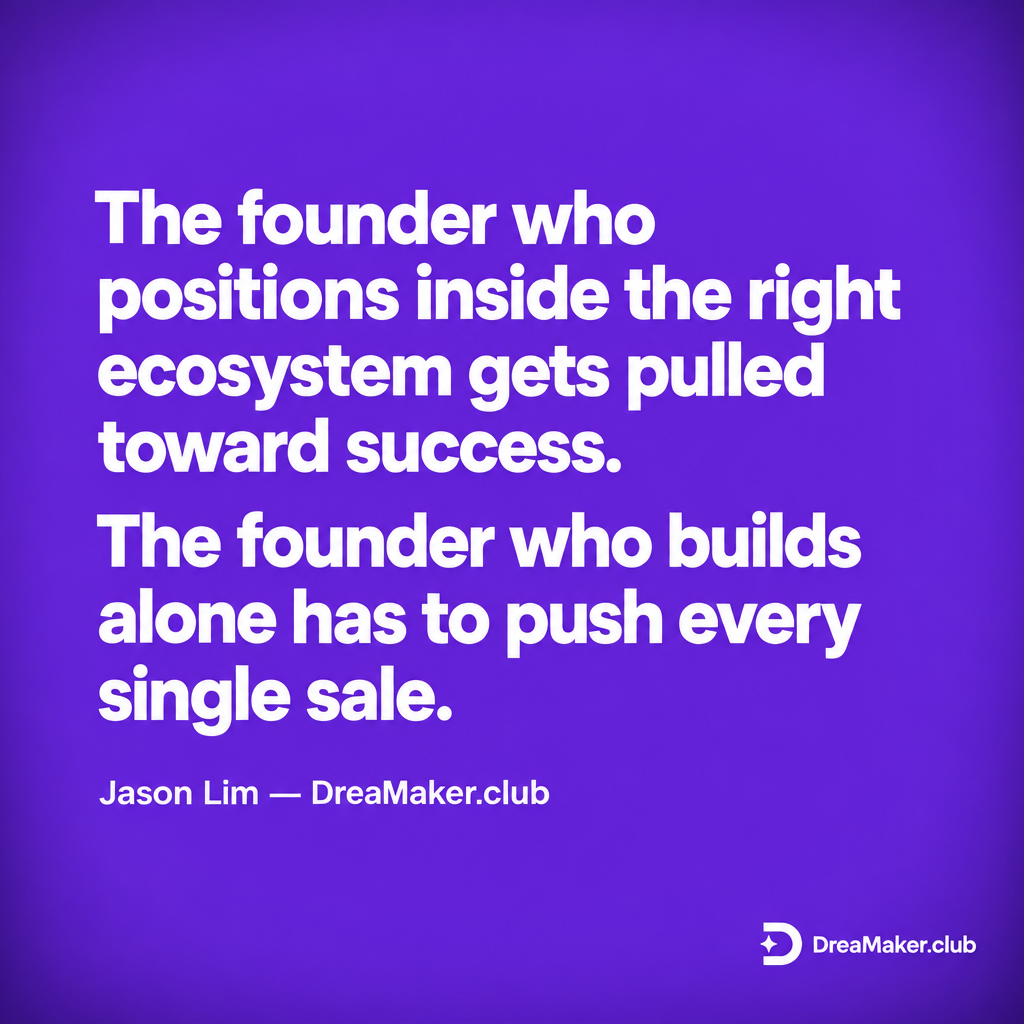
"The founder who positions inside the right ecosystem gets pulled toward success. The founder who builds alone has to push every single sale."
Think about what that means at the sales level. When you are embedded in the right ecosystem — the right industry community, the right referral network, the right thought leadership conversation — buyers arrive already pre-warmed. The trust is distributed by the ecosystem itself. You are not pitching strangers; you are showing up in a room where people already want to say yes.
When you are outside that ecosystem, every conversation starts from zero. You are fighting attention, credibility, urgency, and trust all at once — before you have even made the ask. That is not a sales problem. That is a positioning problem that no amount of sales technique will fix.
Founder Story Card
The visible problem: A SaaS founder with a genuinely strong product kept losing deals to larger, better-known competitors — even when prospects admitted the product was technically superior.
The real root cause: She was pitching into a vacuum. Her competitors were embedded in the industry associations, the podcasts, the Slack communities, and the LinkedIn conversations where buyers formed opinions before they ever booked a demo.
The founder lesson: Positioning inside the right ecosystem creates a pull that no amount of cold outreach can manufacture. Buyers trust what the ecosystem endorses — and they distrust what arrives uninvited.
The move to make now: Before your next sales push, map the two or three ecosystems where your ideal buyers already spend attention. Then ask: how do you become part of what they already trust — before you ever ask for the sale?
The Hidden Opportunity Right Now
Here is what Kushner's story reveals that almost no founder is discussing: the AI era is creating entirely new ecosystems at a speed that has never existed before. That means the windows for early positioning — the equivalent of getting into OpenAI's orbit in 2021 — are open right now in dozens of emerging industry verticals, AI-adjacent communities, and specialist networks.
The founders who will look back in three years and say "that was when everything changed" are not the ones who doubled down on cold outreach. They are the ones who identified where the next high-velocity ecosystem was forming — and planted themselves inside it while there was still room at the table.
The opportunity is not to copy Kushner's exact moves. It is to copy his logic: find the ecosystem where your buyer's trust is already being built by others, and position yourself as a native, not a visitor.
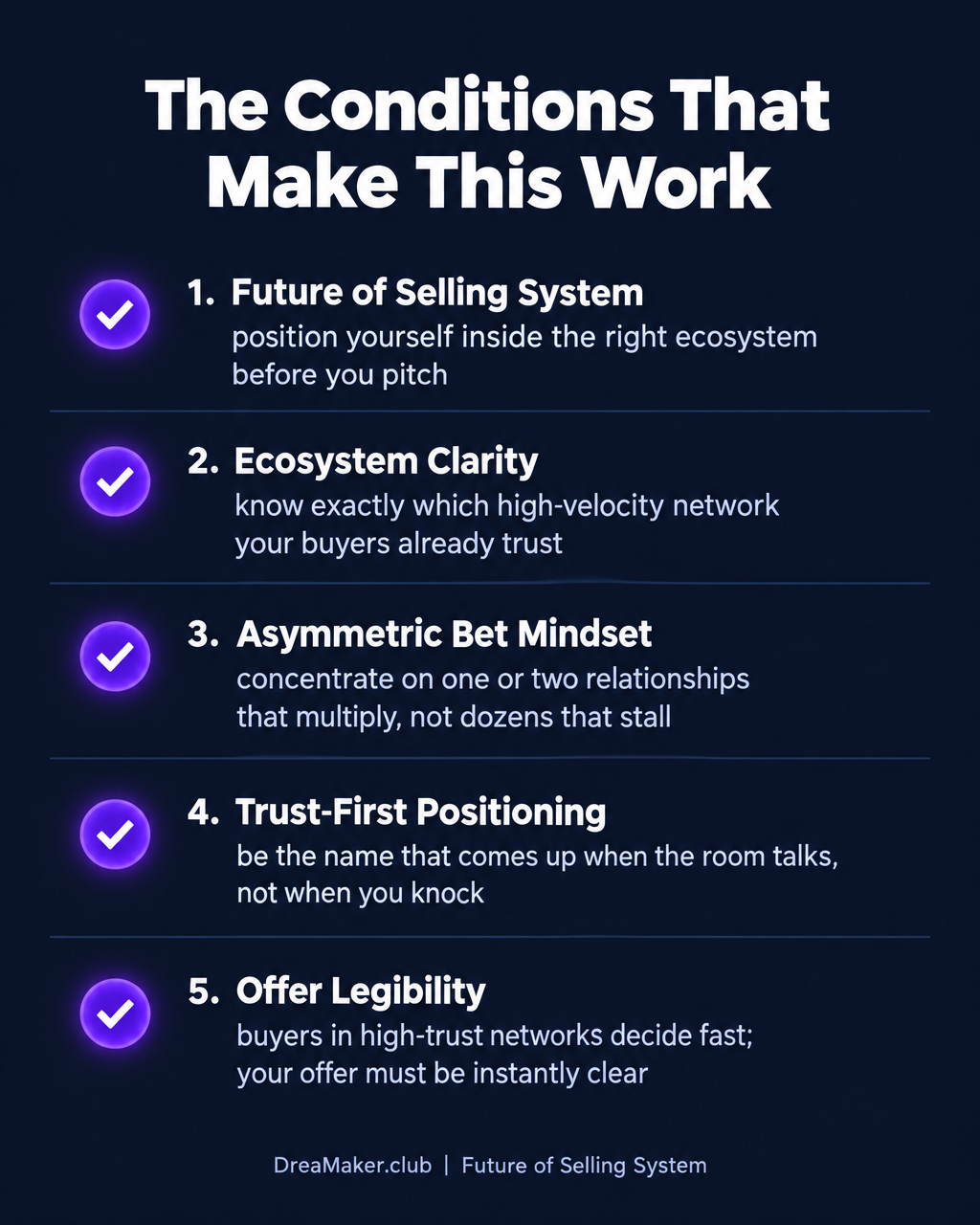
But this only works under specific conditions.
The Conditions That Make This Work
- Future of Selling System: Ecosystem positioning without a clear, compelling offer creates visibility with no conversion. FOS gives you the sales infrastructure to turn ecosystem trust into closed deals — so that when the room is finally paying attention, you have something worth buying.
- Ecosystem Clarity: You need to be brutally honest about which one or two ecosystems your buyers already inhabit and trust. Being everywhere is the same as being nowhere. Kushner concentrated. So must you.
- Asymmetric Bet Mindset: The biggest returns come from concentrated, high-conviction positioning decisions — not from spreading effort thinly across every channel. Pick the ecosystem with the highest velocity and go deep before you go wide.
- Trust-First Positioning: Your goal inside the ecosystem is to give value before you ask for anything. Buyers in high-trust networks decide fast — but only for people who have already earned the right to be heard.
- Offer Legibility: In a fast-moving ecosystem, buyers do not have time to decode a complicated offer. Your value proposition must be instantly clear — one sentence, one outcome, one buyer. If it takes more than that, the ecosystem moves past you.
Kushner already moved. The only question is whether you will — or whether you'll read about someone else who did.


