Billionaire Ken Griffin Just Gave $3 Billion to a University — And It Changes Everything For Founders Who Think Big Deals Close Fast
Ken Griffin just handed a university $3 billion. The deal took two years to close.
On September 30, 2026, Citadel founder Ken Griffin announced the largest individual gift in higher education history — $3 billion to Carnegie Mellon University, reported by CNBC, Forbes, and the Washington Post on the same day. No one saw it coming. The pipeline had been running for two years before anyone wrote a check. That gap — between when Griffin started and when he signed — is the lesson most founders will never extract from this story.
Think about your last big deal that didn't close.
You probably thought the problem was the price. Or the timing. Or a competitor who swooped in at the wrong moment. You told yourself: "They just weren't ready yet."
Here is the harder truth: the deal you lost this quarter was decided six months ago. Not by your pitch. Not by your deck. By whether you were already in the room when the buyer started forming an opinion about who they trusted.
Griffin spent two years visiting Carnegie Mellon, walking its campus, meeting its students — before the ask. By the time $3 billion was on the table, CMU already knew exactly who they were dealing with. The close was almost irrelevant. The pipeline had already done the work.
Most founders are trying to close deals they haven't planted yet. That's not a pitch problem. That's a pipeline problem.
Here are the verified facts, as reported by CNBC, Forbes, Fox Business, and Carnegie Mellon University on September 30, 2026:
- $3 billion total gift — the largest individual donation in higher education history, surpassing Phil Knight's $2 billion to Oregon Health & Science University in 2025 (Forbes, Sep 30, 2026)
- $2 billion to build Carnegie Mellon University Miami, a 35-acre campus in Wynwood set to open in 2028, built around societal challenges rather than academic majors (CNBC, Sep 30, 2026)
- $500 million to CMU's School of Computer Science, renamed the Kenneth C. Griffin School of Computer Science (Fox Business, Sep 30, 2026)
- $500 million in flexible support for CMU's highest institutional priorities (CMU press release, Sep 30, 2026)
- Griffin's net worth: $57.6 billion, ranked #33 globally by Forbes (Forbes, Sep 30, 2026)
- Griffin has given more than $5.7 billion to education, opportunity, and health sciences over his lifetime (CMU.edu, Sep 30, 2026)
- The gift was the result of two years of quiet discussions with CMU leadership, described by the Chronicle of Philanthropy as "the end product of years and years of co-creation" (Chronicle of Philanthropy, Oct 2026)
Griffin started Citadel in 1990 from his Harvard dorm room and moved its global headquarters to Miami in 2022. He now has committed roughly $2.4 billion to South Florida alone. Billionaire Ken Griffin's move is one Jason has seen across 1,000+ founders. Here's what most miss.
The Lesson: Griffin Didn't Close a $3 Billion Deal. He Harvested a Two-Year Pipeline.
Beat 1 — Root Cause Reframe
Most founders think the problem is closing. "I just need better objection handling." "I need a stronger pitch." "I need to follow up more."
But the real problem is that they have no pipeline. They are trying to manufacture trust at the moment of the close — which is the single most expensive place to try to build it.
Griffin did the opposite. He built the relationship long before the ask. He visited the campus. He spent time with students. He let Carnegie Mellon see who he was — not as a donor, but as someone who genuinely believed in what they were building. By the time he committed $3 billion, the close was a formality. The decision had already been made. In rooms he had already been in.
The Chronicle of Philanthropy described the gift as "the end product of years and years of co-creation between the institution and the donor really thinking about what they are trying to accomplish" (Oct 2026). That is not a fundraising observation. That is a sales system observation. And most founders have no system like it.
Beat 2 — The Lesson
Think about what CMU Miami produces: engineers, AI researchers, founders, future executives — the exact profile that Citadel recruits from year after year. Griffin isn't being philanthropic. He's being strategic. He is planting a forest of future talent, future relationships, and future deal flow — and calling it a gift. That's not charity. That's the most sophisticated pipeline move in business this year.
The lesson for founders is not "donate to universities." The lesson is: your biggest deals are not won at the close. They are won at the planting. And right now, you are probably not planting enough.
Founder Story
Stanley Tan: 45 buyers in 3 hours
Stanley Tan didn't sprint to close on launch day. He spent months building his pipeline — showing up consistently, creating value in advance, and warming buyers before he ever made an ask. When he launched, 45 buyers said yes in 3 hours. Not because his pitch was brilliant. Because his pipeline was already full. The close was a harvest, not a hunt.
The Hidden Opportunity: Right Now, Your Competitors Are Still Hunting. You Can Start Farming.
Beat 1 — Hidden Opportunity
The reason Griffin's gift is news is because almost no one operates this way. The vast majority of founders — including your competitors — are transactional. They contact buyers when they need revenue. They follow up when they remember. They pitch when they're desperate. They plant nothing and then wonder why the harvest never comes.
That is your opening. Right now, in October 2026, the window to build a pipeline that closes in Q1 2027 is still open. But it closes faster than most founders think. The buyers who will say yes in January are forming their shortlists this month. If you are not already in their orbit — not selling, just visible, valuable, present — you will not be on the shortlist.
Griffin bet on Miami years before it was obvious. He planted $2.4 billion into the city before anyone else was paying that kind of attention. The founders who will dominate their market in 2027 are planting their pipeline right now — not in January.
Beat 2 — Conditions: Are You Ready to Build Your Pipeline?
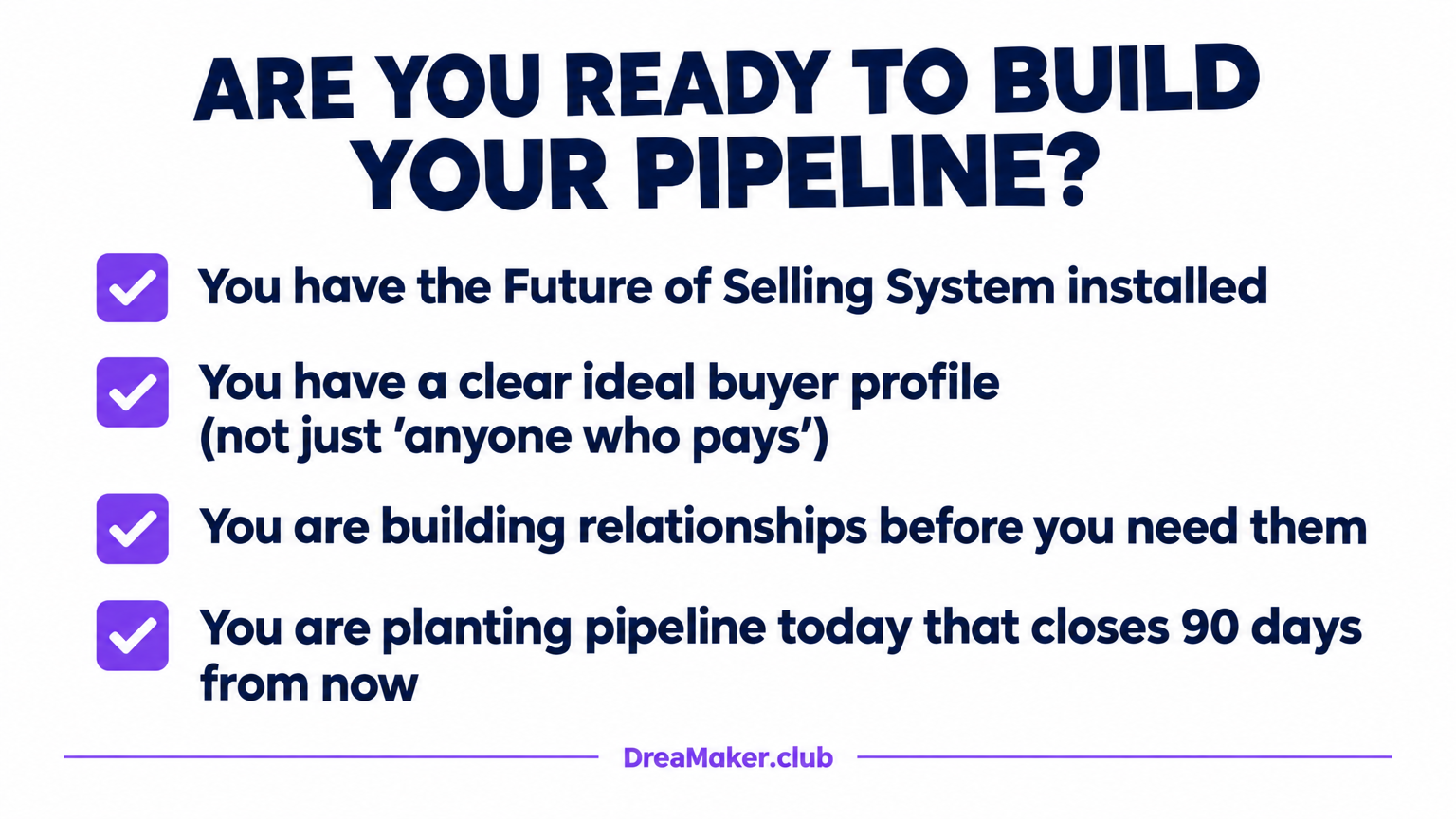
Your Pipeline-Readiness Checklist
Condition 1: You have the Future of Selling System installed
FOS is the operating system that turns relationship-building into a repeatable pipeline — so you are always planting, always warming, always harvesting. Without it, you are hunting every month from zero. Get it at dreamaker.club/buyfos →
Condition 2: You have a clear ideal buyer profile — not just "anyone who pays"
Griffin didn't give $3 billion to every university. He chose one, based on deep strategic alignment. You cannot build a pipeline without knowing exactly who belongs in it. Fuzzy ICP = empty pipeline.
Condition 3: You are building relationships before you need the revenue
Griffin spent two years at CMU before the ask. If you only show up in a buyer's inbox when you need a sale, you are not relationship-building — you are cold calling with extra steps. Real pipeline starts when there's no urgency.
Condition 4: You are planting Q1 2027 pipeline today — in October
The buyers who close in January are deciding in October. If you are not visible to them right now — not pitching, just present and valuable — you will not be on their shortlist when the window opens. The planting season for Q1 is this month.
NEW!
October 2026
Dear Founders — Your pipeline isn't empty because you can't close. It's empty because you have no system planting relationships before buyers are ready to decide.
You're working hard. Your product is solid. But every month, deals that should have closed went quiet — not because the buyer said no, but because you were never visible when they were forming their shortlist. No system. No planted pipeline. Just hunting from zero, every single month.
I felt that too. For years, Jason Lim watched founders — good founders, with strong products — lose to competitors who had worse offerings but better pipelines. They had a system. The founders hunting didn't. When Jason cracked the system, everything changed. He's trained 1,000+ founders since 2015. Jeffrey Teo used it to land 63 customers in 100 days. Stanley Tan closed 45 buyers in 3 hours. Leon closed a $2M partnership. Combined, graduates have produced $22M+ in sales.
And they're not alone. According to Salesforce State of Sales, 76% of salespeople say a structured sales process is "key" or "critical" to closing. The founders who win aren't closing harder — they're running a system that builds pipeline automatically.
The Future of Selling System (FOS) is that system. Built for startup founders with a team of 5+, leading their own sales, in the US market. It is the operating system underneath every deal you will close in 2027.
Not ready for $19? Start free.
The Objection Playbook: 25 Word-for-Word Scripts to Close More Sales
The exact words Jason's founders use when a buyer says "too expensive", "send me info" or "I need to think about it". Free PDF, sent to your inbox.
Send Me the 25 ScriptsKen Griffin already moved — two years before anyone noticed. The only question is whether you will plant your pipeline today, or read about someone else who did.


