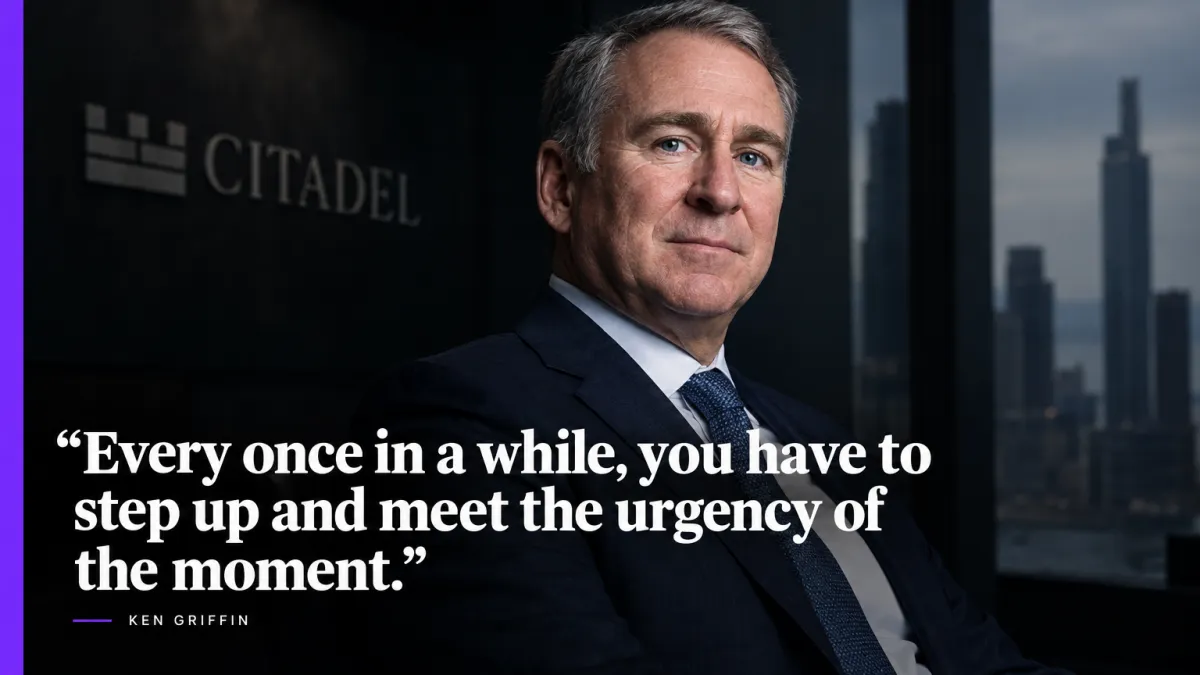
Billionaire Ken Griffin Just Gave Away $3 Billion — And It Reveals the One Investment Every Startup Founder Is Refusing to Make
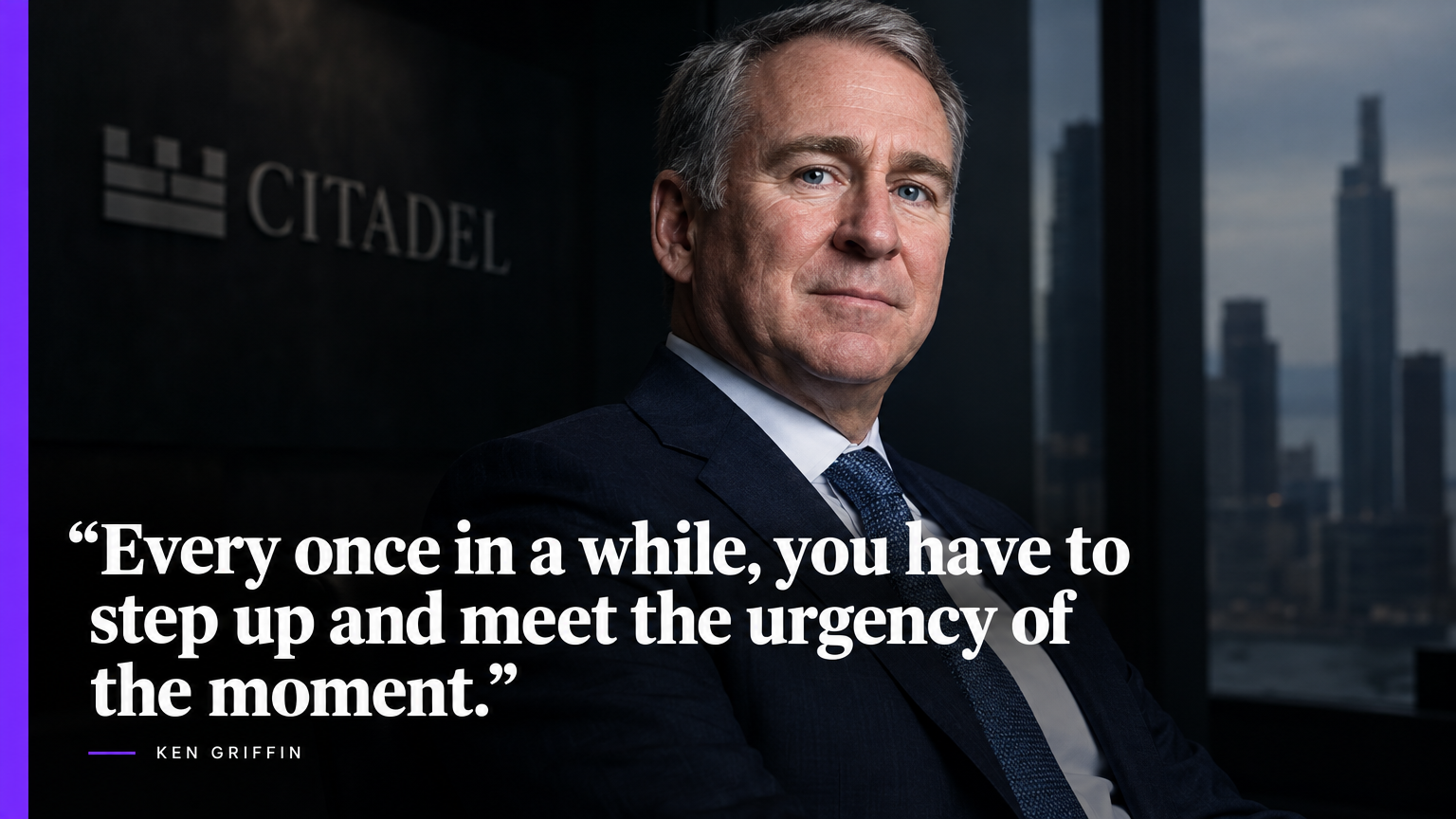
Billionaire Ken Griffin Just Gave Away $3 Billion — And It Reveals the One Investment Every Startup Founder Is Refusing to Make
By Jason Lim | September 30, 2026 | Breaking News
Ken Griffin just handed away $3 billion in a single announcement — and the media called it generosity. That's the wrong story.
The Citadel CEO didn't write a cheque and walk away. He bought a 100-year compounding machine — a new university campus bearing his name, a renamed school of computer science, a talent pipeline flowing directly into his city, and a seat on Carnegie Mellon's Board of Trustees.
Every founder watching the headlines this morning is asking: How does a billionaire give away that much? The real question is: Why do you keep spending on things that don't compound?
You Already Know You Need a System. So Why Haven't You Built One?
You wake up every morning and you sell. You take the call, you write the email, you follow up, you pitch. And when you stop — the revenue stops.
That is not a sales problem. That is a system problem.
Ken Griffin didn't build a $57.6 billion fortune by being the smartest person in the room every single day. He built systems — algorithms, teams, infrastructure — that work when he sleeps, when he travels, and apparently, when he's busy writing $3 billion cheques.
While you're chasing leads, he's building a 35-acre campus in Wynwood, Miami that will produce talent for the next 50 years. While you're hoping your best month repeats itself, he's renaming a school of computer science after himself so his legacy compounds long after he's gone.
The uncomfortable truth: the gap between you and the world's 33rd-richest person isn't intelligence or luck. It's that he builds systems. You build a job.
What Griffin Actually Did — and What the Numbers Say
On September 30, 2026, Carnegie Mellon University and Citadel founder and CEO Ken Griffin announced a $3 billion gift — confirmed by CNBC, Bloomberg, Forbes, and Carnegie Mellon's official press release as "the largest individual gift in higher education history" (CNBC, September 30, 2026).
Here is exactly how the $3 billion breaks down:
- $2 billion — New Carnegie Mellon Miami campus, 35 acres in Wynwood. Construction starts 2027. Students enrolled by 2028. Capacity: 3,500+ undergraduate, masters, and PhD students. (CNBC, Sep 30, 2026)
- $500 million — CMU's Pittsburgh School of Computer Science, to be renamed the Kenneth C. Griffin School of Computer Science. (Carnegie Mellon official release, Sep 30, 2026)
- $500 million — Flexible support for CMU Pittsburgh's highest priorities. (Forbes, Sep 30, 2026)
This shatters the previous record: a $2 billion gift from Nike co-founder Phil Knight to Oregon Health & Science University in 2025 (CNBC, Sep 30, 2026). Griffin also joins Carnegie Mellon's Board of Trustees — ensuring he doesn't just fund the system, he governs it.
On the TODAY show (Sep 30, 2026), Griffin said: "Their most important education will not be a knowledge base that they acquire at university. They will learn how to learn, because their entire life will be in a fast-changing environment where intellectual flexibility and agility will be key to success."
Griffin's net worth: $57.6 billion (Forbes, Sep 30, 2026). This $3B gift represents roughly 5.2% of his fortune — deployed into a system that compounds for decades.
Billionaire Ken Griffin's move is one Jason has seen across 1,000+ founders. Here's what most miss.
The Lesson — and The Root Cause Every Founder Gets Wrong
Beat 1: Root Cause Reframe
Most founders think the problem is cash flow. Or marketing. Or the wrong niche. Or a bad month.
The real problem is this: every dollar you spend disappears. There is no infrastructure. No compounding. You spend on ads — and when the ads stop, the leads stop. You hire a salesperson — and when they leave, the pipeline drains. You work 60 hours a week — and when you take a holiday, the business holds its breath.
Griffin didn't give $3 billion. He invested in a system that: names a school after him (brand), produces 3,500 graduates per year (talent pipeline), is governed by him personally (ongoing influence), and transforms an entire city into his ecosystem (market positioning). Every dollar is structural. Every dollar multiplies.
Most founders spend like it's 2015 — on things that vanish. Griffin deploys like a billionaire — on things that compound.
Beat 2: The Lesson
Here's what Jason sees after working with 1,000+ founders since 2015: the ones who break through don't work harder. They stop spending on things that evaporate and start building infrastructure that sells — without them in the room.
Griffin's CMU Miami campus won't open until 2028. He won't see a return for years. But that's the point — he's not optimising for this quarter. He's building a machine. Founders who win do the same thing with their selling system.
Founder Story
Jeffrey Teo — 63 Customers in 100 Days
Jeffrey Teo was pitching one-on-one, hoping each conversation would close. He was the system — which meant the system had a ceiling. After building a structured selling approach through the Future of Selling System, he enrolled 63 customers in 100 days. The difference wasn't hustle. It was infrastructure. His process ran. His pipeline moved. He stopped being the bottleneck and started being the founder.
The Hidden Opportunity — and Whether You Qualify
Beat 1: The Hidden Opportunity
Here is what almost no one is saying about the Griffin story: the founders who will benefit most from CMU Miami are not the ones who are waiting for 2028. They're the founders who are building their own compounding selling infrastructure right now — so that when that talent graduates into the market, when the next AI wave crashes, when the next economic cycle turns, they already have a system that captures it.
Griffin's move signals something bigger: the highest-stakes game in the next 10 years is not product. It's not funding. It's not even AI. It's who builds the compounding infrastructure first. The market is rewarding systems over hustle at every level — from $57B hedge funds down to a 6-person startup.
The opportunity is not to watch Griffin. The opportunity is to do — at your scale — exactly what Griffin did at his: stop spending on things that evaporate and invest in a system that compounds.
The Future of Selling System is that investment. At $0.63/day, it is the founder's version of Griffin's $3B bet. Built for founders with a team of 5+, leading their own sales, targeting the US market.
Beat 2: Are You Ready to Build a System That Compounds?
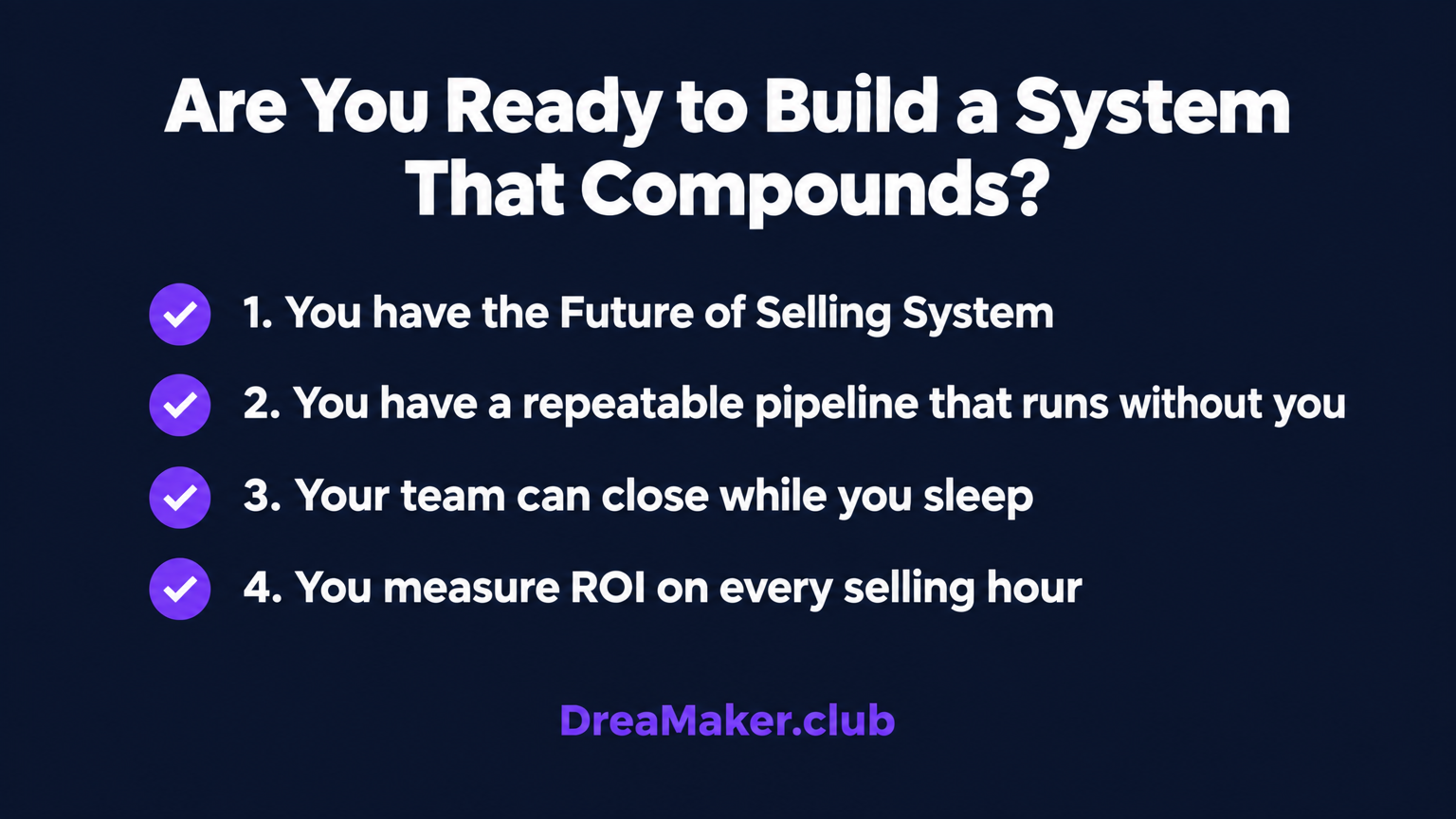
Check these before you move. This is for founders who are ready to stop being the bottleneck:
Condition 1 — You have the Future of Selling System. This is the non-negotiable foundation. Without a repeatable, structured selling process, every other condition is built on sand. The FOS is the infrastructure every other result compounds on top of. Start here → dreamaker.club/buyfos
Condition 2 — Your revenue must not stop when you stop. If you take three days off the phone and the pipeline freezes, you don't have a system — you have a personal treadmill. The move is to build a process your team can run without you.
Condition 3 — You are done spending on things that evaporate. Ads, one-off campaigns, random hires — these are expenses. A selling system is infrastructure. If your last three investments vanished when you stopped watching them, it's time to invest in something that compounds.
Condition 4 — You are leading your own sales with a team of 5+. This is not for solo operators or coaches. This is for founders in the field, with a real team, chasing a real market. If that's you — this is your move.
NEW!
September / October 2026
Dear Founders,
If your revenue stops the moment your selling effort stops, you don't have a business — you have a very expensive treadmill. Ken Griffin didn't become the 33rd-richest person in the world by running harder. He built systems that run for him. You can do the same — starting today, for $0.63/day.
Build Your Selling System → $0.63/day
I know how you feel. You feel like you're doing everything right — pitching, following up, working late — and still the pipeline isn't consistent. I felt the same way when I was grinding through my first 100 founder clients. What I found was the same thing Griffin knows and most founders refuse to accept: the effort alone is never enough. The system is everything.
Salesforce's State of Sales report (2025) found that 76% of sales professionals say their selling processes are inconsistent — meaning most founders are pitching differently every time, with no compounding effect. The Future of Selling System fixes that.
Here's what the FOS has done for founders just like you:
- $22M+ in combined sales by FOS graduates
- 1,000+ founders coached since 2015
- Jeffrey Teo — 63 customers in 100 days
- Stanley Tan — 45 buyers closed in 3 hours
- Leon — $2M partnership unlocked
Not ready for $19? Start free.
The Objection Playbook: 25 Word-for-Word Scripts to Close More Sales
The exact words Jason's founders use when a buyer says "too expensive", "send me info" or "I need to think about it". Free PDF, sent to your inbox.
Send Me the 25 ScriptsBillionaire Ken Griffin already moved. The only question is whether you will — or whether you'll read about someone else who did.


