Billionaire Larry Ellison Just Lost $15 Billion In A Single Day — And It Changes Everything For Founders Who Think They Are Their Business
Larry Ellison just lost $15.3 billion — in one day.
On October 14, 2026, Forbes' Real-Time Billionaires tracker recorded Oracle co-founder Larry Ellison as the session's second-biggest wealth loser: down $15.3 billion, or 8.26%, in a single trading day. That is not a typo. That is not a quarter. That is not a correction. That is one afternoon. And here is what makes it worse: it is not an isolated event. Over the past year, Ellison has shed nearly $200 billion from his peak fortune of more than $400 billion — the largest sustained wealth destruction of any individual in modern financial history. The man who briefly became the world's richest person has now fallen outside the global top ten. And almost every founder reading this is making the exact same structural mistake that caused it.
Think about what $15 billion in one day actually means.
That is more than most founders will generate in ten lifetimes. It evaporated between the opening bell and the closing bell. No fraud. No scandal. No product failure. Just Oracle's stock moving in one direction — and 40% of one man's entire net worth moving with it.
Now ask yourself this: if your pipeline dries up for one week — if the one sales method you use stops working, if the one referral source goes quiet, if the one big client delays — what happens to your revenue?
If the answer is "everything stops," then you are not looking at Ellison's problem from the outside. You are looking at your own problem in a very large mirror. The difference is scale. The structure is identical.
Ellison is 82 years old. He founded Oracle in 1977. He has spent nearly five decades building one of the most powerful technology companies in human history. He controls more than 40% of its stock. And on October 14, 2026, one company's share price movement cost him $15.3 billion in eight hours. That is the price of being the system.
Here are the facts, sourced and verified.
In September 2025, Larry Ellison became only the second person in history to be worth more than $400 billion, driven by an AI-fuelled surge in Oracle's stock price (Forbes, September 2025). By September 13, 2026, the Bloomberg Billionaires Index placed him at $204 billion — a drop of roughly $200 billion in twelve months (Bloomberg, September 2026). Oracle stock, which once traded above $304, closed at $137 by late September 2026, down more than 53% over the prior twelve months (Fortune, September 26, 2026). By October 14, 2026, Forbes' Real-Time Billionaires List recorded him losing a further $15.3 billion — 8.26% — in a single session, placing him as the day's second-largest wealth loser (Forbes Real-Time Billionaires, October 14, 2026).
Why? Oracle has been spending aggressively to transform from a legacy software company into an AI infrastructure operator. Capital expenditures hit $28 billion in a single quarter. Free cash flow turned negative $5 billion. The company executed a $20 billion equity issuance and laid off tens of thousands of workers at a cost of $2.1 billion in severance in fiscal 2026 alone, with a further $700 million in restructuring costs flagged for fiscal 2027 (247 Wall St., September 2026; Fortune, September 26, 2026). The upside is real: Oracle's cloud infrastructure revenue grew 121% year-over-year and remaining performance obligations reached $664 billion (Yahoo Finance, September 2026). But the market is pricing the cost of the bet, not just the potential. And Ellison — with more than 40% of his net worth tied to a single stock — absorbs every single point of that repricing personally.
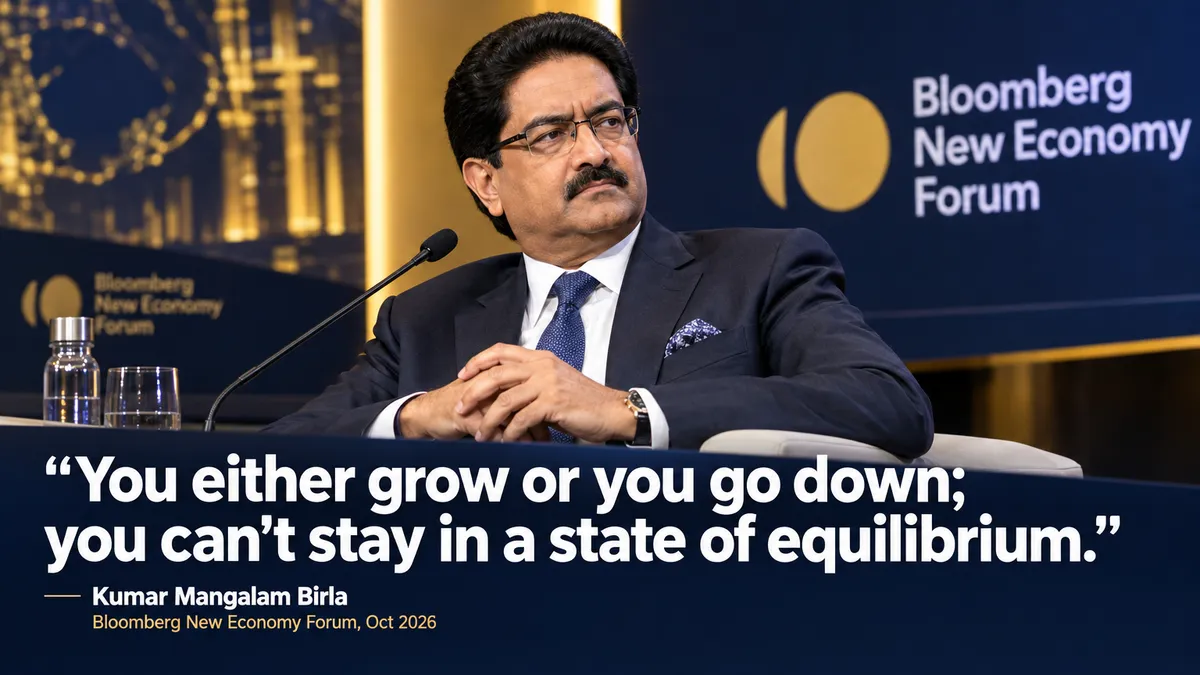
Billionaire Larry Ellison's move is one Jason has seen across 1,000+ founders. Here's what most miss.
The Lesson Most Founders Miss
Beat 1 — Root Cause Reframe
Most founders think Ellison's problem is Oracle's stock price. But the real problem is structural concentration — 40% of one man's entire financial world sits inside one ticker symbol. When that symbol moves, he moves with it. There is no buffer. There is no system running independently. There is only the position.
Most founders think their sales problem is a lead quality problem, or a pitch problem, or a follow-up problem. But the real problem is structural concentration. Your revenue runs through you — your relationships, your calls, your instincts, your effort on any given day. When you are off, your pipeline is off. When you are sick, revenue slows. When a key contact goes quiet, you have no other system generating output. You are the ticker symbol. And every bad week is a $15 billion day at a founder scale.
Beat 2 — The Lesson
"The most dangerous business is the one where removing you for 30 days also removes the revenue."
Ellison is not a cautionary tale about Oracle. He is a cautionary tale about what happens when the outcome of your life's work — all of it — depends on one asset moving in the right direction, every single day, forever.
For founders, the parallel is almost exact. Most startup founders with a team of five or more are running what looks like a business — but operates like a one-person sales effort. The founder holds the relationships. The founder runs the calls. The founder does the closing. The team delivers. But the engine of revenue? That is still one person, still one method, still one concentration point.
Billionaires survive concentration because they have so much that even a 50% wipeout leaves them with $100 billion. Founders do not have that buffer. A 50% wipeout of their pipeline, their referral source, or their personal selling capacity is an existential event.
The lesson is not "diversify your stock." The lesson is: build a selling system that generates predictable revenue independent of any single relationship, any single channel, or any single version of you on your best day.
Founder Story
Leon — $2M Partnership, Without the Founder on the Call
Leon came to Jason after years of being the sole rainmaker in his company. Every deal went through him. Every relationship lived in his head. When he built the Future of Selling System into his team's process, he closed a $2M partnership — and he was not even on the closing call. The system ran. The revenue came. The business no longer needed him to personally show up for every dollar.
The Hidden Opportunity Most Founders Are Missing Right Now
Beat 1 — The Hidden Opportunity
Here is what almost nobody is saying about Ellison's $15 billion day: Oracle's underlying business is not collapsing. Cloud infrastructure revenue grew 121%. Performance obligations hit $664 billion. The AI demand is real. The problem is that none of that business performance insulates one man's personal outcome from a single stock move in a single session. The value is there. The protection system is not.
For founders, the same gap exists. Your product may be excellent. Your clients may love you. Your team may be capable. But if your sales output is still running through you personally — through your energy, your memory, your relationships, your calendar — you do not have a business. You have a highly skilled job. And the moment you step back, so does the revenue.
The opportunity right now is for founders to build what Ellison does not have at a personal financial level: a system that produces predictable output regardless of external conditions. Founders who install a repeatable selling system in the next 90 days will be the ones who compound — while others remain one bad quarter away from a reset.
Beat 2 — Are You Ready To Move?
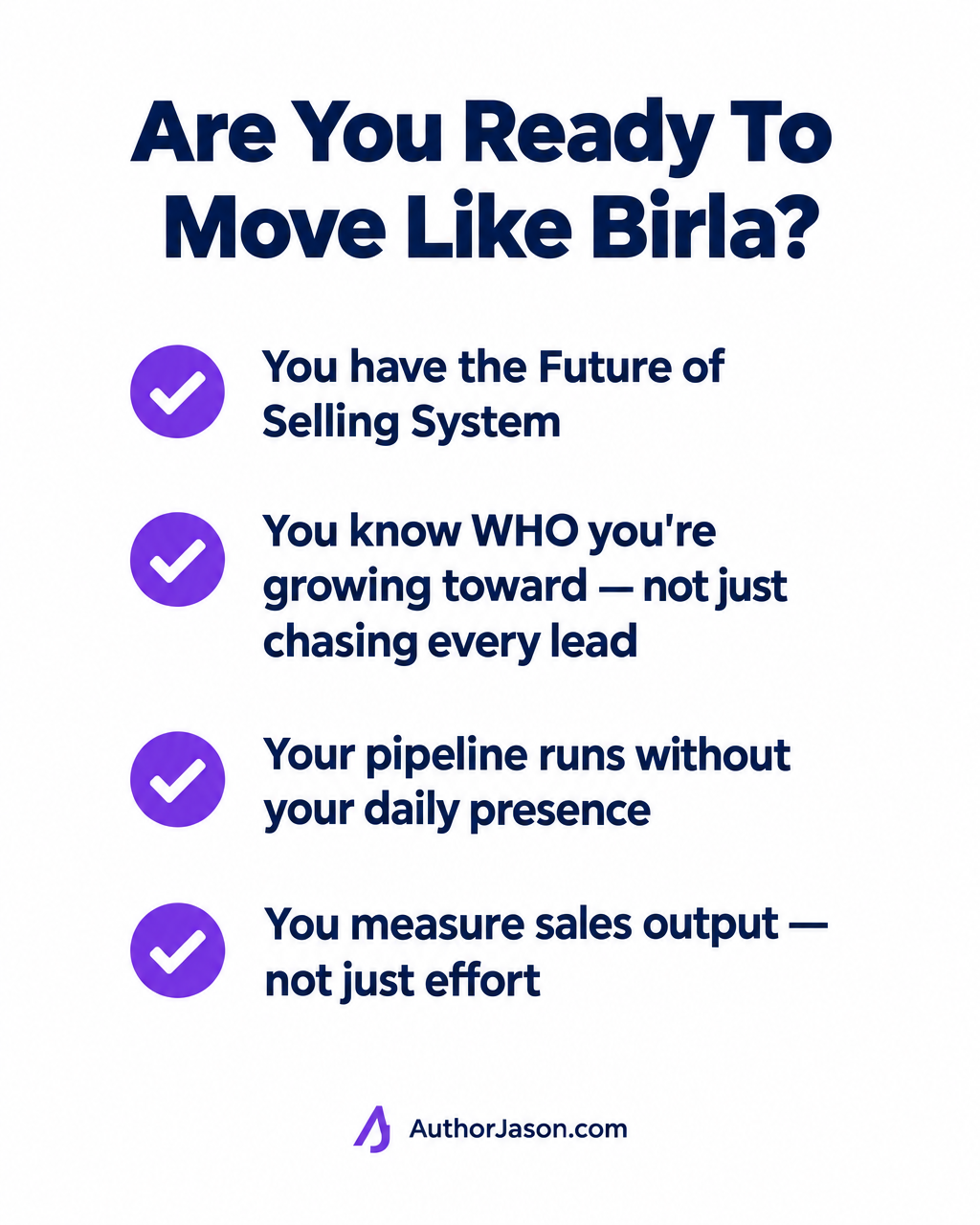
Before you can capture this opportunity, four conditions must be true:
Your Readiness Conditions
- ✅ Condition 1 — You have the Future of Selling System. Without a structured selling system that your team can execute without you, every sale still depends on you personally. This is the minimum entry requirement.
- ✅ Condition 2 — You know exactly who you are selling to. Founders who chase every deal are as fragile as Ellison's single-stock position. Concentrate on a defined buyer and build repeatability there first.
- ✅ Condition 3 — Your pipeline moves without your daily presence. If you take three days off and the pipeline freezes, you are the system. That must change before you can scale.
- ✅ Condition 4 — You measure sales output, not just effort. Effort is what employees track. Output is what founders must build their business around. If you cannot measure your selling system's daily output in numbers, you are flying blind.
NEW! → October 2026
Dear Founders — If removing you for 30 days would also remove your revenue, you do not have a business yet. You have a job with a team around it.
Here is the real pain: You are good at what you do. Your clients trust you. But every deal still runs through you — your energy, your calendar, your personal relationships. The day you step back, so does the revenue. That is not a sales problem. That is a system problem.
I know how you feel. Many of the 1,000+ founders Jason has worked with since 2015 felt the same way — like the business needed them personally in every deal. They felt that stepping back meant losing control. And then they found the Future of Selling System.
What they found: a five-step P.I.T.C.H. Formula that turned their personal selling habits into a team-executable system — one that generates $22M+ in combined graduate sales across founders in the US market. Jeffrey Teo used it to sign 63 customers in 100 days. Stanley Tan closed 45 buyers in 3 hours. Leon closed a $2M partnership without being on the call.
And the data backs it up: Salesforce's State of Sales report found that 76% of salespeople say their biggest challenge is finding time to sell because they are stuck doing everything manually, without a system (Salesforce, State of Sales). The Future of Selling System fixes that — for $19 a month.
Not ready for $19? Start free.
The Objection Playbook: 25 Word-for-Word Scripts to Close More Sales
The exact words Jason's founders use when a buyer says "too expensive", "send me info" or "I need to think about it". Free PDF, sent to your inbox.
Send Me the 25 ScriptsBillionaire Larry Ellison already moved — he built Oracle into a $664 billion contracted backlog — but he forgot to build a system that separates his personal outcome from one stock's daily price. The only question is whether you will build yours before your next bad week becomes your own $15 billion day.


