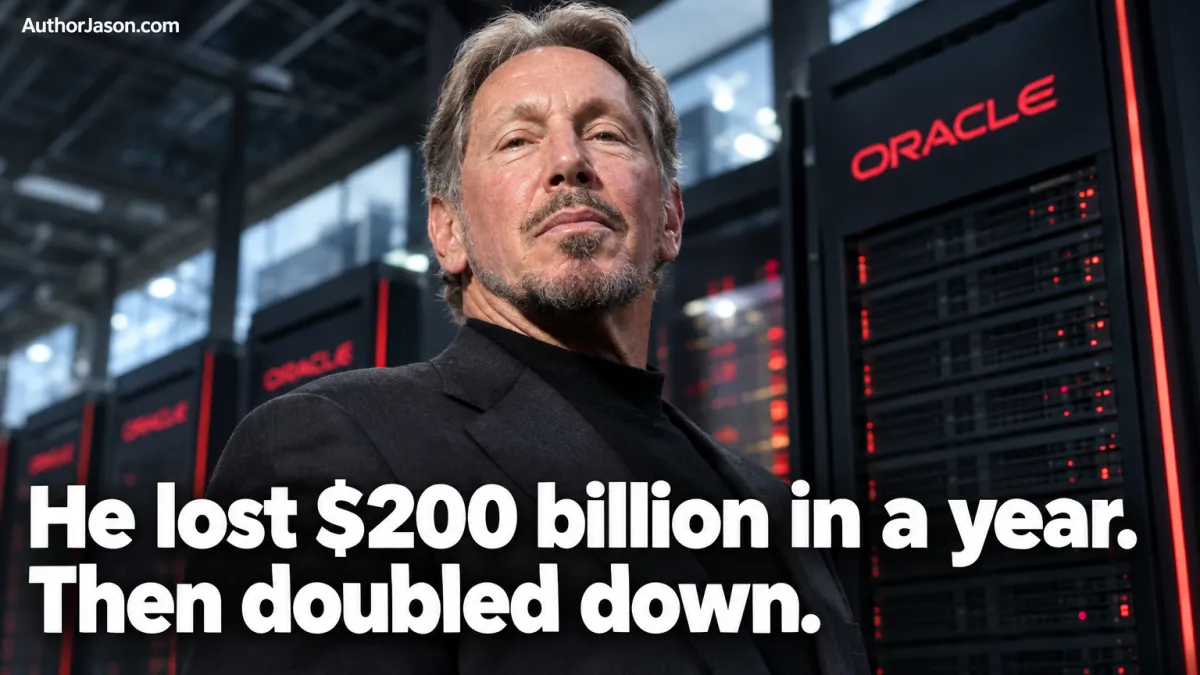
Billionaire Larry Ellison Just Lost $182 Billion In One Year — And Then Doubled Down On A $125 Billion Bet. Every Founder Needs To See Why.
BREAKING BILLIONAIRE NEWS | OCT 6, 2026
Billionaire Larry Ellison Just Lost $182 Billion In One Year — And Then Doubled Down On A $125 Billion Bet. Every Founder Needs To See Why.
Larry Ellison lost $182 billion in a year — and responded by committing $125 billion more. Wall Street calls it reckless. Most founders call it scary. But the founders who are quietly winning in 2026 see something completely different.
In September 2025, Ellison briefly became the second person in history to be worth more than $400 billion — an AI-driven boom in Oracle's stock took his fortune to $393 billion, according to Forbes. By mid-September 2026, Forbes estimated his net worth had fallen to approximately $195.8 billion. That is a drop of roughly $182 billion in twelve months — the largest single-year paper loss of any billionaire this decade. And what did he do next? He doubled Oracle's AI data-centre budget to $125 billion and pledged $56.6 billion of his own Oracle shares as personal loan collateral.
This move is one Jason has seen across 1,000+ founders. Here is what most miss.
Why This Should Make Every Founder Uncomfortable
Here is what the headline does not tell you: Oracle's stock fell 32–34% in 2026, according to Bloomberg's Billionaires Index and BigGo Finance, while the S&P 500 was up 9%. Oracle went from a top-20 company in the world by market cap to 36th — behind Costco. Wall Street's verdict was blunt: Ellison is over-leveraged, over-concentrated, and over-committed to a bet that Oracle's revenues at $19.2 billion per quarter cannot support at the rate he is spending.
And yet — and this is what makes most founders put the article down without reading to the end — Oracle's cloud infrastructure revenue grew 84% year-on-year, and the company's remaining performance obligations (its contracted backlog) hit $553 billion in Q3 2026, up 325% from the prior year, according to Finance Monthly. The business underneath the noise is not collapsing. It is compounding.
That contrast — collapsing stock price, exploding business backlog — is the most important thing you will read in any billionaire news story this week. And almost no founder is talking about it.
What Actually Happened — The Facts Behind The Fear
Let us be precise. According to TheStreet and Forbes, Larry Ellison's net worth peaked at approximately $378–393 billion in September 2025 — briefly making him the second wealthiest person in history. By mid-September 2026, Forbes estimated it had fallen to approximately $195.8 billion. The primary cause: Oracle's stock fell 32–34% in 2026, and Ellison owns roughly 40–41% of Oracle, according to the company's 2026 proxy statement cited by Bloomberg.
The spending behind the drop is not small. According to 24/7 Wall St. and BigGo Finance, Oracle invested $55.7 billion in AI data centres in the fiscal year that just ended, and disclosed plans to spend an additional $70 billion in the current fiscal year — a two-year total approaching $125.7 billion. The company's debt load is on course to exceed $100 billion. Moody's has a negative outlook on Oracle's credit rating, according to Bloomberg. On top of this, Ellison's family trust backs nearly 50% of Paramount Skydance — the $28 billion media merger that closed in August 2025, according to Forbes.
Meanwhile, Oracle's cloud revenue grew 44% to $8.9 billion in Q3 2026, and cloud infrastructure specifically surged 84%, according to Finance Monthly. The contracted backlog — $553 billion and rising — tells the story of what is coming, not what has already arrived.
Billionaire Larry Ellison's move is one Jason has seen across 1,000+ founders. Here's what most miss.
The Lesson — And The Root Cause Most Founders Get Completely Wrong
Most founders think the problem with Ellison's story is concentration risk. Pour everything into one company, lever it up, and one bad year wipes out $182 billion. The lesson most people extract is: diversify. Hedge. Don't go all-in.
But the real problem is not concentration. The real problem is the question it raises about founders who can't go all-in even when they want to.
Ellison's $125 billion AI bet is only possible because Oracle is a machine — a selling system with thousands of enterprise relationships, a 84%-growth cloud infrastructure business, $553 billion in contracted backlog, and a revenue engine that does not require Larry Ellison to personally close a single deal. He has the leverage to go all-in because the system underneath him works without him in it.
Most startup founders do not have that. They are the system. When they take a week off, the pipeline cools. When they have a bad month, revenue gaps. Every big strategic move — a new market, a new product, a high-conviction bet on a trend — gets delayed because they cannot step back from the day-to-day selling long enough to think at the level the move requires.
And here is the quotable truth most founders need to hear:
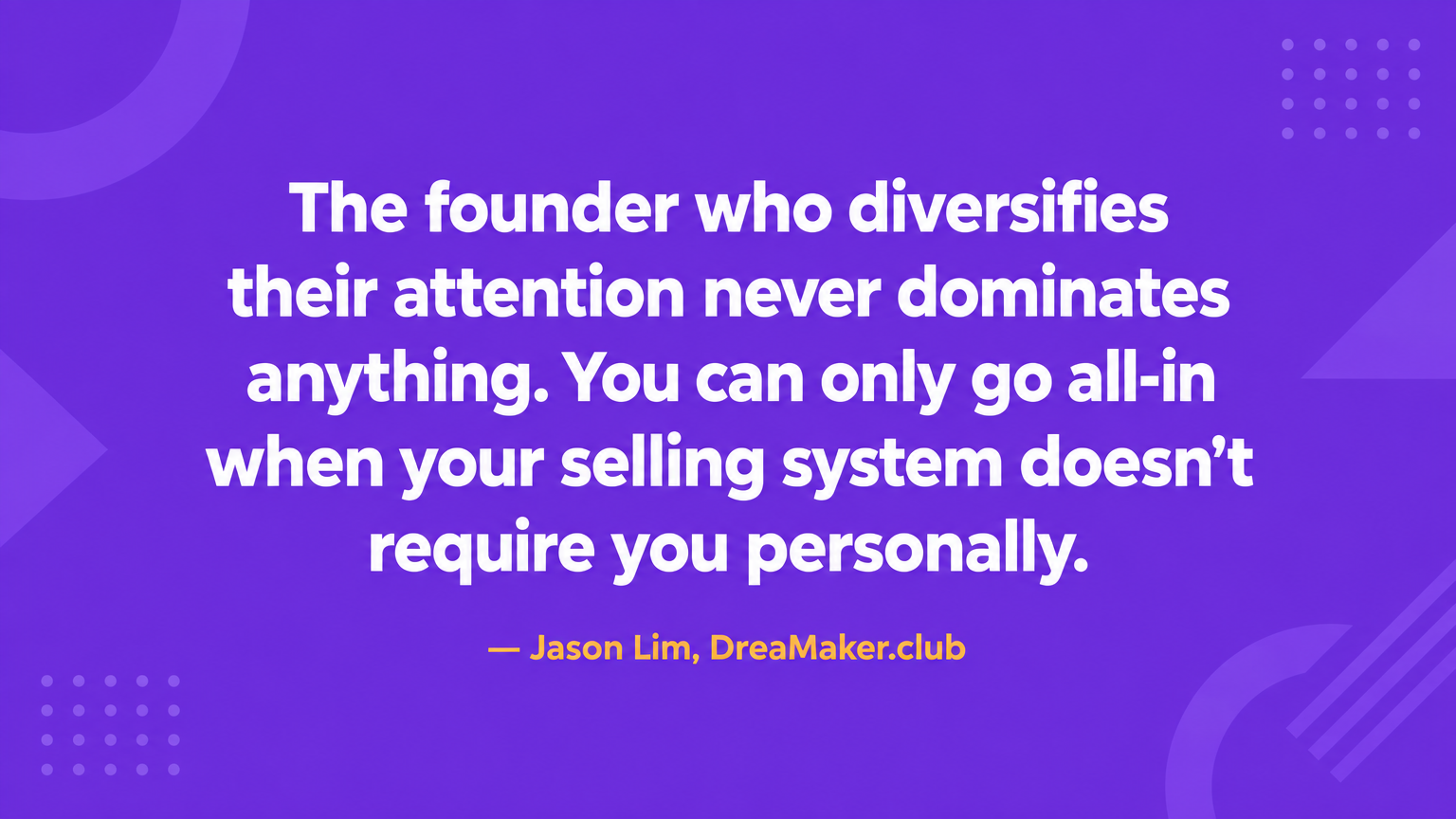
The founder who diversifies their attention never dominates anything. You can only go all-in when your selling system doesn't require you personally.
FOUNDER STORY
Stanley Tan: 45 Buyers in 3 Hours
Stanley was running every sales conversation himself — demos, follow-ups, proposals. Revenue was inconsistent and he was exhausted. Once he installed a selling system, he ran a structured launch event and closed 45 buyers in 3 hours. He did not close them one by one. The system did. He was finally free to think at the level his business needed him to think at.
Ellison can absorb a $182 billion paper loss and commit $125 billion more because he has separated himself from the operational execution. That separation is not a luxury available only to billionaires. It is a skill — and a system — that founders at every stage can build. But only if they stop treating founder-led selling as a permanent state rather than a stage.
The Hidden Opportunity — And The Conditions You Must Meet
Beat 1: The Hidden Opportunity
Oracle's $553 billion contracted backlog is not a number — it is a signal. It means that customers are lining up to pay before the product is even fully delivered, because the selling system is so well-designed that conviction runs ahead of execution. Most founders are chasing next month's revenue because they have no backlog. They have no pipeline discipline. And they have no selling system that generates committed future revenue without their personal involvement in every conversation.
The opportunity for founders right now is not to copy Ellison's AI bet. It is to copy the underlying architecture: a selling system that converts attention into committed revenue, predictably, without the founder in every call. Founders who build this in 2026 — while competitors are still winging it — will be in position to go all-in on the big strategic moves that 2027 will demand. Those who don't will still be closing their own deals when the window closes.
Beat 2: The Four Conditions
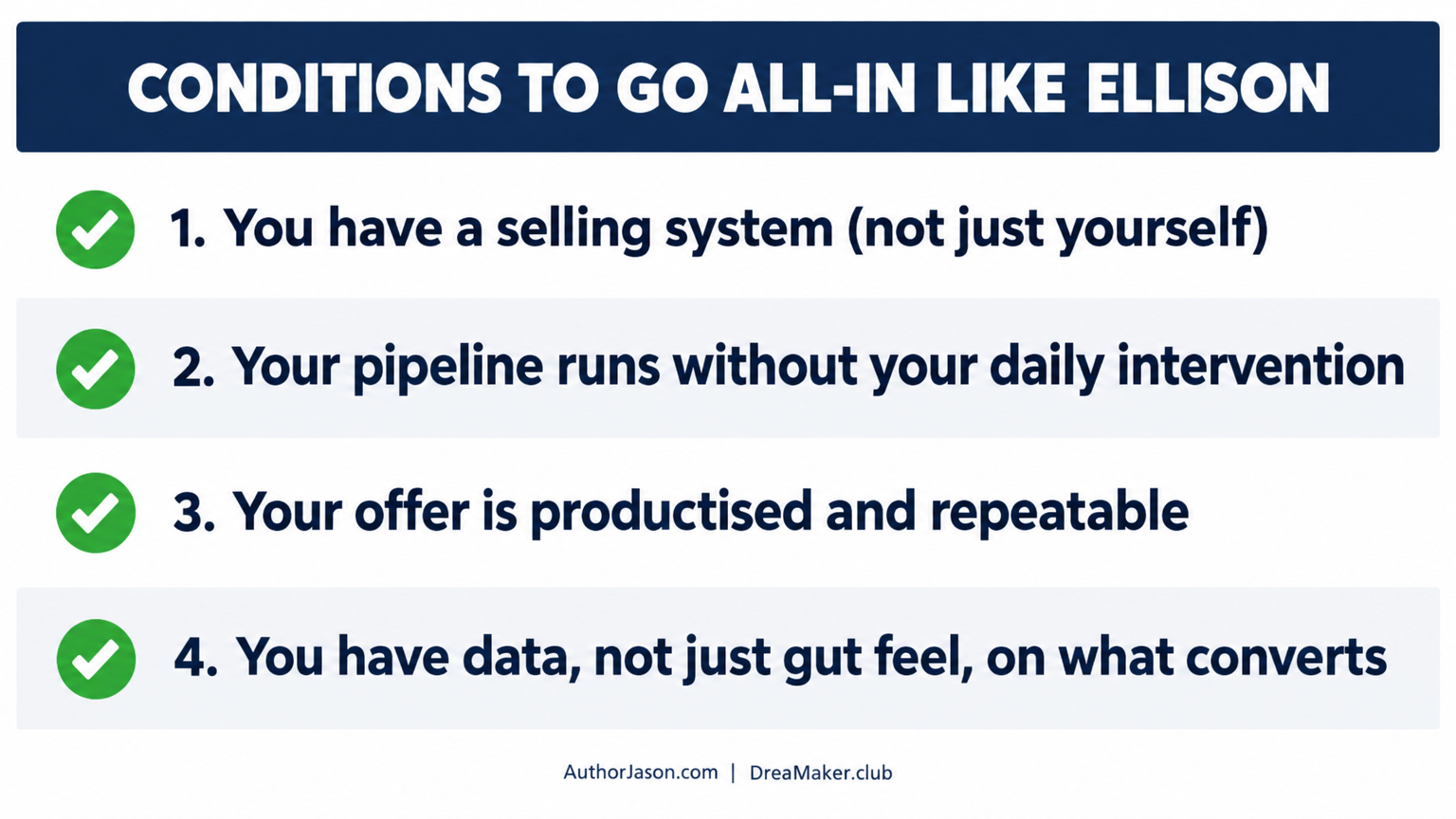
CONDITIONS TO GO ALL-IN LIKE ELLISON
Condition 1: You have a selling system — not just yourself
The Future of Selling System gives you a repeatable, founder-installed sales process that works even when you're not in the room. This is condition one. No system = no leverage. No leverage = no all-in.
Condition 2: Your pipeline runs without your daily intervention
If you stop prospecting for two weeks, does your pipeline freeze? If yes, you are the system. You need lead flow, follow-up sequences, and conversion processes that run independently of your attention.
Condition 3: Your offer is productised and repeatable
Oracle doesn't custom-pitch every enterprise. Your offer needs to be structured so that someone else — or a well-designed process — can present it without you customising it from scratch for every prospect.
Condition 4: You have data on what converts — not just gut feel
Oracle's $553B backlog did not come from hoping. It came from knowing exactly which conversations convert, at what stage, with what language. Founders with data make bets. Founders without data make guesses.
NEW! → OCTOBER 2026
Dear Founders — If You Can't Take A Week Off Without Your Pipeline Going Cold, You're Not Running A Business. You ARE The System.
That is the gap between where you are and where Ellison is. Not billions. Not connections. A selling system that generates committed revenue without requiring you in every conversation.
I know how you feel. Many of the 1,000+ founders Jason has worked with since 2015 felt the same way — stuck being the sole engine of their own revenue, unable to step back, unable to go all-in on the big move. What they found was this: once they had a selling system, everything changed. Jeffrey Teo acquired 63 customers in 100 days. Stanley Tan closed 45 buyers in 3 hours. Leon landed a $2M partnership. None of them did it by working harder at selling themselves. They did it by systematising how selling happened.
According to the Salesforce State of Sales report, 76% of sales professionals say their tools and systems — not their personal effort — are the primary driver of their revenue growth. Founders who treat selling as a personal heroic act rather than a designed system are leaving 76% of their potential on the table.
With $22M+ in combined sales generated by FOS graduates and 1,000+ founders served since 2015, the Future of Selling System is the infrastructure that lets you think and move like the founders you read about in this blog — instead of being buried in the selling that should already be running without you.
Not ready for $19? Start free.
The Objection Playbook: 25 Word-for-Word Scripts to Close More Sales
The exact words Jason's founders use when a buyer says "too expensive", "send me info" or "I need to think about it". Free PDF, sent to your inbox.
Send Me the 25 ScriptsEllison already moved — $182 billion poorer on paper and $125 billion deeper in conviction. The only question is whether you will build the system that lets you move next — or whether you'll read about someone else who did.


