Billionaire Larry Ellison Just Personally Guaranteed $40.4 Billion — And It Changes Everything For Startup Founders
Billionaire Larry Ellison Just Personally Guaranteed $40.4 Billion -- And It Changes Everything For Startup Founders
Larry Ellison just put $40.4 billion of his own name on a deal he did not have to. As Paramount closed in on its roughly $110 billion acquisition of Warner Bros. Discovery in September 2026, Ellison's irrevocable personal guarantee -- reported by NBC News, CNBC, and CNN Business -- became the headline that moved markets. But the real story has nothing to do with Hollywood. It is a masterclass in what closes a deal when logic alone cannot.
He did not add slides. He did not refine the pitch. He added skin. And it changed everything.
The Question Every Founder Needs to Sit With Right Now
When was the last time a buyer hesitated on your offer -- and you had nothing left to offer except a better pitch?
This is the part founders consistently get wrong. You optimise the deck. You sharpen the messaging. You tweak the pricing. And then the buyer still hesitates, still stalls, still says let us think about it -- because the real gap was never information. It was conviction.
Buyers are not waiting for more data. They are waiting for a signal that the seller is as committed to the outcome as they are. When that signal is missing, the deal dies quietly while the founder wonders what went wrong.
Ellison's move -- on the largest scale imaginable -- exposes the mechanism most founders never see. The gap between a stalled deal and a closed one is almost never features, pricing, or proof. It is the buyer's unspoken question: how much does this person actually believe in what they are offering?
What Actually Happened -- And Why the Numbers Matter
Oracle co-founder Larry Ellison's irrevocable personal guarantee of $40.4 billion was issued in December 2025 to backstop the equity financing for Paramount's bid for Warner Bros. Discovery, according to NBC News, CNBC, and CNN Business (December 22, 2025). The deal was valued at approximately $110 billion on an enterprise basis, with total equity financing of approximately $47 billion including contributions from three Middle Eastern sovereign wealth funds from Saudi Arabia, Qatar, and the United Arab Emirates, according to IBTimes (September 24, 2026).
The deal faced fierce resistance. A coalition of 12 state attorneys general sued to block the merger, arguing it would harm competition, according to Yahoo Finance (July 2026). The FCC granted approval on September 17, 2026, waiving a congressionally mandated foreign ownership cap to allow the sovereign wealth funds to hold 49.5 percent of the merged company, according to Deadline (September 22, 2026). The state antitrust case was subsequently settled, clearing the final regulatory hurdle.
The guarantee was not structurally required. Paramount had institutional backing, sovereign wealth fund commitments, and major investment bank financing already in place. Warner Bros. Discovery Chairman Samuel Di Piazza told CNBC that the board's central concern was confidence that Ellison would be there at closing. Ellison's response was not a better argument -- it was an irrevocable personal guarantee. WBD's board, which had initially rejected Paramount's offer and backed Netflix's competing bid, ultimately chose Paramount. Billionaire Larry Ellison's move is one Jason has seen across 1,000+ founders. Here is what most miss.
The Lesson Most People Will Completely Miss
Most founders think the problem is that buyers do not trust their product yet. But the real problem is that buyers do not trust their commitment.
There is a critical difference. Product trust is built through demonstrations, case studies, references, and testimonials. Commitment trust is built through sacrifice -- through putting something personal at stake that communicates: I am more invested in this outcome than you are, and I am willing to prove it.
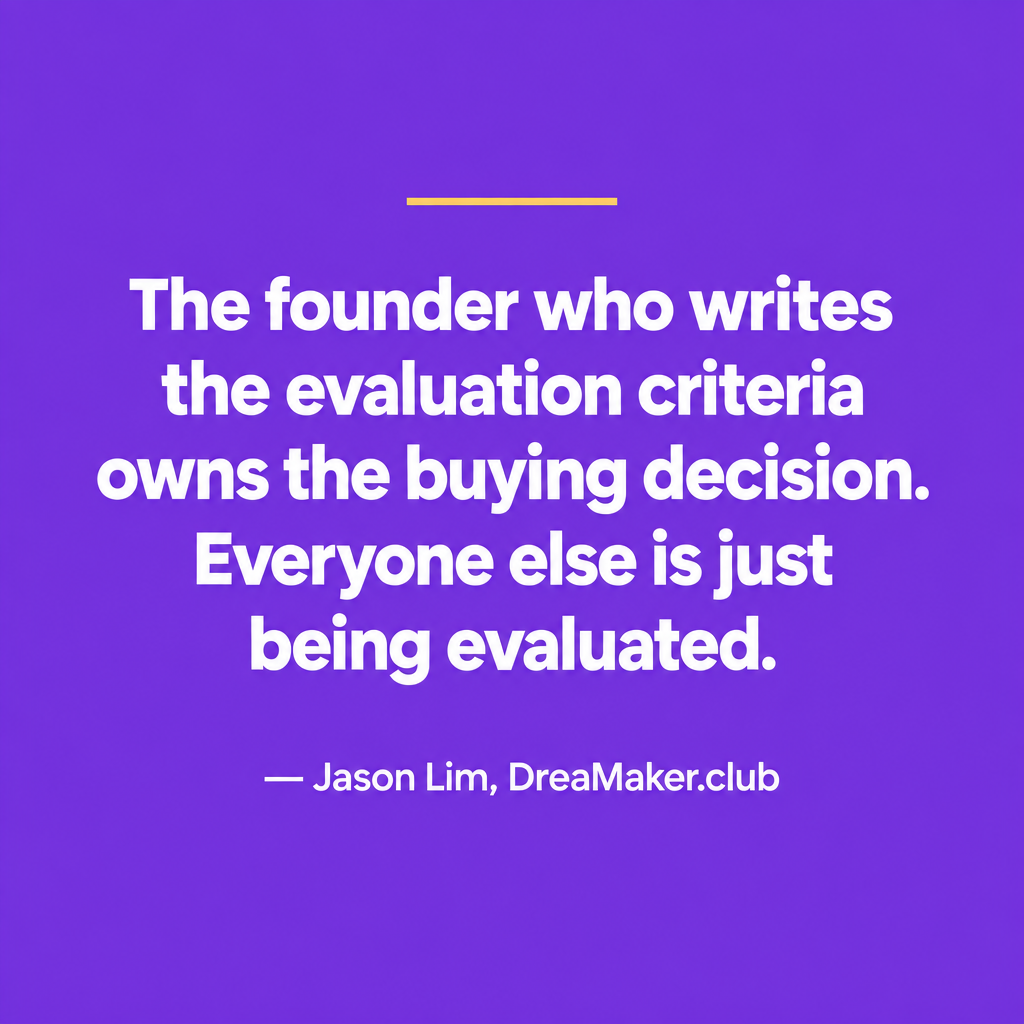
The founder who puts more skin in the game than the buyer expects removes the last reason the buyer has to say no.
Ellison did not need to guarantee $40.4 billion personally. The deal was financed without him. His guarantee was not structural necessity -- it was a trust signal of historic proportion. The WBD chairman said explicitly that the only fix would be a personal guarantee from Ellison, according to Yahoo Finance (December 2025). When Ellison delivered it as irrevocable, the deal moved.
Every founder has a version of this available to them. Not at $40 billion -- but at the scale that matters to their buyer. A guarantee. A performance commitment. A refund clause with teeth. A personal stake in the outcome rather than a contract where only the buyer carries the risk.
The founders who never think about this keep losing deals to let me think about it. The founders who understand it close by eliminating the last psychological barrier between the buyer and yes.
Founder Story Card
The visible problem: Buyers keep stalling after a promising pitch. They ask for more time, more references, more proof. The deal never closes.
The real root cause: The founder's offer asks the buyer to carry all the risk. There is no skin in the game and no commitment signal strong enough to shift the psychological balance.
The founder lesson: Trust is not built by adding more information. It is built by demonstrating that you are as invested in the outcome as the buyer -- and willing to prove it with something you can actually lose.
The move to make now: Audit your current offer. Where does all the risk sit? Add one concrete commitment signal -- a milestone guarantee, a performance clause, a conditional refund, or a personal stake -- that puts you alongside the buyer, not across the table from them.
The Hidden Opportunity Nobody Is Talking About
The hidden opportunity here is not in media mergers. It is in buyer psychology.
Every market has a trust threshold -- a point at which a buyer will commit regardless of how good the alternative looks. Below that threshold, no amount of logic, features, or pricing closes the deal. Above it, the close is almost automatic.
Most founders spend all their energy below the threshold: adding more persuasion, more proof, more pitch. Ellison's playbook goes straight to the threshold with a signal so unambiguous that hesitation becomes irrational.
You do not need a nine-figure guarantee to do this. You need to identify what your buyer's specific trust threshold is -- and then design a commitment signal that crosses it. That window is open right now in every market, for every founder willing to put something real on the line.
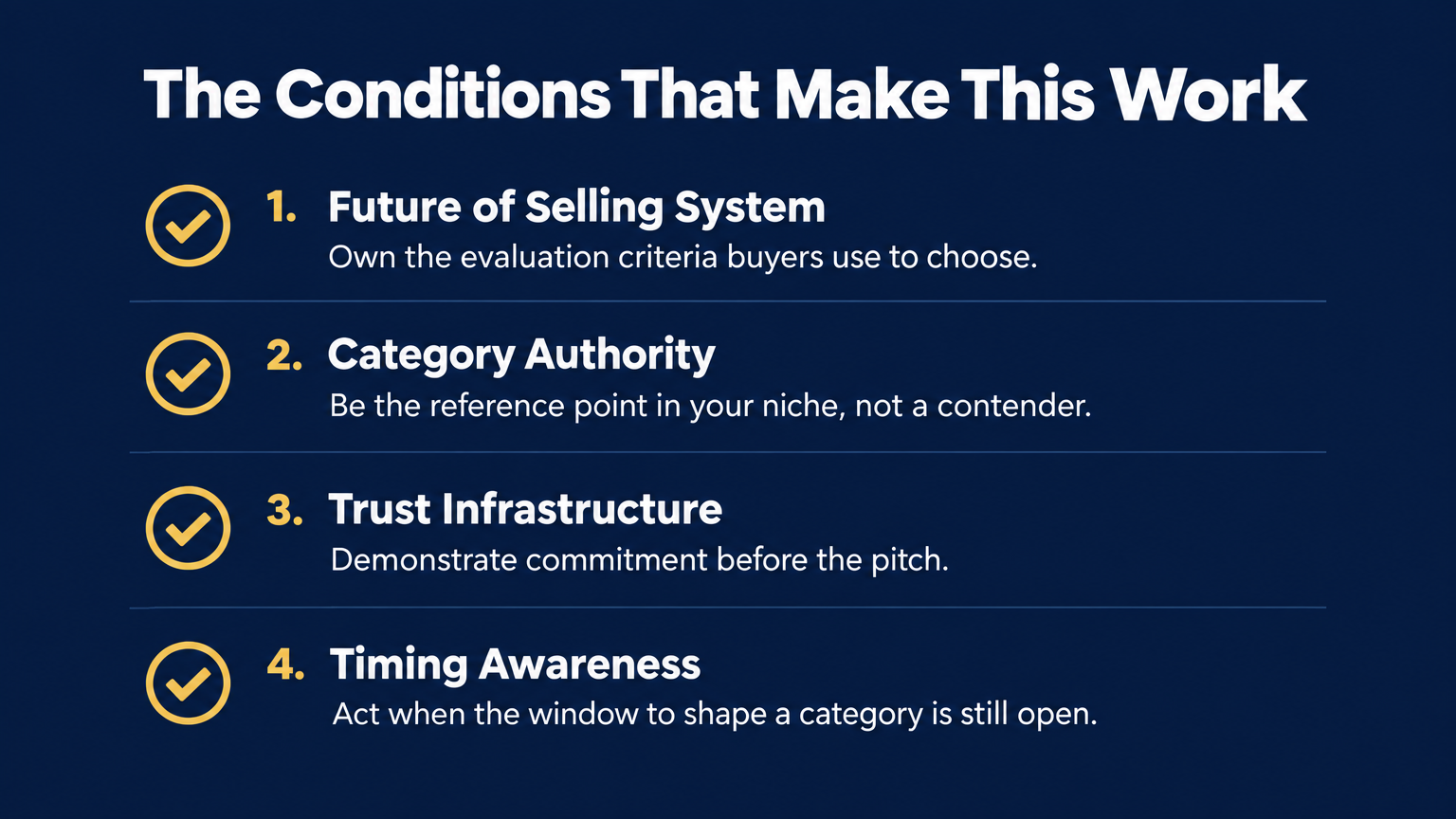
The Conditions That Make This Work
- Future of Selling System: You need a sales system built around buyer psychology, trust architecture, and conviction signals -- not just pitch decks and follow-up sequences. FOS gives founders the framework to identify what their buyer's trust threshold is and how to cross it with genuine commitment, not more persuasion.
- A Defined Risk Reversal: Before you can signal commitment, you need to know exactly where the buyer's risk sits. Map every point where your offer transfers risk to the buyer -- then build a commitment clause, guarantee, or performance structure that absorbs some of it.
- Conviction That Exceeds the Buyer's Doubt: Ellison's guarantee only worked because it was real and irrevocable. Performative commitment signals backfire. The move is to offer only what you genuinely stand behind -- then make sure the buyer knows it with specificity and in writing.
- Timing -- Act Before Doubt Becomes a Habit: Every deal has a moment when hesitation either resolves or calcifies. Identify that moment in your sales cycle and deploy your commitment signal before stalling becomes the buyer's default position.
If this story hit a nerve, it is probably because the same pressure is already showing up in your business.
Buyers are stalling. Deals are slipping. Prospects say they are interested but will not commit. And you have been responding by adding more proof, better decks, sharper positioning -- when the real gap has nothing to do with information and everything to do with the conviction signal your offer is sending.
The Future of Selling System helps founders turn expertise, trust, and timing into a sales system that buyers can understand, believe, and act on.
Ellison already moved. The only question is whether you will -- or whether you will read about someone else who did.


