Billionaire Larry Page Just Lost the #2 Richest Spot to Bezos and Said Absolutely Nothing — And It Changes Everything For Founders Who Think They Have to Be in Every Deal to Win
Billionaire Larry Page Just Lost the #2 Richest Spot to Bezos and Said Absolutely Nothing — And It Changes Everything For Founders Who Think They Have to Be in Every Deal to Win
Larry Page lost billions in a day. Jeff Bezos took his #2 spot on the Bloomberg Billionaires Index. And Page said exactly nothing — no interview, no tweet, no appearance.
Meanwhile, Alphabet ran without him. Gemini surpassed 900 million monthly active users (Google I/O, May 2026). Annual capital expenditure for Alphabet reached as high as $205 billion in 2026 (Reuters, June 2026). The machine kept printing. The founder was nowhere to be seen — and that was the whole point.
This Should Bother You More Than It Does
Think about your last week in business. How many deals stalled because you had not followed up? How many conversations went cold because you were in the wrong meeting? How many proposals are sitting in someone's inbox right now, waiting for you to show up and push them over the line?
Larry Page stepped away from day-to-day management in December 2019. That was six years ago. Alphabet has since added hundreds of billions in market cap. Its AI products are used by nearly a billion people. The deals get done. The contracts get signed. The revenue compounds.
And the founder did not show up for any of it — because he did not have to. He built something that did not need him in the room. The question for every startup founder reading this: has your business passed that test? Or does everything stop the moment you do?
What Actually Happened — And Why It Matters
In September 2026, Jeff Bezos overtook Larry Page on the Bloomberg Billionaires Index, claiming the #2 position on the global rich list (Bloomberg, September 2026). The move triggered headlines across financial media. Page's net worth, while still estimated in the hundreds of billions, had slipped relative to Bezos's surging Amazon-linked holdings.
Page's response: total silence. He has made no public appearance since stepping down as Alphabet CEO in December 2019 — not even attending Alphabet's own shareholder meetings (The Guardian, 2019). No press conference. No investor call. No LinkedIn post.
What has he left behind? Alphabet — a company that in 2026 spent $205 billion in capital expenditure (Reuters, June 2026), deployed Gemini AI to over 900 million monthly users (Google I/O, May 2026), and continues to dominate global search, cloud, and AI infrastructure. The system he helped build generates tens of billions in quarterly revenue — without him presenting a single pitch deck.
Billionaire Larry Page's move is one Jason has seen across 1,000+ founders. Here is what most miss.
The Lesson — And the Root Cause Most Founders Never Diagnose
Root Cause Reframe
Most founders think the problem is they are not talented enough, well-connected enough, or charismatic enough to close big deals without being in the room. So they try harder. They attend every meeting. They send every follow-up personally. They insert themselves into every conversation because they believe the deal needs them — personally, physically, specifically them.
But the real problem is they never built a selling system that works when they do not show up.
Larry Page did not stop being rich when he stopped showing up. Alphabet did not stop closing enterprise contracts when he stopped attending meetings. The value was not in his presence — it was in the system, the process, the infrastructure he and Sergey Brin put in place before they ever stepped back.
Page said it plainly when he stepped down: We have never been ones to hold on to management roles when we think there is a better way to run the company. (Larry Page, Alphabet Blog, December 3, 2019.) That is not humility. That is architecture. He was describing a company designed to compound without its founders as the bottleneck.
Most founders' sales processes are the opposite of that architecture. They are entirely founder-dependent. The pitch only works when the founder tells it. The follow-up only happens when the founder remembers. The close only comes when the founder shows up. That is not a business — that is a job you gave yourself with no HR and unlimited working hours.
The Lesson
The founder who builds a system gets rich twice. The founder who never builds one stays busy forever.
The builder who is present for every deal has built a fragile business. The builder who designed a process that runs without them has built a compounding one. Larry Page chose the second path at age 46. Most founders have not chosen it at all — not because they cannot, but because they have never been shown what the system looks like in a business of 5 to 50 people where they are still the primary seller.
Founder Story
Leon: $2M Partnership — Without the Founder in the Room
Leon was a founder who had spent two years chasing a partnership deal that kept stalling every time the conversation reached the decision-maker. He was the only person who could advance it. The moment he stepped out of the loop, the deal went cold. After building his selling system through FOS, Leon structured the conversation so his process did the work. The $2M partnership closed — and Leon was not in the final room. The system was.
The Hidden Opportunity — And Whether You Are Ready For It
The Hidden Opportunity
There is a class of startup founder emerging right now that almost no one is talking about. They are not the loudest on stage. They are not posting daily on LinkedIn. They are not the face of every deal. But their companies are closing more consistently, growing faster, and compounding in ways their founder-dependent peers cannot replicate.
The opportunity is this: right now, while most founders are grinding through one deal at a time, the founders who invest in building a repeatable selling process are building a business that compounds. Every deal closed with a system teaches the system how to close the next one better. Every follow-up sequence that runs without you is an asset that pays dividends in perpetuity.
Larry Page did not invent search. He built the system that scaled search. The distinction made him one of the wealthiest humans alive. The same distinction — between doing the thing and building the system that does the thing — is available to every founder leading their own sales right now. The window to build that system before your market gets crowded is exactly now.
Are You Ready? Check the Conditions.
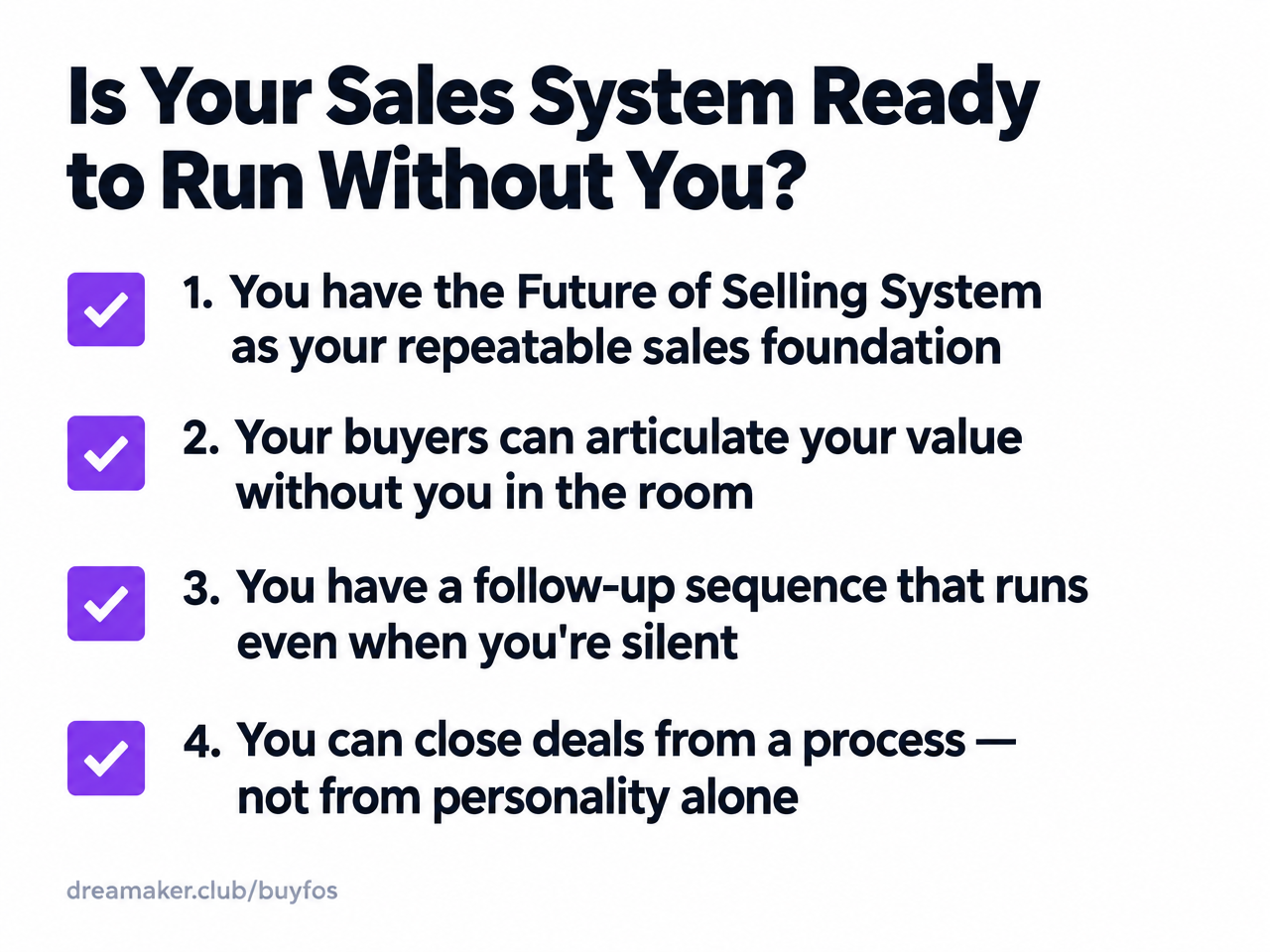
You are ready to build a system that sells without you when:
Condition 1 — You have the Future of Selling System as your repeatable sales foundation. Without a documented, repeatable process, you are not running sales — you are improvising. FOS gives you the architecture before you need to scale it.
Condition 2 — Your buyers can articulate your value without you in the room. If they cannot explain why they chose you to someone else at their company, your system has not done its job.
Condition 3 — You have a follow-up sequence that runs even when you go silent. Deals do not close in the first conversation — and the founder who disappears after the pitch loses to the founder whose process keeps showing up.
Condition 4 — You can close from a process — not from personality alone. The most dangerous dependency in a startup is when only one person can close. Build the process. Make yourself optional in the conversation. Keep yourself essential in the architecture.
NEW! — October 2026
Dear Founders,
If your pipeline freezes the moment you stop calling, you are not running a business — you are running a one-person show. That gap is costing you deals this quarter.
I know how that feels. I have sat across from founders who were brilliant, hard-working, and genuinely great at what they do — and watched them lose deals they should have won, not because of their product, but because they had no repeatable system to carry the conversation forward when they were not in the room.
What I found — and what 1,000+ founders since 2015 have now found — is that when you have a system, the deals keep moving. Salesforce State of Sales reports that 76% of buyers expect consistent engagement across every touchpoint — but most founders deliver zero consistency because there is no system to create it. (Salesforce State of Sales, 2024.)
Graduates of the Future of Selling System have generated $22M+ in combined sales. Jeffrey Teo closed 63 customers in 100 days. Stanley Tan closed 45 buyers in 3 hours. Leon landed a $2M partnership — without being in the final room.
They did not get lucky. They got a system. And it is available to you right now for $19/month — that is $0.63 a day.
Future of Selling System · dreamaker.club/buyfos
Not ready for $19? Start free.
The Objection Playbook: 25 Word-for-Word Scripts to Close More Sales
The exact words Jason's founders use when a buyer says too expensive, send me info, or I need to think about it. Free PDF, sent to your inbox.
Send Me the 25 ScriptsLarry Page already built the system that runs without him — the only question is whether you will too, or whether you will keep showing up to every deal hoping your presence is enough.


