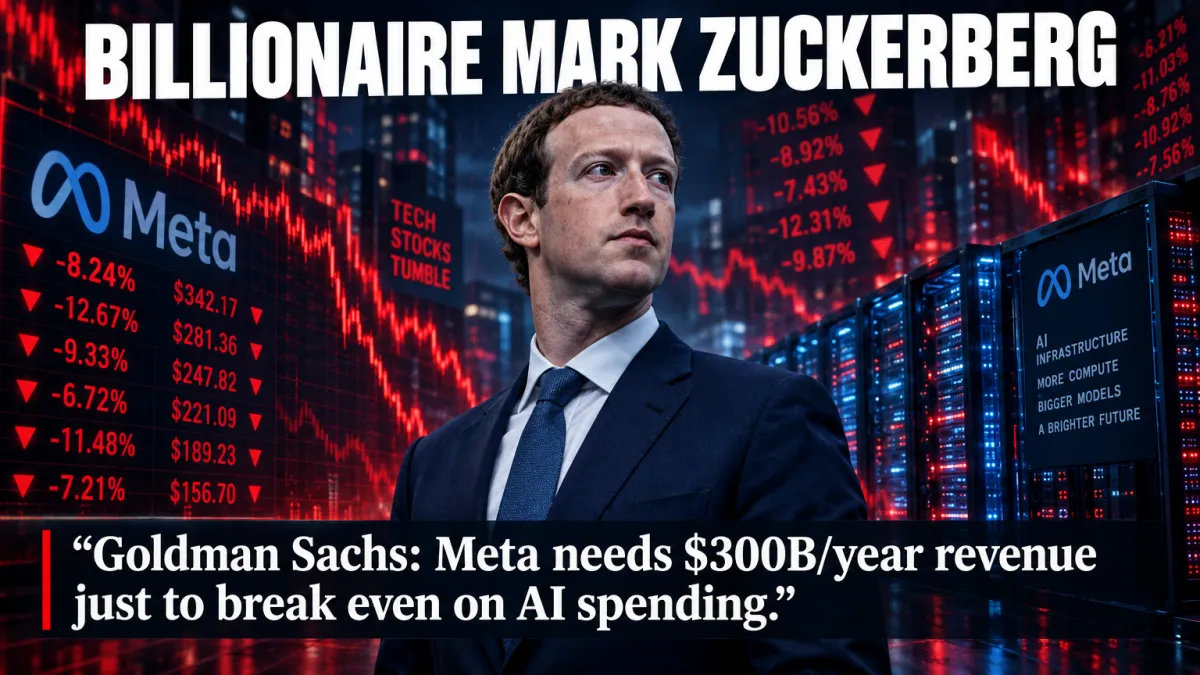
Billionaire Mark Zuckerberg Just Lost $19 Billion in Two Days — And It Changes Everything For Founders Who Think More Spending Is the Answer
Billionaire Mark Zuckerberg Just Lost $19 Billion in Two Days — And It Changes Everything For Founders Who Think More Spending Is the Answer
By Jason Lim | September 29, 2026 | Breaking News
PART 1 — THE HOOK
Zuckerberg just lost $19 billion in 48 hours — and the person who triggered it works at Goldman Sachs.
A Goldman Sachs analyst published a blunt warning this week: Meta would need to generate approximately $300 billion in annual revenue just to break even on the AI capital expenditure it has committed to. At the time of the note, Meta was doing roughly half that. The market did not wait for a rebuttal. It wiped billions off Zuckerberg's net worth in two trading sessions. If the richest man in tech cannot escape the ROI question, neither can you.
PART 2 — THE PRESS
Here is what every founder needs to feel in their gut right now.
Zuckerberg is spending $60 to $65 billion on AI infrastructure in 2026 alone. That is not a bet — it is a conviction. He has publicly declared that Meta will be the world's leading AI company. He has hired aggressively. He has built data centres the size of small cities. He is doing everything founders are told to do: invest boldly, move fast, outspend the competition.
And then Goldman Sachs asked the one question every investor, board member, and enterprise buyer eventually asks: what does this actually return?
The market's answer was swift and brutal. Nineteen billion dollars erased in two days.
Now ask yourself: when your buyer sits across from you and silently asks the same ROI question about your solution, what is your answer? Do you have one that is fast, specific, and citable? Or do you wing it, hope they believe in you, and wonder why deals stall at the finish line?
This is not Zuckerberg's problem alone. This is every founder's daily problem.
PART 3 — THE PLAY
Here is what actually happened, with the numbers that matter.
Meta's stock dropped approximately 4.4% on September 26, 2026 — its worst single-day move in months — after Goldman Sachs published a research note questioning whether the company's AI capital expenditure could generate sufficient returns at its current revenue run rate. The note framed the break-even threshold at roughly $300 billion in annual revenue, nearly double what Meta generates today (Reuters, September 2026).
Combined with broader Nasdaq weakness and rising yield pressure, Zuckerberg's personal fortune fell approximately $19 billion across two trading sessions, according to the Bloomberg Billionaires Index (Bloomberg, September 2026).
Meta's 2026 AI capex guidance stands at $60–65 billion. Its closest rival, Alphabet, has committed $75 billion for the full year. The race is real. But Goldman's note forced a reckoning: spending at scale only creates enterprise value if the revenue engine can outrun it.
Meta has three primary revenue lines — advertising, Reality Labs hardware, and nascent AI API licensing — and only one of them is currently generating meaningful returns at scale. The Goldman note was, in essence, a sales problem disguised as a capital allocation problem.
Billionaire Mark Zuckerberg's two-day $19 billion loss is one Jason has seen mirrored across 1,000+ founders at smaller scales. Here's what most miss.
PART 4 — THE LESSON + ROOT CAUSE REFRAME
Beat 1 — Root Cause Reframe
Most founders think the problem is cash. Not enough budget, not enough backing, not enough runway to spend their way to dominance.
But the real problem is a selling system that cannot answer the ROI question before the buyer even asks it.
Goldman Sachs did not panic because Meta is spending $65 billion. Wall Street funds bets that size every quarter. They panicked because there was no credible, pre-built answer to the most predictable question in finance: what does the revenue engine look like at that level of spend?
Founders make this same mistake daily — just at smaller scale. They invest in the product, the team, the tech stack, the office, the LinkedIn ads. But they never install the sales system that converts all that spending into a predictable revenue story. So when a buyer says walk me through the ROI, or what happens if this does not work, or why should I buy this now — the founder improvises. And improvisation at the closing table is the most expensive habit in business.
Beat 2 — The Lesson
You do not have a spending problem. You have a system problem — and the market always figures that out before you do.
The founders who survive market scrutiny — from buyers, investors, and partners — are not the ones who spend the most. They are the ones who can answer the ROI question in 60 seconds, with specificity, before the room even asks. That answer is not a number. It is a system. A repeatable, teachable, demonstrable sequence that shows how spending turns into closing turns into revenue.
Zuckerberg built an extraordinary product machine. But in this moment, the market revealed a gap in the revenue narrative. For a founder with a team of five leading their own sales, the same gap is fatal faster — because you do not have a $164 billion revenue base to cushion the fall.
Founder Story Card
Jeffrey Teo — 63 Customers in 100 Days
Jeffrey did not have a product problem. He had a sales system problem. Every pitch was a fresh improvisation — different framing, different order, a different answer to every objection. After installing the Future of Selling System, he closed 63 paying customers in 100 days. The product did not change. The system did.
When the ROI question came, he had the answer ready. Every single time.
PART 5 — THE OPPORTUNITY + CONDITIONS
Beat 1 — The Hidden Opportunity
Here is what almost no one is talking about inside this story.
Goldman Sachs just handed every B2B founder in the US market a gift. Enterprise buyers — the CFOs, procurement leads, and heads of operations — are about to get a lot more rigorous about ROI conversations. The AI gold rush created a generation of buyers who approved spending because everyone else was doing it. That era is ending.
The Goldman note has put ROI scrutiny back at the centre of every boardroom conversation. Which means the founder who shows up with a sharp, pre-built ROI narrative — before the buyer asks — will not just close deals faster. They will become the only vendor in the room the buyer actually trusts.
This is a window. The founders who install a proper selling system right now will be positioned as the credible choice when buyers tighten their gates. The ones who keep improvising will be the casualties of the next Goldman Sachs note — written about their pipeline, not Zuckerberg's.
Beat 2 — Are You Ready for This Moment?
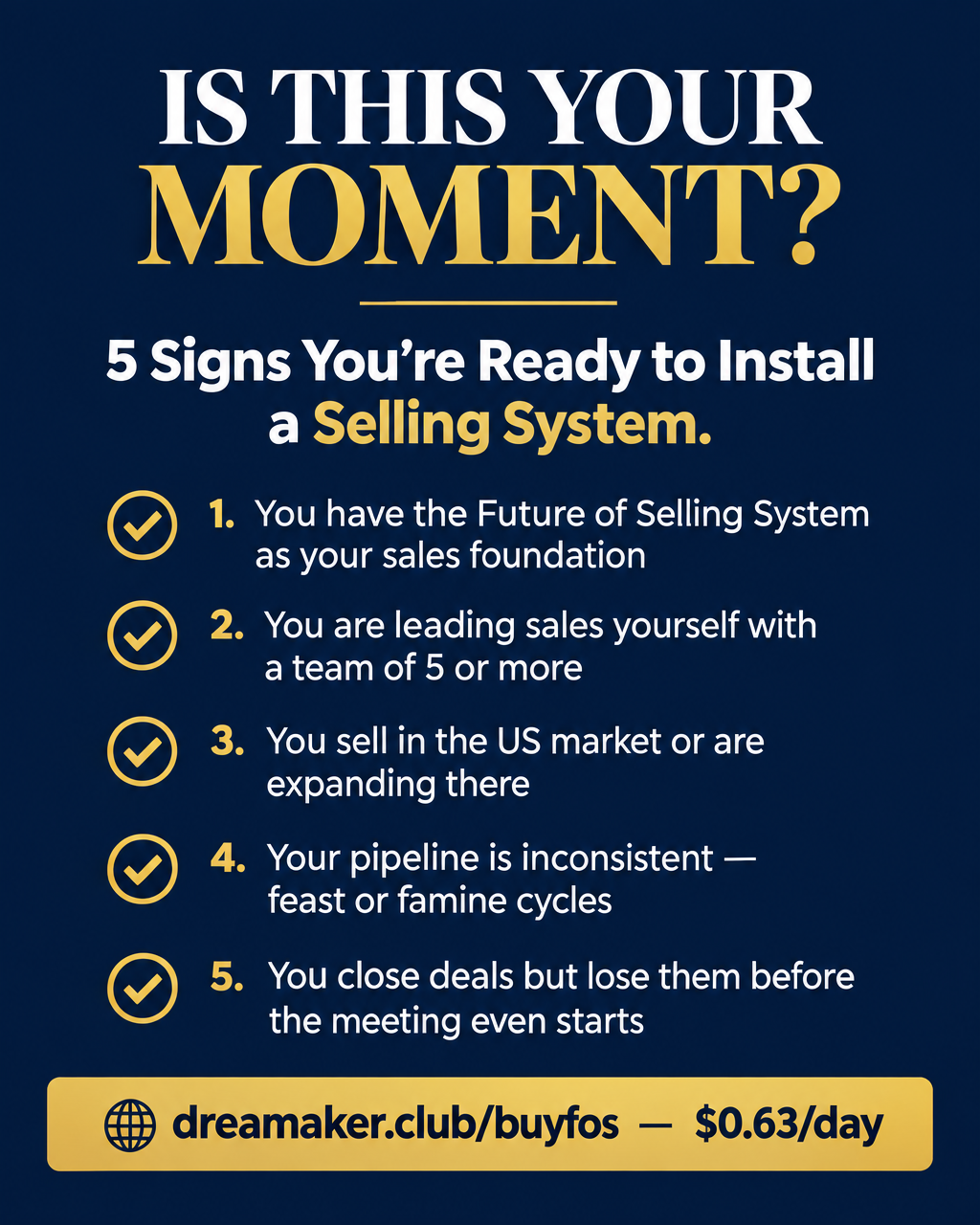
Check the conditions that apply to you:
Condition 1 — You have the Future of Selling System as your sales foundation
Not improvising. Not hoping. Running a repeatable, teachable system that produces a pre-built ROI narrative your whole team can deliver.
Condition 2 — You are leading sales yourself with a team of 5 or more
The ROI question gets harder as the team grows. You need a system the whole team can run, not just an answer you keep in your head.
Condition 3 — Your buyers are becoming more rigorous about ROI
If enterprise or mid-market buyers are slowing down approvals and asking harder questions, that is your signal — not your obstacle.
Condition 4 — You close deals but the process is inconsistent
You win when you are on — but you cannot replicate it, predict it, or hand it to the next person. That is a system gap, not a talent gap.
Condition 5 — You sell in the US market or are expanding there
US enterprise buyers are the first to tighten. The window to install the system before the gates close is shorter than you think.
PART 6 — FROM THE DESK OF JASON LIM
NEW! — September 2026
Dear Founders — The ROI Question Is Coming. Do You Have the Answer?
Your buyer is about to get a lot harder to close. Goldman Sachs just told Wall Street that AI spend needs a believable revenue story. Your buyer's CFO read the same note.
If your pitch still relies on hope, improvisation, and trust me energy — you are about to feel a wall you did not see coming.
I felt the same wall when I was leading sales for my first startup. I felt the silence after a buyer asked what does this actually return? I found that the founders who had a system — a repeatable, teachable sequence for every stage of the sale — answered that question in 60 seconds and closed the room. The ones without a system lost deals they had already won in their heads.
According to Salesforce State of Sales, 76% of salespeople say they struggle to answer ROI and value questions in the moment (Salesforce State of Sales, 2026). The buyers know this. The ones who ask it hardest are the ones who have been burned before.
The Future of Selling System has been used by 1,000+ founders since 2015, generating over $22M in combined sales by graduates. Jeffrey Teo closed 63 customers in 100 days. Stanley Tan closed 45 buyers in 3 hours. Leon unlocked a $2M partnership. None of them changed their product. They installed the system.
Not ready for $19? Start free.
The Objection Playbook: 25 Word-for-Word Scripts to Close More Sales
The exact words Jason's founders use when a buyer says too expensive, send me info or I need to think about it. Free PDF, sent to your inbox.
Send Me the 25 ScriptsZuckerberg already moved — he committed $65 billion before the market asked the question. The only question is whether you will install your selling system before your buyer asks theirs — or whether you will read about a founder who did.


