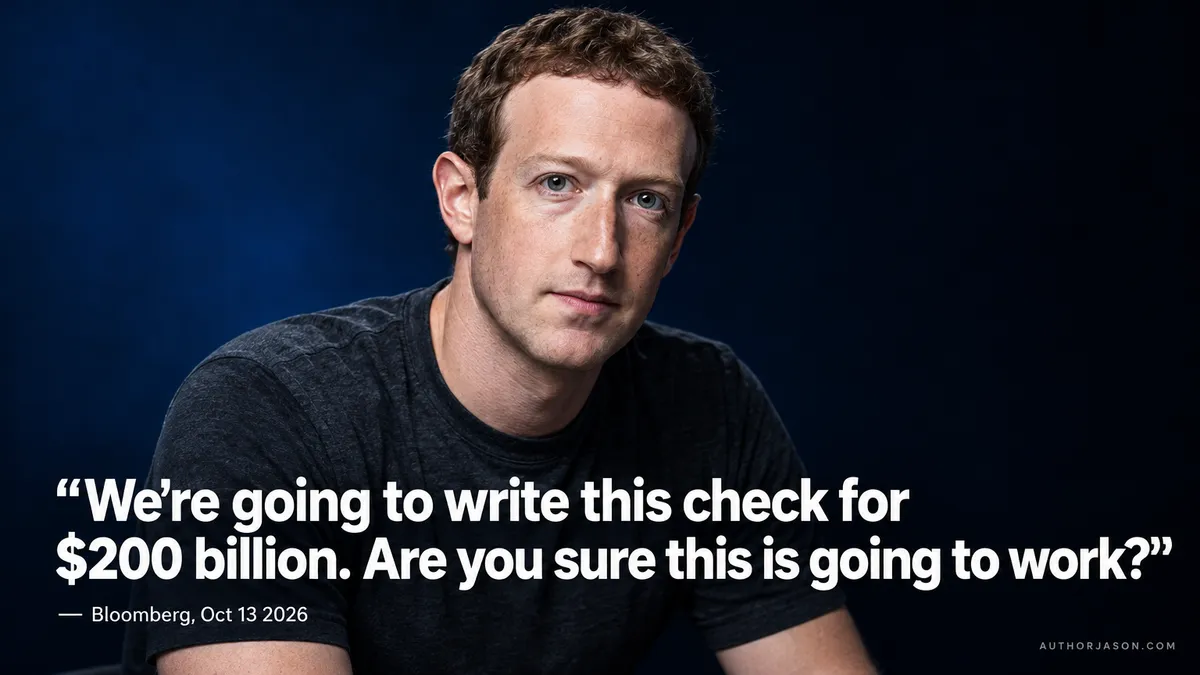
Billionaire Mark Zuckerberg Just Admitted He Didn't Know If His $200 Billion Bet Would Work — And It Changes Everything For Founders Who Are Still Waiting Until They're Ready
Billionaire Mark Zuckerberg Just Admitted He Didn't Know If His $200 Billion Bet Would Work — And It Changes Everything For Founders Who Are Still Waiting Until They Are Ready
Zuckerberg just told the world he wrote a $200 billion check without knowing if it would work. Most founders haven’t written a single proposal for the same reason.
On the Cheeky Pint podcast released October 13, 2026, Mark Zuckerberg recounted the moment he told Meta’s Chief AI Officer Alexandr Wang they were going to commit up to $200 billion to AI infrastructure — then immediately asked: “Alex, are you sure this is going to work?” [Benzinga, October 13, 2026]. Wang’s answer was not a guarantee. The models were not proven. The CFO was worried. And Zuckerberg committed anyway. That same week, Meta’s Muse app reached #1 on the US App Store, surpassing ChatGPT [Quartz / Sensor Tower, September–October 2026]. If you read this as a story about boldness, you missed the lesson entirely.
Here’s Why This Should Make Every Founder Uncomfortable
Think about the last deal you did not pursue. The proposal you did not send. The conversation you kept postponing because your product was not quite ready, your pricing was not quite right, or you were not quite sure the buyer would say yes.
Now consider: Meta’s CFO Susan Li pulled Alexandr Wang aside at an executive gathering and told him directly: “If this doesn’t work, like, you know, this is going to be really, really bad. It’s going to be very, very bad in financial terms” [AOL / Business Insider, October 13, 2026]. The stakes were existential. The uncertainty was genuine. And Zuckerberg still moved.
You are not waiting because the timing is not right. You are waiting because you have confused certainty with readiness. And the market does not reward founders who wait for certainty. It rewards founders who build the system that removes the need for it.
Every week you delay your next sales conversation, your competitor is already on the call. This is the cost of waiting — and it compounds faster than any interest rate Zuckerberg is paying on those data centers.
What Actually Happened — And What the Numbers Tell Us
In late 2025, at an executive offsite in Hawaii, Meta’s leadership team stared down a decision that would define the company’s next decade. According to Zuckerberg on the Cheeky Pint podcast, he told Wang: “We’re going to write this check for, like, I don’t know, like $100 billion, $200 billion” — and then immediately questioned whether it would pay off [Benzinga, October 13, 2026].
Meta’s 2026 capital expenditure guidance — including finance lease principal payments — sits at $130 billion to $145 billion [AOL / Business Insider, October 13, 2026]. A single one-gigawatt AI computing cluster costs approximately $50–$60 billion to build upfront and $15 billion per year to operate [Benzinga / The Street, October 13, 2026]. Meta is building two: the Prometheus cluster in Ohio (scaling beyond one gigawatt) and the planned Hyperion cluster in Louisiana (targeting five gigawatts) [Benzinga, October 13, 2026].
The result? Muse Wonder launched October 12, 2026, positioning itself as a frontier model matching OpenAI and Anthropic on coding, legal, financial, and health tasks [CNBC, October 12, 2026]. Meta’s Muse personal AI agent — launched September 8, 2026 — reached 5 million downloads in 22 days according to Sensor Tower data cited by Quartz [Quartz, October 12, 2026], and reached #1 on the US App Store [Yahoo Finance / TradingKey, September 2026]. Meta shares are up more than 12% in 2026 as of October 13 market close [Quartz, October 13, 2026].
Zuckerberg’s own risk framing was precise: “In order for it not to work out, it’s not just that we have to fail, AI overall has to fail” [The Street, October 13, 2026]. He committed before certainty — but he did not commit blindly. He built a system that made the downside survivable and the upside compounding.
Billionaire Mark Zuckerberg’s move is one Jason has seen across 1,000+ founders. Here’s what most miss.
The Lesson — And The Root Cause Every Founder Misses
Beat 1 — Root Cause Reframe
Most founders think the problem is that they do not have enough certainty. They tell themselves: once I know the product is right, I will sell harder. Once I land the next case study, I will reach out to that category of buyer. Once Q1 feels more stable, I will run the campaign.
But the real problem is that certainty is not the prerequisite for selling. A system is. Zuckerberg did not move because he was certain. He moved because he had a system — an infrastructure, a team, a risk architecture — that made moving survivable. What keeps most founders stuck is not doubt. It is that they have no system to fall back on when the call does not go perfectly. So they wait. And wait. And call it strategy.
Beat 2 — The Lesson
“The founders who wait for certainty will always lose to the ones who bet on process.”
Zuckerberg’s $200 billion was not recklessness. It was system-faith. He bet because he had built the infrastructure — the team, the compute, the monetisation architecture — that would catch him if the product stumbled. He was not betting on the outcome. He was betting on the system’s ability to generate outcomes, iterate on them, and survive the ones that disappointed.
This is exactly what Jason has seen in 1,000+ founders since 2015. The founders who close consistently are not the ones with the best product, the most polished pitch, or the most certainty about their market. They are the founders with a repeatable selling system — a set of moves, words, and sequences that work whether the product is perfect or not, whether the economy is cooperating or not, whether they are having their best week or their worst.
The founders Jason works with who close fastest are not the ones who finally felt ready. They are the ones who installed a system before they felt ready — and let the system carry them.
Founder Story
Stanley Tan closed 45 buyers in 3 hours.
Stanley did not wait until he had a perfect pipeline, a perfect product, or a perfect moment. He installed the Future of Selling System before any of those things were in place. Then he ran a single session and closed 45 buyers in 3 hours. Not because he was certain. Because his system was.
The Hidden Opportunity — And The Conditions That Unlock It
Beat 1 — Hidden Opportunity
Here is what nobody is talking about: Zuckerberg’s move just created one of the most powerful buyer psychology windows for B2B startup founders in years. Every buyer your team is talking to right now is watching the AI infrastructure arms race — and recalibrating what “ready enough to buy” means. Zuckerberg just publicly demonstrated that the smartest operators in the world commit before proof. That reframes your conversation entirely.
Your buyers are watching the same news. They see Meta committing $200 billion before certainty. They see Muse hitting #1 on the App Store before it even ran on its best model. The market is telling them: the penalty for moving late is higher than the penalty for moving early. You can use this moment right now. If you have a selling system, you walk into every conversation with a frame that matches exactly what Zuckerberg just modelled: you are not selling a perfect product. You are selling a proven process — and the process is what makes the risk survivable.
Beat 2 — Conditions Checklist
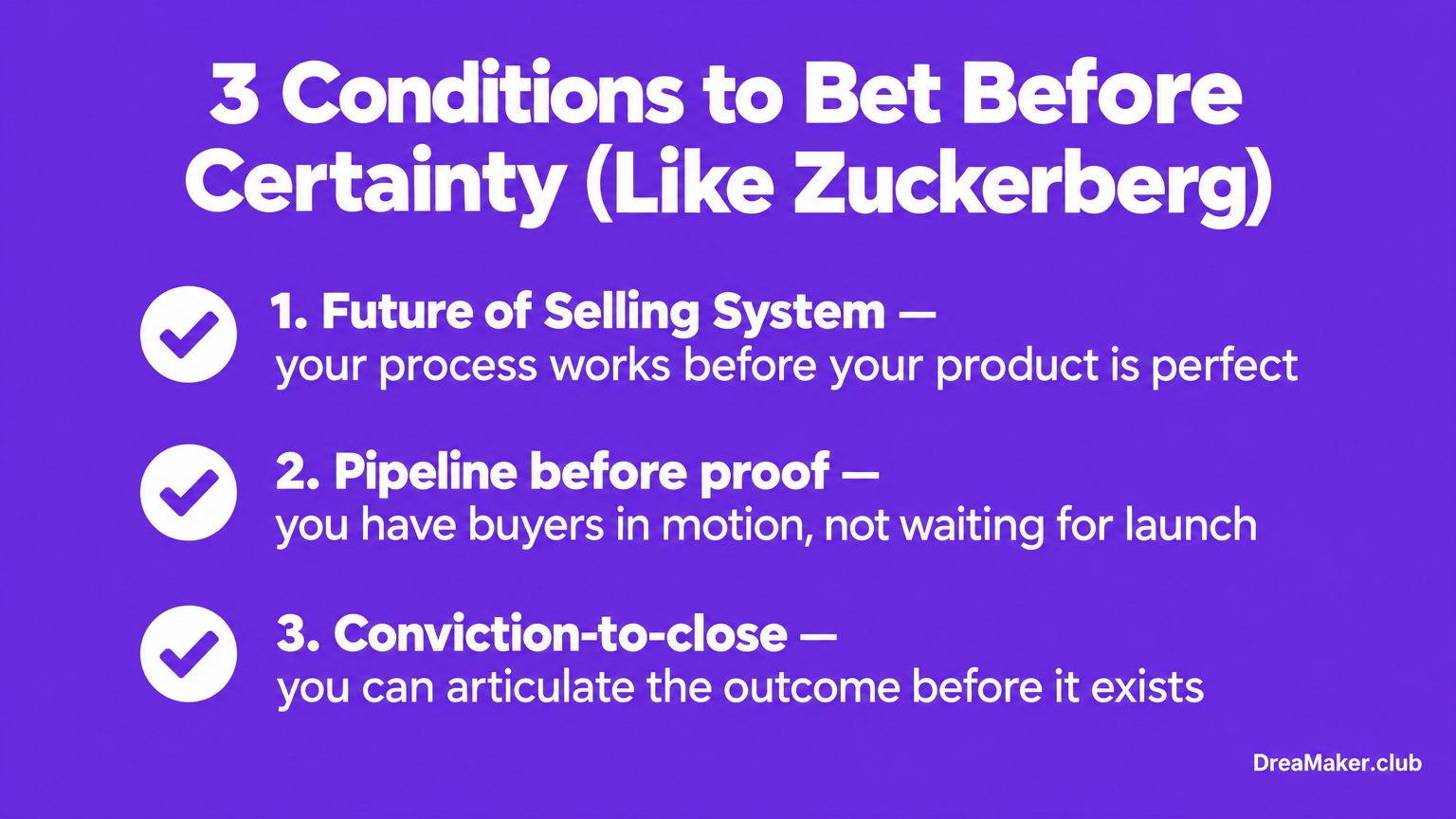
3 Conditions to Bet Before Certainty (Like Zuckerberg)
✅ Condition 1 — Future of Selling System: You have a repeatable selling process that generates outcomes independently of whether your product is perfect. Your system is the safety net that makes early moves survivable — and compounding. Start here: dreamaker.club/buyfos
✅ Condition 2 — Pipeline Before Proof: You have real buyers in motion — conversations active, proposals out, or follow-ups scheduled — before your product or offer reaches its final form. If your pipeline is empty while you perfect the product, you are writing a $200 billion check with no team to deploy it.
✅ Condition 3 — Conviction-to-Close Language: You can articulate the outcome your buyer will experience — in concrete, specific terms — before that outcome fully exists. Zuckerberg could describe Meta’s AI future in precise terms before a single model was proven. Your buyer buys the future. If you cannot describe it clearly, they will not buy it at all.
NEW! → October 2026
Dear Founders — You Keep Waiting Until You Are Ready. Your Competition Is Already On The Call.
You are not waiting because your product is unready. You are waiting because you have no system to fall back on when the conversation gets hard. Zuckerberg committed $200 billion without certainty — not because he was fearless, but because his system made the risk survivable. You do not have $200 billion. But you can have a system that closes deals before your product is perfect.
If you have ever felt this way, you are not alone. According to Salesforce’s State of Sales report, 76% of sales reps say selling is harder than it was five years ago — not because buyers are tougher, but because most sellers have no consistent process. That is the gap.
Jason Lim has worked with 1,000+ startup founders since 2015. The Future of Selling System has produced $22M+ in combined sales by graduates. Jeffrey Teo closed 63 customers in 100 days. Stanley Tan closed 45 buyers in 3 hours. Leon secured a $2M partnership. None of them waited until they were certain. They installed a system — and the system closed.
Not ready for $19? Start free.
The Objection Playbook: 25 Word-for-Word Scripts to Close More Sales
The exact words Jason’s founders use when a buyer says “too expensive”, “send me info” or “I need to think about it”. Free PDF, sent to your inbox.
Send Me the 25 ScriptsBillionaire Mark Zuckerberg already moved. The only question is whether you will — or whether you will read about someone else who did.


