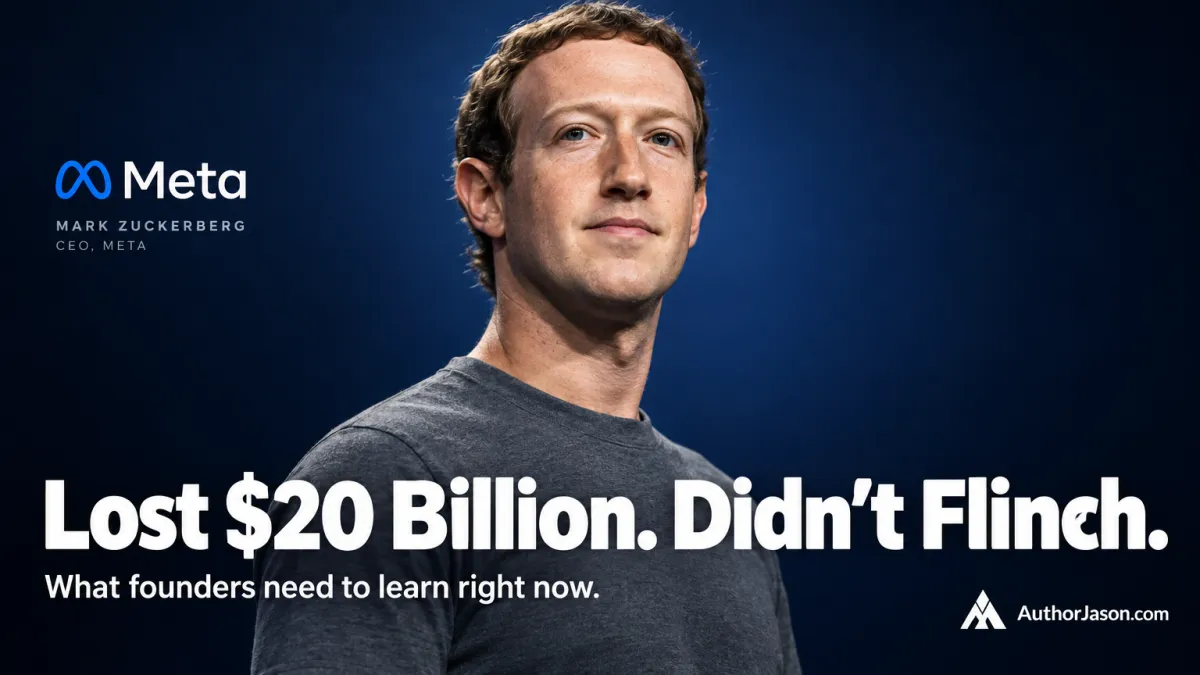
Billionaire Mark Zuckerberg Just Lost $20 Billion in Two Days — And What He Did Next Changes Everything For Founders Who Quit Their Process When Deals Go Cold
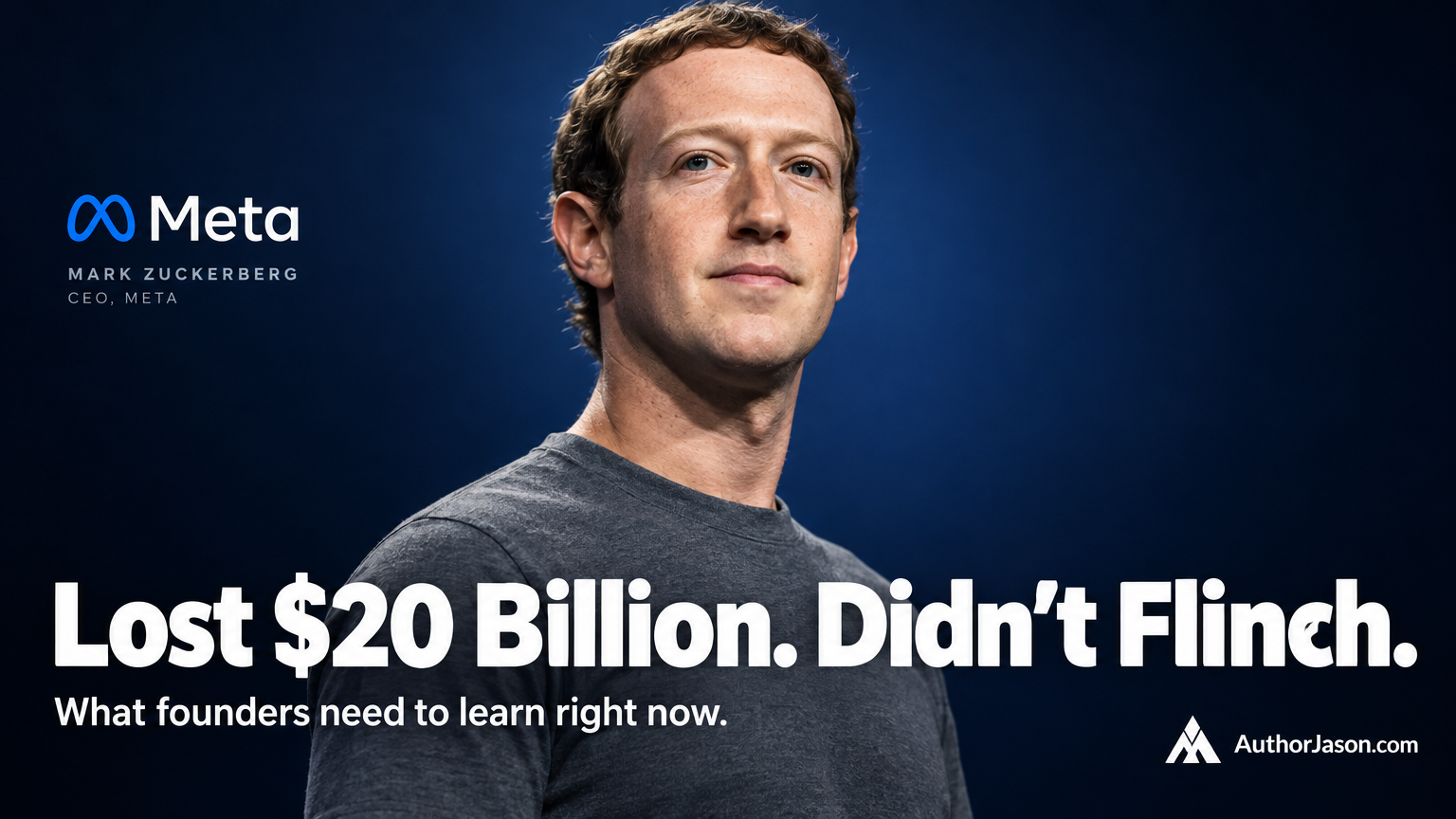
Billionaire Mark Zuckerberg Just Lost $20 Billion in Two Days — And What He Did Next Changes Everything For Founders Who Quit Their Process When Deals Go Cold
Zuckerberg just lost nearly $20 billion in 48 hours — and then kept spending. Between September 25 and September 29, 2026, Meta stock dropped roughly 4% on both sessions. Goldman Sachs dropped a bombshell note warning that AI hyperscalers would need $300 billion a year in AI revenue just to break even. The market panicked. Zuckerberg did not. He did not cut a dollar from Meta's $130 to $145 billion capital expenditure plan for 2026. That decision — not the loss — is the story every founder needs to understand right now.
Think About What That Actually Feels Like
You wake up on a Friday. Your company stock has dropped 4%. Your personal fortune has fallen $8.9 billion in a single trading session — before lunch. A Goldman Sachs analyst has just published a note telling the world that your entire AI strategy needs to generate $300 billion a year just to break even, and $1 trillion a year for solid returns. By Monday, another $10.9 billion is gone. Your net worth has dropped from $266 billion to $246 billion in two days. You have dropped from 4th to 6th on the Forbes billionaires list. The press is writing about your losses by the hour.
Now ask yourself: would you change your plan?
Most founders change their entire sales strategy after a single cold meeting. They pivot the pitch after one prospect says no. They slash prices after one too-expensive objection. They abandon a process after one bad quarter. The scale is different. The psychology is identical. And that psychology is exactly what is killing your pipeline right now.
What Actually Happened — The Facts
On September 25, 2026, Meta shares fell roughly 4% to $749.26, wiping $8.9 billion from Zuckerberg's personal fortune in a single session — dropping his estimated net worth to $257.5 billion, per Forbes Real-Time Billionaires. The trigger was a Goldman Sachs strategy note: the firm estimated that AI hyperscalers would collectively need roughly $300 billion in annual AI services revenue just to break even on capital spending (Benzinga, September 25, 2026).
By Monday September 29, 2026, another 4% drop had erased a further $10.9 billion — pushing his fortune to $246.7 billion and a combined two-day loss of nearly $20 billion, per Forbes. Meta stock hit $719.44 at midday. Zuckerberg dropped from 4th to 6th on the global billionaires ranking (billionaires.africa, September 29, 2026).
What did not change: Meta's commitment to spending $130 to $145 billion on capital expenditure in 2026 — nearly double its 2025 spend — on data centers, AI infrastructure, models, and talent (The Street, September 2026). During the same two-day selloff, Meta announced the appointment of MongoDB CEO Chirantan CJ Desai as Chief Enterprise Platform Officer — signaling an acceleration of its enterprise AI push, not a retreat. Before the selloff, Meta shares had gained approximately 36% in September alone. Muse, Meta's AI assistant, recorded 2.8 million downloads in its first two weeks (Nairametrics, September 29, 2026).
Billionaire Mark Zuckerberg's move is one Jason has seen across 1,000+ founders. Here is what most miss.
The Lesson Most Founders Will Never Extract From This Story
Beat 1 — The Root Cause Reframe
Most founders think the problem is market doubt. When a prospect goes cold, when a deal goes quiet, when a quarter misses — they think the problem is external. The market. The timing. The economy. The Goldman Sachs note.
But the real problem is they have no selling system to anchor to when doubt arrives. Because when you have no system, every piece of bad news becomes a legitimate reason to change direction. Every cold deal becomes evidence that the whole approach is wrong. Every negative signal gets to rewrite your strategy. You become reactive by default — not because the market is hard, but because you have nothing solid to stand on.
Zuckerberg did not ignore the Goldman Sachs note. He understood the arithmetic. He simply had a system — a $130 to $145 billion commitment with a decade-long thesis — and one analyst note did not meet the bar for changing it. That is not arrogance. That is process discipline. And process discipline is only possible when you have a process worth trusting.
Beat 2 — The Lesson
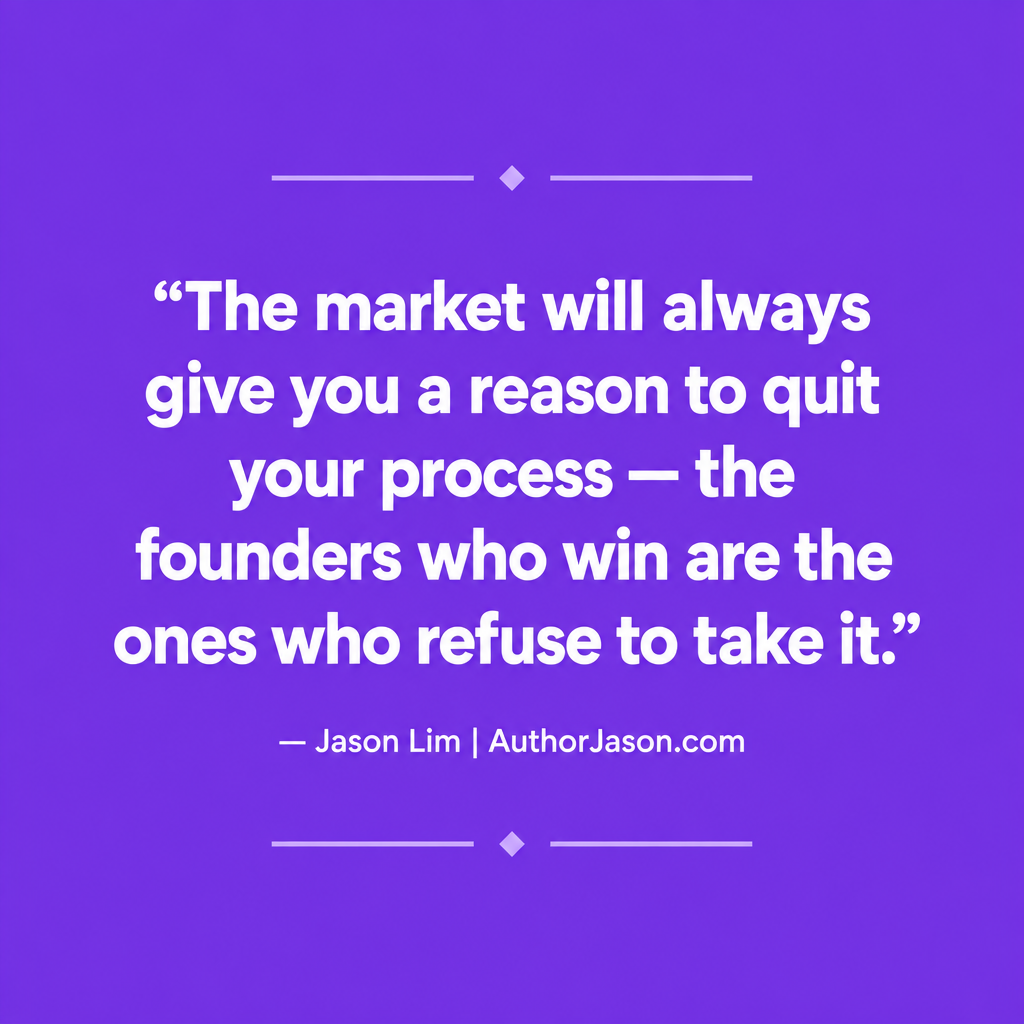
The market will always give you a reason to quit your process. Goldman Sachs gave Zuckerberg one. Your prospect's silence is giving you one right now. The question is not whether the external signal is real — it usually is. The question is whether you have a system robust enough to outlast the doubt.
Here is what Jason sees across 1,000+ founders: the ones who consistently close deals are not the ones with the best pitch. They are the ones with a repeatable selling system they refuse to abandon at the first sign of friction. The ones who close 45 buyers in a single day like Stanley Tan, or land a $2M partnership like Leon, or sign 63 customers in 100 days like Jeffrey Teo — they all shared one trait. They had a system. And they ran it even when the room was cold.
Founder Story
Stanley Tan — 45 Buyers in 3 Hours
Stanley Tan did not close 45 buyers in 3 hours because he had a perfect market or a friendly audience. He closed because he had a structured selling system he had rehearsed and trusted. When the room got skeptical, he had a process to run — not a new pitch to invent. The system carried the result, not the moment.
The lesson is not to be like Zuckerberg and spend $145 billion. The lesson is this: what system do you have that you trust enough to run when the market, the prospect, or the quarter turns against you? If your answer is that you adjust your approach based on how things are going — you do not have a system. You have a habit of improvising. And improvisation is the enemy of consistent closes.
The Hidden Opportunity — And the 5 Conditions to Capture It
The Hidden Opportunity
Right now, across every industry, the market is generating noise. AI concerns, economic signals, interest rate uncertainty, competitor moves — every one of your prospects is being bombarded with reasons to delay. Most founders are responding by softening their pitch, dropping their price, or going quiet and hoping things settle.
This is your opening. When your competitors get reactive, you get systematic. The founder with a reliable, repeatable selling system does not disappear when the market gets noisy — they show up with the same structured approach, the same calm certainty, the same follow-up sequence. And in a sea of founders who are pivoting and panicking, that consistency becomes your single most powerful differentiator.
The window is specific: Q4 2026. Buyers are finalising budgets. Founders who show up with a system-driven approach in October are the ones who fill January pipelines. The ones who panic now will spend Q1 rebuilding from scratch.
Are You Ready to Double Down Like Zuckerberg?
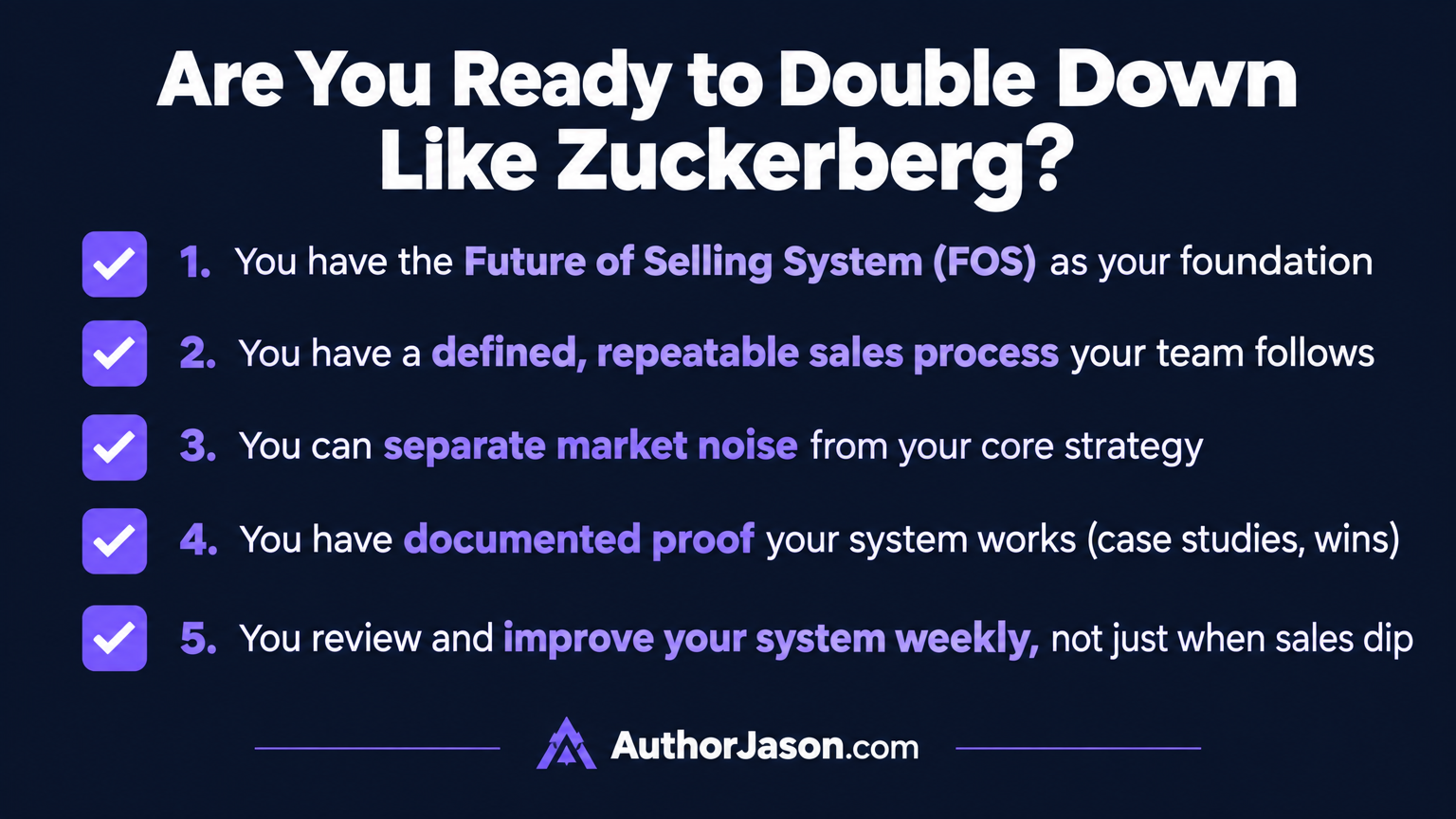
5 Conditions Checklist
✓ Condition 1 — You have the Future of Selling System (FOS) as your foundation
Not a list of tactics. Not a deck you update each week. A structured, repeatable 5-step selling system you can run regardless of market mood. This is the non-negotiable starting point. Everything else is built on it.
✓ Condition 2 — You have a defined, repeatable sales process your team follows
Your team should be able to run the process without you improvising. If every conversation starts from scratch, you are relying on talent — not system. Talent is inconsistent. System compounds.
✓ Condition 3 — You can separate market noise from your core strategy
You have a criteria set for what actually warrants a strategy change — and a cold prospect or a slow week does not meet that bar. Noise is not signal. Only founders with a system can make that distinction reliably.
✓ Condition 4 — You have documented proof your system works
Case studies. Conversion data. Win patterns. Zuckerberg points to 36% September gains and 2.8M Muse downloads as evidence his strategy is working. What evidence anchors your confidence when a deal goes cold?
✓ Condition 5 — You review and improve your system weekly, not just when sales dip
Process discipline is not just running the system. It is improving it on a rhythm — before the market forces you to. Founders who review the system weekly compound their edge. Founders who review it only when things break are always a quarter behind.
NEW! October 2026
Dear Founders — If your sales process collapses every time a deal goes sideways, you do not have a process. You have a habit of hoping.
You have felt it before. A promising deal goes quiet. A prospect who was enthusiastic stops responding. A quarter ends with half the pipeline you expected. And you tell yourself it was the market, the timing, the pitch — when the real issue is you had no system to run when the room went cold.
Other founders felt the same way — until they installed a system they could trust regardless of what the market was doing. Jeffrey Teo closed 63 customers in 100 days. Stanley Tan closed 45 buyers in 3 hours. Leon closed a $2M partnership. They all used the same structured approach: the Future of Selling System.
According to Salesforce State of Sales, 76% of sales professionals say the buying process has become more complex — yet most founders are still pitching from instinct. The Future of Selling System has helped 1,000+ founders since 2015 generate over $22M in combined sales with a structured, repeatable 5-step P.I.T.C.H. Formula built specifically for startup founders leading their own sales in a team of five or more.
Not ready for $19? Start free.
The Objection Playbook: 25 Word-for-Word Scripts to Close More Sales
The exact words Jason's founders use when a buyer says too expensive, send me info or I need to think about it. Free PDF, sent to your inbox.
Send Me the 25 ScriptsZuckerberg already moved. The only question is whether you will — or whether you will read about someone else who did.


