Billionaire Mark Zuckerberg Just Changed How Buyers Shop Forever — And It's The Wake-Up Call Every Founder Needs Right Now
Billionaire Mark Zuckerberg Just Changed How Buyers Shop Forever — And It's The Wake-Up Call Every Founder Needs Right Now
Mark Zuckerberg just rewired how billions of people will buy things, and most founders are watching the wrong part of the story.
At Meta Connect 2026, Zuckerberg unveiled Muse — an AI agent that books travel, shops at Walmart, negotiates cable rates, and handles purchases across dozens of retailers, all without the buyer lifting a finger. Meta's stock climbed 4.50% on September 25 alone. His net worth stood at approximately $274 billion as of September 24, 2026, according to the Bloomberg Billionaires Index. And the real lesson has nothing to do with AI.
The Uncomfortable Question Every Founder Must Answer Right Now
If an AI agent is now making purchasing decisions on behalf of buyers — comparing options, selecting vendors, completing transactions — what exactly does your pitch deck have to say to a machine?
And more pressingly: when a buyer delegates their wallet to an AI, what signal does that AI use to rank you above your competitor?
The answer is not your LinkedIn following. It is not your cold email sequence. It is not your ad spend.
The signal that AI agents weight most is trust. Credibility signals. Reputation infrastructure. The kind of clarity and consistency that tells a system: this vendor delivers what they promise.
Most founders have spent years building sales funnels that rely on human attention and emotional momentum. Muse — and every AI agent like it — operates on a different logic entirely. And most founders are nowhere near ready for it.
What Actually Happened at Meta Connect 2026
On September 23 and 24, 2026, Zuckerberg took the stage at Meta Connect 2026 and presented Muse as the centrepiece of Meta's future. According to Yahoo Finance on September 25, 2026, Muse launched on September 8 and immediately became the top-ranked app on both Apple's App Store and Google Play. It supports purchases at Walmart, Best Buy, Gap, Sephora, Wayfair, American Eagle, Expedia, and Instacart, among others.
The business model marks a radical departure from Meta's 20-year advertising history. Meta generated $59.36 billion in advertising revenue in Q2 2026 alone — nearly all of its $60.80 billion in total quarterly revenue, according to Yahoo Finance on September 25, 2026. Muse changes that equation: Meta now earns a transaction fee every time Muse completes a purchase, aligning Meta's revenue directly with buyer outcomes rather than advertiser eyeballs.
Zuckerberg announced a "Muse Secure VM" and committed to a forthcoming "Muse Confidential VM" so that even Meta cannot access user data. William Blair analyst Ralph Schackart wrote in a note to investors — cited by Yahoo Finance on September 25, 2026 — that "as consumers increasingly trust AI systems with financial information, communications, calendars, purchasing decisions, and other sensitive tasks, we believe trust could become an important competitive differentiator."
Even the world's most-funded AI company cannot assume buyer trust. Meta still carries the reputational weight of its $5 billion Cambridge Analytica data-privacy settlement from 2019.
Billionaire Mark Zuckerberg's move is one Jason has seen across 1,000+ founders. Here's what most miss.
The Root Cause Reframe: It Was Never About Reach
Most founders think the problem is not enough reach. More followers. More ads. More visibility.
But the real problem is buyer trust infrastructure. And no amount of reach fixes a trust deficit.
When Zuckerberg unveiled Muse at Meta Connect, he did not open with features. He opened with privacy architecture. The single most sophisticated technology company in the world — with more behavioural data than any government on earth — spent its biggest keynote moment of 2026 explaining why buyers should trust it with their wallet.
If the richest AI company on the planet cannot assume buyer trust, what does that say about a startup founder with a landing page and a LinkedIn profile?
The Lesson
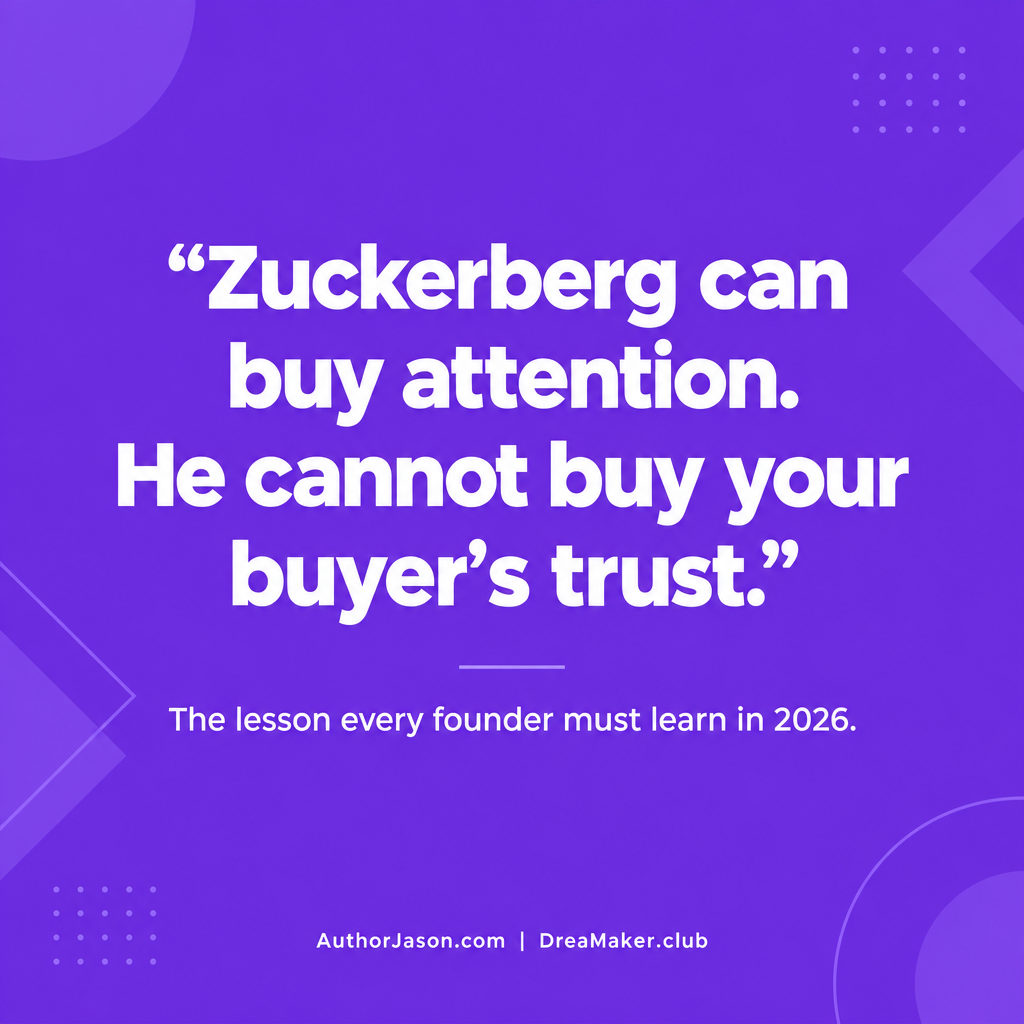
"Zuckerberg can buy attention. He cannot buy your buyer's trust."
This is the insight most founders walk straight past. They see Muse and think: AI is going to replace my sales pitch. That is the wrong conclusion.
The right conclusion is this: trust has always been the conversion variable. AI agents simply make it impossible to fake. When a machine routes a buyer's dollar, it routes on signals — verified credentials, consistent content, clear positioning, social proof, domain authority, response track record. All of which a founder either has or does not have.
Founders who have spent years building genuine trust with their market are now sitting on the most durable competitive asset in the AI era. Founders who relied on hype, interruption, and manufactured urgency are going to find that AI agents route around them entirely.
This is not a future threat. Muse is live. Millions are already using it. The routing is already happening.
Founder Story Card
The visible problem: AI agents like Muse are reshaping how buyers discover and purchase — and most founders feel invisible in the new buying process.
The real root cause: Most founders have no trust infrastructure. They have outreach sequences and ad funnels, but nothing that signals credibility to a machine or a sceptical buyer making a high-stakes decision.
The founder lesson: Trust is not a soft variable. It is the primary input in the new buying equation. Every piece of content, every positioning statement, every sales conversation either builds or erodes it.
The move to make now: Audit your trust signals. Ask: if an AI agent were evaluating your business against your three nearest competitors right now, what would it find? Then close the gap — before your window closes.
The Hidden Opportunity Most Founders Will Miss
Zuckerberg did something at Meta Connect that most founders have not yet fully processed: he publicly admitted that even Meta cannot take buyer trust for granted. That admission — from a company with approximately $274 billion in founder net worth and 3 billion daily active users across its apps — is the clearest market signal startup founders have received in years.
Here is the hidden opportunity: in a world where AI agents mediate purchasing, the founder with the clearest positioning, the most specific expertise signal, and the most consistent buyer communication wins by default. Not the loudest. Not the most funded. Not the one with the biggest ad budget.
The window to build that trust infrastructure before your market normalises to AI-mediated buying is narrow. Muse launched September 8, 2026. It was the most downloaded app on both major platforms within days of launch, according to Yahoo Finance on September 25, 2026. The transition is not coming — it has arrived.
Founders who move now will have a trust footprint already built when buyers fully delegate their purchasing to agents. Founders who wait will be invisible in that layer.
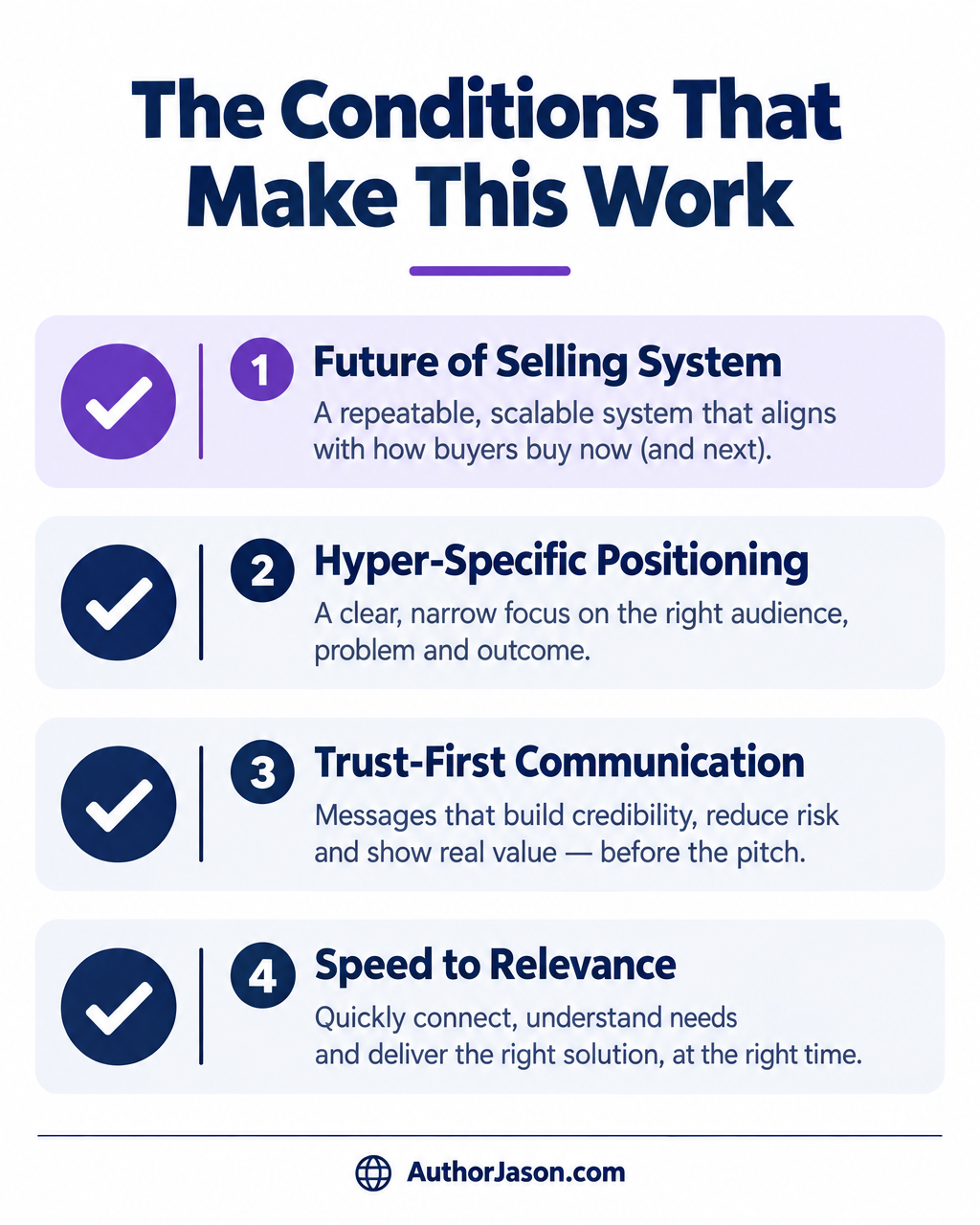
The Conditions That Make This Work
- Future of Selling System: A structured, repeatable framework for turning your expertise and credibility into a sales process that AI agents, sceptical buyers, and time-poor decision-makers can all act on — without you needing to be in every room.
- Hyper-Specific Positioning: Vague positioning is invisible to algorithms and unpersuasive to buyers. The opportunity belongs to founders who can articulate exactly who they serve, what outcome they deliver, and why a buyer should believe it — in a single sentence.
- Trust-First Content Infrastructure: Buyers — and the AI agents acting on their behalf — look for consistent, credible signals before committing. Sporadic content and empty profiles do not qualify. A deliberate, trust-building content system does.
- Speed to Relevance: The trust gap between you and your competitors closes fast once buyers begin using AI agents to shortlist vendors. The window to build your credibility signal is right now, not next quarter.
Zuckerberg already moved. The only question is whether you will — or whether you'll read about someone else who did.


