Billionaire Mark Zuckerberg Just Announced Personal Superintelligence — And It Changes Everything For Startup Founders
Billionaire Mark Zuckerberg Just Announced Personal Superintelligence — And It Changes Everything For Startup Founders
Part 1 — Hook
Mark Zuckerberg just told every buyer on the planet they no longer need to trust your pitch — they have AI for that.
At Meta Connect 2026 on September 23, Zuckerberg unveiled what he called the era of Personal Superintelligence — AI agents that research, shortlist, and advise individual users on every decision they make, including buying decisions. Meta AI has now crossed one billion monthly active users, according to announcements made at the event (Meta, September 2026). Your next prospect already has an AI advisor. It already knows your category. It has already formed an opinion about whether you are worth a conversation. And you were not in the room when that opinion was formed.
Most founders are still perfecting their pitch decks. The buyers have moved on.
Part 2 — Press
Here is what should make every startup founder stop scrolling right now.
The single skill every founder has been told to master — the ability to explain what you do, build trust in a conversation, and convert a curious stranger into a paying client — is being restructured at the infrastructure level. Not disrupted. Restructured. When a buyer's first touchpoint with your category is an AI agent that has already processed hundreds of competitor reviews, pricing pages, founder LinkedIn profiles, and testimonials before you ever book a discovery call, the question is no longer how do you pitch? The question is do you even make it to the pitch?
The founders who win in an AI-advised buyer world are not the ones with the smoothest close. They are the ones whose positioning, proof, and expertise are structured in a way that AI can find, verify, and recommend without a human sales rep in the loop. That is a fundamentally different business problem — and almost no founder is solving it yet.
This is not a technology trend to watch. It is a buyer behaviour shift happening right now. The window to get ahead of it is measured in months, not years.
Part 3 — Play
On September 23, 2026, at Meta Connect 2026, Mark Zuckerberg delivered what many observers described as his most consequential keynote in a decade. The central theme: the arrival of Personal Superintelligence — AI systems capable of acting as a personalised advisor, researcher, and decision-support engine for every individual user (Meta Connect keynote, September 23, 2026).
Meta AI had already surpassed one billion monthly active users heading into the event, making it the most widely distributed AI assistant in history at that point (Meta, September 2026). The announcements at Connect extended that reach further: AI agents capable of autonomous browsing, scheduling, research synthesis, and task execution on behalf of users — all personalised to individual preferences, history, and goals.
The commercial implication is direct. When a buyer has an AI agent that can research your product category, identify the top providers, cross-reference reviews, scan your credentials, and produce a shortlist — all before the buyer has even typed your name into a search bar — the traditional top-of-funnel sales process is not slower. It is bypassed entirely. The buying decision is being partially pre-made by AI before any human-to-human conversation begins.
Zuckerberg also announced Orion, Meta's augmented reality glasses, signalling that AI advisory capability will soon be ambient — present in every environment, not just on a screen (Meta Connect 2026, September 23). The AI advisor is no longer a tool buyers reach for. It will simply be there.
Billionaire Mark Zuckerberg's move is one Jason has seen across 1,000+ founders. Here's what most miss.
Part 4 — Lesson + Root Cause Reframe
Root Cause Reframe
Most founders think the problem is that buyers are harder to reach. But the real problem is that buyers are being reached by AI before you ever get a chance to reach them yourself.
The standard response to a tougher sales environment is to improve the pitch — sharper deck, better cold email, stronger close. None of those interventions work if the buyer's AI agent has already decided your offer is unclear, your authority is unverifiable, or your category positioning is indistinguishable from the five competitors it found first.
Founders are trying to win a conversation that AI is now having on their behalf — without their input, without their story, and without their best arguments. The pitch is happening. You are just not in it.
The Lesson
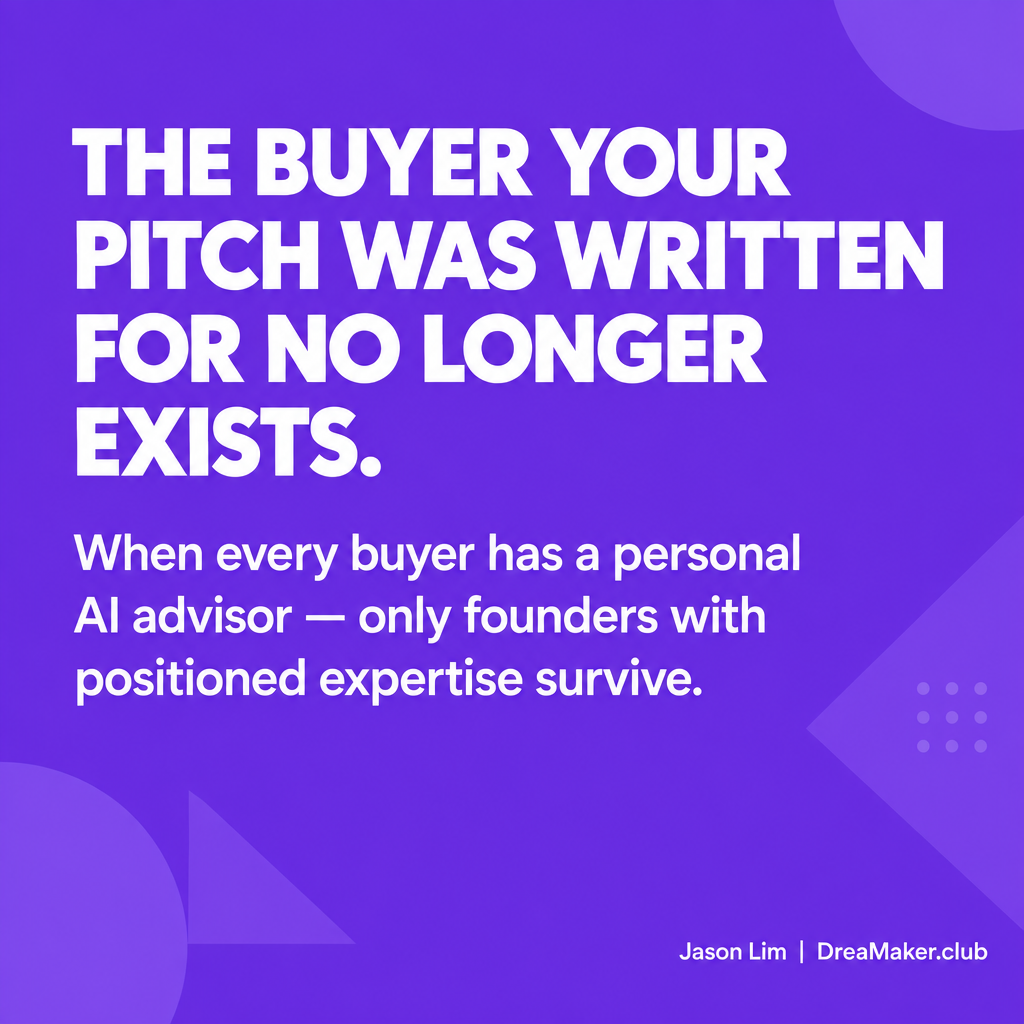
"The buyer your pitch was written for no longer exists."
The pitch was written for a buyer who would discover you through a referral, take a call, feel your energy, and trust their gut. That buyer still exists — but they now arrive with an AI-formed pre-opinion. If your positioning does not survive AI scrutiny before the call, you are starting every conversation already behind.
What survives AI scrutiny? Specificity. Verified expertise. A clear articulation of who you help, what result you deliver, and why you are the credible choice. These are not pitch skills. They are positioning and trust-architecture decisions that have to be made before you ever open a sales conversation — structured in a way that any AI can extract, verify, and relay.
Zuckerberg's announcement is not a future warning. It is a current-state description. One billion people are already using Meta AI monthly. Every one of them is a potential buyer in some market. The AI-advised buyer is not coming. The AI-advised buyer is already on your pipeline list — and their AI has already looked you up.
Founder Story Card
The visible problem: A SaaS founder with strong client results keeps losing early-stage discovery calls. Prospects arrive cold, already sceptical, and focused on price. The founder assumes they need a better pitch.
The real root cause: The prospect's AI agent researched the category, found three competitors with clearer positioning and more visible proof, and pre-framed the conversation around those benchmarks before the call began. The founder's pitch was irrelevant before it started.
The founder lesson: Winning the pitch is downstream of winning the AI shortlist. If your expertise, positioning, and proof are not structured for AI legibility, you are losing deals before you know they exist.
The move to make now: Audit your online presence as if you are an AI agent researching your own category. Ask: is it immediately clear who I help, what specific result I deliver, and why I am credible? If the answer takes more than 30 seconds to form — a buyer's AI has already moved on.
Part 5 — Opportunity + Conditions
The Hidden Opportunity
Here is what almost no founder is seeing yet: the AI-advised buyer era does not destroy the advantage of a great founder. It amplifies it — for founders who build the right structure now.
When AI pre-filters every category before a human buyer makes a call, the founders with precise positioning, verifiable expertise, and structured proof do not just survive the filter. They dominate it. AI-advised buyers are, by definition, buyers who have done more research, have clearer criteria, and are closer to a decision before they ever reach out. That is a warmer, higher-quality lead — for the founders who make it through the filter.
The opportunity right now is to build the positioning and trust infrastructure that qualifies you as the AI-recommended choice in your category — before your competitors realise the game has changed. The window is open. It will not stay open long. When every founder rushes to optimise for AI-advised buyers in 12 months, first-mover positioning will already be locked in by whoever moved now.
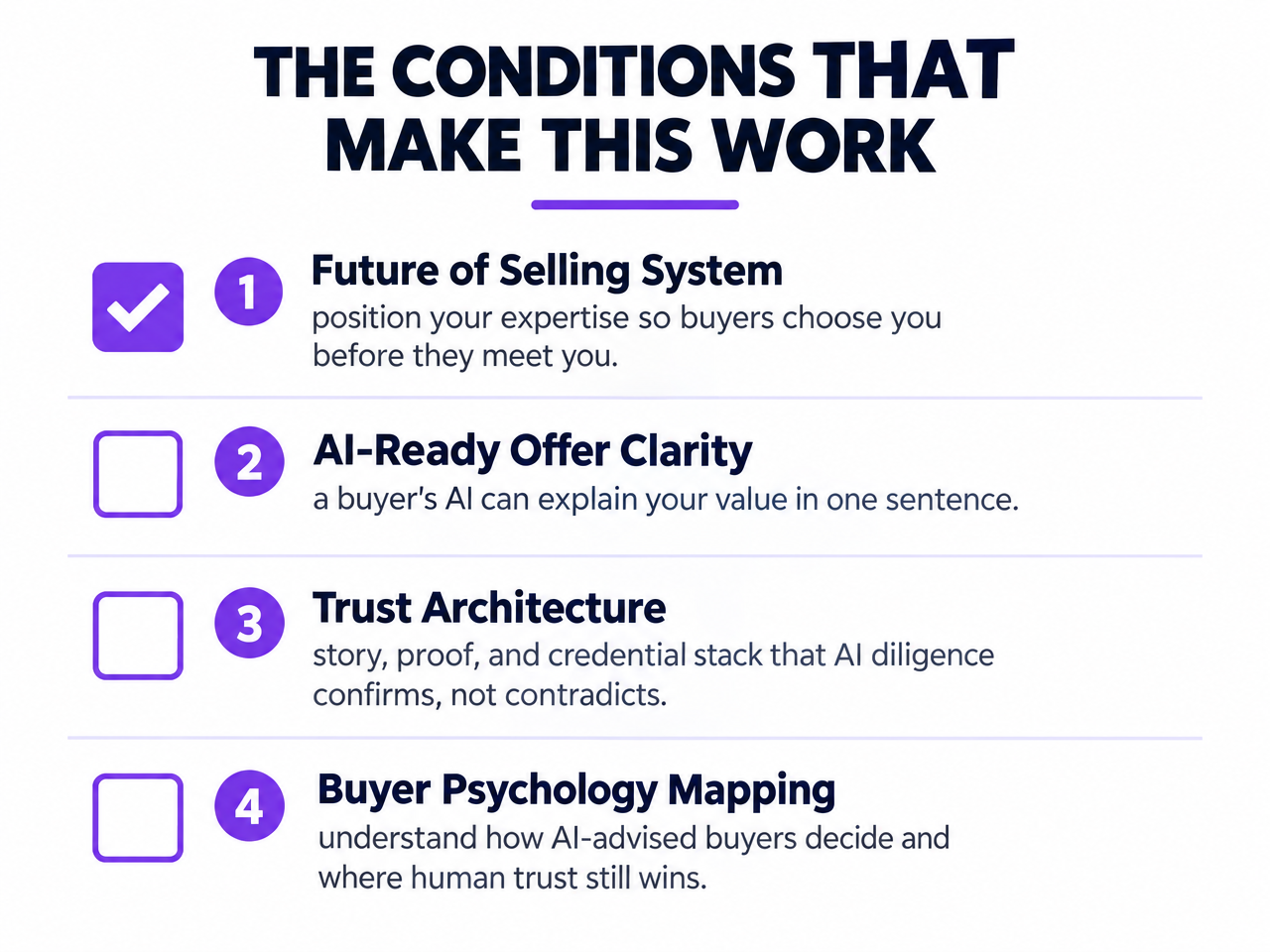
The Conditions That Make This Work
- Future of Selling System: A structured approach that positions your expertise so buyers — and their AI agents — understand, trust, and choose you before a sales conversation begins. This is the prerequisite. Without positioned expertise, no other condition activates.
- AI-Ready Offer Clarity: Your offer must be describable in a single crisp sentence that an AI can extract from your website, LinkedIn, or content and relay accurately to a buyer. Vague offers are invisible to AI-advised buyers.
- Trust Architecture: A visible, verifiable stack of proof — client outcomes, credentials, content authority, and social proof — that AI due diligence confirms rather than contradicts. AI finds what is publicly structured. If your proof is locked in your head or in private DMs, it does not exist to the AI.
- Buyer Psychology Mapping: An understanding of where human trust still outperforms AI recommendation — and a sales process deliberately designed to activate that trust at the right moment. AI-advised buyers still make human decisions. Knowing where the human moment lives is how you close.
Part 6 — Native Ad
Part 7 — Sting
Zuckerberg already moved. The only question is whether you will — or whether you'll read about someone else who did.


