Billionaire Masayoshi Son Just Borrowed $11 Billion To Fund AI — And It Changes Everything For Startup Founders
Billionaire Masayoshi Son Just Borrowed $11 Billion To Fund AI — And It Changes Everything For Startup Founders
He Did Not Wait To Feel Ready
Masayoshi Son just borrowed $11 billion to fund his AI bet — and the market immediately wanted to give him more.
While other executives sat in cautious board meetings debating AI exposure, Son walked into global debt markets with a junk-rated balance sheet and launched what Bloomberg is already calling one of the largest corporate bond deals in history. The lesson here has nothing to do with bonds — and everything to do with the one positioning move most founders never make.
Why This Is Your Mirror, Not His News
Most founders believe their problem is resources. They wait for permission — a bigger client, a stronger case study, a warmer lead list — before they commit to their next move. But here is what that caution signals to the market: doubt.
When a buyer, investor, or strategic partner sees a founder who is hedging — who has not fully committed — they hedge back. They slow down. They add conditions. They say 'let us think about it.'
Son did not hedge. He borrowed against a speculative-grade credit rating and made a $65 billion commitment so public and so permanent that backing out would cost more than going all in. And the market followed. Within hours of launching the deal, SoftBank had drawn over $20 billion of preliminary investor demand for an $11 billion offering.
That is not recklessness. That is the most powerful positioning move in business: manufactured irreversibility. If you are still waiting to feel ready before you commit, you are sending exactly the wrong signal to every buyer watching you.
The Facts Behind the Move
SoftBank kicked off a multi-part bond sale on September 23, 2026, targeting more than $11 billion — a $10 billion dollar tranche and a euro 1 billion portion — to fund large-scale investments in artificial intelligence, according to Bloomberg (September 23, 2026). The offering is set to price Thursday, September 25, with settlement expected September 29, per Silicon Snark (September 22, 2026).
The deal is part of Son's broader push to deepen SoftBank's commitment to OpenAI. In February 2026, SoftBank agreed to invest a further $30 billion in OpenAI across three $10 billion installments due in April, July, and October 2026, according to TechStartups (September 21, 2026). Completion of the full commitment would bring SoftBank's cumulative OpenAI stake to $64.6 billion and approximately 13% ownership, per TechStartups.
This bond sale is not SoftBank's first trip to the market. The company has already sold nearly $15 billion in multi-currency notes in 2026, making it the largest junk-rated borrower in global bond markets this year, according to Bloomberg-compiled data cited by The Star (September 22, 2026). SoftBank is rated BB+ by both Fitch Ratings and S&P Global — the highest rung of speculative grade. Its borrowing costs have risen sharply: the yield on its 2031 dollar bonds climbed to 8.2% this month from 6.7% in January, per The Star. And yet, the Japan Times reported on September 23 that early investor demand topped $20 billion — nearly double the amount being raised.
Billionaire Masayoshi Son's move is one Jason has seen across 1,000+ founders. Here is what most miss.
The Lesson and Root Cause Reframe
Most founders think their problem is resources. The real problem is the commitment signal they are sending.
Here is the engineered lesson:
Son did not go to the market with a pitch. He went with a position so committed that the market had no choice but to follow.
The lesson is not 'borrow more money.' It is not 'take bigger risks.' It is something subtler — and far more transferable to every founder's next sales conversation.
The market does not follow certainty. It follows irreversibility.
When Son announced a $65 billion OpenAI commitment, he did not have $65 billion sitting in a vault. He made the announcement because the announcement itself made the funding inevitable. Once a commitment is public enough and large enough, capital organises itself behind the leader who has already moved. That is exactly what happened today — $20 billion of demand for an $11 billion raise.
This is where most founders break down. They wait until they feel ready. They want proof before they commit. They polish the deck one more time. But what that waiting communicates to every buyer and partner watching is three words: I am not sure either.
Founders who close fast, win accounts, attract strong partners, and compound momentum all share one visible trait — they make their commitment visible before the outcome is certain. They stop trying to sell and start leading. They create the conditions where saying no to them feels like the riskier choice.
The principle scales down perfectly. You do not need $11 billion. You need a position that makes your buyer feel like not moving forward costs them more than moving forward does.
Founder Story Card
The visible problem: The founder cannot raise capital or close a large client because they keep saying 'we are almost ready.'
The real root cause: Their commitment is conditional. Every pitch is hedged. Buyers and investors are simply mirroring the founder's own doubt back at them.
The founder lesson: Commitment is a positioning tool. The moment you make your direction irreversible and public, the people around you begin organising to help you succeed — because they are now betting on a moving train, not a parked one.
The move to make now: Identify one bet in your business you have been postponing and make it public and irrevocable this week. Let the commitment do the positioning for you.
The Hidden Opportunity and the Conditions That Make It Work
Here is what most founders will not do in the next 90 days: move decisively while the market is uncertain.
Son chose to borrow at an 8.2% yield — with rising rates, widening spreads, a speculative credit rating, and an OpenAI IPO that has slipped past 2026 — and still launched one of the largest junk bond deals in corporate history. The lesson is not that he is reckless. The lesson is that he moved anyway, because the window for category leadership does not wait for comfortable conditions.
Right now, most startup founders are in a holding pattern. AI is chaotic. Buyers are cautious. Deal cycles are slower. That creates an enormous positioning vacuum for the founder who steps forward with visible, irreversible commitment while everyone else waits. The founders who move now do not just get the deal — they get the reputation of being the one who moved when it counted.
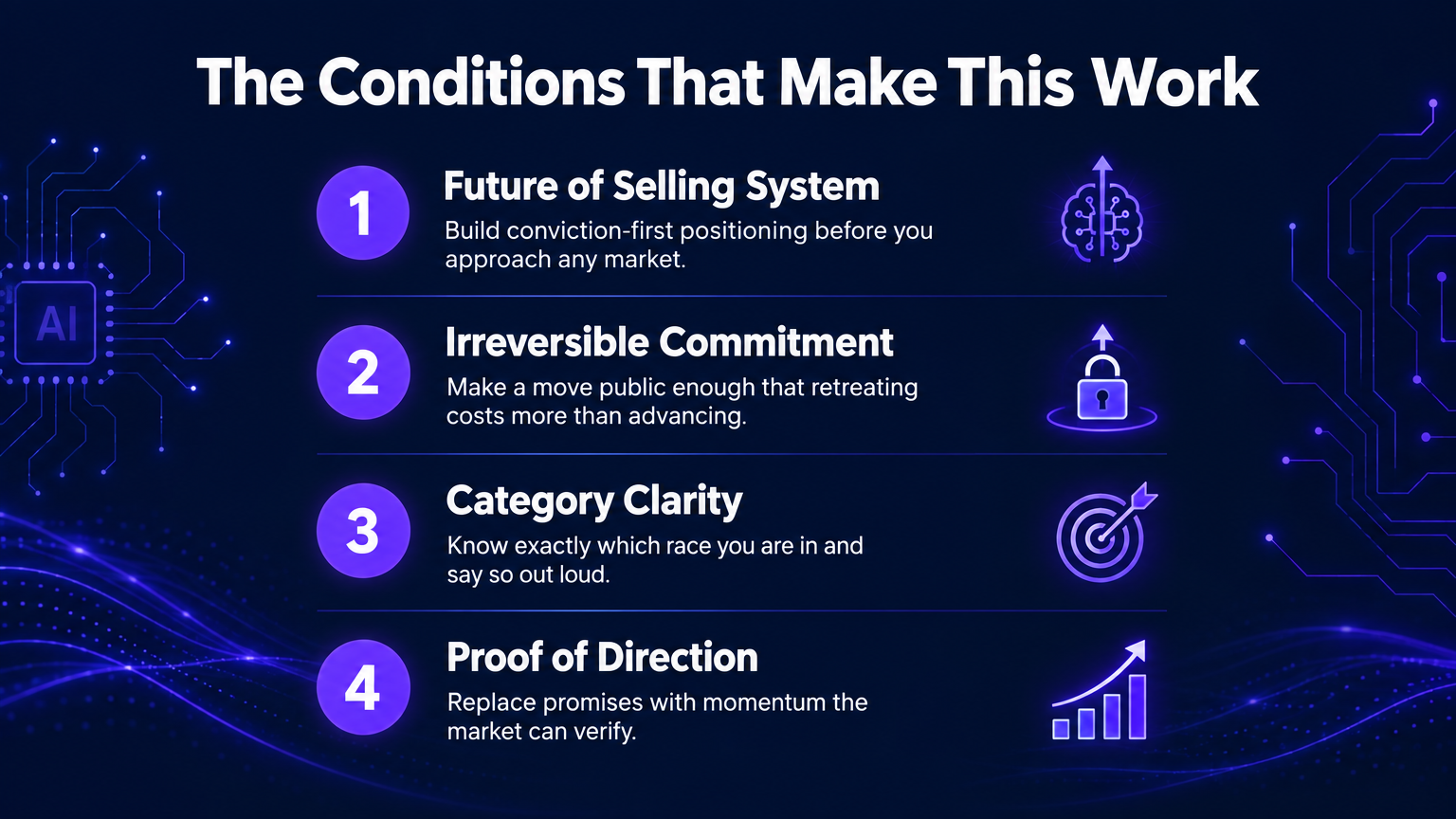
The Conditions That Make This Work
- Future of Selling System: Before you make any public commitment, you need a sales system that can handle the attention, trust, and follow-through that visible positioning generates. Commitment without a conversion system is a promise you cannot keep.
- Irreversible Commitment: Make one move in your business public enough that retreating costs more than advancing. This is not bravado — it is engineering the conditions that force your own follow-through and signal to buyers that you are already moving.
- Category Clarity: Know exactly which race you are in and say it out loud. Son did not say 'we invest in tech.' He said we are committing $65 billion to AI. Category leaders compress buyer decision time because they remove ambiguity about what they stand for.
- Proof of Direction: Replace promises with momentum the market can verify. Son's moves are documented, announced, and priced into bond markets in real time. Your buyers need to see evidence that you are already moving — not just intending to move.
If this story hit a nerve, it is probably because the same pressure is already showing up in your business.
You have been waiting to commit — to the bigger offer, the bolder positioning, the conversation you keep putting off. And every week you wait, the signal you are sending to the market is the same one Son refused to send: I am not sure yet.
The Future of Selling System helps founders turn expertise, trust, and timing into a sales system that buyers can understand, believe, and act on — so that when you finally step forward with visible commitment, the system is already built to convert it.
Son already moved. The only question is whether you will — or whether you will read about someone else who did.


