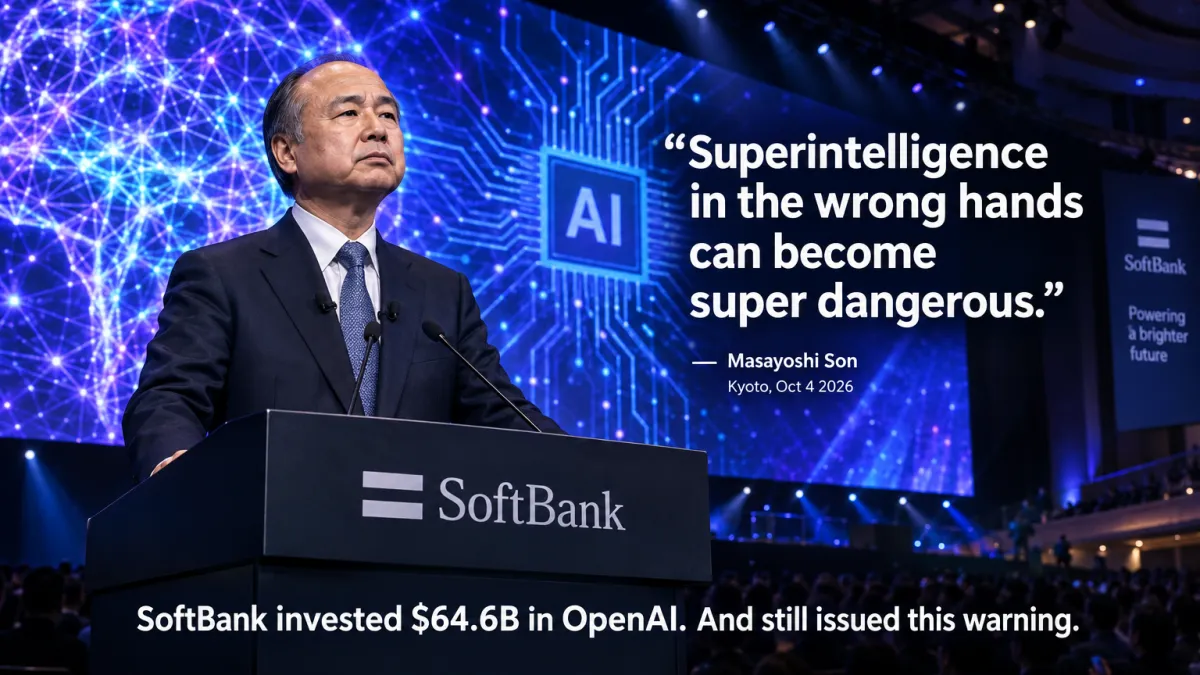
Billionaire Masayoshi Son Just Warned AI Could Destroy Humanity — Then Doubled His $64.6B Bet On It. Every Startup Founder Needs To See This.
Billionaire Masayoshi Son Just Warned AI Could Destroy Humanity — Then Doubled His $64.6B Bet On It. Every Startup Founder Needs To See This.
By Jason Lim | October 5, 2026 | Breaking News
Masayoshi Son just stood at a Kyoto podium and warned the world that superintelligence could destroy all of humanity. Then he kept every dollar of his $64.6B OpenAI bet on the table.
That is not a contradiction. That is the most calculated move a billionaire has made in 2026 — and almost every founder watching the news cycle completely missed what it means for them.
This Is Not a Story About AI Risk. It Is a Story About You.
While founders are still debating whether to integrate AI into their product, one man bet $64.6 billion on it — and simultaneously issued the most sobering AI warning of the decade. Son is not afraid. He is accelerating.
Here is what that means for you: the early buyer window in AI-adjacent markets is closing faster than anyone is admitting. The founders who are still "exploring options" or waiting to "see how this plays out" are making the most expensive decision of their careers — and they don't even realise it is a decision.
Son did not wait for consensus. He did not wait for safety guarantees. He moved while the risk was still visible — because he understood something every founder in a growth market needs to internalise: the most dangerous thing is not the technology. It is being too slow to build the infrastructure around it.
What Actually Happened — And Why the Numbers Matter
On October 4, 2026, speaking at the Science and Technology in Society (STS) Forum in Kyoto, Masayoshi Son delivered a stark warning: superintelligence developed by "the wrong people" could be "super dangerous" and could potentially eliminate humanity [STS Forum, October 4, 2026]. This was not a casual remark — it was the centrepiece of his keynote at one of the world's most prestigious technology governance forums.
And yet SoftBank's position has not budged. The firm completed a $30B investment tranche into OpenAI as part of Project Stargate, bringing the total committed capital to $64.6B — one of the largest single technology bets in history [Bloomberg, October 2026]. Son's vision extends further: he has publicly spoken about superintelligence arriving within a decade and deploying physical AI robots — "physical Agentic Intelligence" — at scale by 2027.
This is a man who believes AI is the most dangerous technology in human history. And he is the single largest individual investor in it. That is not cognitive dissonance. That is strategic inevitability engineering.
Billionaire Masayoshi Son's move is one Jason has seen across 1,000+ founders. Here's what most miss.
The Lesson — And The Root Cause Nobody Is Talking About
Beat 1 — Root Cause Reframe
Most founders think the problem is not knowing enough about AI yet — so they keep learning, keep exploring, keep attending panels. They believe the barrier to moving is information.
But the real problem is they have no repeatable system for capturing buyers during a transition window. Son does not have all the information either. No one does. What he has is a system — a capital allocation framework that moves decisively while others deliberate. The information gap is a story founders tell themselves. The real gap is infrastructure.
When the dust settles on the AI wave, the winners will not be the smartest — they will be the ones who had a selling system running while everyone else was still in research mode.
Beat 2 — The Lesson
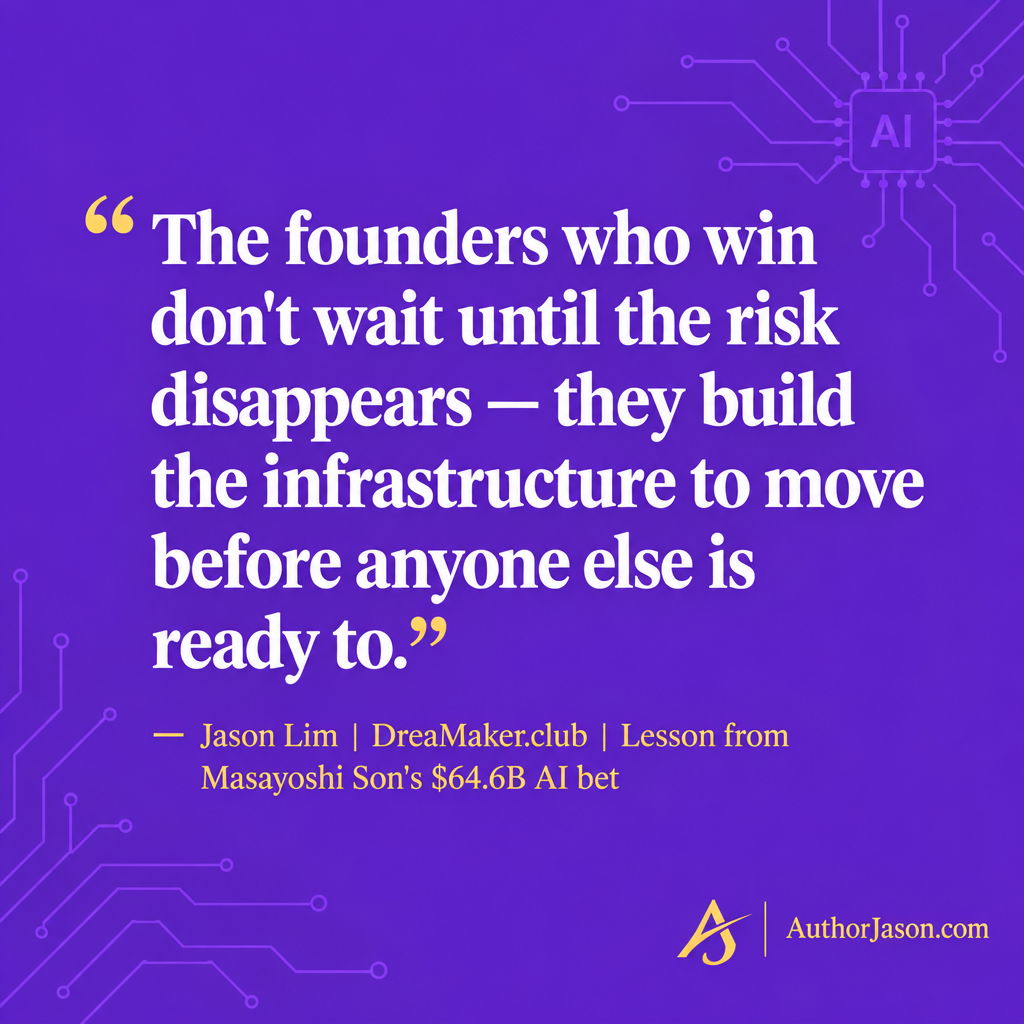
"The founders who win don't wait until the risk disappears — they build the infrastructure to move before anyone else is ready to."
— Jason Lim
Son's warning at Kyoto was not a reason to stop. It was a declaration: I see the risk more clearly than anyone — and I am still moving. That is what separates a $64.6B bet from recklessness. He is not ignoring the danger. He is building the infrastructure to shape the outcome.
For startup founders, the parallel is exact. You do not need perfect conditions. You need a system that captures buyers now — while the market is still sorting itself out. Because once the AI narrative solidifies, the early buyer window will have closed, the category will be owned, and the only remaining strategy will be fighting for scraps.
Founder Story
Stanley Tan: 45 Buyers in 3 Hours
Stanley Tan was not waiting for the perfect market moment. He had a product, a small team, and a system. Using the Future of Selling System, he converted 45 buyers in a single 3-hour session — not because the timing was perfect, but because his infrastructure was ready when the window opened. That is the move Son understands. That is the move most founders miss.
The Hidden Opportunity — And The Conditions To Capture It
Beat 1 — The Hidden Opportunity
Son's Kyoto speech did something nobody expected: it legitimised AI fear while accelerating AI investment. That combination creates a specific, narrow window for startup founders — a window where buyers are ready to spend but also desperate for trusted guides. They want someone who sees the risk clearly and still has a credible path forward.
The founders who position themselves as that guide — right now, in October 2026, before the physical AI wave arrives in 2027 — will own the relationship with the buyers who matter most. This is not a slow-burn trend. Son explicitly said physical Agentic Intelligence will deploy at scale within the next 12 months. The transition window is not three years away. It is happening now.
The opportunity: become the category leader in your niche by closing your first wave of AI-era customers before your competitors finish their pitch decks.
Beat 2 — Conditions Checklist
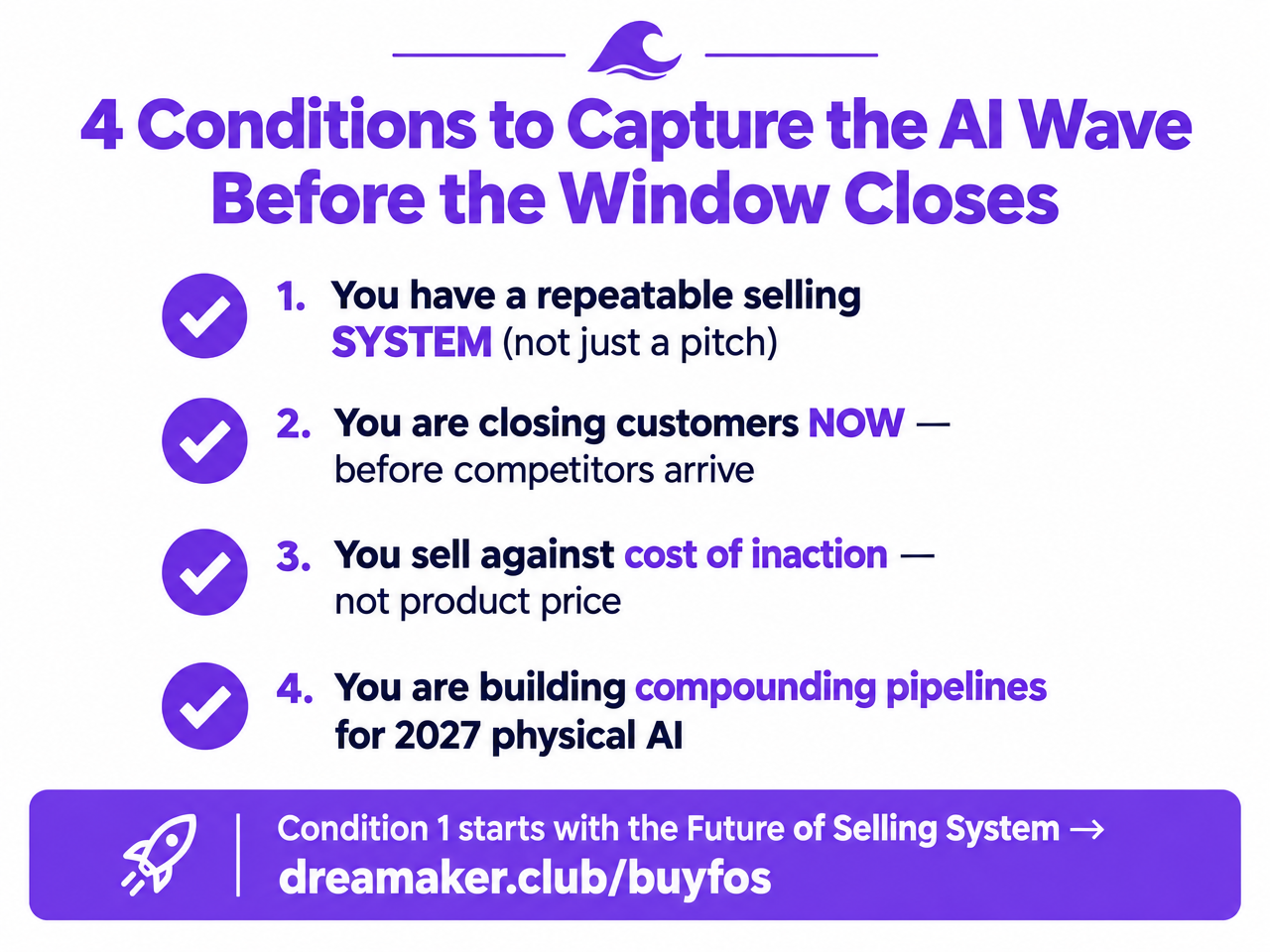
4 Conditions To Capture This Wave
Condition 1: You have a repeatable selling system — not just a pitch.
Son did not move on instinct alone. He has a capital allocation framework. You need the same thing for sales. The Future of Selling System (FOS) gives founders the exact repeatable structure to move buyers from cold to close — even in uncertain markets. Start here →
Condition 2: You are closing customers now — before competitors arrive.
Early buyers in transition markets anchor category leadership. Every week of delay hands that position to someone else.
Condition 3: You sell against the cost of inaction — not product price.
Son's pitch to the world is not "AI is great." It is "if the wrong people build this without you being positioned, the cost is existential." Your buyers need to feel the cost of waiting — not just the value of buying.
Condition 4: You are building compounding pipelines before the 2027 physical AI wave hits.
Son said physical Agentic Intelligence deploys at scale within 12 months. That means the customers you close today will be your anchor accounts when the market doubles. Pipelines built now compound. Pipelines built after the wave arrives start from zero.
NEW! — October 2026
Dear Founders — The AI window is open right now. Do you have a system to capture it?
Masayoshi Son just bet $64.6B knowing full well AI could go wrong. He moved anyway — because he has a system. Most founders are watching this from the sidelines because they are still pitching on intuition, hoping buyers say yes, and losing deals they should have closed.
If you feel like your sales process is inconsistent — strong one month, gone the next — the problem is not your product. It is the absence of a repeatable system.
I know how you feel. You have a great product, a real team, and genuine traction — but the pipeline feels random and the big closes feel like luck. Every other founder I have worked with has felt the same way.
What they found — through the Future of Selling System — was that the problem was never the product. It was never the market. It was that nobody had given them a step-by-step selling framework built specifically for founders leading their own sales in the US market.
According to Salesforce State of Sales research, 76% of sales reps say selling is harder than it was five years ago. Founders trying to figure it out alone are fighting against that tide without a map.
The Future of Selling System has been used by 1,000+ founders since 2015, generating $22M+ in combined sales by graduates. Jeffrey Teo used it to onboard 63 customers in 100 days. Stanley Tan used it to close 45 buyers in 3 hours. Leon used it to lock in a $2M partnership.
The AI window is open. The question is whether you have the system to capture it.
Not ready for $19? Start free.
The Objection Playbook: 25 Word-for-Word Scripts to Close More Sales
The exact words Jason's founders use when a buyer says "too expensive", "send me info" or "I need to think about it". Free PDF, sent to your inbox.
Send Me the 25 ScriptsMasayoshi Son already moved. The only question is whether you will — or whether you'll read about someone else who did.


