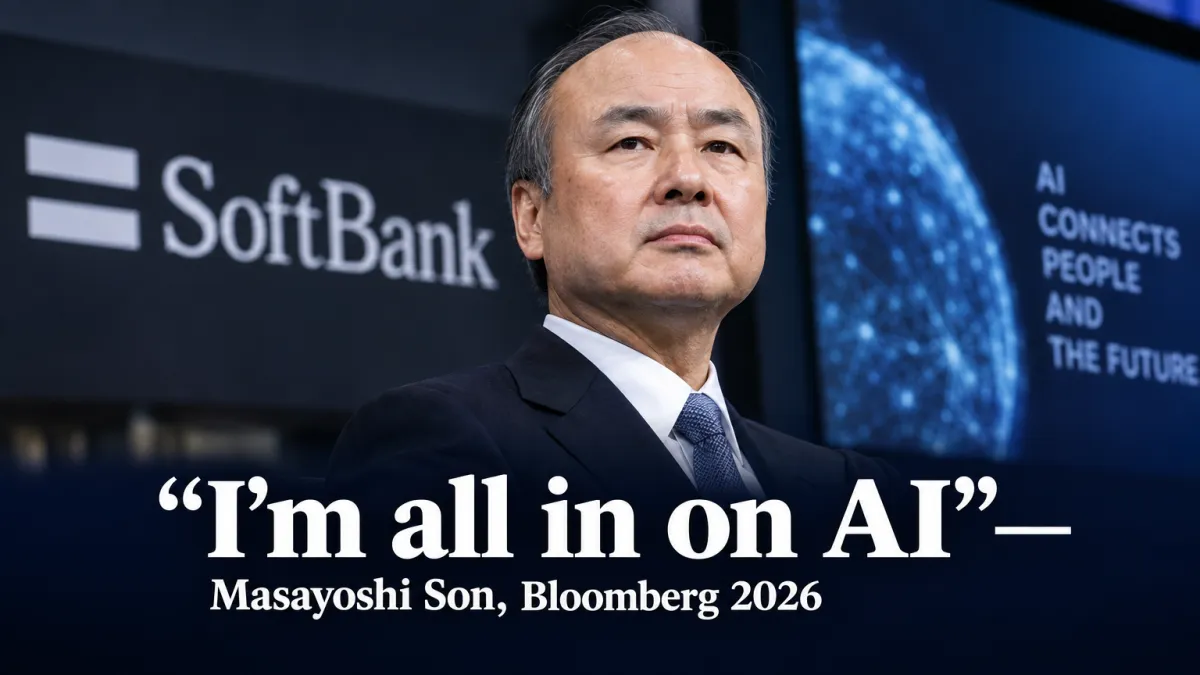
Billionaire Masayoshi Son Just Borrowed $11 Billion at Junk Rates to Go All In on AI — And It Changes Everything For Founders Who Think Caution Is a Strategy
Part 1 — The Hook
Masayoshi Son just paid junk-bond rates — up to 9.75% — to borrow $11 billion more for AI. Most people called it reckless. The room full of institutional buyers called it closed.
On September 28, 2026, Bloomberg reported that Son's $11.1 billion junk bond deal — one of the largest in history — had settled. Not proposed. Settled. Buyers lined up. Demand exceeded $20 billion before pricing. And Son walked away with the biggest junk-bond war chest any company in Asia-Pacific has ever assembled to fund a single bet.
Everyone is talking about the debt. Nobody is talking about what he sold to get it — and that silence is exactly where your lesson lives.
Part 2 — Why This Should Make You Uncomfortable
Here is what most founders are doing right now: building carefully, spending cautiously, selling tentatively — and losing deals to silence.
Meanwhile, Masayoshi Son walked into the global debt market — one of the most skeptical rooms on earth — carrying a balance sheet already showing credit default swaps at a three-year high. Bond investors knew the risk. They saw the WeWork losses. They saw the $70 billion Vision Fund implosion. They saw a company rated BB+, one notch below investment grade.
And they still said yes. Twenty billion dollars worth of yes.
If Son can raise $11.1 billion at 9.75% interest from the world's most sophisticated institutional skeptics — how is it that a founder with a legitimately great product for a genuinely urgent problem still cannot close a $30,000 deal? The answer is not product. It is not price. It is not timing. It is the absence of a selling system built on conviction — the kind of conviction that makes buyers move despite the risk, not because it disappeared.
Part 3 — The Play: What Actually Happened
Here are the verified numbers. Bloomberg (Sep 28, 2026) confirmed SoftBank's record $11.1 billion junk bond deal settled this week. The structure: $1 billion at 8.625% (3.5-year), $4.5 billion at 9.25% (5.5-year), and $4.5 billion at 9.75% (7.5-year), per The Japan Times (Sep 24, 2026). Proceeds fund the third and final tranche of SoftBank's $30 billion follow-on investment in OpenAI, bringing total cumulative commitment to $64.6 billion for approximately a 13% stake — per Eastern Herald (Sep 22, 2026).
SoftBank has already sold nearly $15 billion in bonds across currencies in 2026 alone, making it the world's largest junk-rated corporate borrower this year (Bloomberg data, cited by Japan Times, Sep 24, 2026). Its credit default swaps hit a three-year high as this deal launched. Yet early investor interest exceeded $20 billion, per Japan Times (Sep 23, 2026).
Son's public rationale: he expects AI-related industries to account for 20% of global output by 2040 — a $46 trillion market — per Japan Times (Sep 24, 2026). His words to the market: "I'm all in on AI" (Bloomberg, Sep 28, 2026).
Billionaire Masayoshi Son didn't just raise capital. He sold inevitability — and Jason has seen this exact pattern across 1,000+ founders. Here is what most miss.
Part 4 — The Lesson: The Root Cause Nobody Names
Beat 1: Root Cause Reframe
Most founders think the problem is that buyers don't have the budget.
But watch what Son just did. He went to buyers who knew the risk. The credit default swaps said so. The BB+ rating said so. The WeWork scar tissue said so. And yet $20 billion worth of demand showed up before the deal even priced.
The real problem is never budget. The real problem is that your buyer doesn't yet believe that the cost of inaction is higher than the cost of saying yes to you.
Son didn't eliminate the risk. He reframed what the risk actually was. To the bond market, the real risk wasn't SoftBank's leverage — it was missing the $46 trillion AI wave entirely. Once buyers accepted that reframe, they moved. At 9.75% interest. In a skeptical credit market. On a company with a history of $70 billion in losses.
Your founder is doing the opposite. Presenting features. Explaining specs. Answering objections with more information. Hoping the logic eventually tips the scale. It won't. Logic informs. Inevitability closes.
Beat 2: The Lesson
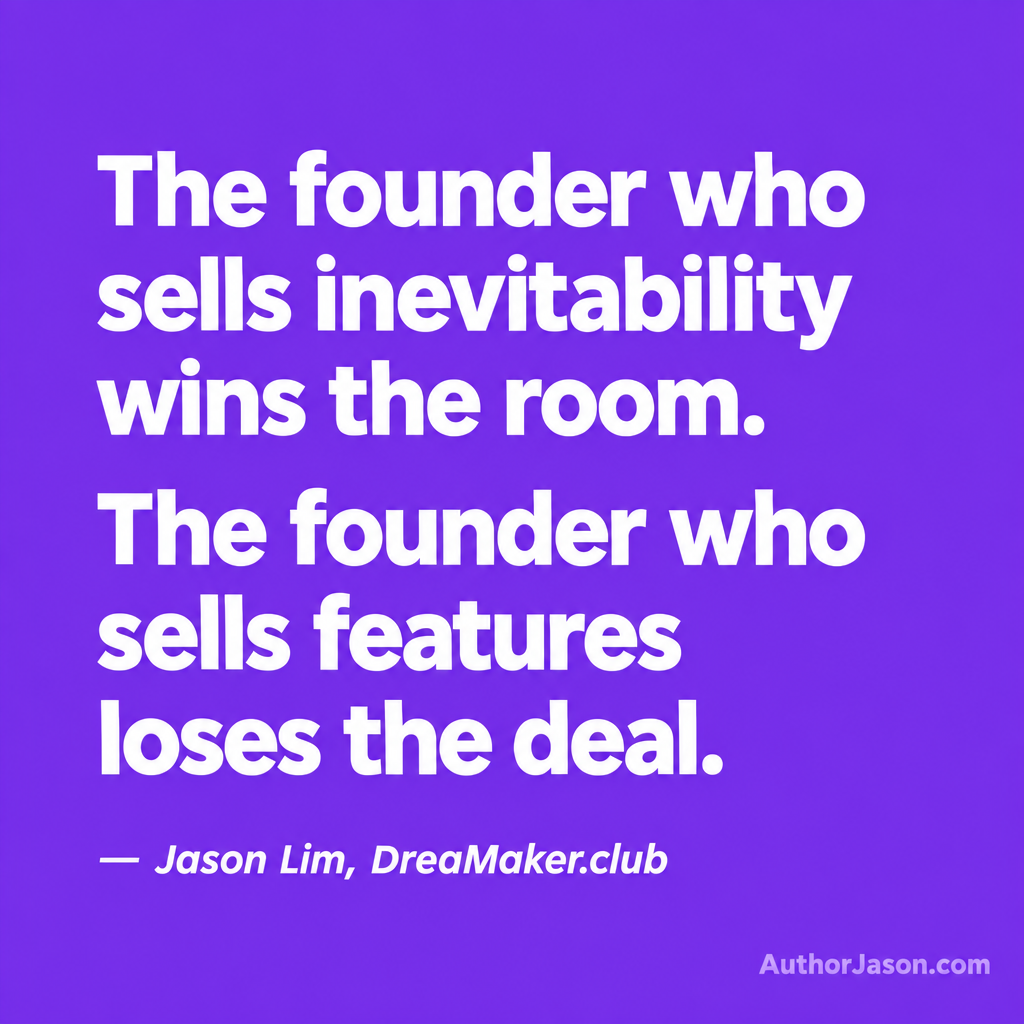
Son's pitch wasn't: here is why OpenAI is a great company. It was: AI will be 20% of global GDP by 2040. This is the company at the center of it. The only question is whether you are in or whether someone else takes your spot.
That is not a product pitch. That is a market inevitability pitch. And it is the difference between chasing buyers and pulling them toward you.
The founders Jason works with who close at the highest rates don't explain their product more clearly than anyone else. They make the cost of not buying feel catastrophically high. They don't sell features — they sell the future state the buyer will miss if they wait.
Founder Story
Jeffrey Teo was presenting his product like every other founder — features first, logic second, hope third.
He wasn't closing. Not because the product was wrong. Because the pitch was selling against objections instead of selling toward inevitability. The moment he restructured his pitch around the cost of his buyer's current problem — and the market window closing — everything changed. 63 customers in 100 days. Not from a new product. From a new selling system.
— Jeffrey Teo, FOS Graduate
Masayoshi Son borrowed $11 billion by making his buyers feel what Jeffrey's customers felt: if I don't act now, someone else gets my seat at this table. That's not charisma. That's a system.
Part 5 — The Hidden Opportunity and The Conditions To Capture It
Beat 1: The Hidden Opportunity
Here is what the Masayoshi Son story reveals that almost no founder is acting on yet: every buyer you are talking to right now is already sold on the general idea of AI. They've read the headlines. They've been in the boardroom conversations. They know something is shifting. What they haven't done is connect the dots between that macro shift and your specific product — in a way that makes sitting still feel riskier than buying.
This is a window. Son is betting $64.6 billion that the AI market is winner-take-most in the next 14 years. You don't need to raise junk bonds. You need to do one thing: restructure your pitch from here is what we do — to here is what happens to your business in 18 months if you don't.
The founders who internalize this before the rest of their market wakes up will inherit the deals their cautious competitors are still thinking about closing.
Beat 2: The Conditions Checklist
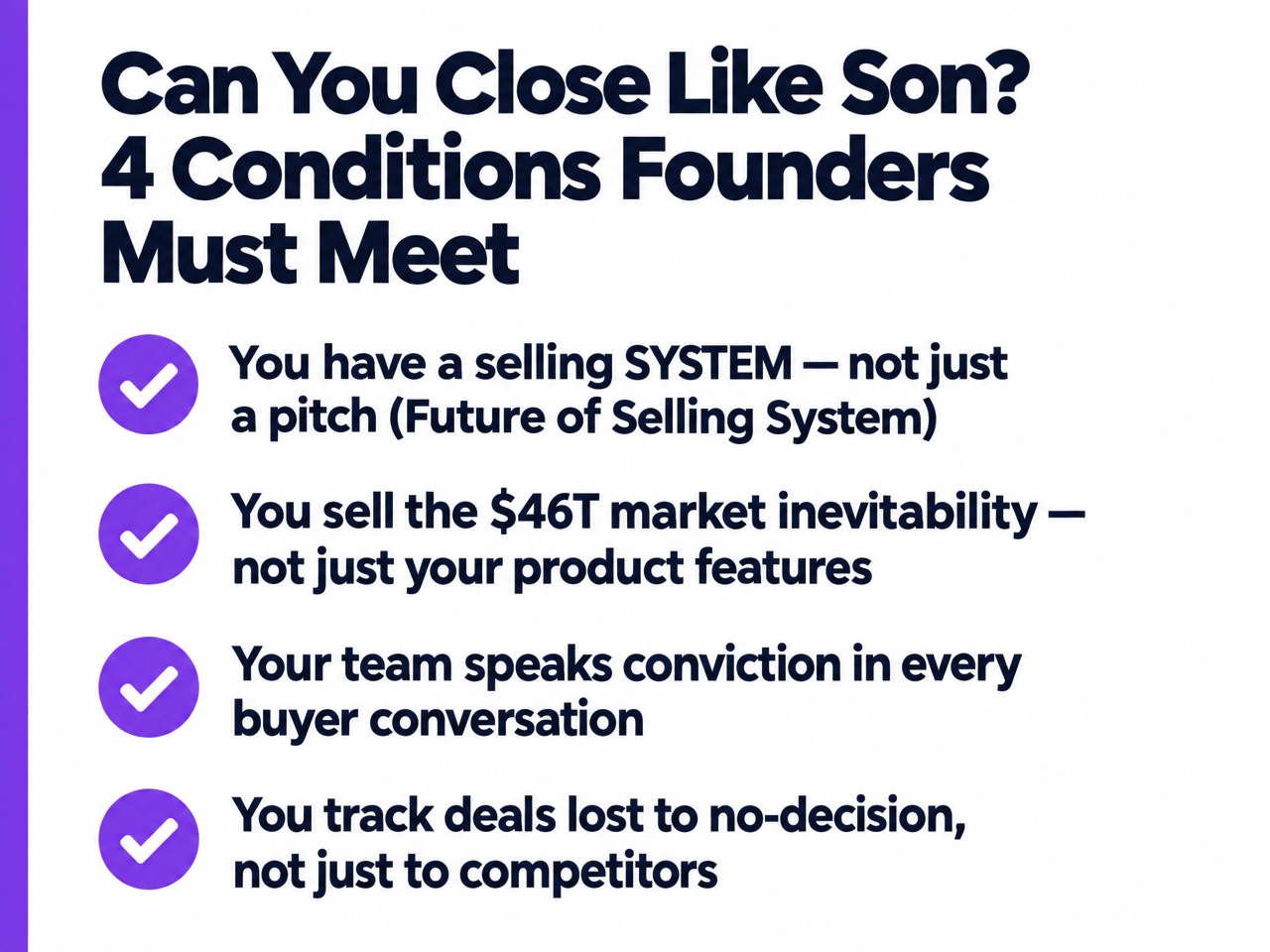
Can You Close Like Son? Check All 4:
Condition 1: You have a selling system — not just a pitch.
Son doesn't wing his investor meetings. He has a repeatable structure that converts conviction into capital, every time. The Future of Selling System is that structure for founders — a step-by-step method to move buyers from curious to committed without discounting or chasing.
Condition 2: You can articulate the market inevitability — not just your product features.
Son pitched a $46 trillion market shift, not a product deck. Your buyer needs to feel what happens to their world if the shift arrives without them. Can you describe that in 60 seconds?
Condition 3: Your team speaks conviction — not just information.
Every person on your team who touches a buyer conversation should be able to deliver the inevitability pitch. If only you can do it, you have a founder dependency — not a sales system.
Condition 4: You track deals lost to no-decision — not just to competitors.
If buyers are going dark — not saying no but not saying yes — you are losing to inaction, not to a better product. That is a selling system problem, not a market problem.
NEW! — September 2026
Dear Founders,
You are building in the biggest technology shift in history — and you are still selling like it is a normal product in a normal market. That gap is costing you deals every week. You have great conviction privately. You just do not have a system that transfers it to your buyer in the room.
I know what you might be feeling. You feel like you need more leads, better timing, a warmer referral — something to make the close easier. I felt that too. What I found — and what 1,000+ founders since 2015 have found — is that the gap is not the lead. It is the system.
According to the Salesforce State of Sales report, 76% of buyers expect sellers to understand their needs before initiating contact. Son's buyers knew exactly what they were getting — a seat at the $46T AI table. Your buyer needs the same clarity about what they are getting from you. That clarity is what a selling system delivers.
FOS graduates:
- Jeffrey Teo — 63 customers in 100 days
- Stanley Tan — 45 buyers in 3 hours
- Leon — $2M partnership in under 90 days
- $22M+ in combined graduate sales since 2015
Not ready for $19? Start free.
The Objection Playbook: 25 Word-for-Word Scripts to Close More Sales
The exact words Jason's founders use when a buyer says too expensive, send me info or I need to think about it. Free PDF, sent to your inbox.
Send Me the 25 ScriptsBillionaire Masayoshi Son already moved — $64.6 billion worth of moved. The only question is whether you will — or whether you will read about someone else who did.


