Billionaire Melinda French Gates Has A 48-Hour Rule For Criticizing People — And It Changes Everything For Founders Who Keep Losing Deals To Vagueness
Billionaire Melinda French Gates Has A 48-Hour Rule For Criticizing People — And It Changes Everything For Founders Who Keep Losing Deals To Vagueness
Melinda French Gates just told the world she waits 48 hours before criticizing anyone. Because being clear is kind.
Most founders will nod along, think great leadership tip, and keep doing the exact opposite in every sales conversation they have this week. They will stay vague. They will soften the close. They will hint instead of ask. And they will lose the deal — quietly, politely, without ever understanding why.
This is not a story about management. It is a story about why your buyers keep saying let me think about it — and how one of the world's most powerful women just handed you the answer.
The Problem Founders Will Not Admit They Have
You have been in a sales conversation where you knew — knew — you should ask for the close. But something stopped you. You added one more feature. You softened the offer. You said no pressure, just let me know. And the prospect went cold.
You told yourself you were being respectful. Professional. Non-pushy. But here is the brutal truth: your buyer did not experience your vagueness as kindness. They experienced it as uncertainty. And uncertainty kills deals faster than any objection.
When you are unclear about what you want, what happens next, or what the offer actually is — the buyer's brain fills the silence with doubt. They do not think you are being polite. They think you do not believe in your own product. And if you do not believe in it, why should they?
Melinda French Gates did not invent this principle for sales. She discovered it the hard way, running one of the largest philanthropic organizations in human history. And what she said this week is the clearest articulation of a truth that costs startup founders millions every year.
What She Actually Said — And Why It Matters
In an interview published by Fortune on October 19, 2026, Billionaire Melinda French Gates revealed that she has a personal rule: she waits 48 hours before criticizing an employee. Not because she avoids hard conversations — but because she wants to have them well.
The principle she cited: Being clear is kind.
French Gates, whose net worth is estimated at approximately $30 billion (Forbes, 2026), is the founder of Pivotal Ventures and former co-chair of the Bill and Melinda Gates Foundation — an organization that granted more than $77 billion to humanitarian causes worldwide. She left the Foundation in 2024 to run her own philanthropic agenda, entirely on her own terms, for the first time in her career.
Her 48-hour rule is not a pause to avoid conflict. It is a discipline to ensure that when she speaks, she speaks with clarity, intention, and precision. She has learned — from leading one of the most complex organizations on earth — that vagueness delivered quickly does far more damage than clarity delivered thoughtfully.
Her move is one Jason has seen at his events, which since 2016 have reached 100,000+ founders across Asia. Here is what most miss.
The Lesson — And The Root Cause Founders Keep Getting Wrong
Beat 1: The Root Cause Reframe
Most founders think the problem is their offer. They assume if they just had a better product, a lower price, or a sharper pitch deck — the deals would close themselves. So they iterate on the offer. They add more features. They create more content. They re-write the proposal for the third time.
But the real problem is not the offer. The real problem is vagueness — and the mistaken belief that being vague is the same as being kind.
Founders go vague in sales conversations because they are afraid of rejection. If you never actually ask, you can never actually be told no. The soft close feels safer. The open-ended follow-up feels less pushy. The just let me know feels respectful. But to your buyer, all of that vagueness communicates one thing: this founder does not really believe in what they are selling.
Clarity, by contrast, is an act of confidence. When you tell a buyer exactly what you want, exactly what happens next, and exactly what they need to decide — you give them a gift. You make it easy to say yes. And you make it easy to say no, which is the second best outcome — because no means you stop wasting time chasing a deal that was never going to close.
Beat 2: The Lesson
Here is the lesson her 48-hour rule is actually teaching: the best communicators are not the most spontaneous ones — they are the most prepared ones.
She does not wait 48 hours because she does not know what to say. She waits 48 hours so that what she says is worth saying — precise, fair, and actionable. That is the same standard you should hold yourself to in every sales conversation. Not spontaneous. Not improvised. Not let us just see how it goes. Prepared. Clear. Decisive.
The founders who close the most deals are not the ones who wing it best. They are the ones who have a system — a repeatable, practiced framework for moving conversations from interest to decision — so that when the moment comes, the right words are already there.
Founder Story Card
Stanley Tan came to Jason with a paid webinar he needed to sell. He had the content. He had the audience. What he did not have was the clarity to present the offer in a way that made people move. After Jason's pitch deck review and a one-on-one pitch consult — which gave him specific, clear language and a structured close — Stanley pitched the webinar to 203 people. 90 showed up. Not because the offer changed. Because the clarity changed.
Jeffrey Teo applied the same system to his consulting practice and acquired 63 customers in 100 days. And Leon secured a $2M partnership — not by adding more to his pitch, but by stripping it down to what was clear, credible, and direct.
Every one of those results came from the same root decision: to stop being vague. To say the specific thing, at the specific moment, with the specific confidence that tells a buyer — this founder knows what they are doing, and I can trust them with my money.
The Hidden Opportunity — And The Conditions That Unlock It
Beat 1: The Hidden Opportunity
Here is what most founders miss about this story: in a market where everyone is busy being polite and non-committal — where every sales email ends with let me know if you have any questions, where every pitch closes with no pressure, just something to consider — the founder who shows up and says something clear is instantly differentiated.
Clarity is a competitive advantage right now. Most of your competitors are vague. Most of your competitors are afraid of rejection. Most of them are softening their asks and watching deals drift into silence. The moment you develop the discipline and the language to be genuinely clear — to say exactly what you want, exactly what happens next, and exactly what the buyer risks by waiting — you step out of the crowd entirely.
The opportunity is not just to close more deals. It is to close them with less effort, less follow-up, and less wasted time — because clarity accelerates decisions. And in a market where time is the one resource no founder can replace, accelerating the buyer's decision is the highest-leverage thing you can do right now.
Beat 2: Are You Ready To Sell With Clarity?
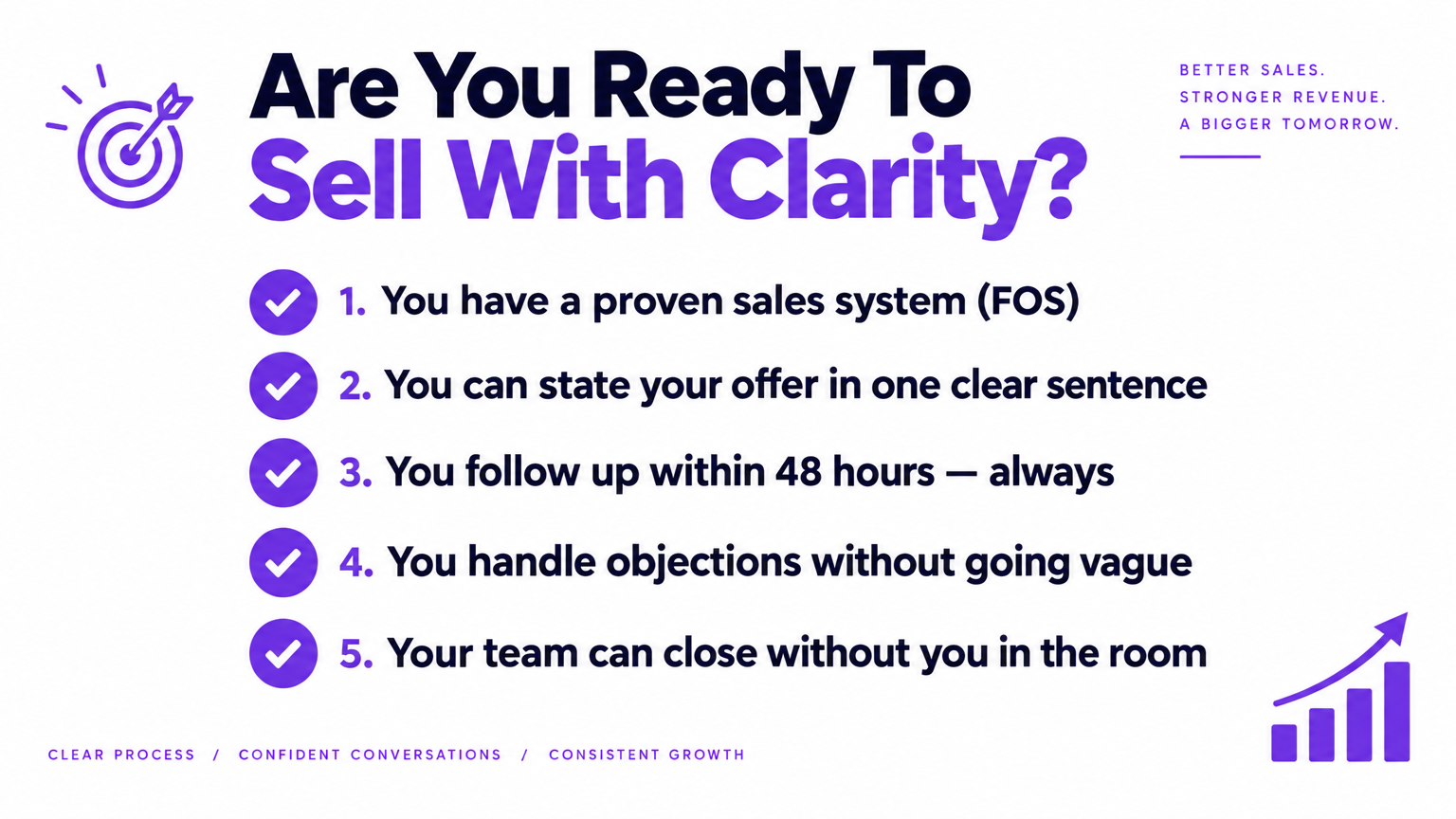
Check these five conditions before you assume your next sales call will go differently than the last:
- You have a proven selling system (Future of Selling System). Not a vague process — an actual, repeatable framework with language for every stage: open, explore, present, handle objections, close. Without this, clarity is impossible — you cannot be precise about something you have never mapped.
- You can state your offer in one clear, confident sentence. If it takes you three minutes to explain what you sell, your buyer is already confused. Clarity begins with compression. Can you say it in 20 words?
- You follow up within 48 hours — always. Like French Gates's 48-hour rule, speed of execution signals competence. A founder who follows up three weeks later is not clear about urgency. Your buyer notices.
- You handle objections without going vague. When a buyer says I need to think about it, do you have a specific, kind, direct response? Or do you say no problem, take your time — and watch the deal die quietly?
- Your team can close without you in the room. If only you can close deals, you do not have a sales system — you have a personal dependency. True clarity is documented, teachable, and repeatable by every person on your team.
NEW!
October 2026
Dear Founders,
If you are losing deals because buyers keep saying let me think about it — the problem is almost never your price or your product. The problem is that you have not given your buyer a clear enough reason to decide today.
I know how that feels. I have spoken with thousands of founders across Asia who say the same thing: We have a great product. We just cannot get people over the line. When I dig in, the answer is almost always the same — they do not have a clear, structured system for moving buyers from interest to decision. They are winging every sales conversation, softening every ask, and hoping the buyer figures it out.
What I found — and what my graduates have proven again and again — is that when you replace vague, improvised selling with a clear, repeatable system, everything changes. Jeffrey Teo acquired 63 customers in 100 days. Stanley Tan pitched 203 people with a structured, clear offer — 90 showed up and converted. Leon closed a $2M partnership by being precise, not by being persistent.
According to Salesforce's State of Sales report, 76% of sales professionals say that selling is harder than it was five years ago — and the top reason is buyers who delay decisions because they do not have enough clarity to say yes. The system that fixes this is the Future of Selling System (FOS) — used by $22M+ in combined sales across my graduates, built from 100,000+ founders trained across Asia since 2016.
For $19/month — that is $0.63/day — you get the complete framework for selling with clarity: how to open, explore, present, handle every objection, and close — in a way that feels natural, confident, and kind. Because being clear is kind. Melinda French Gates already knows that. Now you do too.
$0.63/day. Cancel anytime. Used by founders across Asia to close more deals with clarity.
Not ready for $19? Start free.
The Objection Playbook: 25 Word-for-Word Scripts to Close More Sales
The exact words Jason's founders use when a buyer says too expensive, send me info or I need to think about it. Free PDF, sent to your inbox.
Melinda French Gates already moved. The only question is whether you will — or whether you will read about someone else who did.


