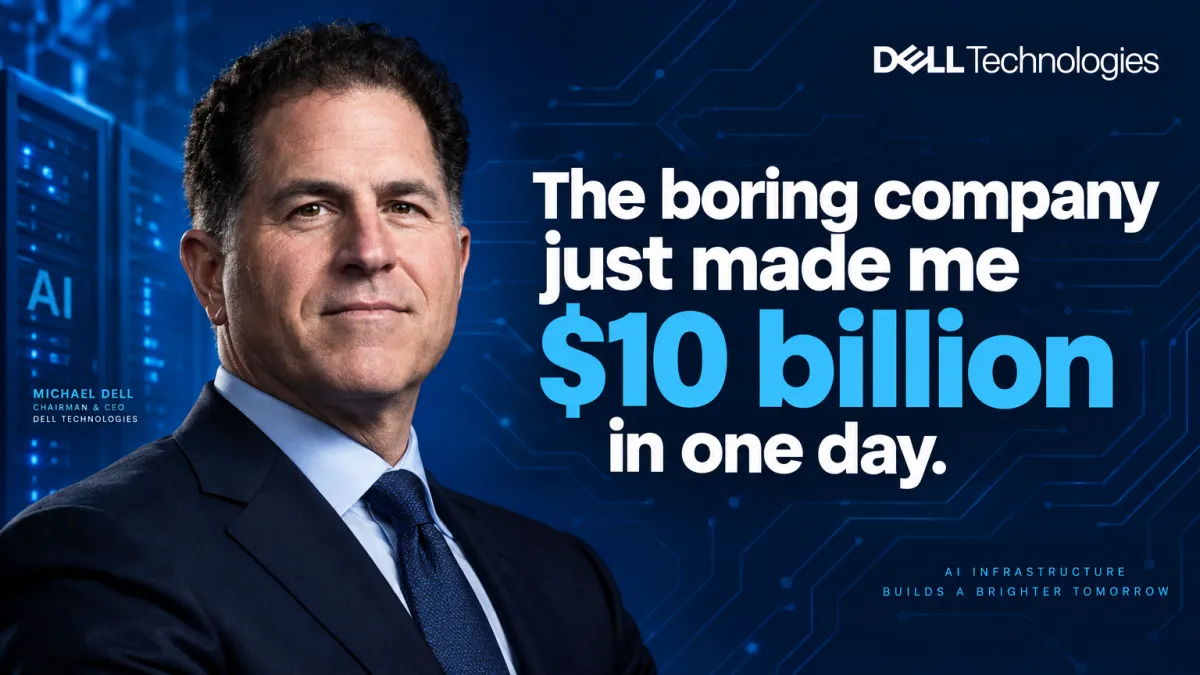
Billionaire Michael Dell Just Made $10 Billion in One Day — And It's the Wake-Up Call Every Founder Selling Into Enterprise Needs
Part 1 — The Hook
Michael Dell just made $10 billion in a single trading day. He did not ship a product. He did not close a deal. He did not even give a speech. He simply owned the infrastructure the entire AI world has decided it cannot function without — and the market paid him for it.
On October 6, 2026, Dell Technologies stock surged roughly 5%, lifting Michael Dell's net worth by more than $10 billion in a single session to approximately $280 billion — placing him among the four wealthiest people on the planet, according to Forbes. Not bad for a Tuesday.
But here is what nobody is talking about: the real reason this happened has almost nothing to do with AI breakthroughs, flashy products, or genius algorithms. And the lesson buried inside it could completely change how you think about selling your startup right now.
Part 2 — The Stakes
Let me ask you something uncomfortable.
Right now, in your market — if your startup disappeared tomorrow, would your buyers feel it like a power outage? Or would they shrug, open a browser tab, and find your competitor in four minutes?
Most founders are selling features. They spend their pitch meetings proving their product is better, faster, cheaper. They compete on comparison. And every time they do, they hand their buyer a reason to pause, shop around, and delay.
Meanwhile, the companies growing fastest — and the billionaires getting richer fastest — are doing something different. They are not selling products. They are selling position. They are the water pipes. The road underneath. The rack that holds the server. The thing nobody glamourises, but nobody can do without.
That shift — from feature to infrastructure — is the difference between a buyer who might buy from you and a buyer who has to buy from you. Your buyers are entering their own AI transition right now. There is a specific, time-limited window to make that repositioning move. Are you inside it?
Part 3 — The Facts
Michael Dell founded his company in 1984 at age 19, building personal computers out of his University of Texas dorm room with $1,000 in startup capital. For the better part of three decades, Dell Technologies was considered a boring hardware company — not the kind of business that made investors salivate.
Then came the AI wave. And what everyone dismissed as unglamorous — server racks, storage systems, enterprise data centre hardware — turned out to be the exact layer that every AI company in the world desperately needed to scale.
The numbers are staggering. Dell Technologies stock is up approximately 349% year-to-date in 2026, according to Forbes (October 6, 2026). AI-optimised server revenue surged 757% year-over-year to $16.1 billion in Q1 fiscal 2027, per Fortune (September 2026). The company booked a record $60.9 billion in AI server orders in a single quarter, ending with a $95 billion backlog, per Benzinga (September 2026). Dell himself sees a $1 trillion AI infrastructure opportunity through 2030.
The personal wealth effect has been equally dramatic. Michael Dell began 2026 at approximately $191 billion in net worth. By October 6, that had risen to $280 billion — an increase of nearly $90 billion in under ten months, driven by his approximately 40% stake in Dell Technologies plus a substantial holding in Broadcom.
Billionaire Michael Dell did not get here by being the most innovative. He got here by being the most essential. That is the move Jason has seen across 1,000+ founders. Here is what most miss.
Part 4 — The Lesson
Root Cause Reframe
Most founders think the problem is that they do not have a good enough product. So they iterate. They add features. They lower the price. They put together a better demo deck. And then they wonder why the buyer still says let me think about it.
But the real problem is positioning. They have entered the conversation as a vendor — one option on a comparison list — instead of as infrastructure. When you are a vendor, buyers can delay. When you are infrastructure, delay costs them money.
Dell Technologies did not get lucky with AI. They spent years after the PC era quietly expanding into servers, storage, and enterprise networking — the boring middle of the supply chain. By the time the AI buildout hit, the market did not have to guess whether Dell was essential. It was obvious. And the stock reflected it.
The same opportunity is in front of your startup right now. Your buyers are under pressure to modernise, automate, and prove AI ROI to their boards. A founder who walks in and says I can help you with feature X is a vendor. A founder who walks in and says here is what happens to your pipeline in six months if you do not close this infrastructure gap — and here is exactly how we solve it — is essential. The close rate is completely different.
The Lesson
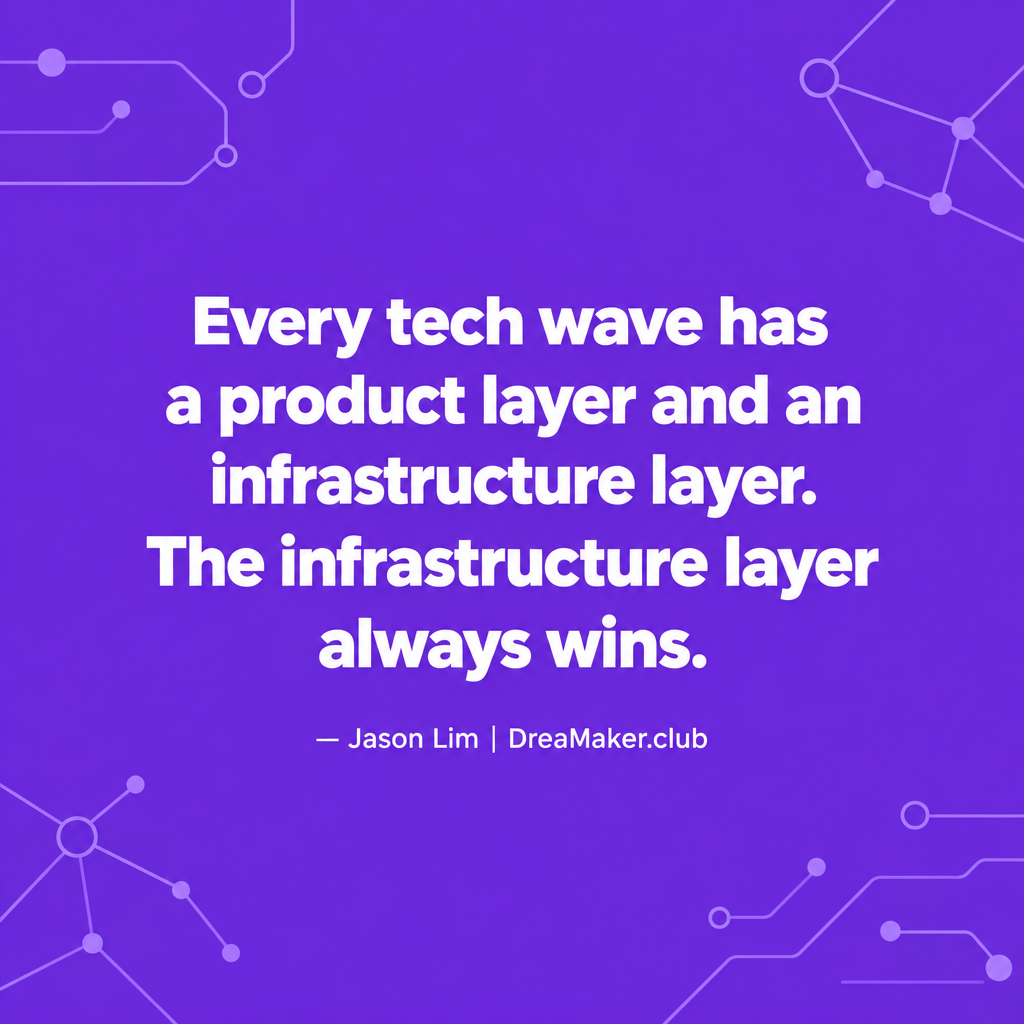
Every major technology wave — the internet, mobile, cloud, and now AI — has two distinct layers of winners. There is the application layer (the hot new apps everyone talks about) and the infrastructure layer (the boring picks-and-shovels everything else runs on). In every single wave, the infrastructure layer wins bigger and wins longer. The application layer chases the trend. The infrastructure layer becomes the condition for the trend.
Founders in the application layer fight price wars. Founders who occupy the infrastructure layer of their buyer's world get paid to exist — and they close faster, with less resistance, at higher deal sizes.
Founder Story Card
How Stanley Tan closed 45 buyers in 3 hours
Stanley had a strong product and a weak close rate. His demos were polished. His follow-up was consistent. But buyers kept stalling. When he went through the Future of Selling System, one shift changed everything: he stopped presenting his product as an option and started presenting the cost of inaction as a certainty. At his next group presentation, 45 buyers committed in the room within three hours. Not because the product changed. Because his positioning did.
The product was always good enough. The positioning was not.
Part 5 — The Opportunity
The Hidden Opportunity
Here is what most founders see when they read the Michael Dell story: a billionaire getting richer. Interesting, but irrelevant to them.
Here is what Jason sees: a once-in-a-decade repositioning window opening right now at the startup level.
Your buyers — the enterprise accounts, the mid-market companies, the scale-ups you are targeting — are all under some version of the same pressure Dell rode to $280 billion. They are being asked by their boards, their investors, and their customers to show they are building the right infrastructure for the AI era. They have budget. They have urgency. But most do not have a clear answer yet.
The founder who walks into that conversation positioned as the system their buyer needs to navigate this transition — not a feature, not a tool, not a nice-to-have — is the founder who closes. This is the same window Dell capitalised on. The AI buildout is not a future event. It is happening now. And buyers who are spending are spending on infrastructure essentials first.
The question is not whether this window exists. It does. The question is whether you have a repeatable system to walk into it — and walk out with a signed deal.
Are You Ready? Check the Conditions
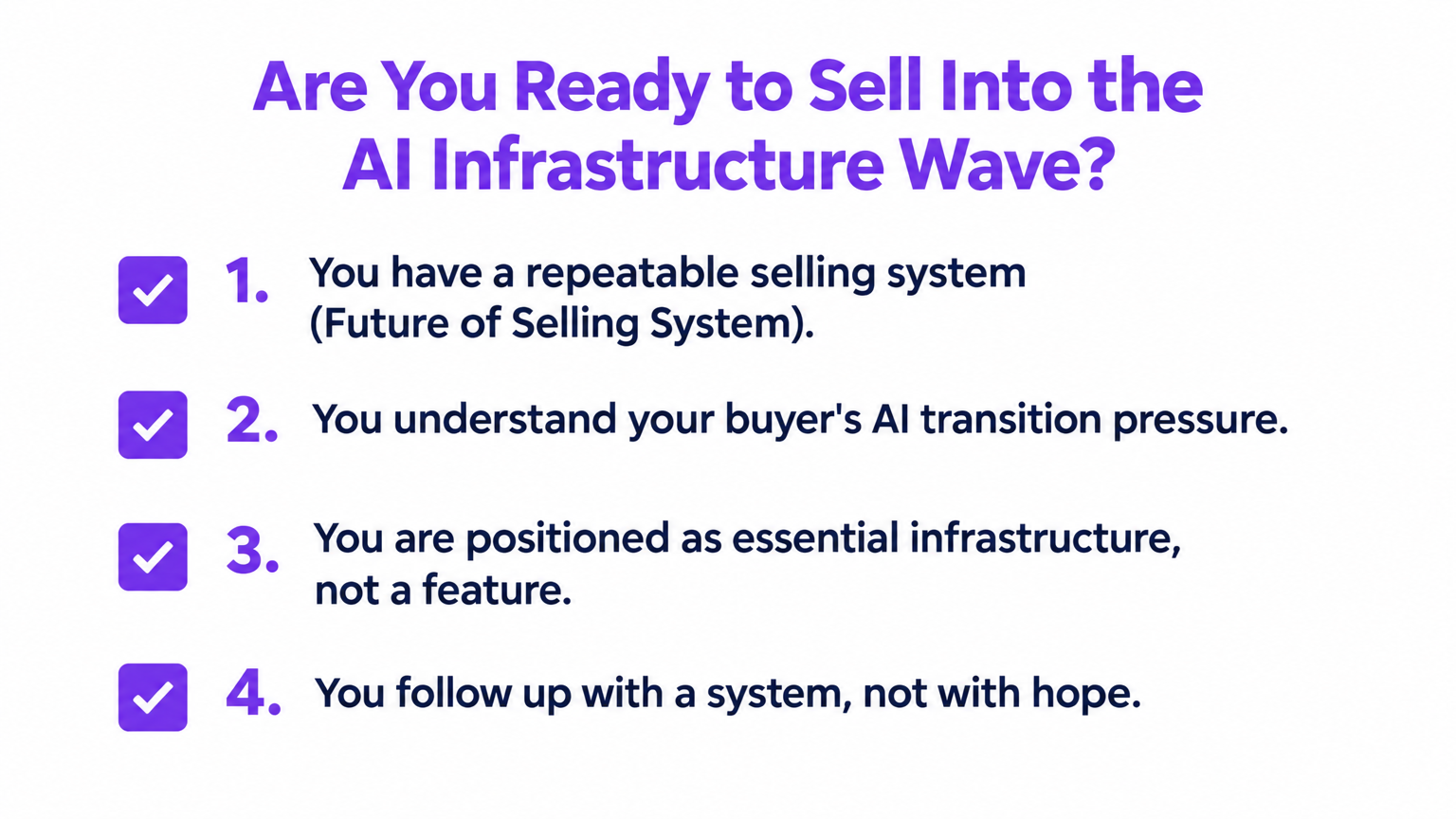
The 4 Conditions to Sell Like Infrastructure — Not a Vendor
Condition 1 — You have the Future of Selling System
Positioning, qualification, objection handling, and close — all systematised. Without a repeatable sales system, you are selling on instinct. Instinct does not scale, and it does not close enterprise buyers who have heard every pitch. FOS is the operating system for founder-led sales. Get it at dreamaker.club/buyfos.
Condition 2 — You understand your buyer's AI transition pressure
You know specifically what your buyer is being asked to prove, automate, or modernise in the next 12 months — and you can speak to that pressure directly in your first meeting.
Condition 3 — Your positioning frames the cost of inaction, not just the benefit of action
Buyers delay when buying feels optional. Infrastructure feels urgent when the buyer understands what breaks without it. Your messaging must make inaction more expensive than your price.
Condition 4 — Your follow-up is systematic, not reactive
Dell did not build a $280 billion empire on a single great quarter. It was consistent execution, deal after deal, year after year. Your follow-up must be a system — not a feeling — or you are leaving your biggest opportunities to chance.
NEW! → October 2026
Dear Founders — if your pipeline runs on hustle, hope, and a great product with no repeatable system, you are the enterprise buyer's biggest risk.
Michael Dell's $10 billion day was not luck. It was the result of decades of being positioned as the infrastructure layer buyers could not live without. You have the same window right now — but only if you have a selling system that makes you feel essential, not optional.
Get the Future of Selling System — $19/month ($0.63/day) →You might feel like your product is not quite ready, your market not quite right, or your pitch needs one more tweak. That is what every founder feels before they realise the product was never the problem. We have seen it across 1,000+ founders since 2015. What we found is a system that removes the guesswork from enterprise sales entirely.
According to Salesforce's State of Sales report, 76% of buyers expect companies to understand their needs and expectations. The founders who close consistently are the ones who walk in already knowing the buyer's pain — and who have a system to convert that pain into a signed deal.
The Future of Selling System (FOS) is built on $22M+ in combined sales by graduates. Jeffrey Teo used it to sign 63 customers in 100 days. Leon used it to land a $2M partnership. Stanley Tan used it to close 45 buyers in 3 hours. These are startup founders with teams of 5 or more — selling into real enterprise markets.
Start the Future of Selling System Today →Not ready for $19? Start free.
The Objection Playbook: 25 Word-for-Word Scripts to Close More Sales
The exact words Jason's founders use when a buyer says too expensive, send me info or I need to think about it. Free PDF, sent to your inbox.
Send Me the 25 ScriptsBillionaire Michael Dell already moved — thirty years ago, he chose to be the infrastructure layer instead of the feature. The only question is whether you will do the same right now, or whether you will read about someone else who did.


