Billionaire Michael Dell Just Added $120 Billion in One Year — And It Changes Everything For Founders Who Think Their Best Days Are Behind Them
By Jason Lim | AuthorJason.com | September 27, 2026
He added $120 billion in one year. Most founders missed why.
Michael Dell just surpassed Sergey Brin and Mark Zuckerberg to become one of the four richest people on earth — adding $120 billion to his net worth in 2026 alone, according to the Bloomberg Billionaires Index (September 26, 2026). The headlines are calling it an AI windfall. They are wrong. This is not about AI. It is about what Dell built before the tailwind arrived — and why founders who are waiting for their moment are building on sand.
If you think this does not apply to you, that is exactly the problem.
Every founder reading this has had a moment where they thought: if only the market would catch up to what I am building. Maybe you have a product that is genuinely ahead of its time. Maybe you have a team that is ready. Maybe you have done the hard work of getting to five, ten, twenty customers. And yet, you are still manually hunting deals, still losing to inertia, still wondering why growth feels so grinding.
Michael Dell felt all of that. He watched analysts bury his company. He was told the PC era was over. He was laughed at for going private at $24.4 billion in 2013 when the smart money said he was buying a tombstone. And then he spent a decade doing the one thing most founders refuse to do: building the system underneath the surface, so that when the market moved, his company was already positioned to capture everything.
The question for you is not whether a wave is coming. The question is whether your sales system is in the water when it does.
What actually happened — the facts every founder needs to see
Michael Dell started at 19 years old, selling custom-built computers from his University of Texas dorm room. He grossed $80,000 in his freshman year — before he ever had a brand, a sales team, or external funding. He dropped out and incorporated Dell Computer Corporation in 1984 with $1,000 in startup capital.
In 2013, when Wall Street declared the PC era dead, Dell took the company private in a $24.4 billion leveraged buyout — the largest technology buyout in history at the time (Reuters, 2013). He spent the next several years rebuilding the infrastructure stack: storage, security, cloud, and eventually AI-optimised server architecture. When the AI infrastructure boom exploded in 2024–2026, Dell Technologies was already the supplier. By Q2 FY2027, Dell's AI server order backlog stood at $95 billion (CNBC, September 1, 2026). Dell's shares have risen 345% year-to-date as of September 25, 2026 (Forbes). His net worth reached approximately $260 billion on the Bloomberg Billionaires Index as of September 26, 2026, placing him #4 in the world.
Billionaire Michael Dell did not win because AI arrived. He won because he built his system a decade before anyone believed he would need it — and that move is one Jason has seen across 1,000+ founders. Here is what most miss.
The lesson — and the root cause most founders will never see
Root Cause Reframe
Most founders think the problem is that they do not have enough demand yet. They are waiting for the market to validate them, for word of mouth to build, for a big partnership to open doors. But the real problem is that they have not built a system that can capture demand when it arrives. They are building product and hoping the market notices. Dell did the opposite: he built the delivery system, the supply chain, the customer relationship infrastructure — and then waited. When the AI server boom hit, there was no scramble. The system was already running.
Founders who are manually closing every deal, relying on their own charisma, and skipping the process work are not building a company. They are building a job that depends on them showing up every day. When the market moves — and it will — they will not have a system to capitalise on it. They will just be busier, and more overwhelmed, and still closing at the same conversion rate they always have.
The Lesson
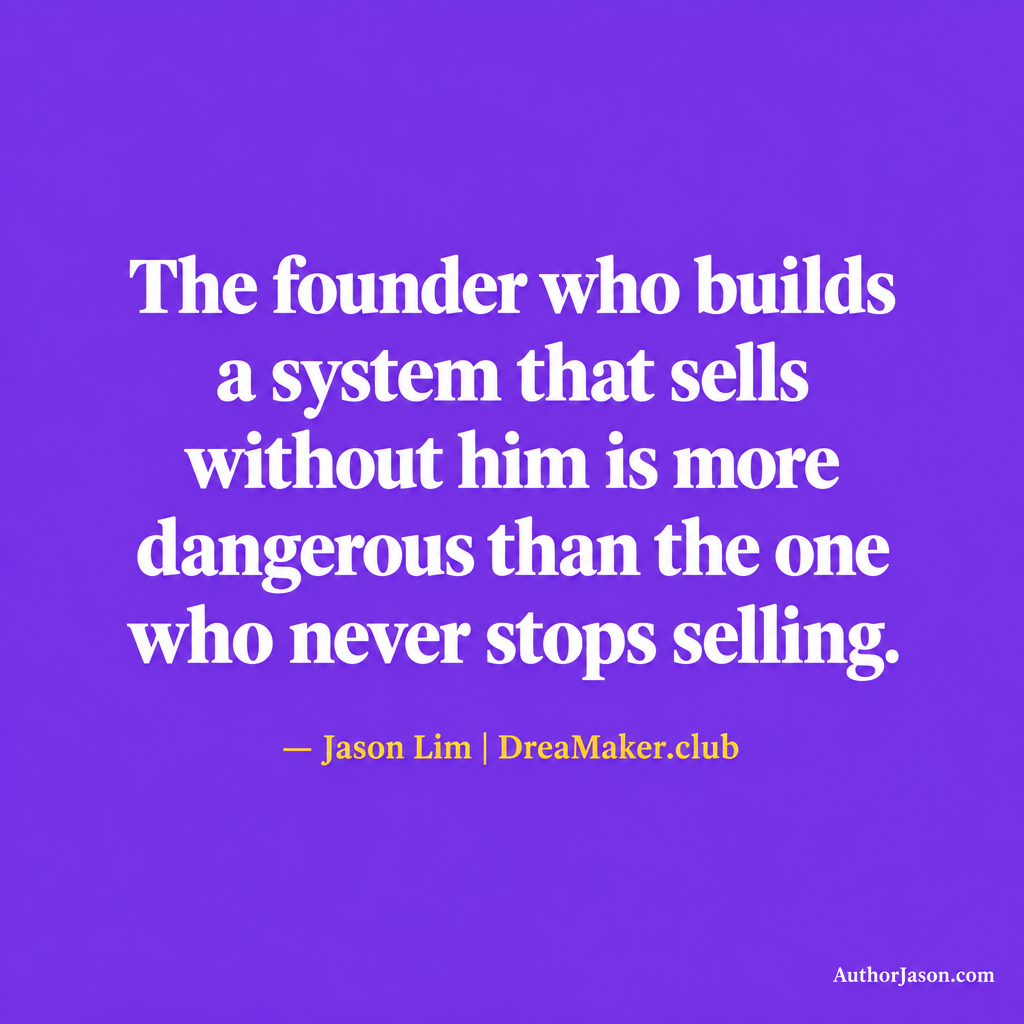
The founder who builds a system that sells without him is more dangerous than the one who never stops selling.
Dell at 19 was not a natural salesman. He was a system builder. He looked at the market and asked: what does a buyer need, and how do I make it frictionless for them to get it? He sold direct-to-consumer before e-commerce existed — cutting out the middleman, eliminating markup, giving buyers a custom-built machine at a price nobody else could match. That was a system insight, not a sales hustle insight. And every dollar of his $260 billion fortune flows from that single original system instinct.
Founder Story Card
Jeffrey Teo — 63 Customers in 100 Days
Jeffrey was closing deals manually — every call was a one-off effort, every follow-up improvised. He had a good product and warm leads, but no repeatable motion. After implementing the Future of Selling System, he closed 63 customers in 100 days. Not because he worked harder. Because he finally had a system that converted demand instead of depending on his memory and mood to capture it.
The market is not your problem. The system underneath your selling is the problem — and the opportunity.
The hidden opportunity — and the 4 conditions you need to check
The Hidden Opportunity
AI is not creating a winner-takes-all moment for the biggest players. It is creating a speed-of-system moment for founders who are ready. Every major buyer in your market is being hit simultaneously by an AI-driven change in how they evaluate vendors. The old relationship-based sales motion is losing ground to buyers who have done their research before you ever get on a call. The founders who have a repeatable, structured selling system will convert that pre-warmed buyer. The founders who are still improvising will lose to a competitor with half their product quality but twice their process clarity.
Dell's $95 billion backlog did not appear because the world suddenly loved Dell. It appeared because Dell was the only company that had the infrastructure, the supply chain, and the customer trust architecture already operational when hyperscalers needed to spend. You do not need a $95 billion backlog. You need the same underlying truth: when a buyer is ready to move, your system needs to be the one waiting for them.
Are you ready to build a system that sells without you? Check these 4 conditions:
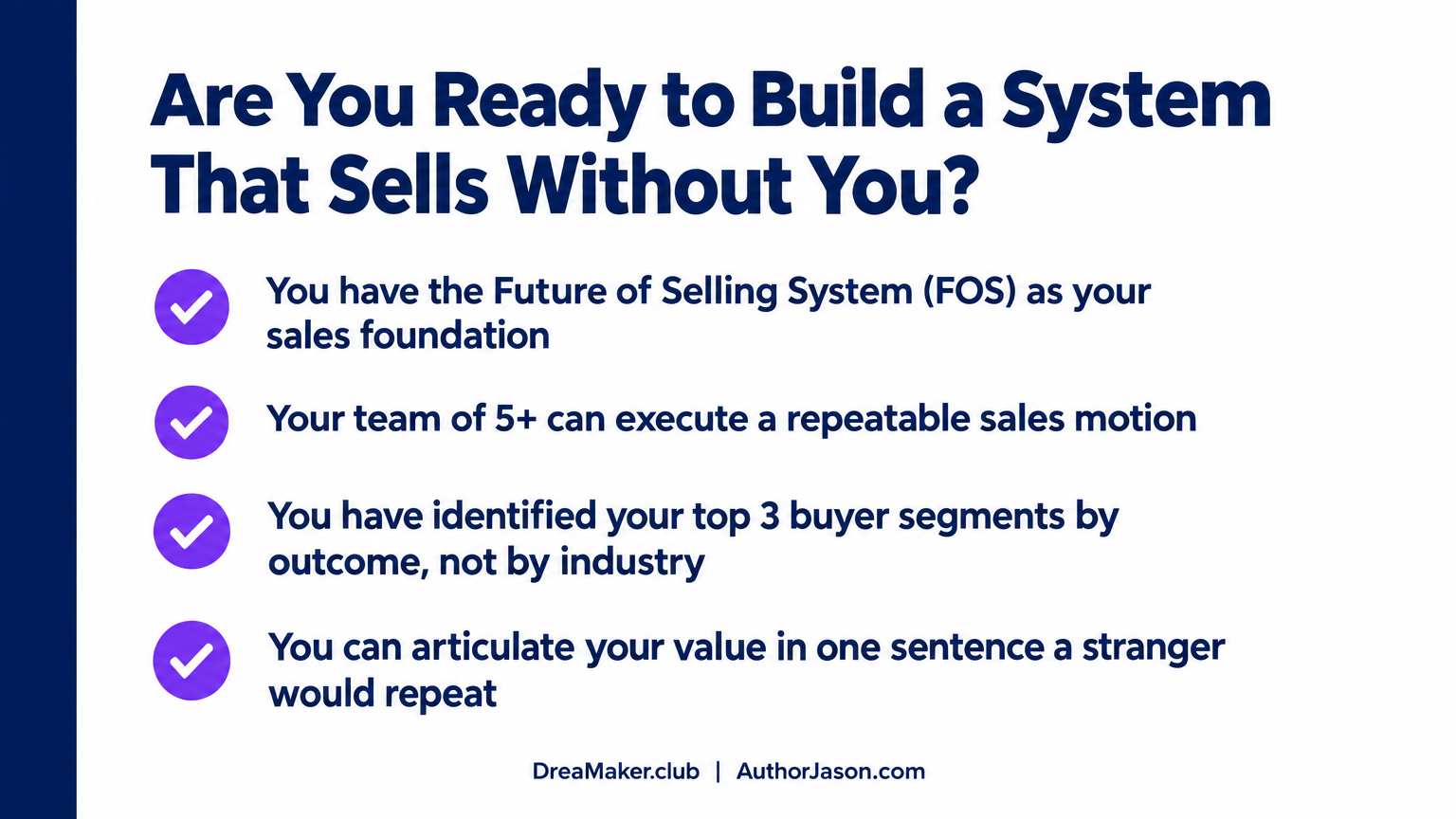
✅ Condition 1 — You have the Future of Selling System (FOS) as your sales foundation
Without a structured, repeatable selling methodology, everything else is improvisation. FOS is the foundation. The rest of these conditions build on top of it. If you skip Condition 1, the other three will leak.
✅ Condition 2 — Your team of 5+ can execute the selling motion without you on every call
If you are still the only person who can close, you have not built a sales system — you have built a dependency. Dell's comeback was powered by distributed execution. Yours will be too.
✅ Condition 3 — You have identified your top 3 buyer segments by outcome, not by industry
Dell did not chase generic technology buyers. He identified exactly who needed a custom machine at a direct price with no intermediary markup. Specificity in your buyer definition is what creates pull instead of push.
✅ Condition 4 — You can articulate your value in one sentence a stranger would repeat
Word of mouth is the oldest demand engine in the world. If your buyers cannot describe what you do in a sentence that makes someone else want to buy, your system has a transmission problem — not a product problem.
NEW! — September 2026
Dear Founders — The Wave Is Here. Is Your System?
Get the Future of Selling System — $19/month ($0.63/day) →Dell's $95 billion backlog did not fall from the sky. It landed on a system that was already built and waiting. If buyers in your market got serious about purchasing tomorrow, would your sales process be ready to capture them — or would you scramble, improvise, and lose half of them to a competitor with a cleaner motion?
I know how you feel. Most of the 1,000+ founders I have worked with since 2015 felt the same way — like they were one big deal away from everything clicking, but somehow that deal never came fast enough. What they found — once they implemented a structured selling system — was that the deals were always there. The system was just missing.
According to Salesforce's State of Sales report, 76% of sales reps say following a structured sales process is very important to closing deals — yet most founders are still winging it on every call. That gap is where revenue disappears.
The Future of Selling System has produced:
- $22M+ in combined sales by graduates
- 1,000+ founders trained since 2015
- Jeffrey Teo: 63 customers in 100 days
- Stanley Tan: 45 buyers in 3 hours
- Leon: $2M partnership closed using the system
Not ready for $19? Start free.
The Objection Playbook: 25 Word-for-Word Scripts to Close More Sales
The exact words Jason's founders use when a buyer says too expensive, send me info or I need to think about it. Free PDF, sent to your inbox.
Send Me the 25 ScriptsMichael Dell already moved — a decade before anyone believed he needed to. The only question is whether you will build your system now, or whether you will read about someone else who did.


