
Billionaire Michael Dell Just Became Richer Than Jensen Huang By Selling What AI Needs To Run — And It Changes Everything For Founders Who Keep Chasing The Wrong Layer
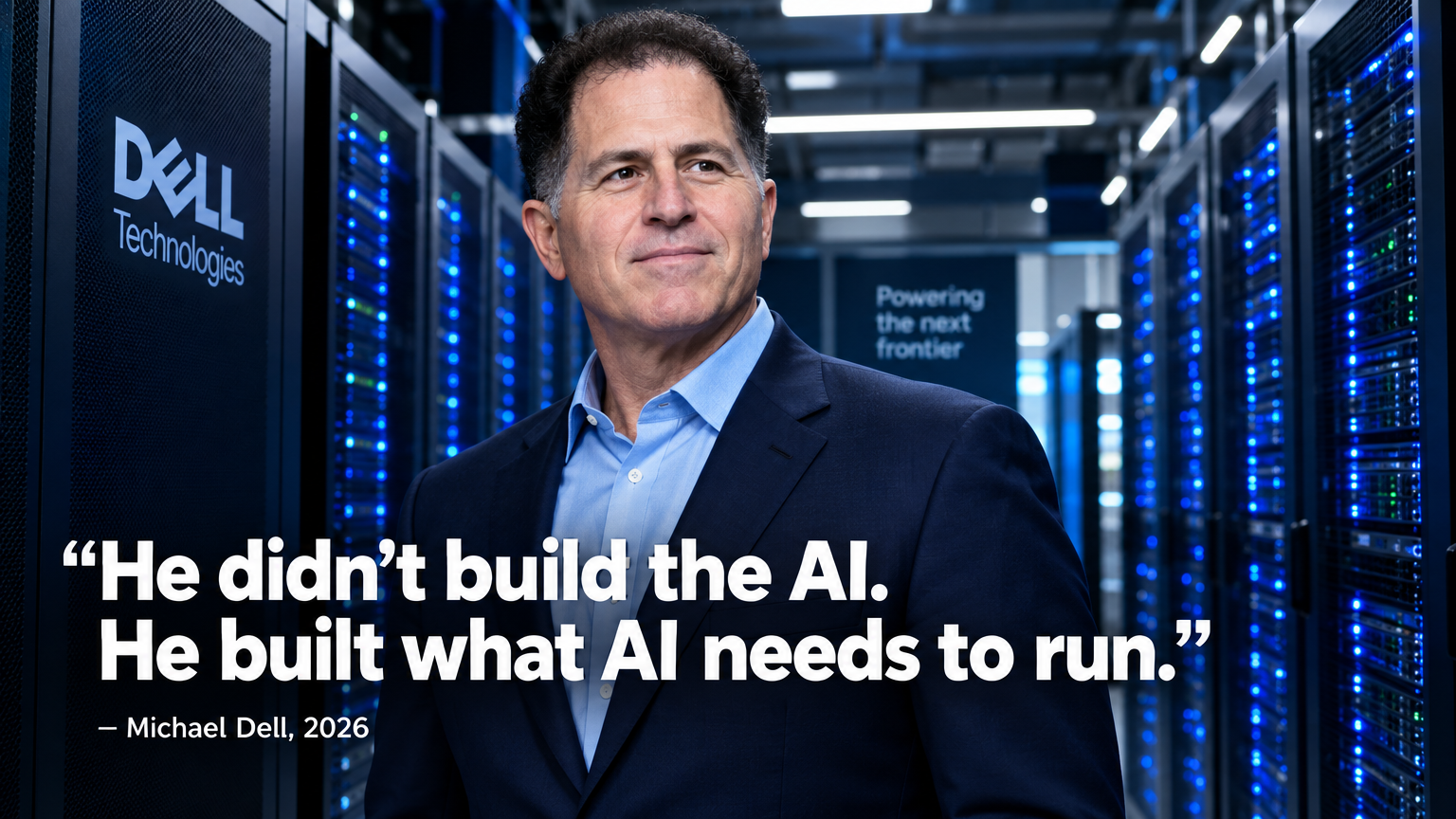
Billionaire Michael Dell Just Became Richer Than Jensen Huang By Selling What AI Needs To Run — And It Changes Everything For Founders Who Keep Chasing The Wrong Layer
Michael Dell did not build an AI model. He did not write a single line of generative code. And in 2026, he surpassed Jensen Huang — the man who literally makes the chips AI runs on — by $87 billion.
While every founder, VC, and startup accelerator told you to build AI-native products, Dell was quietly owning the layer every AI product must pass through to exist. His net worth crossed approximately $268 billion in 2026 — making him one of the four wealthiest humans alive. The lesson inside this story is not about hardware. It is about which layer you choose to own.
The Question That Should Be Keeping You Up Tonight
If you are a startup founder leading your own sales right now, ask yourself this: are you selling a product — or are you owning a layer? Because there is a profound difference between the two, and that difference is worth $87 billion.
Every week, founders pitch products. Features. ROI calculators. Testimonials. And every week, they lose deals to competitors who did not out-feature them — they out-positioned them. The market never rewards the most sophisticated product. It rewards whoever owns the layer the buyer cannot afford to skip. Dell figured that out decades ago. He just cashed in the chip in 2026. Most founders will read about it. A small number will act on the lesson before someone else does.
What Actually Happened — And Why The Numbers Matter
In 2026, Dell Technologies became the unlikely centrepiece of the global AI infrastructure boom. While Nvidia grabbed the headlines for GPU dominance, Dell quietly captured the contracts that make GPU deployment possible at enterprise scale: the servers, storage, networking, and integration layer that sits between Nvidia chips and every Fortune 500 data centre.
The numbers are staggering. Dell AI server orders hit a record $60.9 billion in Q2 2026 alone, with an order backlog surpassing $95 billion (Dell Technologies Q2 FY2027 Earnings, August 2026). Dell stock surged approximately 325% in 2026, hitting an all-time high on September 11. The company secured a $9.7 billion Pentagon software infrastructure deal (CNBC, May 2026). Michael Dell personally owns 40.9% of Dell Technologies — 265.6 million shares — meaning every dollar of enterprise value flows disproportionately back to him (Dell Technologies 2026 Proxy Statement).
Jensen Huang net worth sits at approximately $189 billion — despite Nvidia holding far superior gross margins. The gap is not explained by product quality. It is explained by ownership structure and layer positioning.
Billionaire Michael Dell move is one Jason has seen replicated across 1,000+ founders. Here is what most miss.
The Lesson Most Founders Will Miss Completely
Most founders think the problem is that they need a better product to win more sales. But the real problem is that they keep entering markets as a comparable instead of positioning themselves as an indispensable layer.
When you position as a comparable, buyers benchmark you against alternatives. They negotiate on price. They delay decisions. They ask for discounts. That is not a closing problem — it is a positioning problem. And positioning is decided before the sales call, in the architecture of how you describe what you do and which layer you claim to own.
Dell did not compete with Nvidia. Dell completed Nvidia. That one shift — from competitor to completion layer — is why enterprise buyers write $60.9 billion cheques to Dell in a single quarter without blinking. They are not buying a server. They are buying the only pathway that makes their $50 million Nvidia GPU investment actually work at scale.
Now apply this to your business. What is the layer your buyers cannot skip on the way to the outcome they want? What is the thing that, without you, the rest of their investment does not fully work? That is your layer. And if you are not selling from that positioning, you are leaving the majority of your deal value on the table — every single call.
Founder Story
They said yes in 3 hours. Not because I pitched harder — because I owned the layer.
Stanley Tan had been selling his services as one of several comparable options in his market. When Jason helped him reframe his positioning — from service provider to indispensable completion layer for his buyers core business outcome — everything changed. His next sales event generated 45 buyers in 3 hours. Not because he dropped his price. Because he stopped being comparable. The product did not change. The layer he claimed to own did.
The Hidden Opportunity — And The 5 Conditions To Capture It
Here is what the Dell story reveals that almost nobody is talking about: the biggest wealth created in the AI era is not going to the people building AI. It is going to the people who own the layer AI must pass through to reach buyers.
For a startup founder leading their own sales, this is the most urgent repositioning moment of the decade. Every major buyer in the US market is currently evaluating AI-adjacent solutions. They are overwhelmed by comparable options. The founder who walks in and says I am not one of many options — I am the layer you cannot skip — will close deals faster, at higher prices, with less resistance than every other founder who walks in with a features deck.
But this only works if your entire selling system — from discovery to close — is built around communicating and defending that layer. That is not a pitch tweak. That is a system.
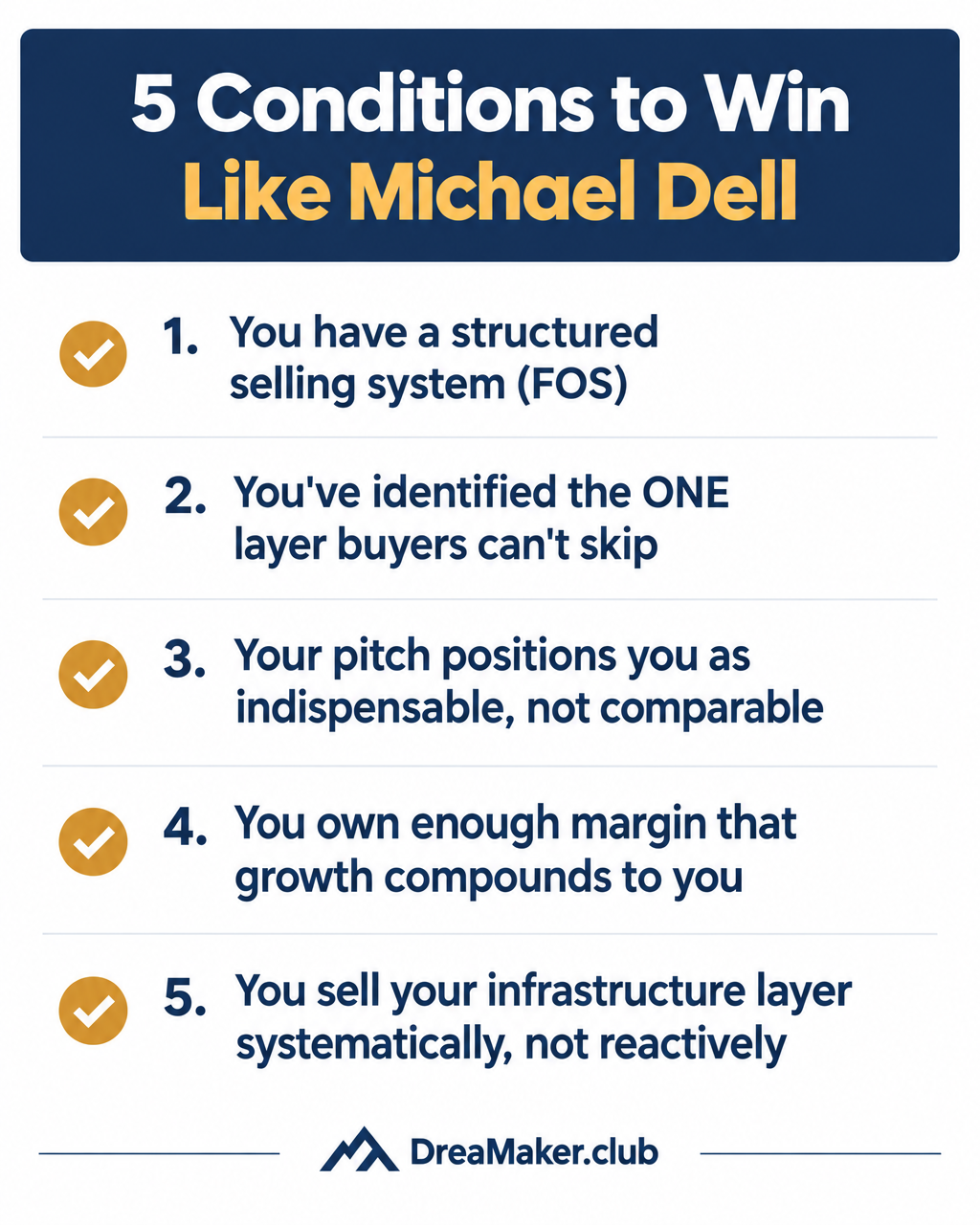
The 5 Conditions To Win Like Michael Dell
1 — You have a structured selling system — not just a pitch
The Future of Selling System (FOS) gives you the complete architecture: positioning, discovery, objection handling, and close — built for founders leading their own sales in the US market. Without a system, you win deals by accident and lose deals by pattern. Dell did not build a $268B fortune on a good pitch. He built a system.
2 — You have identified the one layer your buyers cannot skip
What is the single step, resource, or capability that sits between your buyer current state and the outcome they actually want — and that you uniquely own? If you cannot name it in one sentence, your positioning is not ready.
3 — Your pitch positions you as indispensable — not comparable
If your sales conversation begins with features, case studies, or pricing — you are already positioning as comparable. Indispensable positioning begins before the first sentence of your pitch, in how you frame the problem you solve and the cost of that problem going unsolved.
4 — You own enough margin that growth compounds back to you
Dell 40.9% ownership stake means every dollar of value creation returns to him at scale. For founders, this translates to pricing architecture: are you priced at a margin that lets you reinvest in growth, or are you discounting your way into a revenue treadmill?
5 — You sell your layer systematically — not reactively
Dell $95B backlog did not happen because he responded to inbound interest. It happened because his enterprise sales teams ran a structured, repeatable system that turned buyer interest into committed orders at scale. Reactive selling fills next month. Systematic selling fills next year.
NEW! — October 2026
Dear Founders — if you are still pitching as one of several options, your deals are leaking.
Every week you sell without a structured system is a week your buyers benchmark you against competitors, stall decisions, and ask for discounts. The cost of that gap is not just lost deals — it is the compounding gap between the revenue you are making and the revenue you should be making.
I know how it feels. Founder after founder tells Jason the same thing: I know my product is great, but buyers keep stalling. What they felt was a product problem. What Jason found — in every single case — was a positioning and system problem. Here is what changed once they had a complete selling system:
- According to the Salesforce State of Sales report, 76% of buyers now expect sellers to understand their needs before the first call — yet most founders still pitch features first. FOS closes that gap.
- Jeffrey Teo went from scattered outreach to 63 customers in 100 days — systematically.
- Stanley Tan closed 45 buyers in 3 hours at a single event — by owning his positioning layer.
- Leon landed a $2M partnership — not by pitching harder, but by selling from the right layer.
- Over 1,000+ founders since 2015 have used the system, generating $22M+ in combined sales.
Not ready for $19? Start free.
The Objection Playbook: 25 Word-for-Word Scripts to Close More Sales
The exact words Jason founders use when a buyer says too expensive, send me info or I need to think about it. Free PDF, sent to your inbox.
Send Me the 25 ScriptsBillionaire Michael Dell already moved — he built the layer, owned the system, and compounded his wealth to $268 billion while everyone else chased the model. The only question is whether you will build your layer — or whether you will read about someone else who did.


