Billionaire Mukesh Ambani Just Pulled $26 Billion Before Jio's IPO Even Opened — And It Changes Everything For Founders Who Think Great Products Sell Themselves
Billionaire Mukesh Ambani Just Pulled $26 Billion Before Jio's IPO Even Opened — And It Changes Everything For Founders Who Think Great Products Sell Themselves
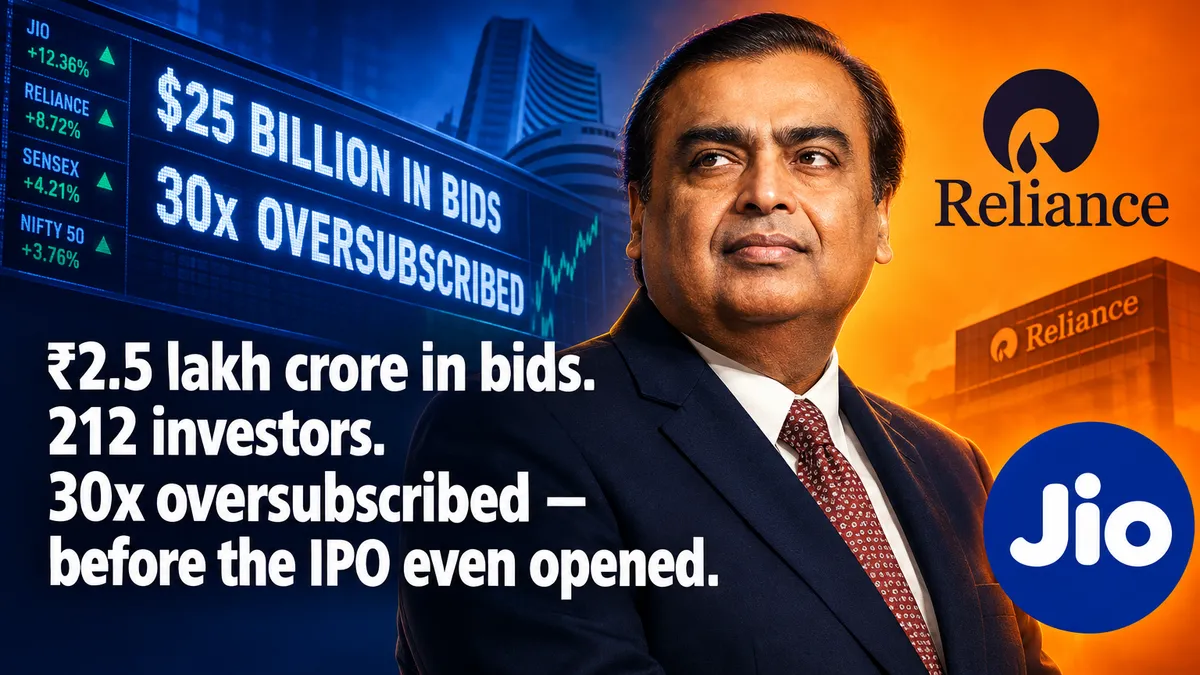
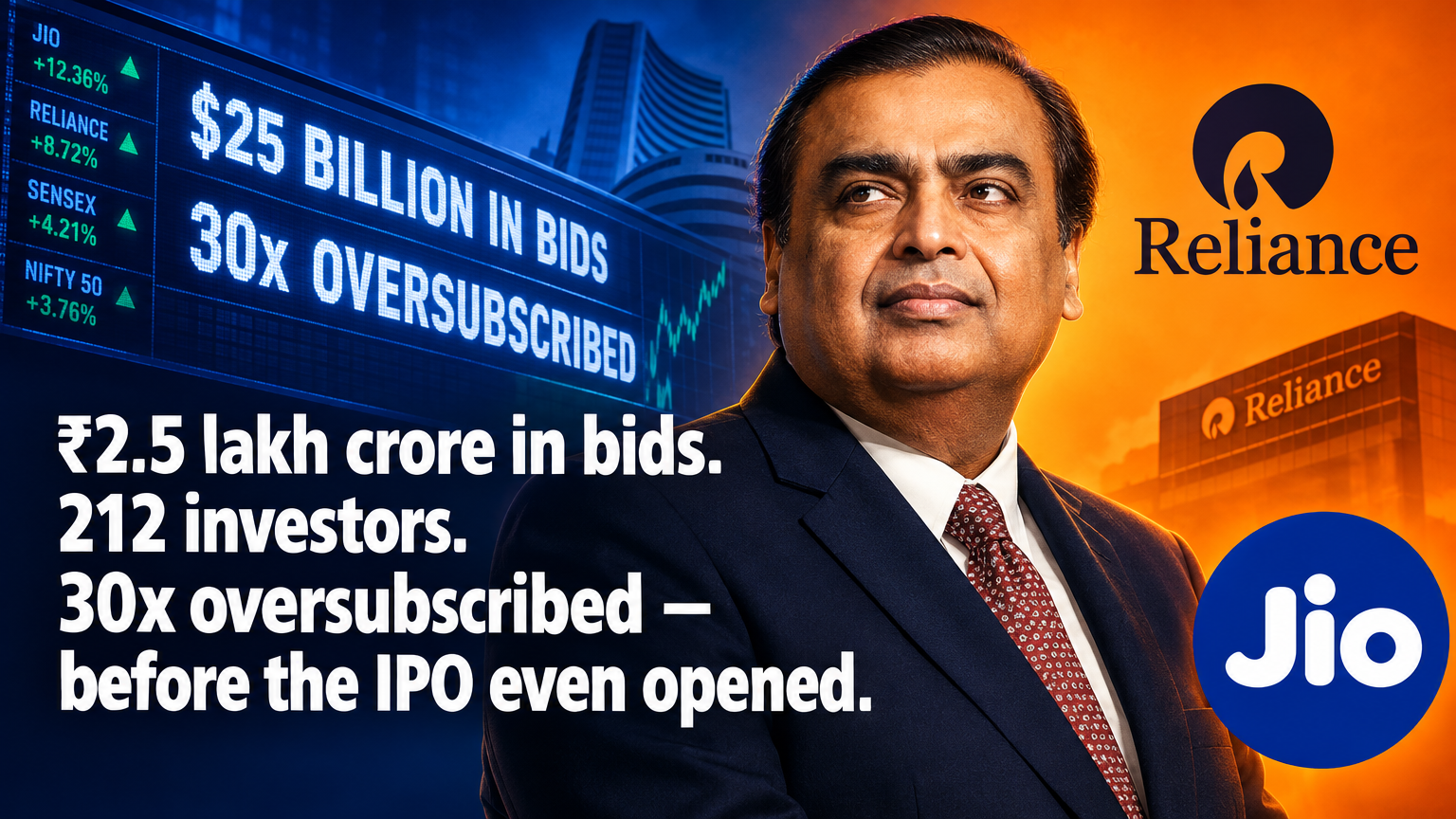
$26 billion. 30x oversubscribed. Before the public saw a single share.
On October 19, 2026, Mukesh Ambani's Jio Platforms opened its IPO anchor book to institutional investors — and the market responded at a scale India had never seen. According to Business Standard and CNBC (October 19–20, 2026), bids crossed Rs 2.5 trillion ($26.3 billion) for an anchor book worth just Rs 8,110 crore. That is more than 30 times oversubscribed. By 212 of the world's most sophisticated investors. Before the public offering even opened. BlackRock. GIC. ADIA. Fidelity. Capital Group. All fighting for allocation in India's largest-ever IPO.
Most founders will read this as a finance headline. Jason reads it as the most dangerous trap a founder can fall into — and the most urgent lesson hiding inside it.
Here Is Why This Should Terrify You
Right now, somewhere, a founder with a genuinely great product is sitting on five unread proposal emails. Three prospects who said send me more info and then vanished. A pipeline that looks full but converts nothing.
And they are telling themselves the same lie: When the product is better, the market will come.
Here is the hard truth: Jio is not the best telecom by pure financial metrics. By return-on-equity, rival Bharti Airtel outperforms it — roughly 20% RONW versus Jio's 9.4%, according to CEOWORLD Magazine (October 20, 2026). Yet Jio is the one pulling $26 billion before its IPO opens. Airtel is not.
That gap is not a product gap. It is a demand-creation gap. And if you are a founder with a team of five or more, that gap is costing you revenue every single week you do not close it.
What Actually Happened — And Why The Numbers Are Staggering
Jio Platforms is the telecom, cloud, and AI arm of Reliance Industries. It is India's largest telco by far — 533.3 million subscribers as of June 2026, carrying nearly 60% of India's entire wireless data traffic (Business Standard, October 19, 2026). The business was built from scratch in a decade: Mukesh Ambani launched Jio in 2016 with free voice calls and cut-price data, disrupting incumbents and creating an entirely new market. Meta owns 10%. Google owns 8%. The IPO is sized at Rs 30,213 crore ($3.2 billion) at the top of the price band, valuing the company at $108.3 billion — India's largest IPO ever (CNBC, October 20, 2026). Public subscription opens October 21–23. Listing is targeted for October 28.
212 of the world's most sophisticated institutional investors placed bids before a single retail rupee was committed. That is not luck. That is a decade of systematic demand-creation at work.
Billionaire Mukesh Ambani's move is one Jason has seen echoed at his events, which since 2016 have reached 100,000+ founders across Asia. Here's what most miss.
The Lesson Most Founders Miss Completely
Beat 1 — Root Cause Reframe
Most founders think the problem is the product. If the product were better, buyers would pull harder. If the price were lower, conversion would be easier. If the timing were right, the pipeline would fill itself.
But the real problem is the system. Ambani did not get 30x oversubscribed because Jio has the highest return-on-equity in its market — it does not. He got 30x oversubscribed because Jio built a decade-long selling system: free entry to create a base, aggressive follow-through to lock in loyalty, strategic partnerships with Meta and Google to signal legitimacy, and a roadshow narrative so compelling that 212 institutional investors competed to get in before the public had a chance.
Most founders are still waiting for the product to be perfect before they build the selling system. Ambani built the selling system and then used it to engineer the product's perceived value. That is the sequence you are getting backwards.
Beat 2 — The Lesson
The founders who get 30x oversubscribed do not have better products. They have a selling system that makes yes inevitable.
Here is what the Ambani playbook teaches, translated for a founder with a team of five to fifty in the US market:
1. Demand is engineered, not discovered. Jio did not wait for the Indian consumer to decide they wanted affordable data. They engineered the demand by making the entry point free and the switching cost irreversible. Your selling system should do the same: engineer entry points that create dependence on the outcome you deliver, not the product itself.
2. Social proof compounds faster than product improvements. The moment GIC and BlackRock placed bids, every subsequent investor became easier to close. In your world, that is the first case study that generates the second, third, and fourth. Your selling system must capture and deploy social proof at every stage of the pipeline — not just at close.
3. Scarcity accelerates decision-making. Ambani structured the IPO so that institutional investors who did not move early got nothing. Your selling system needs built-in decision frames that create the same urgency — not manufactured pressure, but structural scarcity around your time, your onboarding capacity, and your results delivery.
FOUNDER STORY CARD
Jeffrey Teo acquired 63 customers in 100 days after implementing Jason's system — not by changing his product, but by changing how he positioned, followed up, and structured each conversation to make yes the natural next step. Stanley Tan pitched his paid webinar to 203 people after Jason's pitch deck and pitch consultation — 90 showed up. Leon built a $2M partnership. The product did not change. The system did.
The Hidden Opportunity — And Whether You Are Positioned To Take It
Beat 1 — The Hidden Opportunity
The Jio IPO is not just India's largest listing. It is a real-time proof that demand-creation systems outperform product-perfection loops — and it arrives at a specific moment in the global market cycle: Q4 2026, when buyers have budget that expires December 31.
Buyers right now are not saying no because they lack budget. They are saying no because they lack conviction. The founders who build a selling system that manufactures conviction — through proof, through urgency, through structured follow-up — will clear their quota in Q4 while their competition spends January explaining why December was slow.
The window is now. The founders who move in the next 30 days will close the year strong. The founders who wait for the product to improve will start 2027 from zero.
Beat 2 — Are You Ready? Check All Three Conditions
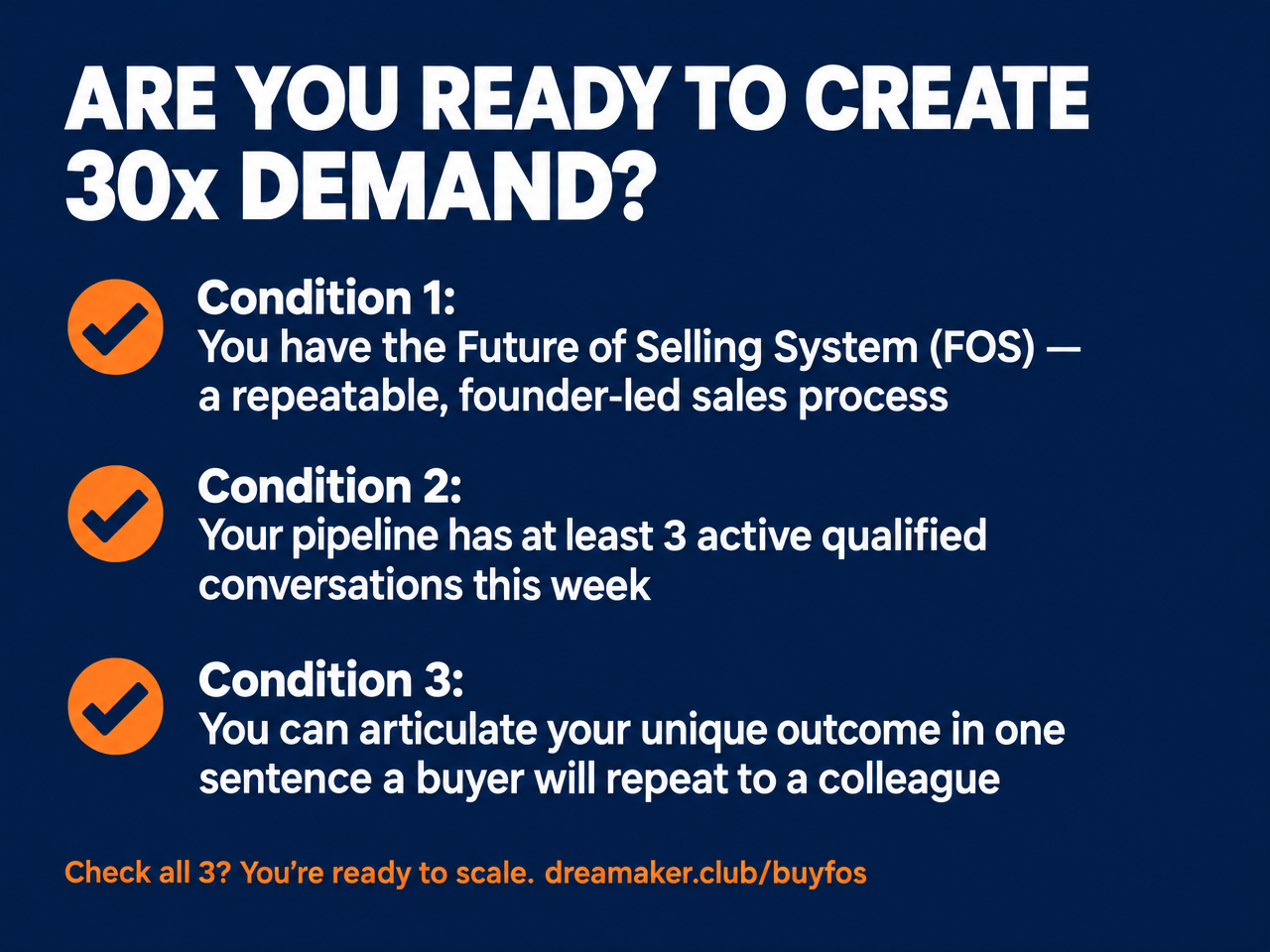
THE 3 CONDITIONS THAT SEPARATE FOUNDERS WHO CREATE DEMAND FROM THOSE WHO CHASE IT
Condition 1: You have the Future of Selling System (FOS)
Not a CRM. Not a spreadsheet. A repeatable, founder-led sales process that engineers demand before a buyer even asks for a proposal. Without this, you are not building a pipeline — you are doing manual outreach that exhausts you and your team. Start here
Condition 2: Your pipeline has at least 3 active qualified conversations this week
Not contacts. Not leads. Qualified conversations where the buyer has articulated a specific problem and agreed to a follow-up. If you cannot name three right now, your system has a generation problem — not a closing problem.
Condition 3: You can articulate your unique outcome in one sentence a buyer will repeat to a colleague
Ambani's team could say: India's largest telecom — 533 million subscribers, 60% of the country's data traffic — now publicly available for the first time. Can your team say the equivalent about you? If not, your buyers cannot sell you internally, and every deal stalls at the second stakeholder.
NEW!
OCTOBER 2026
Dear Founders...
If your pipeline has ever gone cold — not because your product was not good enough, but because no one was pulling to buy — this is for you.
I understand how you feel. You have a solid product. You have happy customers. But deals take forever, follow-ups go cold, and your best prospects always seem to need more time. You start to wonder whether you are the problem.
I have felt the same. So have hundreds of founders I have worked with across Asia since 2016 — from teams of five to companies scaling past $10M.
Here is what I found: the issue is never the product. It is always the system. Salesforce's State of Sales research confirms that 76% of sales professionals say their greatest challenge is competing for buyer attention — not product fit. The founders who win are not those with the best products. They are the ones with a system that manufactures conviction at every step.
Jason's graduates have generated $22M+ in combined sales using the Future of Selling System. Jeffrey Teo closed 63 customers in 100 days. Leon built a $2M partnership. Stanley Tan pitched a paid webinar to 203 people — 90 showed up. These are not extraordinary people. They are founders who installed an extraordinary system. Jason's live events have reached 100,000+ founders across Asia since 2016.
No lock-in. Cancel any time. Start creating demand — not chasing it.
Not ready for $19? Start free.
The Objection Playbook: 25 Word-for-Word Scripts to Close More Sales
The exact words Jason's founders use when a buyer says too expensive, send me info or I need to think about it. Free PDF, sent to your inbox.
Ambani already moved. The only question is whether you will — or whether you'll read about someone else who did.


