Billionaire News: September 2026 Wealth Insights
Wealth, Billionaires, Entrepreneurship, Markets
Billionaire News: September 2026 Roundup
September 2026 is closing with billionaire wealth at historic highs, a once‑in‑a‑century wealth gap, and a new generation of fortunes being forged in AI, chips, and data‑center infrastructure. For entrepreneurs and founders, this month’s billionaire news is less about celebrity net worth gossip and more about understanding where value is being created, how capital is moving, and what that signals for the next decade of opportunity.
Elon Musk Nears the Trillion-Dollar Mark
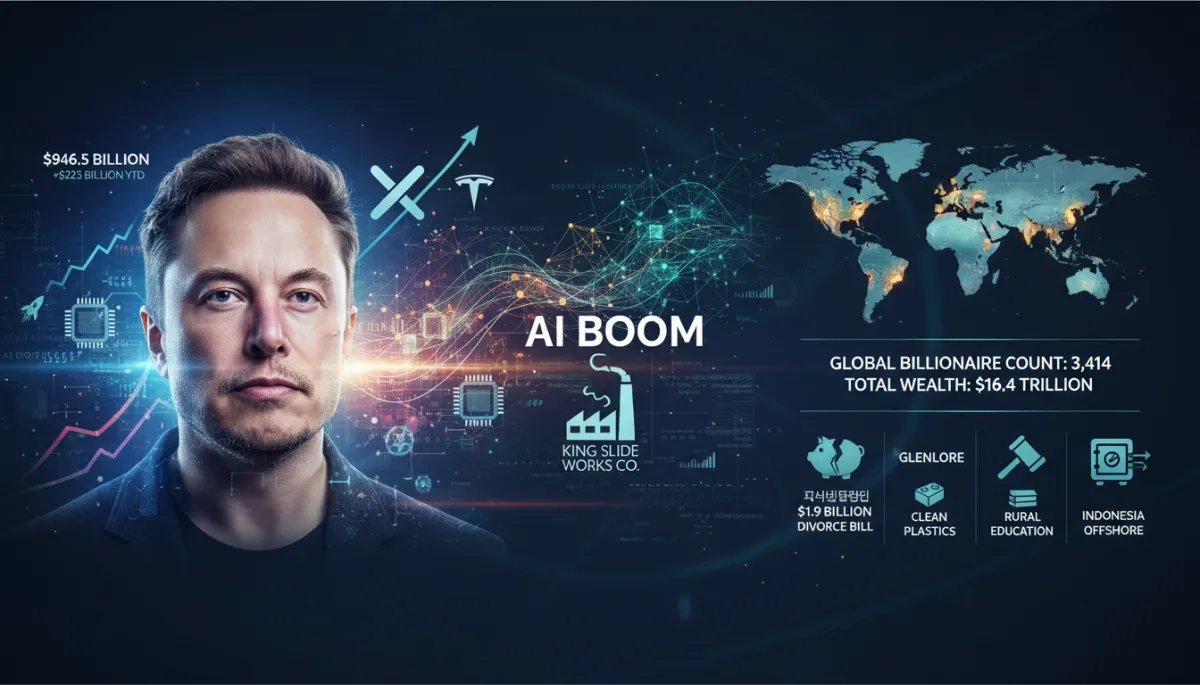
At the top of the pile, Elon Musk continues to redefine what extreme wealth looks like. Depending on the data provider and timestamp, his fortune in mid‑September is hovering around $946.5 billion, according to Grizzly Bulls’ Billionaires Index, and has already crossed the trillion‑dollar threshold in some Forbes estimates after the SpaceX IPO earlier this year. That puts him within touching distance of a sustained, undisputed $1 trillion valuation as markets digest the full impact of AI, robotics, and satellite infrastructure on his portfolio.
Musk’s wealth is up more than $323 billion year‑to‑date, powered by three engines: a resurgent Tesla riding the autonomous and robotaxi narrative, SpaceX monetizing launch dominance and satellite broadband, and the broader AI boom that has re‑rated anything tied to compute, data, or automation. For founders, the signal is clear: markets are assigning premium multiples to platforms that sit at the intersection of infrastructure and intelligence, not just consumer‑facing apps.
The Rest of the Top Five: Still Miles Behind
Behind Musk, there’s a steep drop‑off. Jeff Bezos sits at roughly $373 billion, according to Grizzly Bulls and real‑time Forbes snapshots, as Amazon’s AI‑driven logistics, cloud, and advertising engines keep compounding. While Bezos’ wealth is enormous by any historical standard, the gap to Musk underscores how dominant a single founder can become when they straddle multiple foundational technologies at once: EVs, rockets, and AI infrastructure.
Alphabet cofounders Larry Page and Sergey Brin remain entrenched in the top tier, with Page in the $285–298 billion range and Brin around $263–277 billion. Their fortunes are tethered to Google’s aggressive AI pivot—search, cloud, and model deployment—reminding entrepreneurs that owning the distribution rails of information is still one of the most powerful positions in the global economy.
Perhaps the most eye‑catching climber is Michael Dell, whose net worth has been bouncing between $262–276 billion this month. Dell briefly surged to the No. 2 spot earlier in September before an AI‑stock selloff shaved tens of billions from his paper wealth. Even after volatility, he comfortably rounds out the top five. His ascent is a case study in how “boring” infrastructure—servers, storage, and data‑center hardware—can become rocket fuel in an AI super‑cycle.

Data-center hardware, once niche, now quietly mints multi-billion dollar fortunes.
AI Is Minting a New Class of Industrial Billionaires
The AI wave isn’t just enriching software founders and chip designers; it’s spilling over into unexpected corners of old‑world manufacturing. One standout example is King Slide Works Co., a Taiwanese company that started out making furniture handles and drawer slides. Today, the same engineering DNA that perfected smooth kitchen drawers is being applied to server rails for hyperscale data centers—and the result is a fresh crop of billionaires emerging from what used to be a low‑margin niche.
For entrepreneurs, this is a powerful reminder: in every technological gold rush, there are fortunes to be made not only in the “picks and shovels,” but also in the hinges, rails, and brackets that make those picks and shovels usable at scale. If your product quietly underpins AI infrastructure—cooling, power, connectivity, or mechanical components—you’re no longer a commodity supplier; you’re part of the value chain that markets are aggressively repricing.
A Bigger, Richer Billionaire Class in 2026
Zooming out, the billionaire universe itself is expanding. In 2026, the global billionaire count has grown by about 5%, reaching roughly 3,414 individuals who collectively control $16.4 trillion in wealth. Other datasets, like Forbes’ March list, peg the total even higher, at over 3,400 billionaires worth more than $20 trillion. However you slice it, the direction of travel is unmistakable: more billionaires, and more capital concentrated at the very top.
In the U.S., the Forbes 400—the 400 richest Americans—now command a combined $8 trillion, up from $6.6 trillion just a year ago. The entry ticket has risen to a record $4.4 billion. That’s not just a trivia stat; it’s a barometer for how aggressively top‑end wealth is compounding. For founders, it means two things: there is an unprecedented pool of private capital available for ambitious ideas—and the expectations around returns, defensibility, and scale have never been higher.
Personal Drama, Legal Risks, and Lifestyle Arbitrage
Not all September headlines are about record highs. In South Korea, a billionaire gamer—a high‑profile figure from the country’s booming gaming and esports economy—was hit with a staggering $1.9 billion divorce bill, one of the largest personal settlements on record in Asia. Beyond the tabloid angle, it’s a reminder that concentrated, illiquid wealth tied up in equity can be brutally exposed by personal life events. Founders who ignore estate planning, prenuptial agreements, and governance structures do so at their own peril.
In the commodity world, Glencore’s former oil trading head pleaded not guilty to bribery charges, underscoring the persistent legal and reputational risk that shadows resource‑driven fortunes. As ESG expectations tighten and regulators coordinate across borders, the cost of “grey‑zone” business practices is rising sharply. For entrepreneurs, that’s both a risk and an opportunity: legacy players with compliance overhangs are vulnerable to disruption from cleaner, more transparent challengers.
Meanwhile, the geography of wealth continues to shift. Hedge fund titan Chris Rokos joined the growing cohort of billionaires quitting the UK, reportedly fed up with tax uncertainty and regulatory creep. At the same time, Indonesia’s richest family moved more than $1 billion offshore, a move that speaks volumes about capital‑flight anxiety in emerging markets. For founders, these moves are a nudge to think strategically about domiciling, tax residency, and where you build and hold your equity.
Capital Raising, Climate Bets, and Quiet Philanthropy
On the capital‑formation front, Africa delivered one of the month’s most consequential stories. Nigerian industrialist Aliko Dangote courted a new wave of small investors by offering a roughly $4 entry point to a record‑breaking African IPO. Rather than relying solely on institutional capital, Dangote is building an army of retail shareholders who can participate in the upside of large‑scale infrastructure and industrial plays. For founders on the continent—and beyond—it’s a template for how to blend public markets, mass participation, and nation‑building narratives into a single equity story.
In Europe, the Lego billionaire family signaled a different kind of long‑term bet: a commitment to invest heavily in clean plastics technology. For a brand built on plastic bricks, this is both existential and strategic. It’s also emblematic of a broader shift: legacy consumer empires are increasingly treating climate tech not as CSR window dressing, but as core R&D and IP. If you’re building in materials science, recycling, or circular manufacturing, this kind of capital alignment is exactly the tailwind you want behind you.
On the philanthropic side, Trott—a low‑profile billionaire compared to the Musks and Bezoses of the world—committed $100 million to rural education. While the figure is tiny relative to global billionaire wealth, the targeting is notable: rural education is one of the highest‑leverage, lowest‑visibility levers for long‑term human capital. For mission‑driven founders, it’s a reminder that alignment with serious, thoughtful philanthropy can unlock patient capital and powerful partnerships far away from the spotlight of mega‑cities and splashy tech hubs.
What This All Means for Founders and Wealth‑Curious Readers
Put together, September 2026 paints a clear picture. The billionaire class is getting bigger, richer, and more tightly linked to AI infrastructure, data centers, and climate‑aligned industrials. The biggest fortunes are being made where software, hardware, and capital‑intensive assets intersect—and where founders are willing to think in decades, not funding rounds.
At the same time, the risks are escalating: personal life events can vaporize billions; regulatory and legal regimes are becoming more aggressive; and tax and political uncertainty are actively reshaping where wealth chooses to live. The entrepreneurs who will thrive in this environment are those who treat capital strategy, jurisdictional planning, and governance as seriously as product‑market fit.
If you’re building today, the lesson from this month’s billionaire news is not to chase net‑worth headlines. It’s to study the underlying patterns: own critical infrastructure, align with structural tailwinds like AI and decarbonization, design for global capital flows, and build institutions that can outlive any single founder. The rest—the rankings, the lists, the commas—tends to follow.
SEO Title: Billionaire News: September 2026 Roundup – Musk, AI Fortunes & Global Wealth Shifts
SEO Description: Dive into September 2026’s biggest billionaire stories—from Elon Musk’s near-trillion-dollar fortune and the AI-driven wealth boom to record Forbes 400 numbers, mega divorces, offshore moves, and climate-tech bets shaping the future of global wealth.


